Renewables marking the end of the line for nuclear power?
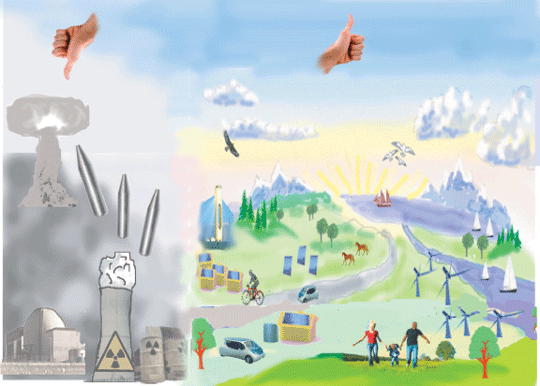 Renewables: The end for nuclear power? http://www.cnbc.com/id/101710759 Anmar Frangoul | Special to CNBC.com Friday, 30 May 2014 It took the Fukushima disaster to put the future of nuclear power in doubt – but could renewable energy mean the end for nuclear power?
In March 2011, disaster struck Japan. An immensely powerful earthquake and tsunami resulted in a catastrophic meltdown at the Fukushima Daiichi nuclear power plant. In the aftermath of the disaster, using atomic power to generate electricity came under intense scrutiny – resulting in both Japan and Germany deciding to phase out nuclear power.
With anti-nuclear sentiment strong in both countries, utility companies are coming under intense pressure, with profits being squeezed and their centralized business model facing an increasing challenge from renewables
It’s a complete destruction of the business model,” Dieter Heuskel, a Dusseldorf based senior partner at the Boston Consulting Group, told CNBC’s Energy Future. “They no longer run with the utilisation that they were planned to run, so there’s a huge destruction of not only revenue but also of profit pools, and they have to reinvent themselves completely,” he added.
Experts warn that the move to a focus on renewables could soon leave nuclear power redundant. “If you accelerate this revolution to a kind of power economy that is very different from what they [nuclear power utility companies] represent, well, you pull the rug even more out from under their feet,” Andrew DeWit, from Rikkyo University, told Energy Future. n April of this year, however, the Japanese government announced a reversal of its decision to phase out nuclear power, despite fierce public opposition.
This places Japan in stark contrast to Germany, where the government is pushing ahead with plans to have 35 percent of its electricity sourced from renewables by 2020, and 50 percent of its electricity from renewables by 2030.
This ambition has fostered an environment where innovation in clean energy is encouraged, giving German businesses specializing in renewables a competitive advantage.
The German government’s energy policies have also forced big utility companies to change the way they operate.
“We are focusing our business towards the more de-central and more renewable aspects,” Peter Terium, CEO of RWE AG, told Energy Future. “We can develop things like smart homes, smart grids – that’s needed in any kind of transition of society,” he added. s Japan, then, in danger of missing the boat when it comes to innovation in renewables? “Hitachi, Toshiba, Panasonic etcetera, they’re very deeply involved in smart city projects around the world,” DeWit said. “You’ve got all kinds of good things happening, and, if you do that very well, to a globally competitive extent, well then you’ve got an export industry.”
Support, however, for this sector is still needed, DeWit added. “Without a very visible effort co-ordinated by the central government, and particularly through the cabinet, investors face too much investor risk.”
No comments yet.
1 This Month

of the week – Shut Down Drone Warfare!


Tell the Ukrainian Government to Drop Prosecution of Peace Activist Yurii Sheliazhenko

Petition to revoke the licensing of the Near Surface Nuclear Disposal Facility (NSDF) at Chalk River. https://www.ourcommons.ca/petitions/en/Petition/Details?Petition=e-7247
To see nuclear-related stories in greater depth and intensity – go to https://nuclearinformation.wordpress.com
-
Archives
- March 2026 (244)
- February 2026 (268)
- January 2026 (308)
- December 2025 (358)
- November 2025 (359)
- October 2025 (376)
- September 2025 (257)
- August 2025 (319)
- July 2025 (230)
- June 2025 (348)
- May 2025 (261)
- April 2025 (305)
-
Categories
- 1
- 1 NUCLEAR ISSUES
- business and costs
- climate change
- culture and arts
- ENERGY
- environment
- health
- history
- indigenous issues
- Legal
- marketing of nuclear
- media
- opposition to nuclear
- PERSONAL STORIES
- politics
- politics international
- Religion and ethics
- safety
- secrets,lies and civil liberties
- spinbuster
- technology
- Uranium
- wastes
- weapons and war
- Women
- 2 WORLD
- ACTION
- AFRICA
- Atrocities
- AUSTRALIA
- Christina's notes
- Christina's themes
- culture and arts
- Events
- Fuk 2022
- Fuk 2023
- Fukushima 2017
- Fukushima 2018
- fukushima 2019
- Fukushima 2020
- Fukushima 2021
- general
- global warming
- Humour (God we need it)
- Nuclear
- RARE EARTHS
- Reference
- resources – print
- Resources -audiovicual
- Weekly Newsletter
- World
- World Nuclear
- YouTube
-
RSS
Entries RSS
Comments RSS
 nuclear-news
Leave a comment