USA’s EPA proposes New Power Generation Emissions Rules

 EPA Proposes New Power Generation Emissions Rules http://www.energymatters.com.au/index.php?main_page=news_article&article_id=4329 The USA’s Environmental Protection Agency has proposed regulations with a goal of slashing carbon dioxide emissions from existing coal fired power plants by as much as 30 percent by 2030.
The USA’s power generation sector is the nation’s biggest source of carbon emissions; representing around 38 percent of the total load.
According to the EPA, the average age of the nation’s coal plants is 42 years. Under the EPA’s proposal, which was directed by President Barack Obama; emission targets for power plants could be met in a few different ways – through power plant upgrades, changing from using coal as a fuel to natural gas, enhancing energy efficiency or increasing uptake of renewable energy.
Rhone Resch, president and CEO of the Solar Energy Industries Association (SEIA), said the announcement marked a defining moment in American history.
“As a nation, we’re poised to finally turn the page from sooty smokestacks to sunnier skies,” he said.
Mr. Resch says the nation’s solar industry is ready to help states meet the challenge.
“Simply put, solar can be a real game-changer for regulators looking to meet the changing needs of their state. Why? Because solar energy is reliable, cost competitive, environmentally friendly and easily scalable, fitting the needs of any state’s Section 111 (d) compliance plan.”
As we reported earlier, cumulative operating solar PV capacity reached 13,395 MW at the end of Q1 2014 in the USA and 74% of new electricity generation capacity in the USA added during the period was solar.
“Solar is now the fastest-growing source of renewable energy in the United States, employing 143,000 Americans and accounting for nearly 30 percent of all new electric generation capacity installed in 2013 – second only to natural gas. All totalled, solar is generating enough clean, reliable and affordable electricity to power 3 million homes,” said Mr. Resch.
The EPA says the proposed regulations will result in the avoidance of up to 6,600 premature deaths, up to 150,000 asthma attacks in children, and up to 490,000 missed work or school days – and this will provide up to $93 billion in climate and public health benefits. It also states the efforts will reduce electricity bills roughly 8 percent by increasing energy efficiency and reducing demand in the electricity system.
With the renewable energy revolution gaining pace and spurred on by initiatives such as the EPA proposes, it seems investing in coal is becoming an increasingly risky affair.
Settlement reached between Vancouver Province and uranium company

 Vancouver’s Boss Power closes on $30-million settlement with province over uranium ban By Tyler Orton http://www.biv.com/article/20140602/BIV0108/140609993/vancouvers-boss-power-closes-on-30-million-settlement-with-province Mon Jun 2, 2014 A Vancouver-based resource company has closed on a $30-million settlement with the B.C. government, officially putting to bed a nearly six-year-old lawsuit.
The province imposed a halt on all uranium exploration and development in April 2008. Boss Power Corp. (TSX.V: BPU) filed suit later in the year claiming the B.C. government expropriated the company’s interest in its Blizzard uranium property near Kelowna when it imposed a “no registration reserve” under the Mineral Tenure Act.
The reserve allowed the government to ensure no future claims included the rights to uranium, however, Boss Power argued the property was registered before this ban went into effect.
Boss Power and Victoria settled for $30 million in 2011 before the case went to court.
The final amended settlement will divide the settlement up between other parties with interests in the property.
About 80% of the settlement will be held in a trust until Boss Power is reorganized into two different corporations, an arrangement expected to be approved in August.
Dodgy future for Canada’s nuclear industry
 Canada’s uncertain nuclear future article is based on Canada’s Nuclear Energy Sector: Where to from here? published by Canada’s Public Policy Forum. 2 June 2014 “……. over the past two decades declining R&D funding has combined with an absence of new domestic nuclear power plant construction to push the sector into stagnation. Political and public support, once a source of strength and pride for the nuclear industry, has waned to such an extent that it is one of the greatest contributors to nuclear energy’s decline. Recent decisions by political leaders, including moratoria on uranium mining in Quebec, Nova Scotia and British Columbia, Ontario’s hesitancy to build proposed new reactors, and the federal government’s privatisation of the reactor business of Atomic Energy Canada Limited (AECL), are seen by many as evidence that government is now looking to redefine its role in the sector……..
Challenges
The following serious challenges have significantly impaired the industry’s ability to compete in domestic and international markets:
High capital costs. In today’s uncertain economic environment, it is difficult to make the political case that public funds should be committed to large, expensive energy projects that may not come online for nearly a decade. Typically, investment costs of nuclear power plants account for around 60% of total project lifecycle costs.
Unclear foreign investment rules. Organisations that constitute a “strategic asset” to Canada may be barred from foreign purchase or takeover. In fact, the phrase “strategic asset” is not discussed in the Canada Investment Act, but its frequent mention by federal and provincial politicians has created confusion in Canada and abroad. As a result, there is uncertainty around whether foreign entities will be able to purchase Canadian nuclear energy companies and assets, or even compete in the Canadian market. In the absence of a transparent investment framework, it is difficult for international organisations to expand or develop operations in Canada that could generate greater economic growth.
A historical CANDU monopoly places the sector in a niche market.The Canada Deuterium Uranium (CANDU) reactor has been the flagship of Canada’s nuclear energy sector for almost 50 years. But since the nuclear energy market shifted to light water reactors (LWRs) — approximately 30 years ago, when France started procuring LWR technology from the US — heavy water reactors have become a minority technology in the global market.
Acquiring and maintaining social license. Among the greatest challenges facing stakeholders in the nuclear sector is the lack of social license for new nuclear power plants. This concern does not necessarily exist in communities near power plants or uranium mines, but it is a broader perspective within the general population. Concerns around safety, spent fuel storage, and high capital costs have decreased public and political support for large nuclear construction programmes. Fears over nuclear proliferation and plant meltdowns and accidents, like those at Chernobyl, Three Mile Island and Fukushima, are common…..
Few political champions. An important element in any country with a successful nuclear energy programme is leaders who champion the merits of nuclear energy, often at great political risk. Overcoming the concerns of the public is much more difficult without this political support……
The University of Washington Medical Center tracking patients’ radiation exposure
 Hospital turns to big data to track, reduce radiation exposure June 2, 2014 To reduce patient exposure to radiation, the University of Washington School of Medicine is taking advantage of big data.Dose tracking technology adopted by the medical center can pull information from multiple imaging devices, then sort it into a database where it can be sliced and diced, according to InformationWeek. UW Medical Director William Shuman said that the data helps to “validate” its imaging efforts, in addition to pinpointing areas in need of improvement.
: Hospital turns to big data to track, reduce radiation exposure – FierceMedicalImaging http://www.fiercemedicalimaging.com/story/hospital-turns-big-data-track-reduce-radiation-exposure/2014-05-30#ixzz33clZoajc
Medical Center Uses Analytics To Reduce Radiation http://www.informationweek.com/healthcare/analytics/medical-center-uses-analytics-to-reduce-radiation/d/d-id/1269179
Uranium mining’s grave risk of polluting aquifer in Southern Black Hills, South Dakota
Risks too great to allow Hills uranium mining Jerry Wilson Argus leader 1 June 14, Chinese and Canadian-funded Powertech wants to mine uranium in the Southern Black Hills by the in situ method — dissolving uranium in the aquifer, pumping it to the surface for extraction, then dumping polluted water deep into the Earth.
Twice before, foreign corporations mined uranium in the Hills and left a radioactive mess. The South Dakota Department of Environment and Natural Resources lists 263 abandoned uranium sites in the state. Radioactive material and toxic heavy metals have polluted tributaries of several South Dakota rivers.
We needn’t repeat the mistakes of neighboring states. The Crow Butte mine near Crawford, Neb., has a long history of spills and “excursions” of radioactive water into the aquifer. And the Wyoming Department of Environmental Quality cited the Smith Ranch/Highland mine near Glenrock, Wyo., for “an inordinate number of spills, leaks and other releases … pond leaks, well casing failures and excursions.” The cleanup was projected to cost $150 million, four times the company’s bond.
Below the Inyan Kara aquifer that Powertech wants to mine lies the Minnelusa aquifer, then the Madison, all vital to future life in the region. A study of risks to the Madison aquifer by three South Dakota School of Mines and Technology researchers concluded that “Water supplies for Rapid City … and the surrounding suburban and rural areas are extremely vulnerable to contamination.” The DENR’s mission statement is clear — “protecting South Dakota’s environment and natural resources for today and tomorrow.” Unfortunately, our Legislature passed a law –– written by Powertech lobbyists –– that tied the hands of the DENR to do its job.
If in situ uranium mining pollutes the water vital to life, tourism and ranching in the Southern Hills, we might know in a year or two, or perhaps only after Powertech is gone. That is a chance we cannot afford to take. The Powertech mine must be stopped.
A cry for help on behalf of Fukushima’s children subjected to radiation
Official in Fukushima: “Please Please HELP US!” — Hot particles of melted fuel are inhaled by children everyday — We are forced to have it in our bodies — “Please let all people in the world know the life we are living” http://enenews.com/official-in-fukushima-please-please-help-us-hot-particles-of-melted-fuel-are-inhaled-by-children-everyday-we-are-forced-to-have-it-in-our-bodies-please-let-all-people-in-the-world-kno?utm_source=feedburner&utm_medium=email&utm_campaign=Feed%3A+ENENews+%28Energy+News%29
Excerpts from Oyama Koichi of the Minamisoma City Council, May 13, 2014 — Translation byDissensus Japan, May 25, 2014:
- I want to shout for all the people in this world: “Please Please HELP US!”
- The cause substance have been found. This is an aggregate of radionuclides which starts with Uranium [in] a nuclear reactor at more than 5000°C.
- This mixed metal contains four different substances, α・β・γ and also have the possibility to radiate neutron ray.
- No creature on earth never knew this substance.
- We are forced to have those strong substances inside our body without knowing where it exactly stays.
- To say that “Cesium has got the same system as potassium and it will be discharged from the body” is just a lie! […]
- We are all manipulated by the words “radiation” and “radiation doze” without knowing the real identity of radiation source. We are not told the real facts of being irradiated […]
- They only compare radiation doze and natural potassium contained in bananas and manipulated people as if it was a scientific study. I really want the scholars patronized by the government to be punished by the rancorous of all children on this earth. […]
- The informations say that hot particles were diffused and flied in all directions in Japan. The particles from hell is flying in the air and people don’t protect themselves anymore three years after the nuclear accident and children are aspirating those horrible particles everyday!!!
- PLEASE PLEASE PLEASE HELP US! Please let all people in the world to know the life we are living since the accident, everyday and today.
Renewed restrictions by Israel on nuclear whistleblower Mordechai Vanunu
 Israel renews restrictions on nuclear whistleblower Mordechai Vanunu By Noam Sheizaf |972 Magazine June 1, 2014 Despite serving 18 years in prison, including 11 in solitary confinement, Vanunu is forbidden from traveling and speaking to the media. Recently, he was denied a permit to speak before the British Parliament, following an invitation by 54 MPs.
The Israeli interior minister and the IDF Central Command have decided to extend restrictions on nuclear whistleblower Mordechai Vanunu’s freedom of movement and speech. Vanunu’s attorney, Avigdor Feldman, has been notified on the decision and told +972 Magazine he will once again petition the High Court of Justice on Vanunu’s case.
Since his release from prison in 2004, Vanunu hasn’t been allowed to leave Israel, enter a foreign consulate or embassy, come within 500 meters of an international border, port or airport or enter the West Bank. He is forbidden from speaking to journalists, and the Shin Bet (Israel Security Agency) monitors all foreign nationals with whom he meets. The Shin Bet must also approve Vanunu’s meetings with a foreign national who the Israeli media says is his partner.
Last month, Vanunu’s request to travel to London for a three-day visit was denied. He had been invited to speak before the British Parliament (his invitation was signed by 54 MPs) as well as to attend an Amnesty International event. Feldman also petitioned the Israeli High Court of Justice against that decision……… Continue reading
Depleted uranium’s massive death toll
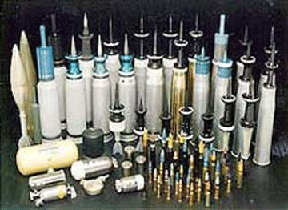 DEPLETED URANIUM: Leaving An Eternal Legacy Of Environmental Radioactivity Wherever It’s Used In War http://stateofthenation2012.com/?p=5585 June 1, 2014 by State of the Nation 2014 THE GREATEST CRIME OF HISTORIC TIME by Victor Connor
“The greatest crime against humanity in all historic time has now been committed by the United States government. It dwarfs Joseph Stalin’s killing of 7,000,000 Ukrainians in the 1930s and Adolph Hitler’s killing of 6,000,000 Jewish people in the 1940s. This crime will cause the premature deaths of TENS of MILLIONS of people and will give a horribly debilitating disease to TENS of MILLIONS more. It is indiscriminate mass murder – genocide. My statements may be dramatic, but they are absolutely true. “Since October of 2001, the United States military has used approximately 3,000 tons of depleted uranium munitions against people in Afghanistan and Iraq. This will soon cause serious health issues including respiratory disease, kidney problems, rashes, birth defects, and the number of cancers of these people will jump to over 500,000 each year.
How do I know this? Because the United States military used 375 tons of depleted uranium munitions against Iraq in 1991, and the cancer rate in children measured in Iraqi hospitals rose from 32,000 per year in 1990 to 130,000 in 1997. According to U.S. Department of Veterans Affairs official reports, U.S. casualties from Gulf War 1 now exceed 180,000 and already over 30,000 are now disabled from Gulf War 2. We’ve now used eight times what we did in 1991 and radiation has long been known to cause cancer. This is well known by our federal government. Continue reading
US tax-payer is propping up the uranium industry
THE GOVERNMENT IS PROPPING UP THE URANIUM INDUSTRY AND WE’RE PAYING FOR IT http://www.esquire.com/blogs/politics/white-mesa-uranium-mill-lawsuit-053014 The Department of Energy is promoting uranium mining at places like the White Mesa Mill and is tasked with the pricey cleanup. By Leslie Macmillan on May 30, 2014
The Grand Canyon Trust, an environmental group, has sued the operator of America’s last conventional uranium processing mill, saying its vast piles of spent ore and radioactive waste emit dangerous levels of radon and other toxins that violate the Clean Air Act.
The group and other critics of the White Mesa Mill near Blanding, Utah say it is a poorly disguised nuclear waste dump that would have gone out of business long ago were it not propped up by a lucrative federal contracts.
 The uranium market has declined in the wake of the Fukushima meltdown. To stay alive in a depressed market, Energy Fuels Resources, the mill’s operator, recycles mine tailings and radioactive waste — known as “alternate feed” — from Superfund sites around the country. The mill extracts any remnants of uranium from the waste then sells the concentrated, purified uranium, called yellowcake, to its customers, some of which are government-owned utilities obligated to buy White Mesa yellowcake at prices far higher than the $35 a pound it is currently fetching on the spot market. The leftover waste, a toxic stew of industrial chemicals, is stored in open pits called impoundments.
Energy Fuels spokesperson Curtis Moore said the issues raised in the lawsuit “are either inaccurate or have already been addressed through the proper regulatory channels.”
Taylor McKinnon of the Grand Canyon Trust says he hopes the lawsuit will “rip the mill from the rat’s nest of bureaucrats who have been protecting the status quo.”
The mill, he and other critics contend that uranium mining, milling and cleanup has become a virtual cottage industry — one orchestrated largely by the federal government.
During the Cold War period of 1940s through the 1980s, uranium was mined extensively in the Colorado Plateau to supply critical materials for the nation’s nuclear weapons program. The U.S. Department of Energy manages the nation’s surplus uranium and much of the cleanup of old processing mills.
Travis Stills, an energy and conservation law attorney, argues that the DOE’s mandate to “provide a domestic supply of uranium” is outdated and wreaks havoc on environmental and human health. He also says it’s unnecessary. The DOE already owns a uranium stockpile worth $7 to $8 billion.
The DOE doesn’t want to sell off the stockpile, Stills argues, because that would drive uranium prices down. Instead, the government artificially inflates prices to keep the industry going, he says.
Energy Fuels also operates several mines at the Grand Canyon, despite the federal ban on uranium mining there, because it possesses old mining claims that were “grandfathered in.” The company said in December it planned to shutter its Pinenut Mine there as well as the White Mesa Mill in 2014 and potentially reopen them in 2015. It reversed that decision last month and announced it would continue mining, but stockpile the ore pending better market conditions.
Cleaning up uranium is not cheap. The DOE is spending a billion dollars to dispose of tailings at an enormous site near Moab — a cost “born by the taxpayer,” the Trust’s lawsuit points out. On the Navajo reservation alone, there are 500 abandoned uranium mines. The EPA estimates the cleanup cost would be in the hundreds of millions. An $18 million bond has been posted for cleaning up White Mesa Mill when it stops processing uranium — not nearly enough, Stills argues. He says the federal government — and the taxpayer — will be left holding the bag for that cleanup too.
Indeed, the DOE is slated to inherit White Mesa Mill for cleanup. Stills says that the department’s mission, to at once promote uranium mining and oversee its cleanup, is contradictory but that it keeps the agency employed. “It’s bureaucratic make-work,” he says. “As long as they keep making a mess, they’ll need to keep cleaning it up.”
Renewable energy employing 6.5 million people world wide
 IRENA: 6.5 M People Employed in Renewable Energy Worldwide http://dailyfusion.net/2014/05/6-5-m-employed-in-renewable-energy-28962/ May 30, 2014 In 2013, approximately 6.5 million people were already employed in the renewable energy industry worldwide, a new study by the International Renewable Energy Agency (IRENA) reveals.

SEE ALSO: IRENA: Global Renewable Energy Share Can Double by 2030
“With 6.5 million people directly or indirectly employed in renewable energy, the sector is proving that it is no longer a niche, it has become a significant employer worldwide,” said IRENA Director-General Adnan Z. Amin. “The insights into shifts along segments of the value-chain revealed in the report are crucial to developing policy that strengthens job growth in this important sector of the economy.”
Renewable energy employment was shaped by regional shifts, industry realignments, growing competition and advances in technologies and manufacturing processes in 2013. The largest employers by country are China, Brazil, the United States, India, Germany, Spain and Bangladesh, while the largest employers by sector are solar photovoltaic, biofuels, wind, modern biomass and biogas.
Among other updates, the 6.5 million figure published in the annual review reflects growth in Chinese numbers, which can be attributed to a significant increase in annual installation and manufacturing activity and differences in the way employment figures are estimated. IRENA estimates a five-fold increase of solar PV installations in China from 2011 to 2013. Surging demand for solar PV in China and Japan has increased employment in the installation sector and eased some PV module over-supply concerns,” said Rabia Ferroukhi, heading the Knowledge, Policy and Finance division at IRENA and lead author of the report. “Consequently some Chinese manufacturers are now adding capacity.”
In the wind industry, China and Canada provided positive impulses while the outlook for the United States remains somewhat mixed because of political uncertainty. The offshore wind industry is still concentrated in Europe, particularly the United Kingdom and Germany.
The biofuels value chain provides the second largest number of renewable energy jobs after solar PV. The United States remains the largest biofuels producer, while Brazil remains the largest employer.
Largest environmental settlement ever to clean up South Dakota uranium mine
Settlement gives $179 million to clean up abandoned uranium mine in Harding County, Rapid City Journal, 1 June 14, Used in the early years of America’s thirst for nuclear fuel, the Riley Pass uranium mine in Harding County was one of hundreds of sites mined to provide fuel for nuclear weapons and reactors.
Companies strip-mined the site, which sprawls across 250 acres of bluffs and other land in the North Cave Hills, about five miles east of the town of Ludlow about 130 miles northwest of Rapid City. In those days, there were no regulations forcing companies to clean up old mines.
“Back in the Cold War era, there was almost sort of a gold rush going on up there for uranium,” said Dan Seifert, a project coordinator for the Riley Pass mine with Custer National Forest.
But for the past 50 years, the mining site has been abandoned, and waste products known as spoils have sat exposed to the wind and rain. That allowed toxic metals and elements like arsenic, uranium, radium and thorium vulnerable to be carried away by the weather.
Now, a tangled series of court proceedings has resulted in a $179 million plan to clean up the majority of the mine site. That money is part of a settlement, announced last month by the U.S. Department of Justice and approved by a judge last week, required Anadarko Petroleum Corp. to pay a $5.15 billion settlement of fraud claims from a 2006 acquisition of Kerr-McGee. Continue reading
Corporate executives could be liable for damages for funding climate denialsim
Big Carbon’s Big Liability Environmental groups have warned directors of fossil fuel companies that they may be held personally liable for misleading the public about climate change. The Nation Dan Zegart May 29, 2014
A new and potentially potent weapon is being unleashed in the climate wars. Yesterday, three major international environmental organizations warned the corporate executives of some of the largest fossil fuel companies that they could be personally liable for damages for funding climate change denialists and working against efforts to slow climate change. Continue reading
Treasure Island homes to be tested for radiation
 OFFICIALS TO TEST TREASURE ISLAND HOMES FOR RADIATION By Nick Smith abc 7 News, Saturday, May 31, 2014 SAN FRANCISCO (KGO) –Officials told San Francisco’s Treasure Island residents that more testing would be done to examine the risks posed by potential radiation exposure there.
“I always just feel like there’s a little bit more to what they’re saying,” Treasure Island resident Linda Brown said. Dozens of Treasure Island residents spent the day pressing state officials for new information about possible health risks associated with radiation contamination at or near their homes. ……
How easily nuclear brinkmanship can slide into nuclear war
The U.S. state presumably does not intend to provoke a hot war with Russia and China.. But directing intensive protowar against powerful nuclear-armed states is to risk the possibility of ‘sleep walking’ into the abyss through miscalculation, or through a gradual hightening of conflicts which finally go out of control.
Nuclear Brinksmanship: Obama’s ProtoWar Against Russia and China By Eric Sommer Global Research, May 31, 2014 Counterpunch Russia and China are both under attack by a multi-pronged U.S.-led ‘proto-war’ which could erupt into ‘hot war’ or even nuclear war. ‘Protowar’ or ‘proto-warfare’ is the term I have coined to describe the use of multiple methods intended to weaken, destabilize, and in the limit-case destroy a targeted government without the need to engage in direct military warfare.
Protowar methods include threats against the targeted country; economic sanctions; military encirclement around its borders. cyber-warfare, drone warfare, and use of proxy forces from within or from outside the country for political and/or military action against the local government.
U.S.-led protowars also invariably include propaganda campaigns against the targeted governments. The media campaigns are waged by the five giant media conglomerates which now control 90% of the U.S. media and which are directly linked to the U.S. foreign-policy establishment through various means including corporate memberships in the Committee for Foreign Relations.
You can recognize these media campaigns because they frequently employ the words ‘human rights’ or ‘democracy’ as the pretext for U.S. state protowars against other countries. Sometimes, of course, these words cannot possibly be applied at all, as in the massive support currently given to the murderous military dictatorship in Egypt or the midevilist kingdom of Saudi Arabia. In these cases the U.S. media and government substitute the words ‘U.S. National Interest’ for ‘human rights’ as the pretext for targeting another country.
Proto-warfare often precedes, or leads up to, hot wars, as when a decade of economic sanctions, media demonization, and media-supported lies about ‘weapons of mass destruction’ led up to the Iraq war. Thousands of young American men and women were sent over to kill and be killed, or to be injured or traumatized, to say nothing of the up to a million Iraqis who died as a result of the war. However, Iraq did not possess nuclear or other weapons of mass destruction, so there was no danger of a nuclear conflagration. Matters are much different with respect to Russia and China, both nuclear powers.
The ProtoWar Against Russia and China
U.S.-led proto-warfare against Russia and China has a number of elements. To begin with, it conforms to two popular doctrines in U.S. foreign policy circles. The first doctrine states that the U.S. must never allow another super-power to emerge, and must remain the unchallenged dominant force on Earth. This doctrine is clearly set-out in the original version of the U.S. Defence Department policy document known as ‘the Wolfowitz doctrine:
“Our first objective is to prevent the re-emergence of a new rival, either on the territory of the former Soviet Union or elsewhere, that poses a threat on the order of that posed formerly by the Soviet Union. This is a dominant consideration underlying the new regional defense strategy and requires that we endeavor to prevent any hostile power from dominating a region whose resources would, under consolidated control, be sufficient to generate global power.”
The document containing this statement and similar notions was changed for public consumption after the original provoked an outcry when it was leaked to the press. The second doctrine underpinning proto-warfare against Russia and China is that U.S. dominance of the planet depends on control of the Eurasian land mass, on which Russia and China occupy key positions. This doctrine has been heavily promoted by former US National Security Advisor Zbigniew Brzezinski. “For America,” he has written, ” the chief geopolitical prize is Eurasia… Eurasia is the globes largest continent and is geopolitically axial. A power that dominates Eurasia would control two of the worlds’ three most advanced and economically productive regions… Eurasia is thus the chessboard on which the struggle for global primacy continues to be played.
In pursuit of Eurasian dominance a whole gamut of protowar tools are now being used by the U.S. in its campaigns against Russia and China. Militarily, the U.S.-led Nato military alliance has progressively squeezed Russia’s’ strategic space by enlisting one former Russian aligned state in Eastern Europe after another. Now, with a U.S.-supported coup-imposed government in power in Kiev, there is open talk of Nato also incorporating Ukraine, a country right on Russia’s’ border……………
On the other side of Eurasia, U.S. military encirclement of China has also recently proceeded apace. Military bases and transfers of billions of dollars in military equipment have been positioned around China for years in areas such as South Korea, Taiwan, and Japan.
Now, with the Obama administrations’ so-called ‘pivot to Asia’, a new more ambitious program called ‘Air-Sea battle plan’ involves deployment of large amounts of very hi-tech military systems and equipment in the pacific area all aimed at China.
At the same time, new U.S. military bases are being opened across the Pacific arena, from the Philippines to Australia, with no other conceivable target but China.
In conjunction with this Pacific military build-up, the U.S.state is attempting to use previously minor disputes over ownership of maritime resources to turn a number of smaller Asian nations into proxies to help it destabilize China. These nations include Japan, South Korea, Vietnam, and the Philippines. By offering its support, and in some cases promises of military assistance in any maritime conflict with China, the U.S. has stoked the ambitions and aggressive nationalist tendencies of these smaller nations vis-a-vis China.
Coinciding with the military build-up against China is extensive cyber-penetration of China by the U.S. NSA (National Security Agency), as revealed by whistle-blower Edward Snowden.
This penetration includes wholesale capture of hundreds of thousands or millions of Chinese mobile text messages; the monitoring of mobile phone conversations of Chinese leaders; and serious intrusions into the computer network backbone system of Beijings’ Tsinghua university, which is linked to large numbers of Chinese research centers including labs engaged in sensitive military-related work………
The danger of the U.S.Eurasian protowar erupting into hot war – or even nuclear war – stems from a single factor: Previous U.S.-led protowars which erupted into hot wars were against countries like Serbia, Iraq, or Libya. Those countries did not have nuclear weapons and could not effectively defend themselves against U.S. military and other pressures Russia and China are in a different category – they are nuclear- armed and can defend themselves.
The U.S. state presumably does not intend to provoke a hot war with Russia and China.. But directing intensive protowar against powerful nuclear-armed states is to risk the possibility of ‘sleep walking’ into the abyss through miscalculation, or through a gradual hightening of conflicts which finally go out of control. . In 1914, with the European powers of the day already on edge, it took just the assassination of a minor duke in a peripheral country to trigger World War I. As an old adage has it, “If you play with fire, you may get burned.” http://www.globalresearch.ca/nuclear-brinksmanship-obamas-protowar-against-russia-and-china/5384644
Questioning the economics of Small Modular Nuclear Reactors (SMRs)
Christian Science Monitor, Small-scale nuclear plants can be strung together and might save utilities on capital costs. But critics question the efficiency and operating costs of small-scale nuclear plants. By Ken Silverstein, June 1, 2014 The Obama administration wants to seed the United States with pint-size nuclear reactors, and this week it backed a new developer to do it. The US Department of Energy (DOE) said it would provide $217 million in matching funds over five years to NuScale, which builds small, ready-made reactors that can be strung together.
But NuScale only gets the federal funds if it can match them with money from private investors, who so far have been leery of the technology. In April, Babcock & Wilcox said it would scale back its DOE-backed plans to build modular reactors for the Tennessee Valley Authority because it failed to secure venture capital. Will NuScale do any better?
NuScale says its advantage is that 12 of its modular reactors can be combined to form a 540 megawatt unit. When one of the modules goes down, it could easily be maintained while the rest of the reactors continue to operate, so that whole facilities are not knocked off the grid. Each individual module could be refueled in relatively short order.
The cost of a 540 megawatt unit would be between $2.2 billion and $2.5 billion. That’s marginally less expensive per unit of output than a traditional nuclear plant. And at that price, utilities would not be taking the kind of financial risks they might otherwise have to if they built a $15 billion to $20 billion central nuclear facility.
As a first step, Oregon-based NuScale is opening a manufacturing plant in Charlotte, N.C., where it will hire 70 employees.
“This expansion … is critical to completing NuScale’s design and submitting our design certification application to the Nuclear Regulatory Commission,” writes Mike McGough, chief commercial officer of NuScale, in an e-mail. The company hopes to submit its design certification in the latter half of 2016. And it plans to begin signing commercial contracts by 2023.
That’s a long and arduous process – just as it is for a larger nuclear plant. Typically, investors don’t want to tie up their money for that long. The Department of Energy’s involvement is aimed at trying to create some legal and financial certainties so they can invest with more confidence. While NuScale says that its units are more affordable than larger centrally located nuclear facilities and that they can replace retiring coal plants, its critics say that the technology lacks efficiencies and cannot compete against combined-cycled natural gas facilities.
“I wish them luck but the economics don’t make sense,” says Mike Keller, president of Kansas-based Hybrid Power Technologies, in an interview regarding both NuScale and Babcock & Wilcox. He adds that the smaller units are inefficient, which means that they produce more nuclear waste than their larger nuclear cousins while they would generate power at three times the current cost of a combined cycle natural gas plant.
“Having a big chunk of money [from the government] does not equal commercial success,” adds Mr. Keller. “The US government should do more due diligence.”………http://www.csmonitor.com/Environment/Energy-Voices/2014/0601/Pint-size-nuclear-plants-get-a-boost-from-Obama-administration
1 This Month

of the week – Shut Down Drone Warfare!


Tell the Ukrainian Government to Drop Prosecution of Peace Activist Yurii Sheliazhenko

Petition to revoke the licensing of the Near Surface Nuclear Disposal Facility (NSDF) at Chalk River. https://www.ourcommons.ca/petitions/en/Petition/Details?Petition=e-7247
To see nuclear-related stories in greater depth and intensity – go to https://nuclearinformation.wordpress.com
-
Archives
- April 2026 (57)
- March 2026 (251)
- February 2026 (268)
- January 2026 (308)
- December 2025 (358)
- November 2025 (359)
- October 2025 (376)
- September 2025 (257)
- August 2025 (319)
- July 2025 (230)
- June 2025 (348)
- May 2025 (261)
-
Categories
- 1
- 1 NUCLEAR ISSUES
- business and costs
- climate change
- culture and arts
- ENERGY
- environment
- health
- history
- indigenous issues
- Legal
- marketing of nuclear
- media
- opposition to nuclear
- PERSONAL STORIES
- politics
- politics international
- Religion and ethics
- safety
- secrets,lies and civil liberties
- spinbuster
- technology
- Uranium
- wastes
- weapons and war
- Women
- 2 WORLD
- ACTION
- AFRICA
- Atrocities
- AUSTRALIA
- Christina's notes
- Christina's themes
- culture and arts
- Events
- Fuk 2022
- Fuk 2023
- Fukushima 2017
- Fukushima 2018
- fukushima 2019
- Fukushima 2020
- Fukushima 2021
- general
- global warming
- Humour (God we need it)
- Nuclear
- RARE EARTHS
- Reference
- resources – print
- Resources -audiovicual
- Weekly Newsletter
- World
- World Nuclear
- YouTube
-
RSS
Entries RSS
Comments RSS
 nuclear-news