Fukushima groundwater radioactive contamination getting worse, but not properly measured
 Ongoing Impact of Wastewater from Fukushima Nuclear Power Station Ongoing Impact of Wastewater from Fukushima Nuclear Power StationHydro International, By Shunji Murai Professor Emeritus, University of Tokyo, Japan08/05/2014 Three years on from the Great East Japan Earthquake and Tsunami of 11 March 2011, air contamination is decreasing and is now concentrated in a limited area. Land contamination has also decreased through decontamination processes. However, despite all the efforts by Tokyo Electric Power Company (TEPCO) and the Japanese government, water contamination in surface and ground water is getting worse, simply because there are no effective countermeasures. ……. Even though the wastewater issue is taken seriously by Japanese people as well as people worldwide, the real status of the effect of the contamination is still unknown because neutral third-party organisations have no access to within a 20km radius of Fukushima NPS. The author has tried to make clear what the status of the wastewater issue is by using various sources including a Fishermen Union’s report, which appears to be more reliable than the government report or the report by TEPCO. http://www.hydro-international.com/news/id6913-Ongoing_Impact_of_Wastewater_from_Fukushima_Nuclear_Power_Station.html |
New research shows that TEPCO underestimated radioactive cesium released from Fukushima
 Radioactive cesium levels at Fukushima higher than TEPCO claims, Voice of Russia, 6 May 14 A new study conducted by Japanese researchers revealed that cumulative amount of radioactive cesium at the disaster-hit Fukushima nuclear power plant is nearly 1,5 times higher than previous estimates of the Tokyo Electric Power Co. (TEPCO), RIA Novosti reports. According to the research, between 17.500 and 20.500 terabecquerels of radioactive cesium-137 was released into the atmosphere from the Fukushima reactors against less than 13.600 terabecquerels declared by the plant operator TEPCO.
Earlier in April Japan’s Ministry of Economy, Trade and Industry issued a report that showed significant drop of radiation levels in areas surrounding Fukushima to under 20 millisieverts per year. These figures, however, exceed the long-term target of Japanese government of 1 millisievert per year.
………..: http://voiceofrussia.com/news/2014_05_09/Radioactive-cesium-levels-at-Fukushima-higher-than-TEPCO-claims-0913/
Sweden turning against nuclear power
 Support for nuclear power falls in Sweden, survey says http://www.alaskadispatch.com/article/20140509/sweden-hydropower-station-challenged-nuclear-energy-loses-favor
Swedes are becoming increasingly skeptical of nuclear power with a new survey showing 50 percent of respondents want the controversial power source phased out.
The report from the SOM Institute at the University of Gothenburg found support falling for nuclear power since a meltdown at Japanese power plant. With other European nations moveing away from nuclear power, Swedes are also growing leery.
“The fact that Germany, Switzerland, Italy and several other countries have begun to phase out nuclear power, it’s likely that nowadays it might happen in Sweden, too,” Sören Holmberg, a political science professor at Gothenburg University, told Swedish Radio News.
Before the nuclear accident at Fukushima in Japan, Swedes were generally positive toward building new reactors with 44 percent supporting the measure and 39 percent opposing it. After the disaster in 2011, 44 percent said they were against nuclear power and now half of respondents are anti-nuclear.
As before, support for new nuclear plants is strongest on the right of the political spectrum and the greatest resistance is from the left. Men and white collar workers are also more positive than women and laborers.
This story is posted on Alaska Dispatch as part of Eye on the Arctic, a collaborative partnership between public and private circumpolar media organizations.
EPA acts to protect public from radioactive danger from thorium at Ridgewood Queens, New York
 EPA Adds Radiation Site in Ridgewood Queens, New York to the Superfund List EPA 05/08/2014 Contact Information: Elias Rodriguez, (212) 637-3664, rodriguez.elias@epa.gov
(New York, N.Y.) The U.S. Environmental Protection Agency has added the Wolff-Alport Chemical Company site in the Ridgewood section of Queens, New York to the federal Superfund list of hazardous waste sites. The soil and nearby sewers were contaminated by radioactive material from past industrial activities at the site. Testing indicates that there is no immediate threat to nearby residents, employees or customers of businesses in the affected area along Irving and Cooper Avenues. Since exposure to the radioactive contamination may pose a threat to health in the long-term, in December 2013, the EPA took action to reduce people’s potential exposure to the radiation and address the potential health risks from the site.
The now-defunct Wolff-Alport Chemical Company operated from 1920 until 1954, processing imported monazite sand and extracting rare earth metals. Monazite contains approximately 6% to 8% thorium, which is radioactive. Radiation can increase a person’s risk of developing cancer such as cancer of the lung or pancreas.
“By placing the Wolff-Alport Chemical Company site on the Superfund list, the EPA can address the contamination to protect people’s health in the long-term,” said Judith A. Enck, EPA Regional Administrator. he Wolff-Alport Chemical Company site includes 1125 to 1139 Irving Avenue and 1514 Cooper Avenue in Ridgewood, on the border of Brooklyn and Queens. During its years of operation, the facility occupied three structures and two yard areas at 1127 Irving Avenue. The company did not operate out of 1125 Irving Avenue or 1514 Cooper Avenue, but those properties were affected by the contamination. Today the site includes six parcels of land with five buildings that house several small businesses, office space and warehouses. Until 1947, the company disposed of thorium waste in the sewer and on its property. The U.S. Atomic Energy Commission ordered the company to stop those practices in 1947.
The EPA assisted New York State and New York City in conducting radiological surveys in the area. These surveys identified waste material and radioactivity throughout the property, beneath adjacent public sidewalks and streets and in nearby sewers above levels expected to be found in a comparable urban area. The EPA, the Agency for Toxic Substances and Disease Registry, the New York City Department of Environmental Protection, the New York City Department of Health and Mental Hygiene, the New York State Department of Environmental Conservation and the New York State Department of Health are working together to reduce potential long-term exposure to radiation from the site.
Beginning in August 2012, the EPA took samples to assess the site and determine what immediate cleanup work would be necessary. The EPA used the results of this sampling to take steps to protect people from exposure in the short-term. At Intermediate School 384, radioactive gas was coming from a hole in an unoccupied storage area. The hole was sealed with concrete and follow-up sampling results showed levels below the action level established by the technical experts. At the Terra Nova Construction Company, the EPA installed a mitigation system that reduced radiation levels to below the action level.
Additional EPA actions included:……….To learn more about the Wolff-Alport site, please visit:http://www.epa.gov/region02/waste/wolff/index.html.http://yosemite.epa.gov/opa/admpress.nsf/0/609e310b78c3ef7a85257cd20055a13a?OpenDocument
The real lessons of Chernobyl and Fukushima
Debating the Merits of Nuclear Power CATHERINE THOMASSON NYT MAY 8, 2014 Re “The Right Lessons From Chernobyl” (editorial, May 2):
The danger posed by nuclear power goes far beyond the catastrophic accidents that have occurred at Chernobyl and Fukushima. As the nuclear weapon programs of North Korea, Pakistan, Israel, India and perhaps Iran have shown, civilian nuclear power programs are inextricably linked with the technology needed to develop nuclear weapons.
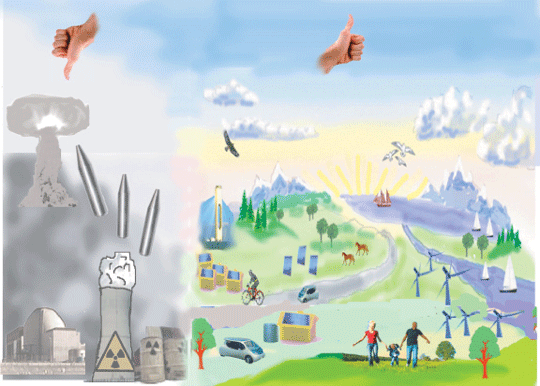
We cannot promote nuclear power as a source of electricity and also expect to prevent nuclear weapon proliferation, a development that poses as great a threat to humanity as global warming.Furthermore, nuclear power is not an inexpensive bridge to an energy system based on renewable sources.
It competes for resources with renewables, diverting money from the very technologies we need to promote. Numerous studies provide blueprints for replacing fossil fuels with renewable energy sources more cheaply and quickly than nuclear power can.
It is time to abandon the myth of the peaceful atom and focus on building a renewable energy system that meets the needs of all people.
Green Party a powerful presence in UK’s Shroud District a powerful force for Green
 Stroud District Green Party 8 May 14 Stroud District Green Party is active in the Stroud and Cotswold District Council areas and parliamentary constituencies. Werepresent Stroud on the County Council and five wards on Stroud District Council. A majority of Stroud Town Councillors are Greens and we are represented on several other Town and Parish Councils.
The Green Party is about more than just the environment: we believe that social justice and environmental responsibility are fundamentally linked. Find out more about our policies.
Stroud District is one of the country’s greenest communities and we are an active local party with a solid membership base. If you agree with our core values, please consider joining, donating or otherwise getting involved……..http://www.stroud.greenparty.org.uk/
Quebec’s moratorium on uranium minng extended for another year
 Study on impacts of uranium mining to extend Quebec moratorium another year mining.com, Cecilia Jamasmie | May 9, 2014 A group of doctors, environmental groups and First Nations leaders gathered in Montreal Thursday to urge Quebec’s new premier to keep the moratorium on uranium mining until the risks and effects of these kinds of operations on nearby communities have been thoroughly studied.
The suspension of uranium mining in the province came in effect in April last year, making Quebec the third Canadian jurisdiction, after Nova Scotia and British Columbia, to halt exploration and development of these kinds of mines.
The Bureau d’audiences publiques sur l’environnement (BAPE), the province’s environmental watchdog, is currently beginning a yearlong study on the matter, which will be carried out in three phases.
The results of this consultation could be critical for the future of mining in the east-central province, which has been losing its allure to investors in the last few years.
Mining investments in Quebec dropped significantly more than expected last year, plunging about 37% from a record year in 2012, and marking the first annual drop in a decade. The jurisdiction has also fallen in the famous index of mining destinations put together every year by the Fraser Institute, an independent think-tank: From being the No.1 desired place to invest in mining from 2007 to 2010, it barely reached the 11th place out of 96 jurisdictions last year……..http://www.mining.com/study-on-impacts-of-uranium-mining-may-extend-moratorium-indefinitely-report-87731-23280/
9 Ukrainian citizens arrested for smuggling Uranium-235
 Report: Ukrainian Police Arrest 9 Militants Smuggling Uranium-235 Prison Planet, Bradford Thomas May 8, 2014 Russian news outlet NEWSru.ua reported Monday that Ukrainian police in the Chernovci region arrested nine militants—eight Ukrainian citizens and one Russian—who were in possession of 1.5 kilos of substance containing Uranium 235, contents that could be used to create a “dirty bomb.”
The car containing the U-235 had foreign plates and was coming from Pridnestrovie (or Transnistria), a Russian military occupied breakaway territory in Moldova………http://www.prisonplanet.com/report-ukrainian-police-arrest-9-militants-smuggling-uranium-235.html
The Pentagon in denial about the harmful effects of depleted uranium
 The Pentagon’s Dirty Bombers: Depleted Uranium in the USA, Aletho News By David Lindorff – 10/26/2009 “……The Pentagon continues a long history of claiming that DU–which is the uranium that is left after the fissionable isotope U-235 is removed to make nuclear fuel and bombs–is not dangerous, although this official stance is belied by the warnings it has given to its troops (though not to civilians in battle zones), to stay well clear of tanks and other equipment destroyed by US tanks, which used DU weapons as the ordnance of choice in both the Gulf War and the current Iraq War. During both wars, DU ammunition was used by Army and Marine tanks, by the Bradley Fighting Vehicle, the A-10 ground support jet, the Marine Harrier jet, and specially equipped F16 fighter jets. The Navy also switched from DU ammunition to tungsten ammunition in its Phalanx anti-missile ship defense system because of health and environmental concerns with the DU ammo.
In both wars, a high percentage of troops have returned with many physical ailments–auto-immune problems, cancers, and later, birth defects in offspring–which have been referred to as Gulf War and now Iraq War Syndrome. As many as a quarter of returning vets from the Gulf War have reported strange illnesses and cancers and the numbers are rising for Iraq War vets. As well, statistics from the National Institutes of Health show that counties hosting bases and test facilities where DU has been uses also show high cancer rates. This is certainly true for Hawaii’s Big Island, which has the highest cancer rates for the Hawaiian archipelago. Meanwhile, the lung cancer rate for the Ft. Knox area is 105-127 per 100,000 for the 2001-2005 period, high by state and national standards. The rate is among the highest in the state of Washington for Pierce County, where Ft. Lewis is located.
The Pentagon denies that it uses depleted uranium in bombs, missiles and cruise missile warheads, but military personnel have reported their use in all three delivery systems, and reports exist of DU bunker-buster bombs, DU-tipped penetrator warheads on Tomahawk cruise missiles and on some air-to-ground missiles.
It’s a good bet that all US munitions containing DU have been widely tested at various US military bases and testing grounds.
The bottom line is that at the same time that US government is continuing to warn about the danger of terrorists acquiring the materials to make a “dirty” bomb that could spread radioactive material in the US, the US military has for years been doing exactly that, and continues to do so, with no intention to clean up its messes, many of which are allowing depleted uranium to percolate into ground water or flow down streams to more populated areas.
Of course, it could have been worse. The M101 mortar that litters Pohakuloa was actually designed as a range-finder for the Davy Crocket mortar, which back in the late 1950s and the 1960s, and up until 1971 was designed to allow infantry troops to fire a small “tactical” nuclear mortar shell at targets just one to two miles distant. Some 700 of these “little nukes”, that had a power of “just” several kilotons or less, were made and actually made their way into the arsenals of troops in Europe and elsewhere during the Cold War. Fortunately there are no reports of any of them having been fired off at any of the military’s firing ranges–especially given that their radiation effect radius was larger than their firing range, meaning that launching one was an automatic suicide mission.
(Actually firing it would have been suicide.)
Then again, the Pentagon doesn’t exactly have a sterling record about telling the truth where nuclear weapons and DU weapons are concerned. (You start to notice as you look into this stuff that with uranium weapons, the military’s attitude towards troop safety is not a whole lot better than its attitude towards the people at the downrange end of the line.)
Nor is the NRC to be relied on to protect the American public. As an administrative judge wrote in a ruling on a case involving DU contamination at Jefferson Proving Ground in Indiana, the NRC exhibited a “more than casual attitude with regard to decommissioning of sites on which radioactive materials remain as a potential threat to public health and safety and to the environment.”
In another case, involving cleanup of the ShieldAlloy Metallurgical Corp.’s site in Newfield, NJ, where DU weapons were made, a judge said, “at the very least, the (NRC) staff has countenanced…a situation that will leave the citizens in the area surrounding the activity site in doubt for close to two decades regarding what measures will ultimately be taken for their protection.” http://alethonews.wordpress.com/2014/05/09/the-pentagons-dirty-bombers-depleted-uranium-in-the-usa/
US Senators oppose changes that would weaken nuclear safety regulations

 Senators oppose changes to nuclear plant emergency regulations Relaxed alerts sought for closed Kewaunee plant postcrescent.com 8 May 14 Richard Ryman CARLTON — Dominion Resources Inc., owner of Kewaunee Power Station, wants to reduce the level of emergency response at the closed nuclear plant, such as the Nuclear Regulatory Commission approved at other reactors being decommissioned.
But five U.S. senators are challenging the NRC’s approval of such requests. In a recent letter to the commission, they pointed out that the NRC granted exemptions for each of the 10 requests made. Their concern is for spent nuclear fuel, which can be stored in water pools or dry casks.
Kewaunee spokesman Mark Kanz said Dominion requested exemptions for evacuation zones and siren alerts………..
They could remain there for 60 years, the amount of time Dominion is allowed to decommission the plant, or longer. The federal government has failed provided a national spent fuel repository as required by law and there is no indication when one will be created………
The senators who wrote to the NRC said National Academy of Sciences and NRC studies determined that draining of a spent nuclear fuel pool can lead to fires, large radioactive releases and widespread contamination. They said emergency protection zones, which can extend up to 50 miles from a reactor, should be maintained.
The senators include Edward Markey of Massachusetts, Barbara Boxer of California, Benard Sanders of Vermont, Patrick Leahy of Vermont and Kirsten Gillibrand of New York. All are Democrats except Sanders, who is independent but votes with Democrats on most issues.
They said exemptions are under review for four nuclear plants, including Kewaunee, Crystal River in Florida, San Onofre in California and Vermont Yankee in Vermont. They cited both the Fukushima, Japan, nuclear incident and the potential for terrorist attacks as reasons for refusing the exemptions……..http://www.postcrescent.com/article/20140508/APC03/305080514/Senators-oppose-changes-nuclear-plant-emergency-regulations
Obama launches renewable energy actions, aided by corporations
 With corporate help, Obama announces actions on renewable energy http://af.reuters.com/article/energyOilNews/idAFL2N0NU2OG20140509 WASHINGTON May 9 (Reuters) – President Barack Obama on Friday will announce executive orders to increase the use of solar panels, boost energy efficiency in federal buildings and train more people to work in the renewable energy field, the White House said.
The president, who will make the announcement during a visit to Wal-Mart in Mountain View, California, will also highlight commitments by corporations to lift solar generation at their facilities. Wal-Mart, Apple Inc, Yahoo Inc, Google Inc and Ikea were among the companies making such commitments.
Several financial institutions, including Citigroup Inc and Goldman Sachs Group Inc, were announcing new plans for “large scale investment and innovative programs” to develop solar and renewable energy installations, the White House said.
Obama’s executive actions would support efforts at community colleges so that 50,000 workers would join the solar industry by 2020, it said.
Another initiative would press for $2 billion in energy efficiency upgrades for federal buildings over the next three years, building on another $2 billion commitment from 2011.
Actions to strengthen building codes were also part of the mix. “Investing in solar and efficiency makes sense to reduce our carbon emissions, but also for our pocketbooks and for our economy,” said Dan Utech, an energy adviser to Obama, during a conference call on Thursday to preview Obama’s announcement.
He said the U.S. solar energy industry had expanded dramatically under Obama’s watch, with installations increasing to an amount enough to power more than 2 million homes.
“So momentum is increasing,” Utech said. “Since President Obama took office we’ve increased production from U.S. solar electricity more than tenfold, and in the last year, U.S. production of electricity from solar energy was double what it was just two years ago.”
An Obama spokesman also announced the completion of a project to install solar panels at the White House itself. The panels were American-made and part of an energy “retrofit” for the building that would improve its energy efficiency.
“The project, which helps demonstrate that historic buildings can incorporate solar energy and energy efficiency upgrades, is estimated to pay for itself in energy savings over the next eight years,” spokesman Matt Lehrich said. (Reporting by Jeff Mason; Editing by Cynthia Osterman)
Renewable energy can bring Europe’s nations together in co-operation
 Balance of power: a renewed case for renewable energy for Europe EurActiv 9 May 14, Reinier de Graaf argues that in the midst of the Ukrainian crisis and the energy risks looming over Europe, EU member states should look more seriously into the Roadmap 2050 project initiated in 2009, and aim at cutting Europe’s greenhouse gas emissions by 80% by 2050 through renewable energy use.
Reinier de Graaf directs the work of AMO, the research and design studio established as a counterpart to the architectural practice of OMA. He has been responsible for AMO’s increasing involvement in sustainability and energy planning, which has included Zeekracht: a strategic Masterplan for the North Sea, the publication in 2010 of “Roadmap 2050: A Practical Guide to a Prosperous, Low-Carbon Europe” with the European Climate Foundation, and “The Energy Report,” a global plan for 100 percent renewable energy by 2050, made with the WWF……….
The introduction of a European Supergrid would thus create a situation of mutual complementarity between both Europe’s energy sources and its individual nations. This would help overcome a major disadvantage of renewable energy: the volatility of supply of its individual sources (wind, sun, tidal, etc…) in the face of constant demand. The possibility to draw from multiple sources would create a robust system where the surplus of one source could immediately be used to mitigate the shortfall of another. A system of permanent back-up between nations would ensure constant energy supply for all. (When there is no wind in the north, there is fair chance that there is sun in the south, and vice versa.) A conservative estimate of the amount of terawatt-hours that could be derived from such a system – relying exclusively on existing technology and assuming no major technological breakthroughs – indicates an energy capacity that would surpass that of the entire oil and gas reserves of the Middle East.
Although little more than a footnote at the time, there was another important aspect to the project: Europe could become self-sufficient in its energy supply. Tied to this is an interesting political trade off: independence from external energy providers in exchange for increased energy interdependence between EU member states. Strangely enough, the byproduct of this essentially technical exercise turned out to be a more compelling case for European integration than any which had ever been made in the political arena. ……..
At the time of its launch in 2010, Roadmap 2050 was primarily driven by technological and environmental parameters; today, it is first and foremost the political aspect that grants the project a renewed momentum. Roadmap 2050 could provide Europe the necessary energy security, so it can remain firm about its democratic principles. Energy is primarily exchanged between European states that have committed to the same values and the dependence on outsiders is drastically reduced. The beauty of the idea lies in that within the proposed system no single European state can ever claim a monopoly on energy provision. Energy is exchanged for energy; todays suppliers are tomorrow’s recipients. Dependencies shift, simply on the basis of seasonal or meteorological conditions. The very strength of the project resides in the fact that it ultimately does not assume energy is ever un-political and the profound knowledge that a Europe that relies on energy provided by those who do not share its principles may ultimately well be a Europe unable to afford those principles. http://www.euractiv.com/sections/energy/balance-power-renewed-case-renewable-energy-europe-302030
UK climate denial organisation’s plan to avoid having to be accurate
Nigel Lawson’s climate sceptic thinktank to launch campaigning arm http://www.theguardian.com/environment/2014/may/09/nigel-lawson-climate-sceptic-thinktank Global Warming Policy Forum will escape scrutiny for accuracy of information by becoming a non-charitable company Fiona Harvey, environment correspondent theguardian.com, Saturday 10 May 2014 The climate sceptic organisation founded by former chancellor Nigel Lawson is to set up a new campaigning arm, which would be free from charity regulations.
The Global Warming Policy Foundation, which is classified as an educational charity and thus covered by strict Charity Commission rules that restrict its ability to conduct political campaigns, said that the new non-charitable company would undertake “activities which do not fall squarely within the educational remit of the charity”.Similar structures are also used by some other non-profit organisations, because it gives them greater freedom in lobbying and in some commercial activities.
The new arm, to be called the Global Warming Policy Forum, will share the same website and initials and publish reports and research papers, as well as organising lectures and debates on science and policy. In particular, it will put out news articles and opinion columns through a section of its website.
If the Charity Commission agrees with the restructuring, the new organisation will start operating by the end of July.
Bob Ward, policy and communications director at the Grantham Research Institute at the London School of Economics, last yearcomplained to the Charity Commission, over what he saw as the dissemination by the GWPF of “misleading and inaccurate” information. Charity Commission rules require organisations granted charitable status – which allows them, and their donors, to benefit from favourable tax treatment – to ensure that any information they put out is fair and as accurate as possible.
Ward said: “I think it is apparent that this move is designed to get around Charity Commission rules that specify that it must not disseminate inaccurate information. It is a deeply cynical move by the Foundation to avoid any formal requirement that they should stop misleading the public with inaccurate information. However, I hope now that it will be more obvious that when Lord Lawson speaks about climate change, it is as a campaigner rather than as an expert. And at least its secret donors will no longer be able to claim tax relief on funding the Foundation’s political propaganda.”
Greenpeace, which was named by the GWPF as an organisation that operates a campaigning arm as well as its core charity, told the Guardian: “They do say imitation is the sincerest form of flattery.” But he said that if Lord Lawson really wants to emulate Greenpeace’s structure he should be open about where his funding comes from and “root his political campaign in the reality of climate science.”
The GWPF does not disclose the names of organisations or individuals who provide its funding, but says that fossil fuel companies are not among them. It did not respond to requests for comment.
Agua Caliente, Florida – the first of many big solar power arrays
World’s Largest Solar Array Set to Crank Out 290 Megawatts of Sunshine Power Megaplants like Agua Caliente in Arizona herald a new efficiency in solar-sourced electricity Megaplants like Agua Caliente in Arizona herald a new efficiency in solar-sourced electricity Scientific American May 9, 2014 |By Roni Jacobson
Global climate change is here, and it’s only going to get worse, according to a White House report released on Tuesday. To combat rising sea levels and blistering summers, the Obama administration has been pushing for clean, renewable energy sources that cut down on carbon emissions. Now one of its projects is poised to pan out: Agua Caliente, the largest photovoltaic solar power facility in the world, was completed last week in Arizona.
The plant comprises more than five million solar panels that span the equivalent of two Central Parks in the desert between Yuma and Phoenix. It generates 290 megawatts of power—enough electricity to fuel 230,000 homes in neighboring California at peak capacity. The Agua Caliente Solar Project represents a significant advance in the technology compared with just four years ago, when the largest solar facility in the U.S. generated only 20 megawatts. “Solar has completely arrived as a competitive energy resource,” says Peter Davidson, executive director of the Loan Programs Office at the U.S. Department of Energy (DoE).

The project, which cost a total of $1.8 billion to construct, received a million-dollar loan from the Loan Programs Office. Under its “SunShot” initiative (so-named in the spirit of president John F. Kennedy’s “moon shot” program), the DoE provides guaranteed loans to unproved ventures in solar power in the hopes of promoting innovation and making the technology more cost-effective.* Although Agua Caliente (owned by U.S. energy giant NRG Energy and partner MidAmerican Solar) is now the largest photovoltaic solar facility in the world, it probably will not hold that distinction for long. …….
But as solar power becomes cheaper, Davidson predicts that utilities will pass those savings on to consumers. And as the technological advancements emerging from megaplants like Agua Caliente become more widely available, individual solar power adopters may eventually see savings as well. http://www.scientificamerican.com/article/world-s-largest-solar-array-set-to-crank-out-290-megawatts-of-sunshine-power/
Japan’s shock as Manga art depicts the reality of Fukushima radiation and health
 Japanese Manga Stirs Up Fukushima Nuclear Controversy http://kotaku.com/japanese-manga-stirs-up-fukushima-nuclear-controversy-1573381718 (Manga pictures on original article) 8 May 14 A famous Japanese food manga takes on the “truth about Fukushima.”
The Japanese manga, Oishinbo (美味しんぼ) is a long-running food manga that has been ongoing since 1983. In his latest chapter that was recently published in the magazine Big Comic Spirits, author Tetsu Kariya depicted the manga protagonist, Shiro Yamaoka, as he returned from a visit to the nuclear-disaster-suffering prefecture when he suddenly has a random nosebleed.After the incident, there is a discussion with another character who says that he, too, has suffered from such unexplained nosebleeds and fatigue, finishing with the comment, “There are a lot of people in Fukushima who suffer from the same symptoms. They just don’t talk about it.”
This depiction managed to stir up the hornet’s nest. According to Japanese news site Ebisoku, soon after the magazine hit the racks, the publisher, Shogakukan, was flooded with complaints and criticism that the manga was showing Fukushima in an exaggerated negative light.
The town of Futaba-machi wrote an official complaint, stating that there was no truth to the claim that “lots of people suffer from nosebleeds and other symptoms” and that the manga was damaging the image of Fukushima that they were trying hard to rebuild. The complaint notes that ever since the manga came out, there have been cancellations of visits and product orders and that Fukushima residents were afraid that the manga was cultivating discrimination against the prefecture and its residents.
Shogakukan has responded, saying that the depictions in the manga are based on real-world coverage by the author and that the manga had been published respecting the author’s expression.
The latest chapter of the manga seems based on personal experience by Kariya that he noted in an interview with Nichigo Press earlier this year. In the interview, Kariya talked of how the damage from the 2011 earthquake and subsequent nuclear disaster was much worse than he had imagined.
In response to the negative criticism against his manga, Kariya stated that while he expected some backlash, the extent of the response has surprised him. In a statement covered byNetarika, Kariya warned that there are still 2 more chapters to come and that he plans on writing harsher things. “People who are in an uproar about a nosebleed might go berserk.” Kariya stated. However, Kariya remains firm in his stance, saying that people are trying to sugar-coat the disaster with euphemisms and falsely positive language to hide the truth – something he hates more than anything else.
The author of Oishinbo recognizes that a lot of people will not like what he has to say, however, he maintains his position and has said that he will release his rebuttal after the last chapter is published.
1 This Month
26 April – Chernobyl: Inside the Meltdown airs on National Geographic on Sunday 26th April from 4pm

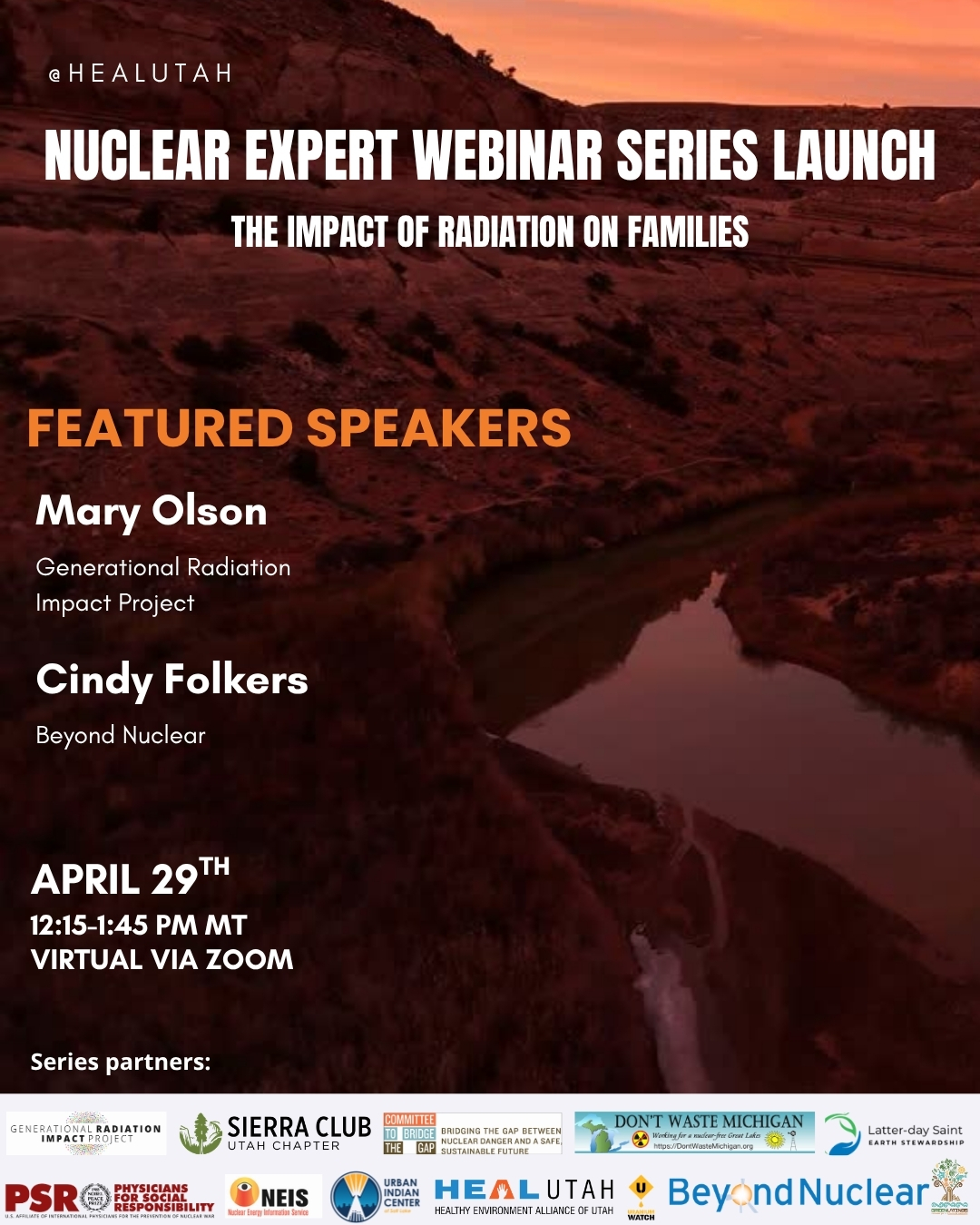
29 April – Nuclear Expert Webinar #1 – Radiation Impacts on Families with Mary Olson and Cindy Folkers
- 12:15 PM MT – 1:45 PM MT
- Location: Virtual – REGISTER TODAY

4 May -West Suburban Peace Coalition to discuss Iran war at May Educational Forum
Monday, May 4, 7:00 – 8:00 PM Central Standard Time
Title: : How Trump’s Narrative Tries to Shape the Reality of the War on Iran.
Contact Walt Zlotow, zlotow@hotmail.com 630 442 3045 for further information
14 May – online event From Bombs to Data Centres: the Face of Nuclear Colonialism

Pine Ridge Uranium is the real threat, not Tehran- Tell Burgum: Stop the Extraction.
Chernobyl: The Lost Tapes – A good documentary on Chernobyl on SBS available On Demand for the next 3 weeks– https://www.sbs.com.au/ondemand/tv-program/chernobyl-the-lost-tapes/2352741955560
To see nuclear-related stories in greater depth and intensity – go to https://nuclearinformation.wordpress.com
-
Archives
- April 2026 (288)
- March 2026 (251)
- February 2026 (268)
- January 2026 (308)
- December 2025 (358)
- November 2025 (359)
- October 2025 (376)
- September 2025 (257)
- August 2025 (319)
- July 2025 (230)
- June 2025 (348)
- May 2025 (261)
-
Categories
- 1
- 1 NUCLEAR ISSUES
- business and costs
- climate change
- culture and arts
- ENERGY
- environment
- health
- history
- indigenous issues
- Legal
- marketing of nuclear
- media
- opposition to nuclear
- PERSONAL STORIES
- politics
- politics international
- Religion and ethics
- safety
- secrets,lies and civil liberties
- spinbuster
- technology
- Uranium
- wastes
- weapons and war
- Women
- 2 WORLD
- ACTION
- AFRICA
- Atrocities
- AUSTRALIA
- Christina's notes
- Christina's themes
- culture and arts
- Events
- Fuk 2022
- Fuk 2023
- Fukushima 2017
- Fukushima 2018
- fukushima 2019
- Fukushima 2020
- Fukushima 2021
- general
- global warming
- Humour (God we need it)
- Nuclear
- RARE EARTHS
- Reference
- resources – print
- Resources -audiovicual
- Weekly Newsletter
- World
- World Nuclear
- YouTube
-
RSS
Entries RSS
Comments RSS
 nuclear-news
