Another pesky NRC Chair who puts public safety above nuclear industry profits!
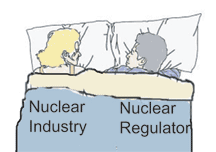 NRC rejects effort to move radwaste from pools; Macfarlane issues strong dissent Michael Mariotte, Green World, 30 May 14, The Nuclear Regulatory Commission has again sided with the nuclear power industry (where have you heard that one before?) and rejected efforts by environmental/clean energy groups and five U.S. Senators to move high-level radioactive waste out of overcrowded, dangerous and poorly-protected fuel pools as soon as it is cool enough to be placed in dry casks.
Not only did the NRC Commissioners take this unconscionable vote, they said this was their last word on the subject and they would refuse to ever again consider the issue.
 But the vote wasn’t unanimous: NRC Chair Allison Macfarlane, who has spent her career studying radioactive waste issues, issued a strong dissent to the decision, essentially arguing that the NRC staff hasn’t done its homework.
Which brings up an interesting subject we’ll talk about more below: what if the four Commissioners who voted for the industry on the waste issue–and nearly always vote for the industry–had been unsuccessful in their efforts in 2012 to oust then-chair Greg Jaczko, who almost certainly would have taken the same position as Macfarlane? We might then be looking at a Commission that could in a few months have had both Jaczko and Macfarlane as members, and perhaps at least one more Commissioner independent of the agency. That would be a very different situation than the industry-dominated and sympathetic Commission that has far too long run the NRC……….
In her dissent, Macfarlane castigated the staff for essentially shoddy research: “In my view, the staff has not adequately explored the issue of spent fuel management in the pool and as a result, I do not have adequate information on which to base a view on the need to require approaches that may lead to some form of expedited transfer of spent fuel from pools to dry casks.”
Macfarlane said she did not necessarily support a program to move the radioactive fuel to dry casks within five years, but primarily because the technical capacity to do so may not exist. And she complained that was the only option presented by the staff to the Commission:…….
In her nine-page dissent, the NRC chair also complained about the NRC staff’s failure unwillingness to fully engage the public in the agency’s radioactive waste discussions, writing, “I do not agree with the staff’s approach in engaging the public near the very end of the
current two-year regulatory review process, without the ability to fully provide input on key regulatory factors or review the draft regulatory analysis that was provided to the Commission. In accelerating this Tier 3 activity to align with the Waste Confidence environmental activities for public transparency, the staff may have ironically impeded the same public from fully vetting this issue in the safety and security arenas.”
Macfarlane concluded citing the precautionary principle:……….http://safeenergy.org/2014/05/29/nrc-rejects-effort-to-move-radwaste-from-pools/
No new contracts for 3 Exelon nuclear reactors: they may now close
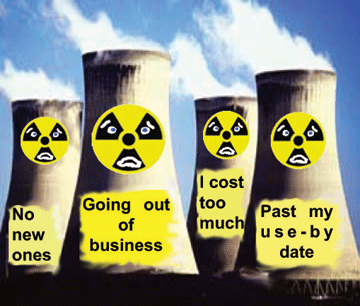 Exelon nuclear plants may retire after failing to secure new contracts, Utility DIVE, By Claire Cameron MAY 27, 2014
Dive Brief:
- Three of Exelon’s nuclear power plants failed to get new contracts at the annual PJM Interconnection capacity auction for 2017-18, putting their future at risk.
- The plants, Byron and Quad Cities in Illinois and Oyster Creek in New Jersey, could now close after they were priced out of the market by cheaper competitors. Traditionally, the company has made between $1-8 per megawatt-hour in revenue from the sale of power from these plants.
- This year’s PJM capacity auction saw power supply prices rise from last year’s three year low of $59.37 per MW to $120 per MW.
Dive Insight:
Exelon relies on the capacity auction to keep funding the expensive nuclear facilities it operates. Without contracts, however, the utility could be forced to turn to federal and state regulators for a bailout.
Exelon has yet to seek such a resolution. Prior to the results of the auction being announced, an Illinois House Resolution charging the Environmental Protection Agency, the Federal Energy Regulatory Commission and grid operators to adopt more nuclear-friendly policies was floored. ……http://www.utilitydive.com/news/exelon-nuclear-plants-may-retire-after-failing-to-secure-new-contracts/267503/
Fukushima radiation has caused genetic deformities in generations of butterflies
Japan Scientist: We gave butterflies food from Fukushima… then, they died; Deformities get worse with each generation — TV: “Truly horrifying… it doesn’t really even look like a butterfly anymore” (PHOTOS & VIDEO) http://enenews.com/japan-scientist-butterflies-fed-leaves-fukushima-died-deformities-worse-generation-tv-doesnt-look-like-butterfly-anymore-especially-scary-photos-video?utm_source=feedburner&utm_medium=email&utm_campaign=Feed%3A+ENENews+%28Energy+News%29
Vice on HBO, Season 2 Episode 10, May 24, 2014 (at 5:30 in):
- Dr. Joji Otaki, lead researcher, University of Ryukyus: We collected houseplant leaves from Fukushima, and those leaves are given to [butterfly] larvae collected from Okinawa… Those larvae aresupposed to be healthy. But they ate contaminated food from Fukushima. Then we see what happens.
- Vikram Ghandi, Vice: What happened?
- Otaki: They died.
- Ghandi: Dr. Otaki’s experiments have shown the truly horrifying effects contaminated food can have on living organisms.
- Otaki: You can see wrinkled wings.
- Ghandi: It doesn’t really even look like a butterfly anymore.
- Otaki: We found that mortality rate and abnormality rate of the 2nd generation is much higher — even worse in the 3rd generation.
- Ghandi: The evidence contaminated food has increasingly worse effects over the course of generations is especially scary since one of Fukushima’s primary industries is agriculture.
- Kazuya Tarukawa, farmer in Sukagawa 50 miles from Fukushima Daiichi: We had been growing produce that measured 3,000 [Bq/kg] without even knowing it. Selling such produce to the markets made me feel severely guilty.
- Ghandi: His father was consumed with guilt.
- Tarukawa: He hung himself from the tree.
Every day over 75 tons of highly radioactive liquid leaking at Fukushima
Official: Breach at Fukushima reactor blamed on saltwater corrosion — Over 75 tons of highly radioactive liquid flowing out everyday (PHOTOS & VIDEO) http://enenews.com/official-breach-at-fukushima-reactor-blamed-on-saltwater-corrosion-over-75-tons-of-highly-radioactive-liquid-flowing-out-everyday-photos-video?utm_source=feedburner&utm_medium=email&utm_campaign=Feed%3A+ENENews+%28Energy+News%29
Kyodo News, May 28, 2014: [Tepco] has identified the location of a leak at the bottom of the container in the No. 1 reactor […] water was leaking from a joint in a pipe […] The metal bellow joint is likely to have been corroded [“destruction of materials from chemical reaction“] by seawater [the Tepco official said.] The official denied the possibility that the leakage was caused because the earthquake damaged equipment. He said the company will continue to investigate if there are other areas of leakage nearby.
Jiji Press, May 28, 2014: Tepco said it had confirmed water was leaking from a pipe in the reactor containment vessel inside the plant’s No. 1 reactor building. The utility used a camera-mounted remote-controlled robot […] water was leaking from the vessel’s bottom near the pipe, at a rate of up to 3.2 tons per hour [76.8 tons/day]. In the No. 1 to No. 3 reactor buildings, highly contaminated water leaking from the vessels has amassed, preventing work to remove nuclear fuel.
NHK,May 27, 2014: The water is leaking from a point on a pipe leading to the containment vessel. An image taken by a robot probe shows a black area on the brown pipe. The leak point is above a donut-shaped unit called a suppression chamber where a robotic investigation detected flows of contaminated water last November. The chamber is in the lower part of the containment vessel. […] A contaminated water leak has also been found in the containment vessel of the Number 3 reactor. Officials say they will now investigate the suppression chamber and other parts of the Number 2 reactor.
Watch footage of the Unit 1 suppression chamber survey published on May 28 here
1 This Month

of the week – Shut Down Drone Warfare!


Tell the Ukrainian Government to Drop Prosecution of Peace Activist Yurii Sheliazhenko

Petition to revoke the licensing of the Near Surface Nuclear Disposal Facility (NSDF) at Chalk River. https://www.ourcommons.ca/petitions/en/Petition/Details?Petition=e-7247
To see nuclear-related stories in greater depth and intensity – go to https://nuclearinformation.wordpress.com
-
Archives
- March 2026 (244)
- February 2026 (268)
- January 2026 (308)
- December 2025 (358)
- November 2025 (359)
- October 2025 (376)
- September 2025 (257)
- August 2025 (319)
- July 2025 (230)
- June 2025 (348)
- May 2025 (261)
- April 2025 (305)
-
Categories
- 1
- 1 NUCLEAR ISSUES
- business and costs
- climate change
- culture and arts
- ENERGY
- environment
- health
- history
- indigenous issues
- Legal
- marketing of nuclear
- media
- opposition to nuclear
- PERSONAL STORIES
- politics
- politics international
- Religion and ethics
- safety
- secrets,lies and civil liberties
- spinbuster
- technology
- Uranium
- wastes
- weapons and war
- Women
- 2 WORLD
- ACTION
- AFRICA
- Atrocities
- AUSTRALIA
- Christina's notes
- Christina's themes
- culture and arts
- Events
- Fuk 2022
- Fuk 2023
- Fukushima 2017
- Fukushima 2018
- fukushima 2019
- Fukushima 2020
- Fukushima 2021
- general
- global warming
- Humour (God we need it)
- Nuclear
- RARE EARTHS
- Reference
- resources – print
- Resources -audiovicual
- Weekly Newsletter
- World
- World Nuclear
- YouTube
-
RSS
Entries RSS
Comments RSS
 nuclear-news