Unfounded and irresponsible claims in favour of Small Modular Nuclear Reactors (SMRs)
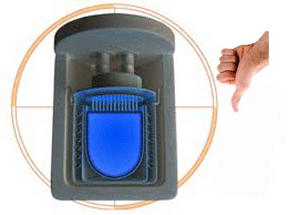 WHY SMALL MODULAR REACTORS ARE PART OF THE PROBLEM, NOT THE SOLUTION Mark Cooper, Ph.D. Senior Fellow for Economic Analysis Institute for Energy and the Environment Vermont Law School May 2014
“………..Unachievable assumptions about cost: Even industry executives and regulators believe the SMR technology will have costs that are substantially higher than the failed “nuclear renaissance” technology on a per unit of output. The higher costs result from
• lost economies of scale in containment structures, dedicated systems for control,
management and emergency response, and the cost of licensing and security,
• operating costs between one-fifth and one-quarter higher, and
• decommissioning costs between two and three times as high.
Irresponsible assumptions about a rush to market: To reduce the cost disadvantage and meet the urgent need for climate policy, advocates of SMR technology propose to deploy large numbers of reactors (50 or more), close to population centers, over a short period of time. This compressed RD&D schedule embodies a rush to market that does not make proper provision for early analysis, testing, and demonstration to provide an opportunity for experience-based design modifications. This is exactly the problem that arose in the 1970s, when utilities ordered 250 reactors and ended up cancelling more than half of them when the technology proved to be expensive and flawed.
Unrealistic assumptions about the scale of the sector: While each individual reactor would be smaller, the idea of creating an assembly line for SMR technology would require a massive financial commitment. If two designs and assembly lines are funded to ensure competition, by 2020 an optimistic cost scenario suggests a cost of more than $72 billion; a more realistic level would be over $90 billion. This massive commitment reinforces the traditional concern that nuclear power will crowd out the alternatives. Compared to U.S. Energy Information Administration (EIA) estimatesof U.S. spending on generation over the same period, these huge sums are equal to
• three-quarters of the total projected investment in electricity generation and
• substantially more than the total projected investment in renewables.
Radical changes in licensing and safety regulation: SMR technologies raise unique safety challenges including inspection of manufacturing and foreign plants, access to below ground facilities, integrated systems, waste management, retrieval of materials with potentially higher levels of radiation, flooding for below-ground facilities, and common designs that create potential “epidemic” failure. Yet ,SMR advocates want pre-approval and limited review of widely dispersed reactors located in close proximity to population centers and reductions in safety margins, including shrinking containment structures, limitations of staff for safety and security, consolidation of control to reduce redundancy, and much smaller evacuation zones. In the wake of global post-Fukushima
Calls for more rigorous safety regulation, policymakers and safety regulators are likely to look askance at proposals to dramatically relax safety oversight.
Unfounded claims of unique supply and demand advantages: Despite their high costs, advocates argue that smaller reactors are more attractive than large reactors because they are moreflexible, requiring smaller capital commitments and shorter construction times.
• By these same criteria, non-nuclear alternatives are far more attractive – smaller, less
costly, quicker to market, and already scalable.
• The alternatives also do not possess the security and proliferation risks and environmental problems that attach to nuclear power. …….. http://216.30.191.148/Cooper%20SMRs%20are%20Part%20of%20the%20Problem,%20Not%20the%20Solution%20FINAL2.pdf
No comments yet.
1 This Month

of the week – Shut Down Drone Warfare!


Tell the Ukrainian Government to Drop Prosecution of Peace Activist Yurii Sheliazhenko

Petition to revoke the licensing of the Near Surface Nuclear Disposal Facility (NSDF) at Chalk River. https://www.ourcommons.ca/petitions/en/Petition/Details?Petition=e-7247
To see nuclear-related stories in greater depth and intensity – go to https://nuclearinformation.wordpress.com
-
Archives
- April 2026 (7)
- March 2026 (251)
- February 2026 (268)
- January 2026 (308)
- December 2025 (358)
- November 2025 (359)
- October 2025 (376)
- September 2025 (257)
- August 2025 (319)
- July 2025 (230)
- June 2025 (348)
- May 2025 (261)
-
Categories
- 1
- 1 NUCLEAR ISSUES
- business and costs
- climate change
- culture and arts
- ENERGY
- environment
- health
- history
- indigenous issues
- Legal
- marketing of nuclear
- media
- opposition to nuclear
- PERSONAL STORIES
- politics
- politics international
- Religion and ethics
- safety
- secrets,lies and civil liberties
- spinbuster
- technology
- Uranium
- wastes
- weapons and war
- Women
- 2 WORLD
- ACTION
- AFRICA
- Atrocities
- AUSTRALIA
- Christina's notes
- Christina's themes
- culture and arts
- Events
- Fuk 2022
- Fuk 2023
- Fukushima 2017
- Fukushima 2018
- fukushima 2019
- Fukushima 2020
- Fukushima 2021
- general
- global warming
- Humour (God we need it)
- Nuclear
- RARE EARTHS
- Reference
- resources – print
- Resources -audiovicual
- Weekly Newsletter
- World
- World Nuclear
- YouTube
-
RSS
Entries RSS
Comments RSS
 nuclear-news
Leave a comment