Plan to bring Germany’s radioactive trash to South Carolina
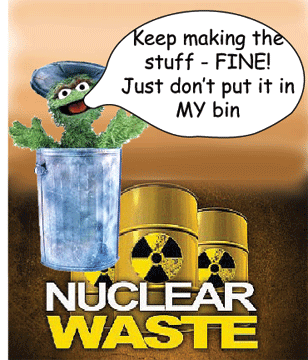 German nuclear waste could be shipped to Savannah River Site http://chronicle.augusta.com/latest-news/2014-04-30/german-nuclear-waste-could-be-shipped-savannah-river-site By Meg Mirshak
The U.S. Department of Energy signed a “statement of intent” with German research agencies offering to evaluate accepting, processing and disposing of waste at SRS. No final decision has been made, according to SRS spokesman Jim Giusti.
“All potential work to support DOE’s evaluation would be funded by the German government so the Statement of Intent is an important step forward,” Giusti said in an email this week to SRS stakeholders.
Additional shipments of waste at SRS has drawn opposition from environmentalist Tom Clements, director of watchdog group SRS Watch. SRS already has its own challenges disposing of large amounts of high-level waste existing at the facility, he said.
“The proposal to import highly radioactive spent fuel from Germany to SRS is simply nuclear dumping dressed up as nuclear non-proliferation,” Clements said. “Germany’s challenging dilemma with what to do with its nuclear waste must not become a waste management problem for the Savannah River Site.”
The graphite-based fuel for the German reactor contains U.S.-origin highly enriched uranium. Returning it to the U.S. would remove it from potential use in a nuclear weapon, Giusti said.
The energy department will “prepare appropriate analysis and consult with the public” as part of the National Environmental Policy Act before any decisions on accepting the waste are made, Giusti said.
France’s nuclear dilemma
France caught between nuclear cliff and investment wall BY MICHEL ROSEPARIS Wed Apr 30, 2014 (Reuters) – France must decide in the next few years whether it wants to continue its nuclear-driven energy policy at a cost of up to 300 billion euros (246.8 billion pounds) or if it wants to embark on an equally costly route towards using other fuels.
Most of the country’s 58 nuclear reactors were built during a short period in the 1980s, and about half will reach their designed age limits of 40 in the 2020s, pushing France towards what industry calls “the nuclear cliff.”
Public support in France for nuclear power has traditionally been strong but is looking shakier since the 2011 nuclear reactor meltdown at Japan‘s Fukushima facility following a massive earthquake and tsunami. And French President Francois Hollande has said he wanted to cut the share of atomic energy in France’s electricity mix to 50 percent from 75 percent by 2025, reduce oil and gas consumption and boost renewable energy.
A replacement of the nuclear plants run by state-controled utility EDF (EDF.PA), or a switch towards alternative sources would cost huge amounts of money.
“There’s a problem, which is decision-making. Are we going towards a new nuclear fleet or not? This needs preparation,” Jacques Repussard, the head of state-funded nuclear advising institute IRSN told Reuters in an interview. EDF has advocated an extension of the reactors’ lifespan to 50 or even 60 years, arguing that they were modelled on similar reactors in the United States which have been granted 60-year licences.
But French nuclear watchdog ASN, the only authority allowed to grant this extension, has so far repeated that the utility should not take this extension for granted and would only give a first opinion next year and a final one in 2018-2019………..
On the one hand, EDF wants to cash in on its nuclear know-how through exporting its technology and services, including to Britain’s nuclear investment power programme.
Yet EDF also faces a 55 billion euro upgrade of its existing reactors by 2025 and will have to decide on how to finance their ultimate replacement, at a potential cost of up to 240 billion euros, about six times EDF’s existing debt pile.
“If you close down all nuclear reactors when they reach 30 or 40 however, you will need to build a huge new fleet, that would be a massive challenge not only from a financial point of view but also from a project management point of view,” said Laszlo Lavro, head of the International Energy Agency’s Gas, Coal and Power division.
Within the government, ministers have voiced contradicting views on nuclear energy, even though the departure of the Green party from the government has made the pro-nuclear case stronger.
An energy transition bill now slated for July has been repeatedly delayed, with Paris naming its fourth energy minister in less than two years earlier this month.
Newly appointed energy minister Segolene Royal, a powerful voice in the new government, has skirted questions on nuclear policy at a news conference earlier this week……….
Decisions cannot be delayed indefinitely as building new energy infrastructure, especiallynuclear power plants, takes time.
Construction of France’s pilot new generation reactor in Flamanville, which started in 2007, has seen repeated delays and cost overruns and is currently expected to be finished in 2016……http://uk.reuters.com/article/2014/04/30/uk-france-nuclear-analysis-idUKKBN0DG0KC20140430
Renewable energy: GE’s $1 billion investment
According to the division’s CEO, David Nason, renewable power is its fastest growing market and also a good way of spurring sales of GE wind turbines and solar inverter equipment.
“We see renewable energy providing very significant returns going forward,” Nason told Bloomberg.
As part of this the company is actively involved in a range of solar projects with solar panel manufacturer and project developer First Solar. According to Kevin Walsh, the company’s head of power and renewable energy, “There is a very active dialog with First Solar”.
100,000 renewable energy jobs now in Britain
Renewable energy sector now supports over 100,000 UK jobs by ClickGreen staff. Published Wed 30 Apr 2014 The renewable energy industry has attracted nearly £30 billion of private sector investment since 2010, according to a new joint report published by the REA, Innovas and PwC.
The huge investment has enabled the industry to sustain over 100,000 jobs in 2013, generate turnover last year of £14 billion and deliver 4.2% of UK energy.
The report, REview – Renewable Energy View: 2014, builds on the REA’s 2012 report Renewable Energy: Made in Britain, the first industry-wide analysis of employment in the UK renewable energy industry.

The 116-page paper is the most complete assessment to date of the UK renewable energy market and will be formally launched this evening by Energy Minister Greg Barker in the House of Commons.
REA Chief Executive Dr Nina Skorupska said the report should provide the Government with a reminder of learning from past mistakes and provide market stability.
She added: “This report highlights the close relationship between clear, stable policies and sustained growth and jobs in the renewable energy industry. The Government’s renewable electricity policies have incentivised nearly £28 billion of private investment since 2010, achieving annual growth rates of over 20%. The world’s first Renewable Heat Incentive is also beginning to spur positive growth in green heating. This is a tremendous success story.
“This positive message also comes with a warning. Drastic Feed-in Tariff cuts in 2011/12 led to widespread job losses in the solar industry, and the continued policy uncertainty for renewable transport has seen employment and investment opportunities in UK refineries go begging.
“Clear, stable policies create the investment, jobs and growth in renewables that the UK needs. We urge the Government to learn the lessons from past experiences, such as solar FITs and biofuels uncertainty, and engage closely with industry to resolve outstanding uncertainties, such as State Aid rules and the details of CfDs.”
Analysis by the REA reveals that:
* Renewable electricity generation has grown steadily, increasing on average by 20.3% year-on-year between 2009 and 2013………
Continue reading
SunEdison going ahead with large solar energy plants
 SunEdison Lighting Up California (And Elsewhere) http://www.energymatters.com.au/index.php?main_page=news_article&article_id=4287 SunEdison has announced it has secured construction financing for the 60 MW Regulus solar power plant located in Kern County, California.
Regulus will consist of around 250,000 solar panels and once operational; SunEdison will provide management and monitoring, field dispatch and reporting services via its Renewable Operation Center (ROC).
“Regulus is our largest North America project to date and is evidence of the momentum we are building in the California utility scale solar market,” said Bob Powell, SunEdison president of North America.
Announcements concerning SunEdison’s involvement in big ticket solar plants in California have become rather commonplace these days – just in the last couple of 6 weeks; the 24 MW Cascade solar farm and the 20MW Adobe Solar Facilityhave been brought online.
Last Thursday, the company also announced it had secured financing from Deutsche Bank Securities Inc. for two solar power plants to be built in Ontario, Canada. Combined, the solar farms will supply enough clean energy to power 1,300 average households.
As well as large-scale flashy solar farms, SunEdison also has interests in helping out those less fortunate with clean energy too.
Last Friday, the company dedicated a solar power system to the Mariposa Center for Girls in the Dominican Republic. The facility assists at-risk schoolgirls in support of the UN’s goals to increase energy access for all. SunEdison donated $10,000 in cash plus an in-kind donation of equipment – a 9.9 kW solar panel system.
“Electricity facilitates education, the delivery of healthcare services, and economic growth,” said Steve O’Rourke, senior vice president and chief strategy officer for SunEdison.
“We are proud to support the UN’s Sustainable Energy for All initiative in this and future endeavors to ensure all people have access to clean, affordable energy.”
Solar Wind Energy Tower (SWET) – a radical idea for energy
A Skyscraper-Sized Solar-Wind Tower Could Become North America’s Tallest Structure, TODD WOODY, The Atlantic, MAY 1 2014 Can a 2,250-foot-high wind tunnel generate electricity more cheaply than coal?
“Our tower makes roughly about half the power of a traditional nuclear power plant,” Ronald Pickett, the chief executive of Solar Wind Energy Tower (SWET), the company behind the $1.5 billion project, told investors during a March conference call. “Enough to power a city of 700,000 to a million people.”
And the price of that carbon-free power would be cheaper than coal-fired electricity, he claimed. ……http://www.theatlantic.com/technology/archive/2014/05/can-a-2250-foot-high-solar-wind-tower-generate-electricity-cheaper-than-coal/361524/
Central Asia to be a nuclear weapons free zone
Five Powers Agree to Respect Central Asian Nuclear-Free Zone National Journal, 30 April 14, By Rachel Oswald The world’s five nuclear powers announced on Tuesday they had agreed to never use their atomic arms against five Central Asian countries.
“They commit not to attack them with nuclear weapons or to threaten them with nuclear weapons and also respect the other [treaty] provisions” banning the deployment or testing of atomic arms in Central Asia, said nonproliferation expert Gaukhar Mukhatzhanova, who is attending the Preparatory Committee meeting in New York City where the announcement was made by the five powers.
The Central Asia Nuclear Weapon Free Zone commits its signatories — Kazakhstan, Kyrgyzstan, Tajikistan, Turkmenistan and Uzbekistan — to refrain from developing, acquiring or possessing nuclear weapons. The treaty entered into force in 2009 without the world’s formally recognized nuclear-armed countries — China, France, Russia, the United Kingdom and the United States — agreeing to abide by its limits.
It took five years of “intensive consultations” for the five powers to agree to sign a protocol to the Central Asian treaty, according to Mukhatzhanova, a senior research associate at the James Martin Center for Nonproliferation Studies.
“It’s certainly one of the bigger news [items] so far” to come out of the Preparatory Committee meeting, Mukhatzhanova said in a Tuesday phone interview. The so-called “PrepCom” gathering is being held in advance of next year’s Review Conference for the Nuclear Nonproliferation Treaty. Peter Jones, director of defense and international security at the British Foreign and Commonwealth Office, in astatement to the meeting said the United Kingdom was “delighted” to demonstrate its “commitment to legally binding negative security assurances by signing a protocol” to the treaty.
Moscow in its statement said it wished to sign the protocol “as soon as possible.” Washington similarly expressed its anticipation for inking the text.
Mukhatzhanova said she believed any signing ceremony at the meeting would take place in private, with the five powers submitting the treaty to their respective legislative bodies for ratification at a later date.
An agreement by the five powers to sign the pact had been held up for years, due to problems that London, France and particularly Washington had with some of the accord’s language, she said. The specific point of contention dealt with Article 12, which states that the agreement “does not affect the rights and obligations of the parties under other [pre-existing] international treaties.”…….http://www.nationaljournal.com/global-security-newswire/five-powers-agree-to-respect-central-asian-nuclear-free-zone-20140430
The Fukushima nuclear crisis is not over, and will have global health implications
The impact of the nuclear crisis on global health Australian Medical Student Journal By Helen Caldicott in Volume 4, Issue 2 2014“……….The Great Eastern earthquake, measuring 9.0 on the Richter scale, and the ensuing massive tsunami on the east coast of Japan induced the meltdown of three nuclear reactors within several days. During the quake the external power supply was lost to the reactor complex and the pumps, which circulate up to one million gallons of water per minute to cool each reactor core, ceased to function. Emergency diesel generators situated below the plants kicked in but these were soon swamped by the tsunami. Without cooling, the radioactive cores in units 1, 2 and 3 began to melt within hours. Over the next few days, all three cores (each weighing more than 100 tonnes) melted their way through six inches of steel at the bottom of their reactor vessels and oozed their way onto the concrete floor of the containment buildings. At the same time the zirconium cladding covering thousands of uranium fuel rods reacted with water, creating hydrogen, which initiated hydrogen explosions in units 1, 2, 3 and 4.
Massive quantities of radiation escaped into the air and water – three times more noble gases (argon, xenon and krypton) than were released at Chernobyl, together with huge amounts of other volatile and non-volatile radioactive elements, including cesium, tritium, iodine, strontium, silver, plutonium, americium and rubinium. Eventually sea water was – and is still – utilized to cool the molten reactors.
Fukushima is now described as the greatest industrial accident in history.
The Japanese government was so concerned that they were considering plans to evacuate 35 million people from Tokyo, as other reactors including Fukushima Daiini on the east coast were also at risk. Thousands of people fleeing from the smoldering reactors were not notified where the radioactive plumes were travelling, despite the fact that there was a system in place to track the plumes. As a result, people fled directly into regions with the highest radiation concentrations, where they were exposed to high levels of whole-body external gamma radiation being emitted by the radioactive elements, inhaling radioactive air and swallowing radioactive elements. [2] Unfortunately, inert potassium iodide was not supplied, which would have blocked the uptake of radioactive iodine by their thyroid glands, except in the town of Miharu. Prophylactic iodine was eventually distributed to the staff of Fukushima Medical University in the days after the accident, after extremely high levels of radioactive iodine – 1.9 million becquerels/kg were found in leafy vegetables near the University. [3] Iodine contamination was widespread in leafy vegetables and milk, whilst other isotopic contamination from substances such as caesium is widespread in vegetables, fruit, meat, milk, rice and tea in many areas of Japan. [4]
The Fukushima meltdown disaster is not over and will never end. The radioactive fallout which remains toxic for hundreds to thousands of years covers large swathes of Japan and will never be “cleaned up.” It will contaminate food, humans and animals virtually forever. I predict that the three reactors which experienced total meltdowns will never be dissembled or decommissioned. TEPCO (Tokyo Electric Power Company) – says it will take at least 30 to 40 years and the International Atomic Energy Agency predicts at least 40 years before they can make any progress because of the extremely high levels of radiation at these damaged reactors.
This accident is enormous in its medical implications. It will induce an epidemic of cancer as people inhale the radioactive elements, eat radioactive food and drink radioactive beverages. In 1986, a single meltdown and explosion at Chernobyl covered 40% of the European land mass with radioactive elements. Already, according to a 2009 report published by the New York Academy of Sciences, over one million people have already perished as a direct result of this catastrophe. This is just the tip of the iceberg, because large parts of Europe and the food grown there will remain radioactive for hundreds of years……… [5]http://www.amsj.org/archives/3487
Saudi Arabia shows off nuclear-capable missiles
The DF-3 has a range of 2,650 km and carries a payload of 2,150 kg. It is equipped with a single nuclear warhead with a 1-3 MT yield.
Watched by a wide array of Saudi defense and military dignitaries, headed by Crown Prince and Deputy Prime Minister Salman bin Abdulaziz, the parade marked the end of the large-scale “Abdullah’s Sword” military war game.
Conspicuous on the saluting stand was the Pakistani Chief of Staff Gen. Raheel Sharif alongside eminent visitors, including King Hamad of Bahrain and Sheikh Muhammad bin Zayed, the crown prince of Abu Dhabi………
By showing off their ageing Chinese missiles, the Saudis intimated that they had acquired the more advanced generation of this weapon, which they are keeping under wraps. DEBKAfile’s intelligence sources report that in recent visits to Beijing, high-ranking Saudi officials negotiated the purchase of Dong-Feng 21 (DF-21), whose range is shorter, 1,700 km, but more precise and effective in view of its terminal radar guidance system. The West has no information about when the new Chinese missiles were delivered to Saudi Arabia.
5. The presence of the top Pakistani soldier at the parade of military and nuclear hardware was meant as corroboration of Islamabad’s active role as the source of the Saudi nuclear arsenal.
6. The Saudis no longer rely on the American nuclear umbrella. They are developing their own nuclear strike force with the help of China and Pakistan. http://www.debka.com/article/23878/Saudis-parade-nuclear-missiles-for-the-first-time-in-defiance-of-US-Iranian-nuclear-accord
Judge orders halt against Powertech uranium license
Judge issues stay against Powertech uranium license http://rapidcityjournal.com/news/local/judge-issues-stay-against-powertech-uranium-license/article_caa4abb9-6082-5ffd-9da3-5b8a3754bc3d.html 30 April 14, Joe O’Sullivan Journal staff A panel of judges Wednesday issued a temporary stay against the operating license Powertech Uranium Corp. received earlier this month by the Nuclear Regulatory Commission.
The ruling, made by three administrative judges on the Atomic Safety and Licensing Board suspends the first official approval Powertech has gotten to operate its proposed Dewey-Burdock mine near Edgemont.
The stay, which both uranium supporters and opponents expected, will allow uranium opponents more time to make their case against the proposal.
1 This Month

of the week – Shut Down Drone Warfare!


Tell the Ukrainian Government to Drop Prosecution of Peace Activist Yurii Sheliazhenko

Petition to revoke the licensing of the Near Surface Nuclear Disposal Facility (NSDF) at Chalk River. https://www.ourcommons.ca/petitions/en/Petition/Details?Petition=e-7247
To see nuclear-related stories in greater depth and intensity – go to https://nuclearinformation.wordpress.com
-
Archives
- March 2026 (230)
- February 2026 (268)
- January 2026 (308)
- December 2025 (358)
- November 2025 (359)
- October 2025 (376)
- September 2025 (257)
- August 2025 (319)
- July 2025 (230)
- June 2025 (348)
- May 2025 (261)
- April 2025 (305)
-
Categories
- 1
- 1 NUCLEAR ISSUES
- business and costs
- climate change
- culture and arts
- ENERGY
- environment
- health
- history
- indigenous issues
- Legal
- marketing of nuclear
- media
- opposition to nuclear
- PERSONAL STORIES
- politics
- politics international
- Religion and ethics
- safety
- secrets,lies and civil liberties
- spinbuster
- technology
- Uranium
- wastes
- weapons and war
- Women
- 2 WORLD
- ACTION
- AFRICA
- Atrocities
- AUSTRALIA
- Christina's notes
- Christina's themes
- culture and arts
- Events
- Fuk 2022
- Fuk 2023
- Fukushima 2017
- Fukushima 2018
- fukushima 2019
- Fukushima 2020
- Fukushima 2021
- general
- global warming
- Humour (God we need it)
- Nuclear
- RARE EARTHS
- Reference
- resources – print
- Resources -audiovicual
- Weekly Newsletter
- World
- World Nuclear
- YouTube
-
RSS
Entries RSS
Comments RSS
 nuclear-news