Climate Change: coastal properties already threatened by sea level rise
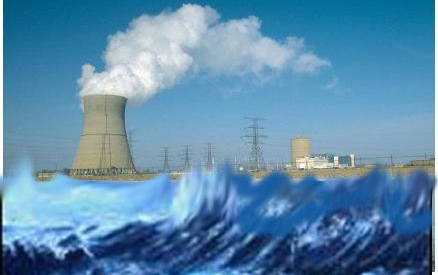 Rising tides threaten communities on the beach — and far from it, too USA Today, Matt Alderton, Green Living April 19, 2014 The mud in Folsom Lake, near Sacramento, Calif., is dry and chapped, like cracked heels. The bottom of the reservoir, once under water, now is largely barren, save for its shallow center and a smattering of stray puddles.
That’s because California is in the midst of one of the worst droughts in state history. Conditions are so bad that
Gov. Jerry Browndeclared a state emergency in January. He urged state residents to voluntarily reduce personal water consumption by 20 percent.
In the context of having so little water, it might seem strange to worry about having too much. And yet, that’s exactly the dilemma facing California today. Even as it reels from drought, it must begin planning for floods. And make no mistake: Floods are coming. Not only to California, but to coastal cities across the country and around the world, which face a certain influx of water as oceans rise under the specter of climate change.
“We analyzed 55 different water level stations throughout the United States and found that for about two-thirds of them, sea level rise from climate change has already more than doubled the risk of extreme flooding,” says Dr. Ben Strauss, director of the Program on Sea Level Rise at Climate Central, a nonprofit organization dedicated to communicating the science and effects of climate change.
Based on the analysis, Climate Central developed Surging Seas, an interactive website (sealevel.climatecentral.org) that maps the flood threats from sea level rise and storm surges. The map shows how more than 3,000 coastal communities in the contiguous United States would be affected if sea levels were to rise from 1 to 10 feet.
“Sea level rise is already happening, and its continuation is inevitable,” Strauss says. “At some point it will be obvious to every family living in a coastal area, and every community will be looking to protect itself.”
A scary proposition
Multiple forces are colluding to make the oceans swell.
One is warming oceans. “Because of that, you have an expansion of ocean waters, and the only place they can go is up,” says Rachel Cleetus, a senior economist in the Climate and Energy Program at the Union of Concerned Scientists, an alliance of citizens and scientists who collaborate on solutions to global problems.
Another is melting land-based ice forms such as glaciers and ice sheets. “You’re adding volume to the world’s oceans, and that’s causing them to rise,” Cleetus says.
Because the rate of ice loss is accelerating, oceans are rising faster than ever before. Cleetus says sea level could rise anywhere from 8 inches to 6.5 feet by the end of the century. Some scientists put estimates as high as 10 or 15 feet. That’s on top of approximately 8 inches of sea level rise already logged in the last century.
“Those 8 inches of sea level rise from climate change are already making every single coastal flood bigger, deeper and more damaging,” Strauss says.
Although scientists typically project sea level rise through the year 2100, communities likely will be impacted much sooner than that. The culprit? Incremental storm surges……….
Ultimately, then, the best solution might be the hardest to swallow: retreat.
“We need to pull back, in essence, from the shore,” says environmental and land-use planning consultant Barry Chalofsky. “If you live (in a coastal floodplain) and you’re counting on your house to be your nest egg when you retire, or you want to pass it on to your children, I would strongly think about elevating your property, then selling it over the next five to 10 years.” http://www.usatoday.com/story/life/2014/04/19/green-living-coastal-communities/7871349/
The dangerous myth of “Chernobyl wild paradise”
 Decay takes a holiday: the wickedness beneath the “Chernobyl wild paradise” myth and the rotten implications for ecosystems and radiation science http://www.beyondnuclear.org/russia-ussr/2014/4/18/decay-takes-a-holiday-the-wickedness-beneath-the-chernobyl-w.html 21 April 14
Zombie forest?
April 26, 2014 will mark 28 years since the Chernobyl nuclear reactor exploded causing an unprecedented nuclear catastrophe. In a creepy revelation, the forests around Chernobyl are having difficulty decomposing. A recently published study indicates that forest matter in the contaminated areas around Chernobyl is taking years or even decades longer to decay than it should. In the areas with low radiation, 70 to 90 percent of the leaves were gone after a year. Where radiation levels were higher, “leaves retained around 60 percent of their original weight…”(Smithsonian.com) This indicates a fundamental disruption to the natural cycle of death feeding life, and calls into question the forest’s longer-term viability. Creatures responsible for decay such as microbes, fungi and some types of insects, are essential components of any ecosystem because they recycle organic material back into the soil. Unfortunately, they do not function properly in the areas around Chernobyl, leaving a forest full of “petrified-looking pine trees that no longer seem capable of rotting.” GIZMODO
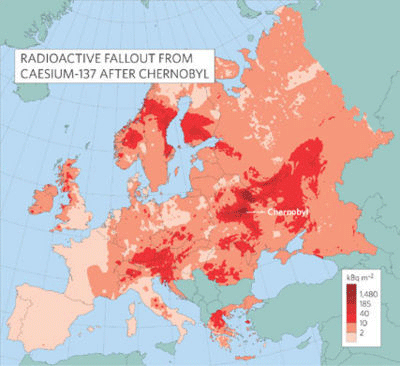
Radiation’s effect on decay processes should be expected, considering how it impacts microbes in food; or considering the results of a bizarre, cavalier and extremely ill-advised series of experiments performed using a “naked reactor” in the late 1950’s and early 1960’s. These experiments intentionally irradiated a number of varying materials and forest land 40 miles north of Atlanta, GA. Wood subjected to this radiation was produced in small-scale and called “Lockwood”, for Lockheed Aircraft Corporation who operated the Georgia Nuclear Laboratory. The building and land is still contaminated with radionuclides.
The lack of decomposer activity has researchers worried that nutrients which trees require for grow are not being recycled, causing trees in the area to grow more slowly. Improper plant decay has potential implications for animal decay as well, although there do not appear to be any Chernobyl studies investigating this yet.
Actual in-the-field examinations of regions contaminated by radioactivity from Chernobyl also reveal evidence for increased mutation rates, abnormal sperm with reduced swimming ability, developmental abnormalities, cataracts, tumors, smaller brains in both birds and mammals, and decreased tree growth rates, a finding of fundamental importance for ecosystem functioning that likely relates to effects on the microbial community. Fewer spiders and insects including bees, butterflies and grasshoppers—live there. Animals and plants show other impacts of radiation after the Three Mile Island nuclear disaster in the US and the Fukushima nuclear disaster in Japan.
Timothy Mousseau, a biologist at the University of South Carolina, Columbia, who collaborated on many of these studies, contends that, fundamentally, this evidence indicates low-dose rate exposures cause significant measurable impacts for the biota inhabiting contaminated regions of Chernobyl. Further, this evidence supports a hypothesis that suggests effects down to very low levels. Further implications for Fukushima should not be ignored.
Humans and animals alike: healthy looking on the outside, disintegrating on the inside
Referencing studies summarized in his book, Chernobyl: Consequences of the Catastrophe for People and the Environment, Alexey Yablokov states:
“Wildlife in the heavily contaminated Chernobyl zone sometimes appears to flourish, but the appearance is deceptive,” says Yablokov. “Levels of incorporated radionuclides remain dangerously high for mammals, birds, amphibians, and fish. Long-term observations of both wild and experimental animal populations in the heavily contaminated areas show significant increases in morbidity and mortality that bear a striking resemblance to changes in the health of humans – increased occurrence of tumours and immunodeficiencies, decreased life expectancy, early aging, changes in blood and the circulatory system, malformations, and other factors that compromise health.
“All of the populations of plants, fishes, amphibians and mammals studied there are in poor condition,” he continues. “This zone is analogous to a ‘black hole’, in which there is accelerated genetic degeneration of large animals – some species may only persist there via immigration from uncontaminated areas. The Chernobyl zone is a micro-evolutionary ‘boiler’, where gene pools of living creatures are actively transforming, with unpredictable consequences. We ignore these findings at our peril.”
Dr. Yablokov’s statement deftly presents the dichotomy between what is observed by a dilettante’s eye – such as lots of members in a wild animal population — versus what is actually happening to these members over time. What is happening to this wildlife has parallel implications for human health.
So where did this “paradise for wildlife” and “biodiversity sanctuary” myth come from? In 2006 the International Atomic Energy Agency, a nuclear power promoter and a member body of the United Nations, released a report entitled Environmental Consequences of the Chernobyl Accident and their Remediation: Twenty Years of Experience. This report references the creation of a nature preserve within the Chernobyl Exclusion Zone and remarks “Without a permanent residence of humans for 20 years, the ecosystems around the Chernobyl site are now flourishing. The CEZ has become a wildlife sanctuary…, and it looks like the nature park it has become.” From another report: “Indeed, the Exclusion Zone has paradoxically become a unique sanctuary for biodiversity.”
The Chernobyl Forum coalition makes this statement in support of “unique biodiversity” in spite of their recognition that “Genetic effects of radiation, in both somatic and germ cells, have been observed in plants and animals of the Exclusion Zone during the first few years after the Chernobyl accident. Both in the Exclusion Zone, and beyond, different cytogenetic anomalies attributable to radiation continue to be reported from experimental studies performed on plants and animals.” They conclude, however, “[w]hether the observed cytogenetic anomalies in somatic cells have any detrimental biological significance is not known.” In order to know this, one has to actually look.
The study summaries compiled by Alexey Yablokov, et al. (studies which had been mostly unavailable in the west until 2009) and the published examinations of researchers Mousseau, et al., indicate rather strongly that there is significant biological detriment to wildlife in the contaminated areas surrounding Chernobyl. And unlike these studies, the Chernobyl Forum documents provide very few references (under ten total) for any claims they make regarding the flourishing of wildlife.
Concern over radiation level in foodstuffs from Japan
 Concerned officials now considering ban on Japan food items — Nuclear scientists previously told gov’t to halt all imports after finding high radiation levels — Never implemented due to fear of hurting bilateral relationship http://enenews.com/concerned-officials-now-consideingr-ban-on-japan-food-items-nuclear-scientists-previously-told-govt-to-halt-all-imports-after-finding-high-radiation-levels-never-implemented-due-to-fear-of-hur?utm_source=feedburner&utm_medium=email&utm_campaign=Feed%3A+ENENews+
The Nation,Apr. 18, 2014: Pakistan may ban Japan edible items […] in case if traces of radioactive material are found on them. Federal Minister of Commerce Khurum Dastgeer Khan told the Senate on Thursday, currently the Ministry of National Food Security and Research is tasked to conduct thorough research to determine either the edible items from Japan were infected by radioactive rays or not. […] Senator Suriya Amiruddin who was interested to know whether there is any proposal under consideration of the Government to impose ban on import of edible items from Japan to avoid negative effect of radiation in those items. […] in April 2011, Pakistan Nuclear Regulatory Authority had directed authorities dealing with Cargo arriving directly or indirectly from Japan to screen all types of consignments including edible/non-edible, for radiation. […] The directives were issued from the country’s well-reputed institution Pakistan Nuclear Regulatory Authority […] The PNRA made clearance mandatory for every consignment being imported from Japan. It is worthy of mentioning here that country’s nuclear scientists had advised the federal government three years back to halt all types of goods from Japan to minimize the threat of radiation following the Fukushima Nuclear Crisis in Japan. The scientists had advised the government after they detected high level of Iodine from the consignments imported from Japan. […] in view that the move to ban imports from Japan may hurt bilateral relationship between the two friendly countries, the Pakistani government never imposed ban on import of goods from Japan.
Khurum Dastgeer Khan, Federal Minister of Commerce: “Concerned officials have been advised to investigate the matter relating to import of edible items from Japan following the incident of radioactivity in Japan. It is up to Ministry of Food Security and Research to advise Ministry of Commerce to continue import of edible items from Japan or impose ban on it.”See also: Award-winning project finds seafood sold in Canada with high radiation levels — Many samples well over contamination limit — “Incredible discovery; Something unexpected may be lurking in Canadian waters” — Believes dangerous Fukushima pollution carried across ocean — “I hope people will open their eyes”
Iran reduces capacity at Arak nuclear recator
 Arak nuclear reactor resolved says Iran http://www.skynews.com.au/world/article.aspx?id=969168 April 20, 2014 Iran and six world powers have resolved their differences over the country’s plutonium-producing Arak reactor, Iranian nuclear chief Ali Akbar Salehi says.
The reactor, which has yet to be completed, has been a main point of contention at the ongoing talks aimed at ending the stand-off over Tehran’s nuclear program.
The governments of Britain, China, France, Russia, the United States and Germany – the so-called P5+1 – have expressed concern that Iran could use the plutonium produced at the facility in the western city of Arak to build nuclear weapons.
‘We have suggested that we will produce only one-fifth of the originally planned plutonium, and this was welcomed by the P5+1,’ said Salehi.
The world powers have called for Arak’s closure or for technical changes so that it no longer turns out plutonium.
Salehi said Arak would not be shuttered because Iran needs it to produce medical isotopes for civilian use, but that reducing its plutonium production capacity alleviates negotiators’ concerns.
The heavy water reactor uses natural uranium as its fuel and will generate plutonium as a by-product.
Iran and the sextet agreed in an interim deal in November on a limited suspension of sanctions in return for some nuclear concessions from Tehran, including suspending construction of the Arak reactor and scaling back uranium enrichment.
Under the broader agreement that both sides are aiming to conclude by July, Iran is expected to accept additional nuclear curbs while the world powers have promised to permanently lift all sanctions and to help Iran build new reactors.
Tehran insists that it has no plans to build nuclear weapons.
Iran and the P5+1 will hold expert-level nuclear talks May 5-9 in New York, said Iran’s Deputy Foreign Minister Abbas Araqchi, according to Press TV.
Greater earthquake risks recognised now for New England nuclear reactors
 Quake risks at New England nuclear plants cited http://www.bostonglobe.com/metro/2014/04/18/markey-and-warren-urge-improved-earthquake-safety-measures-pilgrim-seabrook-nuclear-plants/1EgTQZCDmgeT2wRmxwDnkJ/story.html Warren, Markey urge upgrades at Pilgrim, Seabrook By Jennifer Smith GLOBE CORRESPONDENT APRIL 18, 2014 US Senators Edward J. Markey and Elizabeth Warren are calling for increased safety measures at two area nuclear power plants after a Nuclear Regulatory Commission report found potential vulnerabilities to earthquakes.
In a letter to NRC chairwoman Allison Macfarlane on Friday, Markey and Warren asked the commission to require that Pilgrim Power Station in Plymouth and Seabrook Station in Seabrook, N.H., “implement mitigation measures against seismic risks that were previously unknown.”
Markey and Warren were “alarmed” by the newly evaluated seismic risks at the two area facilities, which are greater than they were originally licensed to withstand, the senators said in the letter.
North Wales doesn’t mind nuclear power – just don’t want the wastes
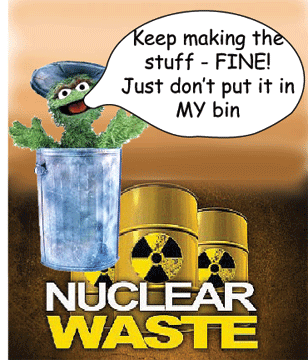 North Wales nuclear waste burial plan North Wales News
Anglesey Apr 16, 2014 By Gareth Wyn-Williams Nuclear waste from across the British Isles could potentially be shipped and stored on Anglesey as part of new plans unveiled by the Government.
But the resulting fallout from the proposals has already generated a storm of objections on the island, with one politician saying that residents should make every effort to stop it turning into a “nuclear waste depository”.
The UK Government’s Energy and Climate Change department is looking for communities to come forward and “volunteer themselves” in order to establish a new site from scratch, that would store nuclear waste from all over Britain.
And it is understood that Anglesey is one of the sites under consideration by the UK Government, with a public meeting set to take place to discuss the matter later this year.
Any communities that agree to the deal, have been promised “substantial” economical benefits.
But Anglesey’s Assembly Member, Rhun ap Iorwerth, says that residents across the island, must strongly reject any proposals to establish any such sites here.
He said: “This is quite separate from arguments for and against nuclear power generation at Wylfa newydd.
“This is about the threat of using Anglesey as a nuclear waste depository……http://www.dailypost.co.uk/news/north-wales-news/north-wales-nuclear-waste-burial-6995133
An economic hazard to United Arab Emirates – nuclear power?
Nuclear Power: Boon Or Bane For The GCC?, Gulf Business,
As the UAE and Saudi race to build nuclear reactors to meet mounting energy needs, the inevitable question arises – is nuclear a viable option?, Gulf business By Aarti Nagra 18 April 14
Fuelled by rising energy demand and depleting oil and gas resources, nuclear energy has gained strong momentum in the GCC, particularly in countries like the UAE. The country has lofty ambitions to generate up to 25 per cent of its electricity needs – or 5.6GW – through nuclear means by 2020.
Abu Dhabi began construction of its first nuclear reactor, Barakah 1, in July 2012, and it is in the process of building three more plants.
Emirates Nuclear Energy Corporation, the body responsible for the project, announced in February that the first two plants are on schedule and are up to 35 per cent complete……..However, nuclear energy may not necessarily be the best option for the GCC region, states Mohammed Atif, area manager, Energy Advisory, Middle East at DNV GL – Energy.
“A reasonable diversification of fuels is always beneficial for a region in order to reduce risks and price volatility,” he says.
“The right composition of a generation portfolio is always a difficult question and has to take political, economic, technical and environmental aspects into consideration.
“We would suggest entering into a roadmap to achieve security of supply at a good price level even without nuclear energy.”……….An Oxford report on nuclear power production in the GCC published in December 2012 also pointed out that nuclear power generation could prove an expensive option for GCC states.
“The substantial initial investment costs, coupled with the high expected level of long run variable costs, is unlikely to render nuclear power cost effective vis-à-vis conventional oil and gas fired power plants in the region,” it says.
“The existing absence of cost-recovering power tariffs throughout the GCC already renders effective cost recovery for nuclear power unlikely, implying a substantial bill in the form of nuclear power subsidies to be picked up by GCC governments.”
There are also other hidden costs, such as national and regional security concerns and the future disposal of nuclear waste.
“And the acquisition of nuclear technology by GCC states, albeit for civilian purposes, provides fuel to those critics of nuclear power in the region who fear a nuclear arms race in the Gulf should Iran pursue a nuclear weapons programme in the future.
“All these concerns make nuclear power a potentially costly option for the GCC,” the report cautions………….http://gulfbusiness.com/2014/04/nuclear-power-boon-bane-gcc/#.U1WPalVdWik
Koch brothers and fossil fuel lobbies out to kill renewable energy
 Koch Brothers, Conservatives & Oil Companies Lobby States Using Renewable Energy Sources: Alternative, Solar Power And Environmentalism Gaining Popularity Latin Post, By Shawn Raymundo (staff@latinpost.com) 20 April 14, As more and more states are beginning to utilize solar energy and adapt other clean green energy solutions
 , conservative lobby groups and oil tycoons have aggressively started pushing back against alternative energy.
The Koch brothers, anti-tax activist Grover Norquist and a number of powerful companies in the nation have started running campaign ads in Arizona, Kansas and North Carolina that paint renewable energy as a greedy bad guy, according to the Los Angeles Times.
With the help of solar power companies, environmentalists are battling back against big oil companies and their lobbyists over states that have implemented two types of energy policies: net metering and renewable energy requirements.
Net metering allows homeowners or businesses that have solar panels installed on roofs to sell back extra electricity to the power grid at attractive rates. The other policy requires utility companies to generate at least 10 percent of renewable energy, the Times reported. The majority of states in the U.S. have begun operating under at least one of the two policies if not both. The only states to not use net metering or generate power from renewable energy are Alabama, Idaho, Mississippi and Tennessee.
South Dakota and Texas are the only two states without metering programs but generate a percentage of their power from renewable energy, according to the Times………
The power industry fears that as more people install solar panels, less money is being paid to maintain transmission lines, substations and computer systems that many people rely on……
Edison Electric Institute, an advocacy group for the power industry, warned power companies that renewable energy policies could irrevocably damage the industry. The institute issued a report that stated, “it may be too late to repair the utility business model” if electric companies do not take action.
Christine Harbin Hanson, a spokeswoman for Americans for Prosperity, the advocacy group funded by billionaire industrialists Charles and David Koch, told the Times in an email that “state governments are starting to wake up” and challenge renewable energy polices.
“These green energy mandates are bad policy,” Hanson said. http://www.latinpost.com/articles/10814/20140420/koch-brothers-conservatives-oil-companies-lobby-states-using-renewable-energy-sources-alternative-solar-power-and-environmentalism-gaining-popularity.htm
1 This Month

of the week – Shut Down Drone Warfare!


Tell the Ukrainian Government to Drop Prosecution of Peace Activist Yurii Sheliazhenko

Petition to revoke the licensing of the Near Surface Nuclear Disposal Facility (NSDF) at Chalk River. https://www.ourcommons.ca/petitions/en/Petition/Details?Petition=e-7247
To see nuclear-related stories in greater depth and intensity – go to https://nuclearinformation.wordpress.com
-
Archives
- April 2026 (57)
- March 2026 (251)
- February 2026 (268)
- January 2026 (308)
- December 2025 (358)
- November 2025 (359)
- October 2025 (376)
- September 2025 (257)
- August 2025 (319)
- July 2025 (230)
- June 2025 (348)
- May 2025 (261)
-
Categories
- 1
- 1 NUCLEAR ISSUES
- business and costs
- climate change
- culture and arts
- ENERGY
- environment
- health
- history
- indigenous issues
- Legal
- marketing of nuclear
- media
- opposition to nuclear
- PERSONAL STORIES
- politics
- politics international
- Religion and ethics
- safety
- secrets,lies and civil liberties
- spinbuster
- technology
- Uranium
- wastes
- weapons and war
- Women
- 2 WORLD
- ACTION
- AFRICA
- Atrocities
- AUSTRALIA
- Christina's notes
- Christina's themes
- culture and arts
- Events
- Fuk 2022
- Fuk 2023
- Fukushima 2017
- Fukushima 2018
- fukushima 2019
- Fukushima 2020
- Fukushima 2021
- general
- global warming
- Humour (God we need it)
- Nuclear
- RARE EARTHS
- Reference
- resources – print
- Resources -audiovicual
- Weekly Newsletter
- World
- World Nuclear
- YouTube
-
RSS
Entries RSS
Comments RSS
 nuclear-news