Radiation exposure leads to one cancer, and to another one, later on
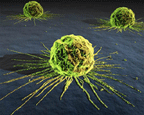 Link between radiation exposure and first and second cancers exposed by researchers http://www.naturalnews.com/044750_radiation_exposure_cancer_tumors.html, April 17, 2014 by: David Gutierre (NaturalNews) Large-scale population studies of survivors of the nuclear attacks on Hiroshima and Nagasaki have confirmed that radiation exposure can lead to multiple cancers that manifest separately over the course of years or decades — a finding with implications not just in cases of nuclear accidents or attacks but also for radiation-based cancer treatments.
The landmark study was conducted by researchers from the Fred Hutchinson Cancer Research Center, the Radiation Effects Research Foundation in Hiroshima and Nagasaki, and the National Cancer Institute, and published in the journal Cancer Research in September 2010. It found that the risk of developing a second cancer from radiation exposure was nearly identical to the risk of developing a first.
“Our findings suggest that cancer survivors with a history of radiation exposure should continue to be carefully monitored for second cancers,” said researcher Christopher I. Li, MD, PhD.
Certain organs more vulnerable
Radiation causes cancer when it damages the DNA of a cell but does not kill that cell outright. If the cell is unable to repair itself, it will continue to produce other mutated cells every time it divides. Eventually, this cluster of mutated cells may progress into clinical cancer.
Although the link between radiation and cancer is undisputed, researchers have been unsure to what degree a single radiation exposure can produce more than one cancer. To answer this question, researchers analyzed data from the Life Span Study of Hiroshima and Nagasaki survivors who had been followed from 1950 through 2002. Out of 10,031 people who survived a primary cancer, 1,088 eventually developed another form of cancer unrelated to the first (a “second primary cancer”).
“We found that radiation exposure increased the risks of first and second cancers to a similar degree,” Li said. “People exposed to radiation who developed cancer also had a high risk of developing a second cancer, and the risk was similar for both solid tumors and leukemias in both men and women, regardless of age at exposure or duration between first and second primary cancers.”
The most common first and second cancers to develop as a result of radiation were of the stomach, lungs, liver and female breast. Primary cancer survivors were also particularly prone to cancers of the colon, thyroid, bladder and blood. All these organs are known to be especially sensitive to radiation.
The study’s findings have obvious implications for the long-term care of people exposed to large amounts of radiation, whether through workplace exposure or through a nuclear accident such as at the Fukushima power plant in Japan.
“We greatly appreciate having the opportunity to conduct this unique research with our Japanese colleagues who, through innumerable publications, have truly transformed the tragedy of the atomic bombings to fundamental scientific advancements that have impacted radiation protection standards and policies worldwide,” Li said.
Implications for medicine
But the findings also have major implications for modern medicine, which is responsible for nearly half of all total radiation exposure experienced by the U.S. population, and well over half of the non-natural exposure experienced by most regular citizens.
“If irradiated at a young age, the lifetime risk is much higher than for those irradiated when older, and the risk is higher for females,” Lawrence said.
No comments yet.
1 This Month

of the week – Shut Down Drone Warfare!


Tell the Ukrainian Government to Drop Prosecution of Peace Activist Yurii Sheliazhenko

Petition to revoke the licensing of the Near Surface Nuclear Disposal Facility (NSDF) at Chalk River. https://www.ourcommons.ca/petitions/en/Petition/Details?Petition=e-7247
To see nuclear-related stories in greater depth and intensity – go to https://nuclearinformation.wordpress.com
-
Archives
- April 2026 (91)
- March 2026 (251)
- February 2026 (268)
- January 2026 (308)
- December 2025 (358)
- November 2025 (359)
- October 2025 (376)
- September 2025 (257)
- August 2025 (319)
- July 2025 (230)
- June 2025 (348)
- May 2025 (261)
-
Categories
- 1
- 1 NUCLEAR ISSUES
- business and costs
- climate change
- culture and arts
- ENERGY
- environment
- health
- history
- indigenous issues
- Legal
- marketing of nuclear
- media
- opposition to nuclear
- PERSONAL STORIES
- politics
- politics international
- Religion and ethics
- safety
- secrets,lies and civil liberties
- spinbuster
- technology
- Uranium
- wastes
- weapons and war
- Women
- 2 WORLD
- ACTION
- AFRICA
- Atrocities
- AUSTRALIA
- Christina's notes
- Christina's themes
- culture and arts
- Events
- Fuk 2022
- Fuk 2023
- Fukushima 2017
- Fukushima 2018
- fukushima 2019
- Fukushima 2020
- Fukushima 2021
- general
- global warming
- Humour (God we need it)
- Nuclear
- RARE EARTHS
- Reference
- resources – print
- Resources -audiovicual
- Weekly Newsletter
- World
- World Nuclear
- YouTube
-
RSS
Entries RSS
Comments RSS
 nuclear-news
Leave a comment