David Cameron acknowledges damage to nuclear test veterans and their offspring
- David Cameron gives nuclear test veterans glimmer of hope after our 12-year campaign for justice
 http://www.mirror.co.uk/news/uk-news/david-cameron-gives-nuclear-test-3406479
- Apr 12, 2014 Prime Minister has promised to investigate setting up a £25 million health fund for descendants of those exposed to genetic suffering genetic defects
David Cameron has at last given hope to families of nuclear test veterans after a 12-year Sunday Mirror campaign for justice.
The Prime Minister has promised to investigate setting up a £25million health fund for descendants suffering genetic defects passed down by servicemen exposed to 1950s blasts.
He will also look at offering personal thanks to the veterans and recognising their sacrifice with a medal.
Campaigners say the breakthrough at a half-hour meeting is the closest they have been to formal recognition of the suffering caused by the South Pacific explosions.
It came days after the Sunday Mirror called for the PM to recognise the plight ofchildren like 15-month-old Ella Denson, who was born with a deformity linked to her great-grandad Eric Denson’s exposure to radiation on Christmas Island in 1958.
The meeting between Mr Cameron and Tory MP John Baron last Wednesday was the first time the veterans have had their case put forward to any prime minister.
Mr Baron, patron of the British Nuclear Test Veterans’ Association, told the PM descendants had 10 times the normal rate of birth defects, their wives had elevated rates of miscarriage, and no other veterans’ group had suffered harm which spread down the generations.
A New Zealand study found veterans’ genes had three times the damage of Chernobyl survivors. The tests have never been repeated here.
Scientists say effects could last for 20 generations.
As Mr Cameron listened, Ella, of Morden, South London, was recovering from her latest hospital admission to deal with her severe defect. She was born with two tubes to a kidney instead of one and needs daily antibiotics to stop infection before having surgery at three.
At the weekend she was rushed to hospital for the third time in her short life. Her brother Jamie and mum Kimberley have teeth deformities.
Ella’s great-gran Shirley Denson, 79, had four daughters with bomb veteran husband Eric and has seen more than a third of his descendants suffer.
She said: “I pray the Prime Minister does the right thing, for the sake of my Ella and all the thousands like her.”
Eric was one of 22,000 men ordered to witness the detonation of nuclear bombs between 1952 and 1967.
He later suffered crippling headaches and killed himself in 1976. Fewer than 3,000 veterans survive.
France, the US, Australia, New Zealand, Russia, China and even the Isle of Man recognise and compensate test veterans. The MoD has always insisted no harm befell the men.
Mr Baron said: “The meeting with Mr Cameron was constructive. He is going to get back to me.”
UK urged to triple or quadruple renewable energy, after IPCC
UN urges huge increase in green energy to avert climate disaster http://www.theguardian.com/environment/2014/apr/12/un-urges-increase-green-energy-avert-climate-disaster-uk
A report by the world’s leading authorities will expose a growing gulf between a Tory party intent on halting construction of more onshore windfarms and the world’s leading scientists, who see them as one of the cheapest ways to provide energy while at the same time saving the environment.
Mitigation of Climate Change, by the UN’s Intergovernmental Panel on Climate Change (IPCC), a panel of 200 scientists, will make it clear that by far the most realistic option for the future is to triple or even quadruple the use of renewable power plants. Only through such decisive action will carbon dioxide levels in the atmosphere be kept below the critical level of 480 parts per million (ppm), before the middle of the century. If levels go beyond this figure, the chances of curtailing global mayhem are poor, they will say.
The report – the third in a series by the IPCC designed to highlight the climate crisis now facing the planet – is intended as an urgent wake-up call to nations to commit around 1-2% of GDP in order to replace power plants that burn fossil fuels, the major cause of global warming, with renewable sources.
Japan’s return to nuclear power will not be easy or soon
 Japan reverses its withdrawal from nuclear power, DW 13 April 14 The Japanese government has decided not to phase out nuclear power. But a fast turnaround in energy policy is also not possible, even if only a third of the nuclear reactors will be restarted again. Japan’s conservative government has drawn different conclusions from the Fukushima disaster than did the German government, which chose to phase out nuclear power. Its new energy plan, which Shinzo Abe’s Liberal Democratic Party (LDP) cabinet approved on Friday (11.04.2014), calls nuclear power the country’s most important power source…….
But the nuclear power plants will have to meet tighter safety requirements. The government wants to allow the operation of power plants classified as safe by the reformed Nuclear Supervisory Authority. The first two reactors could gain approval before summer.
A majority of Japanese oppose nuclear power, according to polls. But this has had no effect on any elections since the Fukushima disaster. With the new energy plan the government satisfies the wish of the economy to use nuclear power as reliable energy source.
The new policy also allows the construction of new nuclear reactors. The government will determine the necessary amount of nuclear power, the paper says. But analysts doubt that it is possible to push through the construction of new reactors. They would have to be build at places where nuclear power plants already exist due to public reluctance.
The energy market is to be liberalized by the end of the decade and that could make the construction of new reactors too expensive. And the future of the decommissioned reactors also looks bleak.
Since last summer the eight electricity suppliers asked the Nuclear Supervisory Authority for permission to restart only 17 of the 48 reactors. Another 14 reactors are heavily disputed politically. There is widespread public rejection of any attempt by operator Tepco to restart Fukushima 2. The Hamaoka nuclear complex with three reactors is located in a heavily populated area in an earthquake zone. The remaining 17 reactors won’t ever go in operation again because security retrofitting won’t pay off due their age……..http://www.dw.de/japan-reverses-its-withdrawal-from-nuclear-power/a-17563405
Fukushima: Sending People Back To The Death Zone
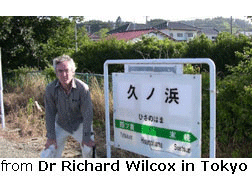 Japan’s Radioactive Potemkin Village: The Government’s Double-Dealing Data, rense.com. By Richard Wilcox, PhD, 4-12-14 “…..Sending People Back To The Death Zone
Japan has coordinated its big push to force residents back into the Death Zone with the cheerful news from the UN that there is “no increase in Fukushima cancer rates” due to radiation (20). While some residents are homesick and want to return, many are wary of returning due to radiation dangers (21).
The excellent website Simply Info summarizes the gist of a recent UN report which fallaciously claims there will be no cancers from Fukushima:
“UNSCEAR uses the fact that cancer can not be traced back to an origin to explain away any potential cancers from the Fukushima disaster. This tactic is well known among the tobacco and asbestos industries.
The source of the data used by UNSCEAR is primarily the IAEA, TEPCO and the Japanese government. Anyone who has been following events in Fukushima knows none of these sources are considered unbiased or accurate. Much dispute about the validity of the data from these entities exists. All of the data from other sources is ignored by UNSCEAR” (22).
A number of studies question the safety of both low and high radiation levels as well as the validity of the UN’s risk assessment model (23; 24; 25; 26; 27; 28).
Irrefutable proof of harm to living organisms from radiation are shown in studies that have already found innumerable forms of damage to wildlife in both Chernobyl, over a quarter a century ago, and in Fukushima today (29; 30). Birds of a feather in the nuclear age drop dead together …..”
* Richard Wilcox is a Tokyo-based teacher and writer who holds a Ph.D. in environmental studies and is a regular contributor to the world’s leading website exposing the Fukushima nuclear disaster, Rense.com. He is also a contributor to Activist Post. His radio interviews and articles are archived athttp://wilcoxrb99.wordpress.com and he can be reached by email for radio or internet podcast interviews to discuss the Fukushima crisis at wilcoxrb2013@gmail.com.
http://www.rense.com/general96/jpsradioctv.html
‘.
* Richard Wilcox is a Tokyo-based teacher and writer who holds a Ph.D. in environmental studies and is a regular contributor to the world’s leading website exposing the Fukushima nuclear disaster, Rense.com. He is also a contributor to Activist Post. His radio interviews and articles are archived at http://wilcoxrb99.wordpress.com and he can be reached by email for radio or internet podcast interviews to discuss the Fukushima crisis at wilcoxrb2013@gmail.com.
No shortage of uranium: economics will kill nuclear power before that’s any concern
Enough Uranium, but Nuclear Power Is Still Shrinking http://www.truthdig.com/report/item/enough_uranium_but_nuclear_power_is_still_shrinking_20140412 By Paul Brown, Climate News Network This piece first appeared at Climate News Network.
LONDON—There is enough uranium available on the planet to keep the world’s nuclear industry going for as long as it is needed. But it will grow steadily more expensive to extract, because the quality of the ore is getting poorer, according to new research.
Years of work in compiling information from around the world has led Gavin M. Mudd from Monash University in Clayton, Australia to believe that it is economic and political restraints that will kill off nuclear power and not any shortage of uranium, as some have claimed.
Writing in the journal Environmental Science & Technology that renewables do not have the disadvantages of nuclear power, which needs large uranium mines that are hard to rehabilitate and which generates waste that remains dangerous for more than 100,000 years.
In addition, research shows that renewable technologies are expanding very fast and could produce all the energy needs of advanced economies, phasing out both fossil fuels and nuclear.
Mudd, who is a lecturer in the department of civil engineering at Monash, has compiled decades of data on the availability and quality of uranium ore. He concludes that, while uranium is plentiful, mining the ore is very damaging to the environment and the landscape.
It is expensive to rehabilitate former mines, not least because of the dangerous levels of radiation left behind. As a result many of the potential sources of uranium will not be exploited because of opposition from people who live in the area.
‘Too cheap to meter’
His paper examines the history of uranium mining and its wild fluctuations in price. These have little to do with supply, but rather with demand that is badly affected by nuclear accidents like Chernobyl and Fukushima, and by the political decisions by governments to embark on new nuclear building programmes, or to abandon them.
“Despite the utopian promise of electricity ‘too cheap to meter’, nuclear power remains a minor source of electricity worldwide”, Mudd writes. In 2010 it accounted for 5.65% of total primary energy supply and was responsible for 12.87% of global electricity supply. Both contributions have effectively been declining through the 2000s.
“Concerns about hazards and unfavourable economics have effectively slowed or stopped the growth of nuclear energy in many Western countries since the 1980s.”
The Fukushima accident in Japan has accelerated the trend away from nuclear power. The growth in projects in some countries, notably China, Russia and India, does not offset the fact that many more nuclear power stations will reach retirement age over the next 15-20 years than will be constructed.
Among the factors Mudd considered in the fluctuation of supply was the conversion of Russian and American nuclear weapons into power station fuel supplying 50% of American needs since the mid-1990s, and 20% of global uranium supply. This has not materially affected the long-term supply of uranium.
Mining blighted
Another issue that is more politically contentious is the high cost of rehabilitating mines, notably in Germany and the US. In many of the countries where uranium has been mined and no rehabilitation attempted, the prospect of further mining is blighted. Mudd gives the examples of Niger, Gabon, Argentina and Brazil, where there has been considerable public opposition to opening up fresh deposits as a result.
If these resources and other uranium deposits elsewhere in the world are to be exploited, Mudd argues, the issue of rehabilitating existing and future mines needs to be addressed.
“There is a critical need for a thorough and comprehensive review of the success (or otherwise) of global U mine rehabilitation efforts and programmes; such a review could help synthesise best practices and highlight common problems and possible solutions,” he says.
The paper also examines in detail the quality of the ore and the difficulty of extracting uranium from various rocks. Mudd concludes that as time passes the richer ores in the rocks that are easiest to extract are becoming scarce.
As a result, for each pound of uranium extracted more greenhouse gases are generated, adding to the CO2 emissions of nuclear power. However, he believes, in the overall comparisons of various energy systems the increase is only marginal.
“The future of nuclear power clearly remains contested and contentious — and therefore difficult to forecast accurately. While some optimists remain eternally hopeful, reality appears to be relegating nuclear power to the uneconomic category of history.
“Overall, there is a strong case for the abundance of already known U resources, whether currently reported as formal mineral resources or even more speculative U sources, to meet the foreseeable future of nuclear power. The actual U supply into the market is, effectively, more an economic and political issue than a resource constraint issue,” Mudd says.
Risks of uranium tailings to Las Vegas water in floods
A flood through Moab uranium tailings could poison Las Vegas drinking water An unseasonable flood through a 17 million ton uraniam tailing pile 500 miles upstream in Moab, Utah could spell the end of Las Vegas valley’s drinking water supply. Isn’t it about time mainstream science started paying attention to radiation remediation methods? by Sterling D. Allan Pure Energy Systems News , 13 April 14
Fukushima saw a situation in which the engineers who built the facility did not properly anticipate the magnitude of storm that ended up hitting the facility on March 11, 2011. Their having put the emergency pumps in the basement further shows their total denial about what mother nature could do.
Such a catastrophe actually hangs over Las Vegas as well, and the extend of mother nature’s unleashing wouldn’t be that high above normal. Ninety percent of Vegas valley’s drinking water comes from the Lake Mead reservoir, which is in the Colorado River drainage (source) — about 500 miles downstream from a 17 million ton uranium tailing pile in Moab, Utah. There is no containment berm protecting the pile from an unseasonably flooding Colorado River. Below is an email I received today from my New Energy Congress associate, Gary Vesperman, who lives in Boulder City, Nevada, neighboring Lake Mead. I share this for two reasons. One, to hopefully prevent such a thing from unfolding by spurring remedial measures; and second, to get you scientists among us thinking more about how we can remediate radiation in general.
It’s an email Gary wrote to John Hutchison, who has working on nuclear remediation for several years, and is coming up with some promising results……..http://pesn.com/2014/04/13/9602470_Flood-through-Moab-Uranium-tailings_could-poison-Vegas-drinking-water/
UK defence chiefs angry over Scotland’s ‘no nuclear’ policy
Defence chiefs go on attack over Nats’ ‘no nuclear’ policyALEX Salmond’s plan to scrap Trident after Scottish independence would put the UK’s nuclear deterrent in jeopardy, senior defence figures have warned. http://www.express.co.uk/news/uk/470464/Defence-chiefs-go-on-attack-over-Nats-no-nuclear-policy
Japan Government malfeasance regarding the nuclear crisis is criminal
Japan’s Radioactive Potemkin Village: The Government’s Double-Dealing Data, rense.com. By Richard Wilcox, PhD, 4-12-14 “……..Plume Of Doom
Government malfeasance regarding the nuclear crisis is beyond the pale, criminal, diabolically evil, in fact. Was it stupidity, bureaucratic intransigence or an intentional plan to genocide the population that kept the government from protecting people at the time of the accident?
As scholar Kyle Cleveland notes in an important research paper which covers “Radiation Plume Politics and the SPEEDI disaster”:
“Despite having elaborate evacuation plans that previously had been coordinated with TEPCO, Baba Tomatsu, the mayor of Namie, initially learned of the nuclear disaster by watching it on TV and was bitterly resentful of the lack of consideration that put his village at risk: There was no coordination with the Japanese Government. Nothing. Baba Tomatsu: ‘They didn’t tell us where to evacuate. Nothing. Namie machi did everything by ourselves. And, disappointingly, because we didn’t hear anything from the government no advisories we used anything that we had—school buses and such—to move people out of the area. People’s cars were destroyed by the tsunami so we placed those people in those buses. At that time, the people who had ways to evacuate had already evacuated, to Miyagi, or Yamagata prefecture. So the 21,000 population were all scattered like a bee’s hive. Because we had no information we were unwittingly evacuating to an area where the radiation level was high so I’m very worried about the people’s health. I feel pain in my heart but also rage over the poor actions of the government… It’s not nice language but I still think it was an act of murder. What were they thinking when it came to the people’s dignity and lives? I doubt that they even thought about our existence’ ” (.
Many people have fled Fukushima specifically to protect their children’s health . Of course, Fukushima prefecture was not the only place to be doused with radiation. One researcher found that highly radioactive hot particles emitted from the accident landed 300 miles from the FNPP#1 and that people not only in Japan, but even in North America were breathing these particles into their lungs for a month after the accident …….”
* Richard Wilcox is a Tokyo-based teacher and writer who holds a Ph.D. in environmental studies and is a regular contributor to the world’s leading website exposing the Fukushima nuclear disaster, Rense.com. He is also a contributor to Activist Post. His radio interviews and articles are archived at http://wilcoxrb99.wordpress.com and he can be reached by email for radio or internet podcast interviews to discuss the Fukushima crisis at wilcoxrb2013@gmail.com. http://www.rense.com/general96/jpsradioctv.html
Israel’s 300 nuclear warhead arsenal
 Israel possesses at least 300 nuclear warheads: Carter, Tehran Times,13 April 14, Former U.S. President Jimmy Carter says that Israel has at least 300 nuclear warheads which is far more dangerous than estimates that are being hypothetically made about Iran’s potential access to nuclear weapons.
Non nuclear States represented in Hiroshima, aim to eliminate nuclear weapons
Foreign ministers at nuclear summit urge world leaders to learn lessons from Japan atomic bombings Australia Network news, 13 Apr 2014,
Foreign ministers from a coalition of non-nuclear weapons states have urged world leaders to visit the Japanese cities of Hiroshima and Nagasaki to learn about the “catastrophic” effects of atomic bombing.
Australian Foreign Minister Julie Bishop represented Australia at a 12-nation summit in Hiroshima to discuss global efforts to eliminate nuclear weapons…..http://www.abc.net.au/news/2014-04-13/an-ministers-attend-nuclear-disarmament-talks-in-hiroshima/5386940
How many people would die instantly if an H-bomb hit a city?
1-megaton H-bomb would kill 370,000 instantly: Japanese research http://www.globalpost.com/dispatch/news/kyodo-news-international/140412/1-megaton-h-bomb-would-kill-370000-instantly-japanese- An estimated 370,000 people would die instantly if a one-megaton hydrogen bomb were dropped on a city with one million residents, according to a report compiled by a Japanese research group.
The report was distributed Saturday at a meeting in Hiroshima of foreign ministers from 12 non-nuclear weapons states belonging to the Non-Proliferation and Disarmament Initiative.
The NPDI consists of Australia, Canada, Chile, Germany, Japan, Mexico, the Netherlands, Nigeria, the Philippines, Poland, Turkey and the United Arab Emirates.
A one-megaton hydrogen bomb is about 50 times as powerful as the atomic bomb dropped on Nagasaki on Aug. 9, 1945.
Some 66,000 people would be killed instantly in a city with one million residents if hit by a 16-kiloton atomic bomb, the same scale as the bomb dropped on Hiroshima on Aug. 6, 1945, the report said.
The group of researchers, including Masao Tomonaga, president of the Japanese Red Cross Nagasaki Genbaku Hospital, compiled the report aimed at looking into the inhuman nature of nuclear weapons, at the request of the Japanese Foreign Ministry.
As the blast from a one-megaton hydrogen bomb radiates for 18 kilometers, another 460,000 people would be injured in addition to the 370,000 killed, and 36,000 people within 3 kilometers of the center of the explosion would be affected by radiation, the report said.
“We found such a bomb would inflict heavy damage on even a modern-day city,” Tomonaga said. “The Foreign Ministry will be using our report as a scientific basis to show the inhuman nature” of nuclear weapons.
Chiho Takahashi: a volunteer reflects on the Fukushima nuclear tragedy
Japan’s Radioactive Potemkin Village: The Government’s Double-Dealing Data, rense.com. By Richard Wilcox, PhD, 4-12-14 A Volunteer Speaks
“………My colleague, Chiho Takahashi, a student at Tsuda College, recently wrote of her experiences as a volunteer to support the folks at the Adachi temporary housing facility:
“In November of 2012, I went to the Adachi temporary housing in Nihonmatsu for the first time. Almost all of the children that participated in our event were shorter than me, my height is 148 cm. But as I visited periodically during the next year and a half I noticed the children growing in height. In that way I could measure the passage of time and see that the victims’ lives were not “temporary” at all but taking place over a long period.
Children who were first grade students of elementary school became third grade students. Children who were first grade students of junior high school became high schoolers. I asked myself, ‘do you think that it is a temporary life?’ I could not think so.
In February of 2013 I had an experience where an elderly man let me into his house at the Adachi temporary housing. He lives in the house all alone. I went up his steps into his small quarters. There are four rooms in the house: kitchen, living room, bed room and bath. He showed me into the living room where there was akotatsu (Japanese foot warmer) and suggested that I warm myself in the kotatsu because it was very cold that day. We talked for about 30 minutes in afternoon and he told me about his children and grandchildren but he rarely sees them because they live in Tokyo and Miyagi prefectures. He was proud that he had done forestry and farming work using his big truck before he was forced to move to Nihonmatsu from Namie town because of the 3.11. disaster. Since then, he has lost everything and has nothing to do every day but drink in broad daylight. There were some bottles of rice wine and potato liquor on the table in the living room.
When I was heard his sad story I could only say to him that ‘that’s too bad.’ Although I felt I was not useful to him I tell people this story to people in Tokyo so they will know what a hard life it is in the temporary housing of Nihonmatsu.
I want many people to know the experience which I saw and heard and felt in Tohoku. I can’t carry out expensive projects like government, but I have always felt that I should try to do important things with my precious friends even if they might seem ‘small.’ In this way, maybe I can inspire more people from Tokyo to assist the refugees of the Tohoku and Fukushima disasters, even if it is just one person at a time. Our small volunteer made the singular effort to go to Nihonmatsu to assist the temporary housing residents, so too if each person made a small but sincere effort it might create a larger effect.”
* Richard Wilcox is a Tokyo-based teacher and writer who holds a Ph.D. in environmental studies and is a regular contributor to the world’s leading website exposing the Fukushima nuclear disaster, Rense.com. He is also a contributor to Activist Post. His radio interviews and articles are archived athttp://wilcoxrb99.wordpress.com and he can be reached by email for radio or internet podcast interviews to discuss the Fukushima crisisat wilcoxrb2013@gmail.com. http://www.rense.com/general96/jpsradioctv.html
Dwindling group of Hiroshima survivors bear witness to the nuclear horror
Hiroshima survivors offer peace and hope for nuclear disarmament April 13, 2014 SMH, Daniel Flitton The two young brothers looked into the bright blue sky and waved happily at the shiny plane flying far above.
Their sister, Emiko Okada, eight years old at the time, remembers an intense flash of light and her mother suddenly rushing into the yard to the children, bleeding from where shards of glass had lodged in her head.
Next came the fire – and people running, hair standing on end, white bones exposed, skin and flesh burning. People were vomiting, not just blood but black ooze from their nose and mouth.
Mito Kosei, in his mother’s womb at the time of the atomic attack, guides tourists around the memorial peace park in Hiroshima.
This was the day the A-bomb fell on Hiroshima.
Ms Okada is one of a dwindling group of survivors from that morning in 1945, determined never to let the terrible human cost of nuclear war be forgotten, even after they are gone.
”Frightening is not the world I can use, it was something much worse,” she said via a translator, still upset by the memory.
Emiko Okada who as an eight-year-old survived the atomic attack on Hiroshima.
Stories from the survivors, known in Japan as hibakusha, were told to foreign ministers of a 12-nation group, including Australia, gathered in Hiroshima at the weekend to kickstart global talks on nuclear disarmament.
Survivors’ stories are being preserved in an online archive by the Tokyo Metropolitan University………http://www.smh.com.au/world/hiroshima-survivors-offer-peace-and-hope-for-nuclear-disarmament-20140412-36k3t.html
1 This Month

of the week – Shut Down Drone Warfare!


Tell the Ukrainian Government to Drop Prosecution of Peace Activist Yurii Sheliazhenko

Petition to revoke the licensing of the Near Surface Nuclear Disposal Facility (NSDF) at Chalk River. https://www.ourcommons.ca/petitions/en/Petition/Details?Petition=e-7247
To see nuclear-related stories in greater depth and intensity – go to https://nuclearinformation.wordpress.com
-
Archives
- April 2026 (68)
- March 2026 (251)
- February 2026 (268)
- January 2026 (308)
- December 2025 (358)
- November 2025 (359)
- October 2025 (376)
- September 2025 (257)
- August 2025 (319)
- July 2025 (230)
- June 2025 (348)
- May 2025 (261)
-
Categories
- 1
- 1 NUCLEAR ISSUES
- business and costs
- climate change
- culture and arts
- ENERGY
- environment
- health
- history
- indigenous issues
- Legal
- marketing of nuclear
- media
- opposition to nuclear
- PERSONAL STORIES
- politics
- politics international
- Religion and ethics
- safety
- secrets,lies and civil liberties
- spinbuster
- technology
- Uranium
- wastes
- weapons and war
- Women
- 2 WORLD
- ACTION
- AFRICA
- Atrocities
- AUSTRALIA
- Christina's notes
- Christina's themes
- culture and arts
- Events
- Fuk 2022
- Fuk 2023
- Fukushima 2017
- Fukushima 2018
- fukushima 2019
- Fukushima 2020
- Fukushima 2021
- general
- global warming
- Humour (God we need it)
- Nuclear
- RARE EARTHS
- Reference
- resources – print
- Resources -audiovicual
- Weekly Newsletter
- World
- World Nuclear
- YouTube
-
RSS
Entries RSS
Comments RSS
 nuclear-news