Japan’s nuclear energy policy dangerously adrift
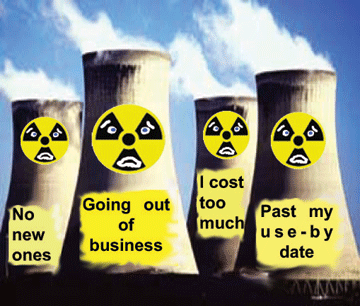 In the Wake of Fukushima: Japan’s Nuclear Energy Policy Impasse 60% of Japan’s 48 viable nuclear reactors,are not as yet being considered for application to the Nuclear Regulation Agency (NRA) for restart By Andrew Dewit Global Research, April 07, 2014
Asia-Pacific Journal Japan’s energy policy regime appears dangerously adrift in the context of accelerating climate change. The core problem is agency. On the one hand, 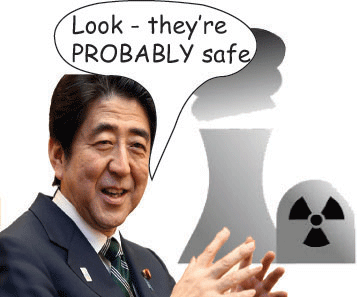 Japanese PM Abe Shinzo and the nuclear village appear obsessed with nuclear power restarts and 20th century paradigms of the power economy. On the other hand, Japan’s anti-nuclear civil society lacks the political vehicle to force a combined nuclear pullout plus drastic reduction of greenhouse gas emissions. Some anti-nuclear forces do not yet understand the urgent need to reduce emissions, and are content to burn coal, despite of the patent threat of climate change. This is precisely what Japan has done in the wake of 3.11. The Abe cabinet is focused on getting restarts and a nuclear-based energy plan. Yet the scope for restarts is surprisingly limited and – incredible in this era of multiple crises and revolutions – the draft new energy plan lacks concrete numbers.1 The country needs better leadership on smart growth, in the context of what McKinsey specialists refer to as a “resource revolution”2 and MIT economists depict as “the second machine age.”3
Nuclear Is Probably No Longer Baseload
All of Japan’s 48 viable nuclear reactors are at present offline, and have been since September of 2013. The Abe cabinet is keen to restart as many of these as possible. But regulatory rules, public opinion and other factors constitute significant barriers to achieving even a third of Japan’s pre-Fukushima 30% reliance on nuclear power. That will mean nuclear will no longer be a “baseload” source of electricity, capable of supplying a reliable load to the grid at all times.
Indeed, an Asahi Shimbun survey of the utilities themselves indicates that fully 60% of Japan’s 48 viable nuclear reactors, meaning 30 reactors, are not as yet being considered for application to the Nuclear Regulation Agency (NRA) for restart. And of these 30 reactors, it appears that at least 13 are write-offs due to age, proximity to a seismic fault, and other factors that render them incapable of satisfying the new safety standards of the NRA.4 For that reason, at present there are only 17 reactors for which restart applications have been filed.
Of these, it appears – even to Japanese supporters of nuclear power – that perhaps only 8 will finally get approval and be restarted. Highly regarded energy specialist Tom O’Sullivan, of Mathyos Japan, concludes this on the basis of a survey of “various established Japanese policy institutes that are close to Japan’s industrial interests.” O’Sullivan notes that “[t]his level of restarts would only amount to 56 TWh of power output or 6% of Japan’s total power requirements and thus may not constitute a baseload power supply.”5
Reuters conducted its own analysis, using a broader set of questionnaires and interviews of over a dozen experts, along with input from the 10 firms that operate nuclear capacity. One suspects these operators painted as optimistic a picture of their restart prospects as possible. Even so, the result of this survey led Reuters’ expert journalists, Mari Saito, Aaron Sheldrick and Kentaro Hamada, to conclude that at best there will be 14 nuclear restarts at some point in time. They add that there is great uncertainty about the remaining 34 nuclear reactors. Their conclusion is that nuclear energy “will eventually make up less than 10 percent of Japan’s power supply.”6
Part of the reason nuclear appears not likely to recover its status as base-load power are the NRA’s new safety rules, in tandem with maintenance schedules and other factors that make a very shrunken fleet unreliable. But another large reason for this likely outcome is the stubbornness of the opposition to nuclear power………. http://www.globalresearch.ca/in-the-wake-of-fukushima-japans-energy-policy-impasse/5376899?utm_source=rss&utm_medium=rss&utm_campaign=in-the-wake-of-fukushima-japans-energy-policy-impasse
No comments yet.
1 This Month


10 March A LIVE WEBINAR THE REAL EFFECTS OF NUCLEAR POWER
What the Industry Isn’t Telling Us
1:00 PM Mountain, 2 pm Central, 3 pm Eastern. Live on the Keepers of the Water Facebook page


18 March Webinar @ 1 PM EST: An Assessment of SMR Projects: The Case of Canada
register for the zoom:
https://us02web.zoom.us/webinar/register/WN_o8BIIOUvQ2ONJR1nta65DQ#/registration


of the week – STOP SMALL MODULAR REACTORS IN CANADA
To see nuclear-related stories in greater depth and intensity – go to https://nuclearinformation.wordpress.com
-
Archives
- March 2026 (76)
- February 2026 (268)
- January 2026 (308)
- December 2025 (358)
- November 2025 (359)
- October 2025 (376)
- September 2025 (258)
- August 2025 (319)
- July 2025 (230)
- June 2025 (348)
- May 2025 (261)
- April 2025 (305)
-
Categories
- 1
- 1 NUCLEAR ISSUES
- business and costs
- climate change
- culture and arts
- ENERGY
- environment
- health
- history
- indigenous issues
- Legal
- marketing of nuclear
- media
- opposition to nuclear
- PERSONAL STORIES
- politics
- politics international
- Religion and ethics
- safety
- secrets,lies and civil liberties
- spinbuster
- technology
- Uranium
- wastes
- weapons and war
- Women
- 2 WORLD
- ACTION
- AFRICA
- Atrocities
- AUSTRALIA
- Christina's notes
- Christina's themes
- culture and arts
- Events
- Fuk 2022
- Fuk 2023
- Fukushima 2017
- Fukushima 2018
- fukushima 2019
- Fukushima 2020
- Fukushima 2021
- general
- global warming
- Humour (God we need it)
- Nuclear
- RARE EARTHS
- Reference
- resources – print
- Resources -audiovicual
- Weekly Newsletter
- World
- World Nuclear
- YouTube
-
RSS
Entries RSS
Comments RSS
 nuclear-news
Leave a comment