New IPCC climate report coming up
 Explainer: how are IPCC reports written? , The Conversation, 29 March 14 David Karoly, Professor of Atmospheric Science at University of Melbourne #………This week, the IPCC has been meeting to approve the second part of its Fifth Assessment Report – the volume that covers “Impacts, Adaptation and Vulnerability”. This assesses the impacts of climate change and vulnerabilities to these impacts, as well as options for how we can adapt to minimize the impacts.
It considers a wider range of sectors than previous reports, as well as more regions of the globe. This means that this Impacts Assessment has twice as many chapters and is nearly twice as long as the previous IPCC Working Group 2 report in 2007.
The different sectors include water resources, terrestrial, coastal and ocean systems, food production, urban and rural areas, human health and human security, as well as approaches to adaptation and multi-sector risks and vulnerabilities. The regions include each of the continents, plus the poles, small islands, and the oceans.
The IPCC has worked hard to include a broader and more representative group as authors. Working Group 2’s writing team consists of 310 scientists from 73 countries, divided into Coordinating Lead Authors, Lead Authors and Review Editors. Most have not previously been involved in any of these roles in the past decade. Some 40% of the writing team come from developing countries and economies in transition.
When the report comes out on Monday, make sure to read its Summary for Policymakers (as well as The Conversation’s IPCC coverage).http://theconversation.com/explainer-how-are-ipcc-reports-written-24641
Seven months ahead of schedule, Bavarian nuclear reactor is shut down
EON notified the Bundesnetzagentur regulator and grid operator TenneT TSO GmbH of its plan to close the 1,275-megawatt Grafenrheinfeld plant at the end of May 2015 “because of its lack of profitability,” the Dusseldorf-based utility said in a statement.
“The continued operation of nuclear power stations in Germany only makes economic sense if they can operate for a sufficient length of time without the burden of the nuclear-fuel tax,” EON said in the statement. The early shutting of Grafenrheinfeld is “unavoidable.”
North Korea’s hostile response to South Korea
N Korea Assaults South Leader Over Nuclear Remarks Liberty Voice, by Fern  Remedi-Brown on March 29, 2014. South Korea President Park Geun-hye has been on a mission to reunify with North Korea. On March 24 the South Korean leader met at The Hague with U.S. President Barack Obama and Japanese Prime Minister Shinzo Abe. In the meeting, the leaders of the three countries pledged to cooperate vis à vis N Korea’s nuclear and missile programs. In The Hague, Ms. Park gave a speech, warning that the North’s nuclear devices could land in the hands of radical extremists. In response to her remarks, the North’s leader, Kim Jong-un, verbally assaulted her, likening her to a “peasant woman” who was “blabbering.” He also said she was a pawn in the hands of the U.S. and that she must learn to cease such reckless babble………http://guardianlv.com/2014/03/n-korea-assaults-south-leader-over-nuclear-remarks/
South Korea offers aid to North Korea
 South Korea proposes aid for North if it halts nuclear arms programme First Post, Mar 29, 2014 SEOUL (Reuters) – South Korean President Park Geun-hye proposed a broad range of economic aid for impoverished North Korea on Friday if it agrees to give up its nuclear programme. It was not immediately clear how the North would respond to the proposal, made in a speech in Dresden, Germany, but it has repeatedly rejected the idea of abandoning its nuclear programme, which it says is a necessary deterrent against U.S. hostility.
…………. http://www.firstpost.com/world/south-korea-proposes-aid-for-north-if-it-halts-nuclear-arms-programme-1455913.html?utm_source=ref_article
Be cautious with devices that give off electromagnetic radiation
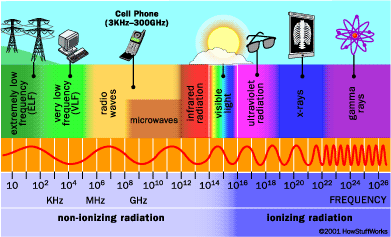
Waves of uncertainty over wi-fi Stuff.co.nz 29 March 14“……..CUT BACK ON YOUR EXPOSURE
MOBILES AND DEVICES
Before buying a cellphone or internet-capable device, check out its SAR (specific absorption rate) rating – though in New Zealand you’ll likely have to go online for this information. The SAR measures how much the device’s emissions are absorbed by the body. Lower ratings indicate lower absorption.
Ensure your mobile has flight mode and use this as often as you can, including overnight, and when carrying it close to your body.
For long computing tasks, select a wired desktop or plugged-in laptop, rather than a wireless tablet.
Avoid holding a laptop or device on your lap or stomach – use a table instead, unless it’s in flight mode.
When you can, choose a text over a call. Keep phone calls to a minimum or use a hands-free kit.
Keep calls to a minimum where reception is bad – when a mobile is far from a cell tower, it has to boost its signal to connect.
Choose a wired mouse and keyboard.
CORDLESS PHONES
If possible, choose corded devices, or purchase one with speaker-phone capabilities.
Keep the main transmitting base of the cordless phone away from bedrooms and desks.
Keep calls short.
WI-FI
When installing a transmitting unit, ask for it to be put up high, such as on the wall or a shelf, away from bedrooms or where people sit.
Only turn the system on when you’re using it. Make sure the router is turned off overnight, especially.
Choose software on a laptop rather than cloud-computing technology such as Google Docs, if you’re using wi-fi. Typing in a Google Docs word processing means a wi-fi signal is sent with every single keystroke.http://www.stuff.co.nz/dominion-post/news/9882716/Waves-of-uncertainty-over-wi-fi
Uranium mining – environmental racism
Uranium Mining http://www.berkeleydailyplanet.com/issue/2014-03-28/article/41964?headline=Uranium-Mining—-By-Tejinder-Uberoi March 28, 2014 In a stark example of environmental racism, Native Indians have become the target of toxic uranium mining. Energy Fuels Resources recently obtained federal approval to reopen a mine in close proximity to the Grand Canyon’s popular South Rim entrance.
 Environmental activists have joined forces with Native Navajos to protest the decision siting serious health risks. Earlier uranium mining has scarred the landscape and left deposits of radioactive waste from 1,000 closed mines. The mining companies failed to adequately remove the radioactive wastes which have resulted in a dramatic increase in cancer and other serious ailments.
One native Indian activist, Klee Benally, remarked that “this is really a slow genocide of the people, not just indigenous people of this region, but it’s estimated that there are over 10 million people who are residing within 50 miles of abandoned uranium mines.” The long term impact of contaminated water seepage into groundwater and its impact on wildlife have been ignored. The five-year cleanup plan initiated by the EPA has also been ignored.
San Francisco Peaks, an area considered sacred by 13 Native tribes, has been severely impacted; to compound health concerns is the practice of using treated sewage water to make snow at the popular Snow bowl resort. The future of indigenous tribes has been railroaded over the interests of corporate greed and government watchdogs have fallen asleep at the wheel.
Renewabl eenergy companies to be offered loan by USA govt
U.S. Energy Dept to offer loan aid to renewable energy companies By Ayesha Rascoe WASHINGTON, March 28 (Reuters) – The U.S. Energy Department will soon issue a plan to offer loan aid for renewable energy projects, Energy Secretary Ernest Moniz said on Friday, doubling down on investments that have drawn intense criticism over past government-backed business flops.
A department loan program funded by the 2009 economic stimulus law that backed solar, wind and geothermal projects was widely attacked by Republicans after the high-profile failure of solar panel manufacturer Solyndra.
Despite the bankruptcy of Solyndra and other recipients of department funds, the Obama administration has stressed that most of its energy investments have been successful, refusing to bow to calls to scrap its remaining loan programs…….
Moniz pointed to the success of utility-scale solar power plants backed by the department through the stimulus package as an example of what the administration hopes to continue to accomplish……. Solar power plants are now being built in the United States by private companies without federal loan aid.
“We want to fund some of the first movers that push the technology out there and then have the private sector expand it,” Moniz said……. http://af.reuters.com/article/energyOilNews/idAFL1N0MP22420140328?pageNumber=2&virtualBrandChannel=0
“A Plea for a Total Ban on Nuclear Energy by Professor Mitsuhei Murata
Mitsuhei Murata, Former Japanese Ambassador to Switzerland, addresses attendees at Coalition Against Nuke’s Sep. 20th Congressional Briefing, hosted by the Congressional Office of Congressman Kucinich (D-OH). Entire Transcript of Speech avail. at this link-
https://docs.google.com/open?id=0B-X7..
Powerful criticisms of Japan’s handling of the Fukushima nuclear crisis
 (NaturalNews), March 27, 2014 by: Ethan A. Huff, staff writerThe three-year anniversary of the Fukushima Daiichi nuclear disaster recently passed, and a prominent nuclear expert has come out in protest of the way both the Japanese government and the country’s nuclear industry continue to handle the situation. During a recent episode of the Nuclear
  Hotseat podcast, celebrity and lawmaker Taro Yamamoto lamented how the Tokyo Electric Power Company (TEPCO) is still downplaying the threat of radiation, which he believes will end up “sacrificing” 99.99 percent of the Japanese population. In Japan, stated Yamamoto, it is still taboo to even talk about radiation, even though its effects have been felt throughout the country and even beyond its borders. Insinuating that the country as a whole has essentially buried its head in the sand on this important issue, Yamamoto called out the nuclear industry in particular for minimizing the radioactive impact of Fukushima, which many now believe to be the worst nuclear accident in recorded history.
“Idiotic ideas — like restarting the nuclear plants — are being considered here in Japan,” stated Yamamoto during the interview. “I think it is wrong that people’s lives are being sacrificed because of money and the company profits… 99.99 percent of the people are being sacrificed.”
You can listen to this podcast episode here:
http://www.nuclearhotseat.com.
“[R]adioactive water is still leaking, there is still a very long way to go until it can be decommissioned, and we must be prepared for a long term battle which will go beyond the present generation,” wrote Fukushima resident Arao Shunsuke in a letter posted at DiaNuke.org. “Even now over 100,000 people from Fukushima are still living in miserable conditions in temporary housing.”
You can read Shunsuke’s full letter here:
http://www.dianuke.org………… http://www.naturalnews.com/044478_Japan_nuclear_industry_radiation.html#
Why did Canadian government stop testing seafoods for radioactive contamination?
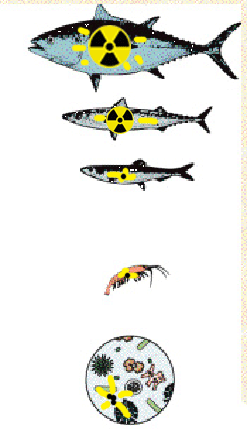
 School Science Project Reveals High Levels Of Fukushima Nuclear Radiation in Grocery Store Seafood Investment Watch By Michael Snyder March 27th, 2014 A Canadian high school student named Bronwyn Delacruz never imagined that her school science project would make headlines all over the world. But that is precisely what has happened. Using a $600 Geiger counter purchased by her father, Delacruz measured seafood bought at local grocery stores for radioactive contamination. What she discovered was absolutely stunning. Much of the seafood, particularly the products that were made in China, tested very high for radiation. So is this being caused by nuclear radiation from Fukushima? Is the seafood that we are eating going to give us cancer and other diseases? The American people deserve the truth, but as you will see below, the U.S. and Canadian governments are not even testing imported seafood for radiation. To say that this is deeply troubling would be a massive understatement.
In fact, what prompted Bronwyn Delacruz to conduct her science project was the fact that the Canadian government stopped testing imported seafood for radiation in 2012…
Alberta high-school student Bronwyn Delacruz loves sushi, but became concerned last summer after learning how little food inspection actually takes place on some of its key ingredients.
The Grade 10 student from Grande Prairie said she was shocked to discover that, in the wake of the 2011 Fukushima nuclear disaster in Japan, the Canadian Food Inspection Agency (CFIA)stopped testing imported foods for radiation in 2012.
And what should be a major red flag for authorities is the fact that the seafood with the highest radiation is coming from China… Armed with a $600 Geiger counter bought by her dad, Delacruz studied a variety of seafoods – particularly seaweeds – as part of an award-winning science project that she will take to a national fair next month.
“Some of the kelp that I found was higher than what the International Atomic Energy Agency sets as radioactive contamination, which is 1,450 counts over a 10-minute period,” she said. “Some of my samples came up as 1,700 or 1,800.”
Delacruz said the samples that “lit up” the most were products from China that she bought in local grocery stores.
It is inexcusable that the Canadian government is not testing this seafood. It isn’t as if they don’t know that it is radioactive. Back in 2012, the Vancouver Sun reported that cesium-137 was being found in a very high percentage of the fish that Japan was selling to Canada…
• 73 percent of the mackerel
• 91 percent of the halibut
• 92 percent of the sardines
• 93 percent of the tuna and eel
• 94 percent of the cod and anchovies
• 100 percent of the carp, seaweed, shark and monkfish
So why was radiation testing for seafood shut down in Canada in 2012?
Someone out there needs to answer some very hard questions……..http://investmentwatchblog.com/school-science-project-reveals-high-levels-of-fukushima-nuclear-radiation-in-grocery-store-seafood/
Rushed to hospital – more Hanford nuclear workers get sick
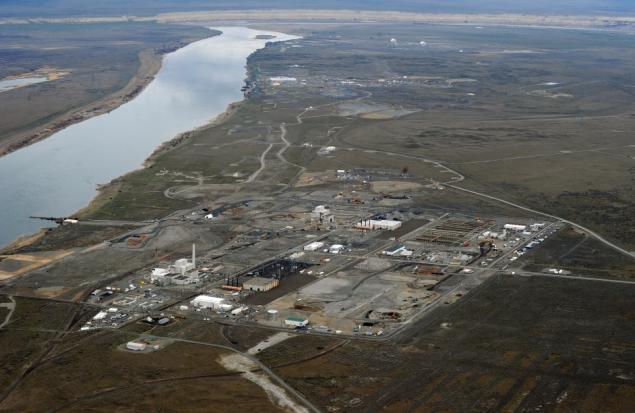 TV: More workers rushed to hospital at U.S. nuclear site — 17 sickened in past week — Former Employee: “It’s pretty scary… to have this many in 8 days is really abnormal” — Company: We’re trying to understand what’s happening (VIDEO) http://enenews.com/tv-more-workers-rushed-to-hospital-at-u-s-nuclear-site-now-17-workers-sickened-in-past-week-former-employee-its-pretty-scary-to-have-this-many-in-8-days-is-really-abnormal-c?utm_source=feedburner&utm_medium=email&utm_campaign=Feed%3A+ENENews+%28Energy+News%29
KING 5 News Seattle, Mar. 26, 2014: Hanford workers sickened by unknown vapors rises to 17— The KING 5 Investigators have found that six Hanford workers were sickened Wednesday from ingesting chemical vapors at the nuclear facility. […] This brings the total to 17 Hanford employees who have needed medical care since last Wednesday due to the inhalation of toxic vapors. […] “Data collection and analysis is underway in the affected (tank) farms to understand what happened and what might be done to reduce the likelihood of future occurrences,” said [Jerry Holloway, External Affairs Manager at U.S. Dept. of Energy’s contractor Washington River Protection Solutions]. […] The incident Wednesday occurred in yet another location at the Hanford site […] Sources tell the reporter 17 people were working on the video inspection when three were suddenly sickened by the release of vapors.
Mike Geffre, retired WRPS employee who spent 26 years at Hanford: “It’s pretty scary. It doesn’t usually happen like this. Usually you see four or five a year. But to have this many in eight days is really abnormal […] Whenever you hear of someone getting tank vapors, you never know what the long term affects are. The affects of exposures like this can show up as health problems years down the road.”
KING 5 News transcript The King 5 investigators learned that workers at the Hanford Nuclear Reservation have been rushed to the hospital. […] I was in Richland doing an interview on this very topic […] during that interview we got word from sources that right at that time that 3 more employees were either going to the hospital here or taken to the onsite medical facility at Hanford because of another such incident […] In those three separate incidents the workers were all at different locations at Hanford, so this isn’t just one problem area where they’re seeing a repeat problem. […] Obviously, workers are concerned, feel there’s a problem here, and they want their employer and the Department of Energy to do something about it.
Defence Committee foresees non nuclear defence system
 CND welcomes Defence Committee’s vision of a post-nuclear future http://www.cnduk.org/cnd-media/item/1886-cnd-welcomes-defence-
 committee%E2%80%99s-vision-of-a-post-nuclear-future 27 March 2014
The Campaign for Nuclear Disarmament (CND) has welcomed a report by the House of Commons Defence Committee which highlights the decreasing salience of nuclear weapons in UK defence policy.
The report, Deterrence in the twenty-first century, states:
‘It is possible to foresee an environment in which the core role of nuclear deterrence – to protect a state from attack – is achieved by the deployment of advanced conventional weapons… This will be a matter which our successor Committee may wish to examine further.’
The paper explores issues around the UK’s possession of nuclear weapons in a shifting security landscape: emphasising ‘the greater significance of asymmetric threats compared to the Cold War strategic context’.
CND’s General Secretary, Kate Hudson, said:
‘It’s good to see the Defence Committee taking a dispassionate and evidence-based approach to nuclear weapons policy: the Ministry of Defence should follow suit.’
‘While the report does not challenge government plans to replace Trident, it presents a stark analysis of a changing security landscape in which it sees nuclear weapons as increasingly irrelevant.’
‘Most tellingly, the report emphasises the difficulty in identifying or retaliating against “asymmetric threats”, as well as concerns amongst senior military figures over the impact of Trident spending on cuts to the Armed Forces.’
‘As we approach a parliamentary vote in 2016 on whether or not to spend £100bn on a new generation of nuclear weapons, greater public and parliamentary debate about this crucial issue is needed: and this report is a step in the right direction.’
Japanese municipality to sue central govt to stop new nuclear power plant
 Hakodate assembly OKs lawsuit against nuclear plant http://www.japantimes.co.jp/news/2014/03/26/national/hakodate-assembly-oks-lawsuit-against-nuclear-plant/#.UzQ9eqhdV9UKYODO HAKODATE, HOKKAIDO – The municipal assembly of Hakodate in Hokkaido on Wednesday approved a plan to sue the central government and an electric utility to stop construction of a nuclear power plant in neighboring Aomori Prefecture.
The assembly plans to file the lawsuit with the Tokyo District Court as early as April 3 in what will be the first nuclear power-related lawsuit against the central government by a local government.Located at the southern tip of Hokkaido, Hakodate is only 23 km across the Tsugaru Strait from the Oma plant, which Electric Power Development Co., better known as J-Power, started building in May 2008.
“In the event of an accident, Hakodate’s core industries of fishery and tourism would suffer devastating damage,” Mayor Toshiki Kudo said after the assembly unanimously approved the suit.Construction of the 1,383-megawatt plant was suspended in the wake of the Fukushima nuclear accident in 2011 but was resumed in October 2012.
J-Power plans to apply to the Nuclear Regulation Authority for safety assessment of the plant as early as this autumn. The plant will house an advanced boiling water reactor using plutonium-uranium mixed oxide fuel, which contains plutonium extracted from spent fuel.
Britain’s contradictory nuclear policies
the problem is that while the Home Office pursues various ways to minimise the dangers from and impact of failures in nuclear security, the Department for Energy and Climate Change is promoting the indigenous development of a new nuclear programme, with the attendant plutonium-based nuclear fuel cycle.
Britain’s Flawed Nuclear Policy http://www.morningstaronline.co.uk/a-9771-Britains-flawed-nuclear-policy#.UzNRm_2gHDZ Under-informed ministers don’t seem to understand the impact of their twin-track policies of nuclear promotion and nuclear controls, writes DAVID LOWRY
At the biennial Global Nuclear Summit in The Hague this week ministers did not see their own policies as promoting nuclear proliferation.
But proliferators they are, just as ministers in the predecessor Labour government were.
It is part of the problem that underinformed ministers do not always recognise the the impact of their policies. But they urgently need to.
Perhaps they suffer from acute cognitive dissonance when pursuing their twin-track policies of nuclear promotion and nuclear controls. This is a term used by social psychologists when “incongruent relations among cognitions (thought and understanding)… result in excessive mental stress and discomfort.
“Individuals who hold two or more contradictory beliefs frequently experience cognitive dissonance.”
That’s a rather dangerous condition for senior decision-makers dealing with a technology that carries the twin dread threats of major accidents and malevolent misuse by determined terrorists.
In January at Lancaster House in London the Home Office, supported by the Ministry of Defence, Foreign Office and Atomic Weapons Establishment, hosted a major international conference of the Global Initiative to Combat Nuclear Terrorism, which Britain co-chairs.
Home Office Minister James Brokenshaw noted that “the impact of a terrorist attack involving chemical, biological, radiological or nuclear materials would be potentially catastrophic. Our focus is to ensure that the UK remains a hard target for any terrorist.
“National security is the first priority of this government,” he stressed.
Is it really? Brokenshaw said that the likelihood of terrorists obtaining a “functioning radiological or nuclear device” to attack Britain is “low,” though he provided no evidence of this.
And he did warn that “the International Atomic Energy Agency’s incident-tracking database records incidents of radiological and nuclear materials being found outside of regulatory control – and between 1993 and 2012 the trafficking database recorded 419 incidents of unauthorised possession and criminal activity relating to radiological or nuclear material. “The availability of nuclear material could increase as more nations adopt nuclear energy.”
The Global Initiative to Combat Nuclear Terrorism aimed to “strengthen global capacity to prevent, detect and respond to nuclear terrorism by conducting multilateral activities that strengthen the plans, policies, procedures and interoperability of partner nations,” the minister said.
Eighty-five nations are signed up to the Global Initiative, alongside four official observers – the EU, IAEA, Interpol and UNODC.
Britain had now developed a nuclear forensics capability which would allow it to investigate criminal acts involving nuclear materials, Brokenshaw claimed.
And he pointed out that nuclear forensics is just part of an interconnected picture.
Expertise had to be embedded and integrated into existing enforcement systems “to provide a seamless end-to-end capability for managing nuclear security incidents.”
Keeping us safe from nuclear accidents would require co-ordinated efforts across government, from the Foreign Office “leading counter-proliferation work overseas” and the Department for Energy and Climate Change ensuring that “robust security architecture exists at our civil nuclear sites.”
He went on to describe the Home Office’s Cyclamen programme, which aims to detect the illicit import of radioactive material.
It sounds impressive – using a combination of fixed and mobile equipment to screen vehicles, containers, freight and pedestrians for the presence of nuclear materials and operating at points of entry to the country 24 hours a day.
But the problem is that while the Home Office pursues various ways to minimise the dangers from and impact of failures in nuclear security, the Department for Energy and Climate Change is promoting the indigenous development of a new nuclear programme, with the attendant plutonium-based nuclear fuel cycle.
At the same time the Department for Business, Innovation and Skills (BIS) is pursuing the export of nuclear explosive materials in new nuclear fuels.
In so doing they are following the strategy initiated by the Labour government, which in 2009 published a document which claimed to “lay out a credible road map to further disarmament” but also proposed increasing the civilian nuclear trade across the world.
A year ago BIS published a suite of documents supporting the expansion of civil nuclear power in Britain and the nuclear export trade abroad.
The 128-page Nuclear Energy Research and Development Roadmap: Future Pathways document “assesses the needs and opportunities for nuclear energy R&D in the context of new build of nuclear generation capacity to levels required.”
It sets out “R&D pathways” to getting nuclear contributions to electricity generation up to 75 gigawatts by the middle of the century – “equivalent to approximately seven times the current level of installed nuclear power capacity.”
The perfect pro-proliferation model for would-be proliferators. At the start of the year the Washington DC-based Nuclear Threat Initiative (NTI) published its latest annual report.
The NTI is a non-profit, non-partisan organisation dedicated to strengthening global security by reducing the risk of nuclear weapons being used and by preventing the spread of nuclear, biological and chemical weapons.
NTI published a table in its report that ought to set alarm bells ringing in Whitehall, whatever Brokenshaw’s claims.
It assessed the nuclear materials security provisions of the 25 countries identified as having the technologies and materials necessary to produce nuclear weapons of mass destruction.
It placed Britain bottom. That should worry ministers. But they are fixated on promoting the growth of nuclear – and thus the risk of proliferation.
That way insanity and disaster lies.
Strong start to USA renewable energy sources in 2014
|
by Renew Grid on March 26, 2014 For the first two months of this year, renewable energy sources accounted for 91.9% of the 568 MW of new installed U.S. electrical generating capacity, according to a report from the Federal Energy Regulatory Commission (FERC). Coal, oil and nuclear provided none, while natural gas and 1 MW of “other” resources provided the balance.
In February alone, wind and solar made up 80.9% of new domestic capacity, with five new “units” of wind providing 99 MW and 12 units of solar providing 92 MW. In addition, one new unit of natural gas provided 45 MW. Citing the FERC statistics, the SUN DAY Campaign, a renewable energy advocacy group, notes renewable energy sources, including hydropower, now account for 16.14% of total installed U.S. operating generating capacity: hydro – 8.45%, wind – 5.26%, biomass – 1.37%, solar – 0.73% and geothermal steam – 0.33%. This is more than nuclear (9.26%) and oil (4.05%) combined. |
-
Archives
- February 2026 (228)
- January 2026 (308)
- December 2025 (358)
- November 2025 (359)
- October 2025 (376)
- September 2025 (258)
- August 2025 (319)
- July 2025 (230)
- June 2025 (348)
- May 2025 (261)
- April 2025 (305)
- March 2025 (319)
-
Categories
- 1
- 1 NUCLEAR ISSUES
- business and costs
- climate change
- culture and arts
- ENERGY
- environment
- health
- history
- indigenous issues
- Legal
- marketing of nuclear
- media
- opposition to nuclear
- PERSONAL STORIES
- politics
- politics international
- Religion and ethics
- safety
- secrets,lies and civil liberties
- spinbuster
- technology
- Uranium
- wastes
- weapons and war
- Women
- 2 WORLD
- ACTION
- AFRICA
- Atrocities
- AUSTRALIA
- Christina's notes
- Christina's themes
- culture and arts
- Events
- Fuk 2022
- Fuk 2023
- Fukushima 2017
- Fukushima 2018
- fukushima 2019
- Fukushima 2020
- Fukushima 2021
- general
- global warming
- Humour (God we need it)
- Nuclear
- RARE EARTHS
- Reference
- resources – print
- Resources -audiovicual
- Weekly Newsletter
- World
- World Nuclear
- YouTube
-
RSS
Entries RSS
Comments RSS
 nuclear-news