Plutonium and/or Americium reached Carlsbad, New Mexico
TV: Officials now confirm Plutonium and/or Americium reached Carlsbad, New Mexico’s 10th most populated city — Container of radioactive waste may have “blew up” (VIDEO) http://enenews.com/tv-officials-now-confirm-plutonium-andor-americium-reached-carlsbad-10th-most-populated-city-in-new-mexico-container-of-radioactive-waste-may-have-blew-up-video?utm_source=feedburner&utm_medium=email&utm_campaign=Feed%3A+ENENews+%28Energy+News%29
Australia’s Dr John White and the secretive schemes for thorium nuclear power
 The Liberal Party’s nuclear dreams: The strange case of Dr John White and Ignite,Independent Australia Sandi Keane 12 March 2014,
Why were Ignite Energy so desparate to dissociate their director Dr John White from both the nuclear industry and the Liberal Party? Deputy editor Sandi Keaneinvestigates.
IS THE nuclear fantasy that has taken hold in South Australia poised to slip under Victoria’s ‘no nukes‘ radar?
More to the point, is the iconic Ninety Mile Beach region of Gippsland being eyed off as a future source of thorium – uranium’s young sister – the substance hailed by nuclear proponents as the green energy source of the future?………
Enquiries to both the Sydney and Melbourne offices of Ignite confirmed that, yes, Dr White was still one of its key people — manager, government and community liaison. Less than five months ago, he was introduced as Ignite’s “executive director” in an interview with the ABC’s The World Today on 17 October 2013. Indeed, the receptionist at Ignite thought that the ‘executive director’ title was still listed on Dr White’s CV.
So, why delete it from the website and have conniptions over us publishing his connections to the Uranium Industry Framework? Also, what did Megan Davison mean by ‘casting aspersions’? Was it the reference to his being ‘a key Liberal Party adviser in the Howard-era’?
As chair of Howard’s Uranium Industry Framework and mastermind of the business plan for the Global Nuclear Energy Partnership (now renamed the International Framework for Nuclear Energy Co-operation), ‘key adviser’ hardly seems to do him justice.
Is this a reaction to the claims by members of the Gippsland community that Ignite is getting favourable treatment because of John White’s special relationship with the Liberal Party?
ELA4968’s thorium prospects Continue reading
USA’s Mixed Oxide Fuel Fabrication (MOX) Facility put on ice
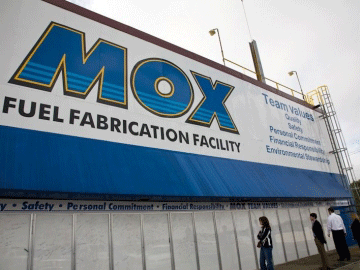 Outsmarting the MOX POGO 7 Mar 14 The Project On Government Oversight is pleased to note that in the President’s FY 2015 budget, released this week, a Department of Energy billion-dollar boondoggle has been put on “cold-standby.” This particular boondoggle would be the Mixed Oxide Fuel Fabrication (MOX) Facility at the Savannah River Nuclear Site in South Carolina.
The MOX facility was designed to convert weapons-grade plutonium into mixed oxide fuel for U.S. commercial nuclear reactors as part of a diplomatic deal with Russia. The budget for the whole project was originally $1.6 billion with an operational date sometime in 2007. But costs have steadily gone up and up as the completion date gets moved again and again. Almost one year ago the Government Accountability Office released a report stating that the cost had risen to $7.7 billion and operations would not begin until November 2019, twelve years after the initially planned start date.
A confidential study recently conducted by the Energy Department reports that yet another cost increase may have been the final nail in the coffin for MOX. The construction costs alone could be as high at $10 billion over the next five years, while operations costs could be an additional $34 billion over the next 15 years.
This astronomical cost increase, in addition to the $4 billion that has already been spent on construction of the facility, is all for a project that doesn’t have a single customer…….http://www.pogo.org/blog/2014/03/20140307-outsmarting-the-mox.html
Russia wants a slice of the action in Britain’s new nuclear power
 Russian state nuclear firm in talks to build power station in the UK Rob Edwards The Guardian, Wednesday 12 March 2014 Rosatom meeting Whitehall officials but experts say a Russian VVER reactor is unlikely to open in UK for at least 10 years Britain is in talks with the Russian state nuclear company about building a nuclear power station in the UK, an official said on Tuesday.Hergen Haye, head of new nuclear development at the Department of Energy and Climate Change (DECC), told students at Edinburgh University that active discussions were taking place in London after amemorandum of understanding had been signed with Russia. “I can tell you that, behind closed doors and with microphones switched off, there are interesting debates happening in Whitehall,” he said. “Russia wants to build a nuclear power station in the UK.”
Haye chairs a UK-Russian working group on nuclear power, and was in Russia recently for discussions. Haye regards the Russian VVER reactor proposed for the UK as “perfectly safe”, but he cautioned that there would be problems convincing the public that a deal with Russia was acceptable, especially given the current crisis in the Crimea. “It’s a long road, a very long road,” he said…..A memorandum of understanding between DECC and the Russian state nuclear corporation, Rosatom, was signed in September 2013. It agreed a programme of co-operation “designed to be the most effective means of enabling Rosatom to prepare for entry into the United Kingdom civil nuclear market.”
The plan was to give Rosatom access to the UK government’s watchdogs, the Office for Nuclear Regulation and the Environment Agency, so that it could understand British regulatory and licencing requirements. The Department for Business, Innovation and Skills “will have detailed discussions with Rosatom to facilitate commercial links with United Kingdom’s industry,” the memorandum said.
Rosatom has already formed a partnership with the British nuclear engineering company, Rolls Royce. “The participants hope that this relationship will lead to joint projects in the United Kingdom and overseas,” said the memorandum.
Russia is also reported to have signed a deal with the Finnish power company, Fortum. It operates two Russian VVER reactors near Loviisa in Finland. In his lecture, Haye highlighted the difficulties of getting private companies to invest in something as commercially risky as nuclear power. He defended the £89.50 per megawatt hour “strike price” for electricity agreed with the French state nuclear company, EDF, for 35 years. This was essential to secure investment in the construction of a new nuclear power station at Hinkley Point in Somerset, he argued. The UK is also seeking Chinese investment in the nuclear station, and has signed a memorandum of understanding with China.
According to Haye, securing money from the Chinese was one of the remaining barriers to actually starting work on the Hinkley station. Another was winning agreement from the European Commission that the strike price deal didn’t breach state aid rules. The commission has announced that it is investigating the funding arrangements for Hinkley. Hay said he was about to embark upon a tour of European capitals to try and win backing for the UK’s position……http://www.theguardian.com/environment/2014/mar/11/russian-nuclear-firm-build-power-station-uk

 Email
EmailJapan plans to develop a giant plutonium stockpile
The US struggles to make Japan fear nuclear terrorism, Global Post, 11 Mar 14 A behind-the-scenes debate over Japan’s plans to develop a giant plutonium stockpile
Already, Japan has 9.3 metric tons of plutonium stored at Rokkasho and nine other sites in the island nation, along with around 35 tons of plutonium stored in France and the United Kingdom.
Japan’s plans to develop a giant plutonium stockpile reveals big cultural clashes. ROKKASHO, Japan — Sporting turquoise-striped walls and massive steel cooling towers, the new industrial complex rising from bluffs astride the Pacific Ocean here looks like it might produce consumer electronics or bath salts.
But in reality it is one of the world’s newest, largest, and most controversial production plants for nuclear explosives. The factory’s private owners said three months ago that after several decades of construction, it will be ready to open in October, as part of a government-supported effort to create special fuel for the country’s future nuclear power plants.
Japan’s leaders affirmed last month they intend to proceed with that effort, a decision that has stoked anxiety in East Asia and set off alarms among Western experts who worry about the spread of nuclear weapons technology — including some inside the Obama administration.
Once it is running, the plant will produce thousands of gallon-sized steel canisters containing a flour-like mixture of uranium and plutonium, in theory capable of providing the building blocks for a huge nuclear arsenal. Continue reading
USA could have 100% renewable energy
100 Per Cent Renewable Energy is Viable: Study A study by scientists from Stanford University claims that it is feasible for the entire United States to derive all of its power from renewable energy sources. http://sourceable.net/100-per-cent-renewable-energy-viable-study/Marc Howe, 11 Mar 14, The team of researchers from Stanford University, led by civil engineerMark Jacobson, has drafted detailed plans outlining how every state in the United States could convert to 100 per cent renewable energy usage by mid-century using current technology. According to Jacobson, even if the United States only makes recourse to renewable energy methods which are available at present, it would still be “technically and economically feasible” for the nation to meet all of its power needs by 2050.
Under Jacobson’s plan, fossil fuel plants would be left to gradually go obsolete as a swath of renewable energy sources, including solar, wind, geothermal and hydropower, come on line to replace them.
All of the renewable energy sources outlined in the plan, with the exception of tidal energy collectors for coastal states, are now commercially available. The researchers’ findings indicate that in California, which is the most populous and economically productive state in the US, wind, solar and hydropower could already be used to satisfy energy requirements 99.8 per cent of the time.
Jacobson’s proposal also contains plans for the abolition of fossil fuel combustion as a means of propelling automobiles. In lieu of carbon heavy combustion engines, vehicles would run on electric batteries or hydrogen produced via electrolysis, thus dispensing with the need for natural gas to run the process.
Jacobson said the plan is a model of affordability as well as efficiency. It would take less than two per cent of the land area of the United States to support all of the renewable energy facilities envisioned by the plan, including the space between individual installations such as wind turbines and solar PV panels.
The plan would also enable the average US consumer to save $3,400 per year as compared to the country’s current fossil fuel-heavy energy portfolio, as a result of anticipated gains in the price of raw materials such as oil and coal, given their increasing scarcity as finite resources.
Other advantages of the plan touted by its developers include savings of $730 billion a year for the US economy in climate-related costs, and savings of between $166 billion and 980 billion a year in savings a year on health care costs, achieved by preventing approximately annual 59,000 deaths from air pollution.
Given the practical viability and demonstrable advantages of opting for renewable energy, the Stanford researchers believe “the greatest barriers to conversion are neither technical nor economic…they are social and political.” Jacobson nonetheless remains confident that his proposals will eventually be adopted – if not because of the prudence and foresight of policy-makers, then because of the mere fact that fossil fuels are finite in nature and destined to run out sooner or later.
Geothermal energy a renewable energy option for Japan
 Audio Nuclear Alternative Faces Pushback In Japan By Eliza Strickland In Japan, all of the country’s 48 operational nuclear reactors are currently shut down for safety checks. It’s been three years since Japan’s nuclear disaster, when a tsunami knocked out the electricity at the Fukushima Daiichi Nuclear Power Plant and caused the meltdown of three reactor cores.
The Japanese people are not keen on restarting the nuclear plants, but that means Japan desperately needs alternative sources of energy. From Japan, Eliza Strickland of IEEE Spectrum magazine reports on one renewable energy source that’s causing some controversy. Every Friday evening in downtown Tokyo, protesters gather outside the prime minister’s house to rally against his nuclear energy policies. In a recent poll by a major Japanese broadcaster, 60 percent of respondents said they disagreed with the government’s plan to restart nuclear plants.
But if Japan wants to give up nuclear power without relying on fossil fuels, it will have to develop its renewable energy sector. Experts say one bright spot for Japan is its excellent geothermal energy reserves — essentially, reservoirs of hot steam trapped miles underground. Utility companies can drill down to that steam, then use the steam to power turbines and produce electricity……..http://hereandnow.wbur.org/2014/03/11/geothermal-japan-fukushima
Taiwanese activist demand local referendums on nuclear power
Activists push for local nuclear polls Taipei Times By Lee I-chia 11 Mar 14 Anti-nuclear supporters yesterday called for an amendment to the Nuclear Reactor Facilities Control Act (核子反應器設施管制法) to allow local referendums for residents to decide whether nuclear plants should be built within 50km of their homes.
The amendment was suggested by former vice president Annette Lu (呂秀蓮) at a public hearing to discuss evacuation zones for nuclear reactors hosted by Democratic Progressive Party (DPP) Legislator You Meinu (尤美女) at the Legislative Yuan yesterday.
Lu said that according to Article 11 of the Act on Sites for the Establishment of Low-Level Radioactive Waste Final Disposal Facilities (低放射性廢棄物最終處置設施場址設置條例), sites for building nuclear waste final depositories must be approved by local residents through referendums.
And while nuclear power plants, with fuel rods in the reactors and highly radioactive nuclear waste stored in the spent-fuel pools, pose greater risks to nearby residents than low-level nuclear waste, the law should be amended so that people living within 50km of plant sites can decide on the construction, installation of fuel rods and operation of reactors through local referendums, she said.
DPP Legislator Chen Ou-po (陳歐珀) said the issue of nuclear power safety includes three aspects — the reactors, disaster response measures and waste treatment………
Yenliao Anti-Nuclear Self-Help Association secretary-general Yang Mu-huo (楊木火) said he is worried that the northeastern monsoon wind will blow airborne substances from the plant to Shuangsi District (雙溪) in New Taipei City, where the catchment area of the Peishih River (北勢溪) — the water source of the Feitsui Reservoir (翡翠水庫) — is located.
“Spent nuclear fuel is like ‘shit’ from the reactors, and it is ridiculous that proposals for building reactors can gain approval, because it’s like building a house with no toilet to ‘deal with the shit,’” association member Yang Kuei-yin (楊貴英) said……
After complaining that residents were led to sites by the sea in previous nuclear disaster drills, which would be deadly if a complex disaster were to occur, like that in Fukushima, Japan, which included a major tsunami, she suggested that drills without warnings be held to see if the government is as well-prepared as it claims……http://www.taipeitimes.com/News/taiwan/archives/2014/03/12/2003585462
Okuma, Fukushima’s radioactive ghost town
When Okuma’s former residents get past the guards at the roadblock on the road into their hometown, they enter a beautiful post-apocalyptic landscape………. They can’t see the poison all around them, but the numbers on their dosimeters tell the tale
You Can’t Go Home Again Is the Japanese government finally giving up on resettling Fukushima’s radioactive ghost town? Foreign Policy, BY ELIZA STRICKLAND MARCH 11, 2014 ore former residents can enter the radioactive ghost town of Okuma, just a few miles from the ruins of the Fukushima Daiichi Nuclear Power Station, they must first get a permit from Japanese bureaucrats, who then advise them on protective measures. They’ll need to suit up before they go in: Disposable paper coveralls, booties, gloves, caps, and facemasks will keep them safe enough for an hour’s visit. The officials suggest they bring a dosimeter so they’ll know exactly what radiation dose they’re receiving as they walk through the desolate streets to their empty houses, and can avoid lingering in the most dangerous places.
Yet until recently, the Japanese government has maintained the politically expedient fiction that this town would soon be fit for habitation once more. The residents of Okuma are among the roughly 100,000 nuclear refugees who are still barred from their homes
…….Fallout settled on rooftops and lawns and driveways, on rice paddies and orchards, on roads and forests. The evacuated towns are still laced with the radioactive isotope Cesium-137, which has a half-life of 30 years.
In the years since the accident, the Japanese government first set out to map the region’s radioactive hotspots, and then began a massivedecontamination effort. A total of 100 municipalities were marked for cleanup, with 11 of those designated areas of special concern. Gradually, towns that weren’t too contaminated — those on the periphery of the evacuation zone — are being reopened for inhabitants. Right now, residents of the town of Tamura are anxiously awaiting the April 1 lifting of the evacuation order for their area, although many say they’re still worried about health consequences of moving back.
The government had stated that this strategy of cleanup and resettlement would continue apace, and would eventually reach Okuma and the other highly contaminated towns. Perhaps in a few years, officials had suggested, Okuma’s displaced residents would be able to safely resume their lives.
But the facts are clear: Some evacuated towns will be poisoned for decades to come, and their residents can’t go home again. It’s a tragedy, of that there’s no question. But perhaps the greater injustice is that these refugees were kept living in limbo for three years, denied the truth by a government that didn’t have the political bravery to speak it.
solar installer certification programme for West Africa.
IRENA, ASU To Develop Solar Installer Certification For West Africa http://www.energymatters.com.au/index.php?main_page=news_article&article_id=4216The International Renewable Energy Agency (IRENA) and Arizona State University (ASU) have partnered to develop a solar installer certification programme for West Africa.
The need to accelerate renewable energy uptake is particularly pressing in West Africa; which is comprised of Benin, Burkina Faso, Cape Verde, Gambia, Ghana, Guinea, Guinea-Bissau, Ivory Coast, Liberia, Mali, Niger, Nigeria, Senegal, Sierra Leone and Togo.
With much of the population having unreliable access to electricity; fossil fuels are king – particularly in the form of dangerous and polluting kerosene used for lighting.
While renewable energy technologies have rapidly reduced in price; a challenge for these nations is having a suitably qualified workforce capable of installing them.
The IRENA/ASU programmes will certify technicians for off-grid and grid-connected solar photovoltaic (PV) energy systems. Workshops in selected countries will occur to engage key stakeholders in order to gain political and policy level support for the initiative.
“ASU is a worldwide leader in PV solar research, power-grid management and sustainability,” said Paul Johnson, dean of the Ira A. Fulton Schools of Engineering at ASU. “We are excited to be collaborating with IRENA to share our expertise and help build the local technical capacity in West Africa.” IRENA is an intergovernmental organisation working to promote the acceleration of renewable energy uptake worldwide. More than 124 states and the European Union are members; Australia among them.
A report from IRENA in January says employment in renewable energy worldwide in 2012 reached 5.7 million; with the largest number of jobs found in the biofuel and solar photovoltaic sectors. IRENA sees potential for adding 11 million jobs in the years to 2030, with many of these new jobs to be created in developing nations.
However, the body says a shortage of necessary skills in the renewable energy sector could become a major barrier to this level being achieved.
Need to upgrade USA’s nuclear emergency response
GAO: Emergency Nuclear Response System Needs Upgrade WSJ, By RACHAEL KING , 11 Mar 14, A government report issued Tuesday says the Nuclear Regulatory Commission’s communication technology may not work in a severe crisis.
The technology is used to transmit data from operators of reactors to regulators and technical experts. The U.S. Government Accountability Office, which issued the report on the third anniversary of the Fukushima Daiichi nuclear meltdown, says that unless the emergency data communications system operated by the NRC is upgraded to a more reliable communications system such as satellite, it “may not be available when the need for it is greatest, such as during a severe accident.”
The NRC has rejected calls to make this upgrade a priority. In the event the system fails, telephone communications are adequate, the agency said in its response to the report, which was included in the GAO’s report. The system, known as the Emergency Response Data System, uses a virtual private network to create a secure point-to-point data pathway from each operator site to NRC headquarters. The ERDS lets operators communicate nuclear power plant performance data such as radiation monitoring and containment or the status of reactor coolant and containment systems to NRC control centers.
During the Fukushima disaster, the prolonged loss of power largely disabled Japan’s automated data system, according to the report. Radiation levels afterward prevented direct assessment by plant personnel, making remote monitoring a more valuable tool.
After several fact-finding missions to Japan starting in May 2011, the International Atomic Energy Agency said that greater consideration should be given to implementing systems, communications and sources of monitoring equipment that are able to withstand difficult conditions in order to provide essential information during severe accidents. The agency specifically urged operators to upgrade to satellite communications equipment.
The GAO concurs with those recommendations and is urging the NRC to upgrade ERDS. …….http://blogs.wsj.com/cio/2014/03/11/gao-emergency-nuclear-response-system-needs-upgrade/
For Japanese citizens and the world trust in nuclear industry is banrupt
Deadly Fukushima Crisis Further Corrodes Viability of Nuclear Energy,Tuesday, 11 March 2014 By H Patricia Hynes, Truthout | Op-Ed At the three-year anniversary of the Fukushima Dai’ichi nuclear power plant reactor meltdowns, the disaster’s consequences continue to unfold. One should be a global switch from nuclear power to renewable energy sources.
The mainstream media moved on some time ago from Fukushima – and left most of us in the dark about this worsening nuclear tragedy, as if there were nothing more to mourn and no lessons to learn……..
A few thousand residents who have been allowed to return to their town Odaka find themselves alive in a dying region: “People don’t believe it is safe to visit here. They won’t believe our produce, our livestock, our fish are safe,” reported one rueful resident.
So difficult has been their fate that, by late 2013, 1,600 nuclear refugees had died of insufficient medical services, the exhaustion of relocating, suicide and, likely, heartbreak. More than 35 percent of some 38,000 Fukushima children examined have cysts or nodules on their thyroids, as compared with 1 percent of a control group of Japanese children. In a callous move to keep schools open in Fukushima, the Japanese government raised the “permissible” level of radiation for children. Japanese children now can be exposed to 20 times more radiation than was previously allowed, a level comparable to the yearly limit for German workers.
Hundreds of thousands of tons of radioactive water from the site have emptied and continue to leak via groundwater into the Pacific Ocean at the rate of 400 tons per day. Radioactive cesium, a carcinogen that bioaccumulates in animal, fish and human tissue, has been found throughout mainland Japan, in fish off the coast of Fukushima (thus closing that industry) and in large migratory fish such as Bluefin tuna off the coast of California. A plume of radioactive water from Fukushima is expected to reach the West Coast of the United States in early 2014. Tragically, there is no solution in sight to trapping and treating the cesium-, tritium- and strontium-contaminated groundwater before it reaches the Pacific Ocean. “The situation at the reactor site is progressively deteriorating, not stabilizing,” stated an international group of experts in their urgent appeal for international action to UN Secretary General Ban Ki-moon.
In the wake of this $250 billion disaster, Japan closed all of its 54 nuclear power plants. An extraordinary (and embattled) act in a country that is dependent on nuclear energy for one-third of its electricity and is planning to achieve 50 percent nuclear-powered electricity by 2030. Japan had lulled its citizens into complacency with nuclear safety myths. Naoto Kan, prime minister at the time of the Fukushima meltdown, has since rejected nuclear power, saying ‘”there is no [other industrial] accident or disaster that would affect 50 million people”‘ like a nuclear accident. An unprecedented anti-nuclear citizen movement ignited in Japan after Fukushima and has persisted, with a strong majority of the population opposing nuclear power in the face of the current conservative and militaristic government’s determination to restart the offline nuclear power plants.
Radioactive waste is the nuclear industry’s nightmare, most currently so in Fukushima Dai’ichi, where intensely radioactive spent fuel rods lie in a warped and sinking structure and at risk of a catastrophic fire if another (and potentially likely) earthquake strikes the region. For this reason, the US State Department advised Americans soon after March 11 to evacuate to at least 50 miles from the plant.
TEPCO, the plant operator responsible for the cleanup of Fukushima nuclear power plants, has bankrupted the trust of Japanese citizens and the world,,,,,,,,,. http://www.truth-out.org/opinion/item/21551-deadly-fukushima-crisis-further-corrodes-viability-of-nuclear-energy
New Mexico nuclear facility has 4 more workers positive for radiation
Four more workers test positive for radiation from New Mexico site BY LAURA ZUCKERMAN Mar 11, 2014 (Reuters) – Four more workers have tested positive for exposure tied to an accidental release of radiation from an underground nuclear waste site in New Mexico, but tests have shown no further contamination in two sections of the site, officials said on Monday.
This brings to 17 the number of workers exposed to radiation at the Waste Isolation Pilot Project, but a U.S. Department of Energy spokesman in a statement characterized the level of exposure as “very low.”…..http://www.reuters.com/article/2014/03/11/us-usa-newmexico-radiation-idUSBREA2A07F20140311
High level of thyroid and breast cancers in Fukushima victims
Fukushima’s radiation victims, DW 11 Mar 14, The residents of the evacuated Japanese town of Namie near the crippled nuclear plant in Fukushima were contaminated with radiation. They have now taken the responsibility for their health into their own hands. When Minako Fujiwara tells the story of her dog which died last June, she still gets sad.
“Hair around the dog’s neck came off and its skin turned black,” the 56-year-old told DW. Similar symptoms were also detected in animals in Chernobyl following the nuclear catastrophe there in 1986. Fujiwara’s family had to leave the dog behind when they were ordered to leave the town of Namie, located nine kilometres (5.6 miles) north of the crippled Fukushima Daiichi nuclear plant. The pet probably died of high radiation.
Fujiwara has so far not experienced any health problems except for high blood pressure. But Shunji Sekine, a physician in Namie, believes the radiation will eventually have a negative impact on public health.
In his medical practice in the city of Nihonmatsu, where around 230 relocated families are situated in a settlement, Sekine has been examining the thyroid glands of Namie citizens on a daily basis ever since the nuclear incident three years ago.
“Children and young people are particularly vulnerable to the uptake in radioactive iodine in their thyroid,” the 71-year-old doctor told DW.
High number of cancer cases
“Although comprehensive studies are missing, I see a connection between nuclear accidents and the occurrence of cancer,” said the retired physician who specializes in thyroid and breast cancer, adding that there are simply too many cases. According to official figures, 33 cancer cases have been identified in about a quarter of a million children and teenagers since the beginning of February.
This translates into 13 cases for every 100,000 inhabitants, a figure almost four times higher than the world average for all age groups. Nevertheless, the government of the Prefecture of Fukushima refuses to publish any relevant details about the prevalence of cancer. Information requests made by Sekine pertaining to previous cancer cases among children and the degree of contamination remain unanswered, with authorities citing data protection laws.
But Shunichi Yamashita, Japan’s top thyroid expert and health advisor to the prefectural government, plays down the issue. “We still need to conduct further investigations, and the time is not yet ripe for making any statement on this issue,” he said……http://www.dw.de/fukushimas-radiation-victims/a-17488269
Taiwanese anxiety about government inaction on nuclear safety
Activists slam government inaction on nuclear safety, Taipei Times, 11 Mar 14, By Tang Chia-ling and Stacy Hsu Several anti-nuclear civic groups yesterday expressed disappointment over what they called the government’s continued disregard of public concerns over the safety of nuclear power as Japan marked the third anniversary of the worst nuclear accident in its history.
Green Citizens’ Action Alliance secretary-general Tsuei Su-hsin (崔愫欣) said the Japanese government had taken several steps to prevent the recurrence of such a catastrophe, including introducing a regulation that prohibits nuclear power plants from being built on top of active fault lines and separating the regulatory body from the administrative body in charge of promoting nuclear power in its Nuclear Regulation Authority.
“The first [Jinshan] and the second [Guosheng] nuclear power plants in New Taipei City are located only 7km and 5km respectively from the active Shanchiao fault (山腳斷層), yet our government has done nothing about that,” Tsuei said.
Alliance deputy secretary-general Hung Shen-han (洪申翰) said the only aspect the government had tried to improve over the past three years was its skill at promoting nuclear power.
That was evidenced by the government’s efforts to purchase keywords from several search engines in August last year based on the names of prominent anti-nuclear activists to link to a pro-nuclear Web site run by the Ministry of Economic Affairs’ Bureau of Energy, and its screening at movie theaters nationwide a commercial trumpeting its plan for a gradual move toward a nuclear-free homeland, Hung said…….“The government is perfectly aware of the possibility of a nuclear disaster occurring in Taiwan, but it has chosen to bury its head in the sand rather than acknowledging and dealing head-on with its inability to evacuate people in the event of a nuclear disaster,” Chih said. http://www.taipeitimes.com/News/taiwan/archives/2014/03/12/2003585463
-
Archives
- February 2026 (233)
- January 2026 (308)
- December 2025 (358)
- November 2025 (359)
- October 2025 (376)
- September 2025 (258)
- August 2025 (319)
- July 2025 (230)
- June 2025 (348)
- May 2025 (261)
- April 2025 (305)
- March 2025 (319)
-
Categories
- 1
- 1 NUCLEAR ISSUES
- business and costs
- climate change
- culture and arts
- ENERGY
- environment
- health
- history
- indigenous issues
- Legal
- marketing of nuclear
- media
- opposition to nuclear
- PERSONAL STORIES
- politics
- politics international
- Religion and ethics
- safety
- secrets,lies and civil liberties
- spinbuster
- technology
- Uranium
- wastes
- weapons and war
- Women
- 2 WORLD
- ACTION
- AFRICA
- Atrocities
- AUSTRALIA
- Christina's notes
- Christina's themes
- culture and arts
- Events
- Fuk 2022
- Fuk 2023
- Fukushima 2017
- Fukushima 2018
- fukushima 2019
- Fukushima 2020
- Fukushima 2021
- general
- global warming
- Humour (God we need it)
- Nuclear
- RARE EARTHS
- Reference
- resources – print
- Resources -audiovicual
- Weekly Newsletter
- World
- World Nuclear
- YouTube
-
RSS
Entries RSS
Comments RSS
 nuclear-news