Science finds damage to plants, animals, in Chernobyl and Fukushima

Radiation Facts and Myths
Many have claimed that wildlife is thriving in the highly-radioactive Chernobyl Exclusion Zone.
Some claim that a little radiation is harmless … or even good for you.
One of the main advisors to the Japanese government on Fukushimaannounced:
If you smile, the radiation will not affect you. If you do not smile, the radiation will affect you.
This theory has been proven by experiments on animals.
Are these claims true?
We Ask an Expert
To find out, Washington’s Blog spoke with one of the world’s leading experts on the effects of radiation on living organisms: Dr. Timothy Mousseau.
Dr. Mousseau is former Program Director at the National Science Foundation (in Population Biology), Panelist for the National Academy of Sciences’ panels on Analysis of Cancer Risks in Populations Near Nuclear Facilities and GAO Panel on Health and Environmental Effects from Tritium Leaks at Nuclear Power Plants, and a biology professor – and former Dean of the Graduate School, and Chair of the Graduate Program in Ecology – at the University of South Carolina.
For the past 15 years, Mousseau and another leading biologist – Anders Pape Møller – have studied the effects of radiation on birds and other organisms.

Mousseau has made numerous trips to the Chernobyl Exclusion Zone and Fukushima – making 896inventories at Chernobyl and 1,100 biotic inventories in Fukushima as of July 2013 – to test the effect of radiation on plants and animals.
On the third anniversary of the Fukushima disaster, we spoke with Dr. Mousseau about what he discovered regarding the effects of radiation on plants, animals … and people.
Question] How did you get into this field? Is it because you are an anti-nuclear activist?
[Mousseau] No.
I’m an activist, but not an anti-nuclear scientist. I’m an activist for evidence-based science policy. Continue reading
Dispelling the false story that Germany imports nuclear power
since the nuclear phaseout of March 2011, power exports in Germany have boomed. Germany remained a net power exporter in 2011 (PDF). 2012 was a record year. So was 2013. 2014 in shaping up to be a fierce competitor for the title (PDF).
So no, Germany has not imported more nuclear power from abroad during its nuclear phaseout.
 German imports of nuclear power – the myth revisited REneweconomy, By Craig Morris on 13 March 2014 Energy Transition When Germany shut down nearly half of its nuclear capacity in the week after Fukushima, critics charged that the country would only be importing more nuclear power from its neighbors as a result. Craig Morris says it is a physical impossibility.
Perhaps the best example of such claims is an article published in September 2011 by Der Spiegel. The opening paragraph sums up the argument well: “the country is now merely buying atomic energy from neighbors like the Czech Republic in France.” Later, we read that “the Czech nuclear industry went into the export business. These days, it’s sending roughly 1.2 gigawatts-hours of electricity across the border every day.”
Embarrassingly, it gets worse from there: Continue reading
Los Alamos’ huge nuclear waste problem, with New Mexico facility shut
 New Mexico nuclear repository mishap leaves Los Alamos waste quandary KFGO, Thursday, March 13, 2014 By Joseph J. Kolb ALBUQUERQUE, New Mexico (Reuters) – The Los Alamos National Laboratory is evaluating how to meet a June deadline to permanently discard plutonium-tainted junk in light of a prolonged shutdown of a New Mexico nuclear waste dump after an accident there last month, a lab official said.
Los Alamos, one of the leading U.S. nuclear weapons labs, has been forced to halt shipments of its radioactive refuse some 300 miles across the state to the nation’s only underground nuclear repository, the Waste Isolation Pilot Plant, near Carlsbad, according to lab spokesman Matt Nerzig.
The repository has remained closed while the U.S. Department of Energy investigates the origins of a radiation leak that occurred there on February 14, exposing at least 17 workers at the facility to radioactive contamination. It was the first such mishap since the facility opened in 1999.
Nerzig said about 1,000 temporary storage drums of the waste remain at the Los Alamos National Laboratory awaiting shipment to the repository near Carlsbad. The lab faces a strict June 30 deadline to permanently discard of the waste…….
“We intend to hold LANL (Los Alamos National Laboratory) to the deadline,” said Jim Winchester, communications director, for the New Mexico Environment Department………
Established during World War Two as part of the top-secret Manhattan Project to build the world’s first atomic bomb, the complex remains one of the leading nuclear weapons manufacturing facilities in the United States.
A massive wildfire that raged at the edge of the complex in 2011 burned to within a few miles of a collection of radioactive waste drums temporarily stored at the site. Since then, Energy Department and state officials have made the removal of transuranic waste from the lab to the repository a top environmental priority. http://kfgo.com/news/articles/2014/mar/13/new-mexico-nuclear-repository-mishap-leaves-los-alamos-waste-quandary/
Wind power racing ahead of nuclear in China
Why is Wind Power Generation Surpassing Nuclear? One of the reasons why nuclear power has not kept up with wind in China is the relative time it takes to get a project up and running. Whereas the typical Chinese nuclear reactor takes roughly six years to build, a wind farm can be completed in a matter of months.
 Wind Leaves Nuclear Behind In China http://cleantechnica.com/2014/03/13/wind-leaves-nuclear-behind-china/By J. Matthew Roney In China, wind power is leaving nuclear behind. Electricity output from China’s wind farms exceeded that from its nuclear plants for the first time in 2012, by a narrow margin. Then in 2013, wind pulled away—outdoing nuclear by 22 percent. The 135 terawatt-hours of Chinese wind-generated electricity in 2013 would be nearly enough to power New York State. Once China’s Renewable Energy Law established the development framework for renewables in 2005, the stage was set for wind’s exponential growth. Wind generating capacity more than doubled each year from 2006 to 2009 and has since increased by nearly 40 percent annually, to reach 91 gigawatts by the end of 2013 (1 gigawatt = 1,000 megawatts). Over 80 percent of this world-leading wind capacity is now feeding electricity to the grid.
Wind generation in 2013 could have been even higher, by an estimated 10 percent, but for the problem known as curtailment—when wind turbines are stopped because the grid cannot handle any more electricity. To help reduce curtailment and reach the official 2020 goal of 200 grid-connected gigawatts, China is building the world’s largest ultra-high-voltage transmission system. The raft of projects now under construction will connect the windier north and west to population centers in the central and eastern provinces. Continue reading
Former nuclear chief Gregory Jaczko lobbies for closing nuclear power
 Three Years After Fukushima, Ex-Nuclear Chief Lobbies For Worldwide Phase-Out HUFFINGTON POST, | by YURI KAGEYAMA TOKYO (AP) 13 Mar 14, — As radiation spewed from Japan’s nuclear disaster three years ago, the top U.S. atomic energy regulator issued a 50-mile evacuation warning for any Americans in the area, a response some found extreme.
Gregory Jaczko, who stepped down as chairman of the Nuclear Regulatory Commission in 2012, still believes he was right, and says the events at the Fukushima Dai-Ichi plant show that nuclear power should be phased out in Japan and worldwide.
“The lesson has to be: This kind of accident is unacceptable to society. And that’s not me saying it. That’s society saying that,” he said in an interview this week in Tokyo, where he is giving lectures and speaking on panels marking the third anniversary of the March 11, 2011 earthquake and tsunami that overwhelmed the Fukushima plant.
Now a lecturer at Princeton University, Jaczko, 43, has become a hit on the speaking circuit in Japan, where all 48 nuclear plants remain offline as the country debates what role nuclear power should play in its future……..
Jaczko said he had always been concerned about nuclear safety. But so much unfolded at Fukushima that experts were unprepared for, that it changed his view, and that of the Japanese public, on nuclear power.
Chernobyl and Three Mile Island were major accidents, but for Jackso, Fukushima definitively undermined industry assumptions such as multiple accidents were unlikely or hydrogen leaks would be controlled………http://www.huffingtonpost.com/2014/03/13/fukushima-gregory-jaczko_n_4954621.html?utm_hp_ref=green
Exciting innovations in wind energy
A Peek Into The Astonishing Future Of Wind Power CLIMATE PROGRESS, BY ARI PHILLIPS ON MARCH 13, 2014 “WHAT IF YOU COULD SCOOP THE AIR? SCOOP IT AND MOVE IT DOWNWARD, AMPLIFYING ITS KINETIC ENERGY ALONG THE WAY, CONCENTRATE IT TO A SINGLE POINT OF INTENSITY, THE WAY A MAGNIFYING GLASS CONCENTRATES SUNLIGHT TO A SINGLE INCENDIARY POINT?”
Dr. Daryoush Allaei, an engineer and founder of Sheerwind, an innovative wind power company, is concentrating his unique thought process on harnessing wind energy in new ways.
“And assuming you could do this technically, could you do it on a large enough scale to make it economically feasible?” Allaei writes in his company description. “More to the point, could you generate energy so inexpensively that it stages a renaissance?”
Sheerwind is pushing the boundaries of wind power innovation with its bladeless wind turbine, called INVELOX. The turbines funnel wind into ground-level generators through a tapering passageway that squeezes and accelerates the air. The units are about half as tall as traditional wind towers, which rise up to 260 feet into the air, and the ground-based turbine blades are more than 80 percent smaller than conventional wind turbine blades, which are about 115-feet long. The device resembles a giant gramophone that sucks in wind instead of blurting out sound.
Sheerwind represents a small point in the larger picture of wind power development, itself part of the story of renewable energy technology. The entire history of power generation, from Ben Franklin’s kite experiments 250 years ago to deep sea drilling for oil and gas is a complex tale of imaginative inventiveness riding up against economic realities. As wind power takes hold across the world, developers are constantly looking for new ways to make the technology lighter, faster, and more efficient but some of the most inventive ideas are often stymied by a lack of financial support during early stages…….http://thinkprogress.org/climate/2014/03/13/3366401/future-of-wind-power/
The role of genes in susceptibility to ionising radiation
 Genes Determine People’s Susceptibility to Radiation, Prison Planet, Washington’s Blog March 10, 2014
 Children are much more vulnerable to radiation than full-grown adults.
And yet standards for “acceptable” levels of radiation exposure are based on the ridiculous assumption that everyone is a healthy man in his 20s … and that radioactive particles ingested into the body cause no more damage than radiation hitting the outside of the body.
Similarly, there is a lot of variation between adults in terms of susceptibility to radiation.
For example, Howard Hughes Medical Institute – the second-best endowed medical research foundation in the world – reported in 2009:
Howard Hughes Medical Institute researchers have identified a group of genes that influence a person’s sensitivity to radiation……..
he most widely-accepted and prestigious publication on radiation – the U.S. National Academy of Science’s 2006 report on Health Risks from Exposure to Low Levels of Ionizing Radiation: BEIR VII Phase 2 – includes an 11-page discussion on genetic vulnerability to radiation, concluding:
At the level of whole populations it is feasible that certain inherited combinations of common low-penetrance genes can result in the presence of subpopulations havingsignificantly different susceptibilities to spontaneous and radiation-associated cancer.
***
The key issue is … the extent to which genetic distortion of the distribution of this risk might lead to underprotection of an appreciable fraction of the population.
While the commonly-accepted, mainstream scientific consensus is that even low levels of radiation can cause cancer and other injury, governments world-wide have reacted to the Fukushima crisis byraising “acceptable” radiation levels. And see this.
http://www.prisonplanet.com/genes-determine-peoples-susceptibility-to-radiation.html
California moves toward efficiency and clean energy to replace San Onofre nuclear power
 It’s Official: Efficiency, Clean Energy to Help Fill California’s Nuclear Generation Gap Switchboard, Switchboard 13 Mar 14 Sierra Martinez, California took another major and symbolic step today with its decision to rely significantly on energy efficiency and other clean energy resources to help replace electricity once generated by the San Onofre Nuclear Generation Station (SONGS) serving San Diego and the greater Los Angeles area.
The California Public Utilities Commission (CPUC) today made official its strategy to address the loss of the huge nuclear plant, which had been offline since January 2012 and was officially retired last year. Fortunately, it closely resembles its proposal released last month.
The final plan uses efficiency and other “preferred resources”—those resources with lower environmental impacts—like demand response (ways customers can consume less energy at key times during the day) and renewable energy such as wind and solar, as well as some upgrades to the electric system, to replace the vast majority of the lost SONGS generation. Continue reading
Plans for replacing energy after closure of San Onofre nuclear plant
New power sources planned to replace nuclear plant MODESTO BEE BY MICHAEL R. BLOOD Associated PressMarch 13, 2014 LOS ANGELES — California regulators Thursday approved a plan for two utilities to develop replacement power to help fill the void left by the closure of the San Onofre nuclear power plant, but environmentalists warned it could open the way for more dirty energy.
The nuclear plant between San Diego and Los Angeles, which stopped producing power in January 2012, once generated enough electricity for 1.4 million homes. The unanimous vote by the California Public Utilities Commission opened the way for Southern California Edison and San Diego Gas & Electric to find ways to plug that gap.
Under the order, the utilities must obtain at least part of the power from renewable sources, conservation and storage. Commission President Michael Peevey said he would have preferred electricity that did not include natural gas-fired generation, but it wasn’t yet possible to rely only on solar and wind power, customer conservation and other alternative sources.
California has been at the forefront among states in moving away from fossil-fuel generation, but solar, wind and other green energy make up only a fraction of overall production in the state.
Environmentalists say the decision increases the odds of seeing more polluting energy as California seeks to address climate change, but Commissioner Mike Florio said no one in the world has managed to run a complex electricity grid without some fossil-fuel energy to handle unexpected shortages………http://www.modbee.com/2014/03/13/3237078/california-vies-to-replace-closed.html
Global anxiety over risks of nuclear terrorism
Our nuclear insecurity Preventing terrorists from seizing bomb materials is still an ad-hoc global effort By Christina Pazzanese, Harvard Staff Writer 13 Mar 14
As the intense conflict between Russia and Ukraine continues, and talk of a return to Cold War-style politics heats up, top world leaders, including President Vladimir Putin and President Obama, are slated to meet later this month to discuss how best to contain what all agree is a significant and growing international threat: nuclear terrorism.
While nuclear arms control and disarmament talks between nations have long been a cornerstone of diplomacy, making sure nuclear materials don’t fall into the hands of individuals or groups bent on harm has not received that same level of attention from the international community until recently. Continue reading
Britain expects to keep nuclear missile base in Scotland
Britain says Scottish independence vote not forcing nuclear base rethink Yahoo News 7, March 14, 2014, BARROW-IN-FURNESS, England (Reuters) – Britain is making no contingency plans for moving its nuclear forces out of Scotland because the government does not expect Scots to vote for independence on September 18, Defence Minister Philip Hammond said on Thursday.
Britain’s submarines armed with Trident nuclear missiles are based at the Faslane naval base northwest of the Scottish city of Glasgow, so a vote to break the 307-year union could cost the government billions of dollars to move the naval base………
‘unprofessional’ culture of nuclear weapons officers
US air force documents reveal ‘rot’ in culture of nuclear weapons officers Launch officers barely passed inspection at North Dakota base as evidence grows of cheating and ‘unprofessional’ behaviour Associated Press in Washington theguardian.com, Friday 14 March 2014 Failings exposed last spring at a US nuclear missile base, reflecting what one officer called “rot” in the ranks, were worse than originally reported, according to air force documents obtained by the Associated Press. Continue reading
Plutonium rush in Japan, as ‘Nuclear Village’ still in control
 Plutonium fever blossoms in Japan Cronyism, influence-buying and a stifling of dissenting voices have kept the Japanese nuclear industry going strong after the Fukushima disaster,
  critics say Center for Public Integrity By Douglas Birch
 R. Jeffrey SmithJake Adelstein 12 Mar TOKYO — When Taro Kono was growing up as the son of a major Japanese political party leader, he had what he calls a “fever for the atom.”
 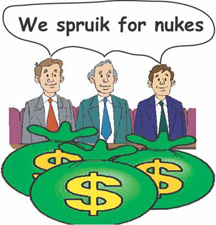 Like many of his countrymen, he regarded nuclear power plants as his country’s ticket to postwar prosperity, a modern, economical way to meet huge energy needs on an island with few natural resources. pro-nuclear sentiment led Japan to build the world’s third largest fleet of nuclear reactors. Its officials spent more than two decades and $22 billion building a factory to create plutonium-based nuclear reactor fuel, the largest ever to be subject to international monitoring. The facility is slated for completion in October at Rokkasho on Japan’s northeast coast,
  kicking off a new phase in the country’s long-term plan to increase energy independence.
The government of Prime Minister Shinzo Abe, who leads Kono’s party, announced in February its support for restarting some reactors and possibly building new ones, designed specifically to burn plutonium-based fuel.
Abe did so with apparent confidence that he has the enduring support — if not of the public — of the so-called “nuclear power village,” a tightly-woven network of regulators, utility industry executives, engineers, labor leaders and local politicians who have become dependent on nuclear power for jobs, income, and prestige.
Kono, a fluent English-speaker who received his undergraduate degree from Georgetown University, said in an interview that he has been talking about nuclear power “for the last 16 to 17 years,” but “no one really paid attention, right?”
Kono was unable to defeat the plutonium fuel program, he said, because its powerful constituency includes not only members of the ruling party, but bureaucrats, media leaders, bankers and academics. They were, he wrote in a 2011 book, “all scrambling for a place at the table” where nuclear-related funds are distributed. The louder he complained, the more these elites turned their backs on him. Just 60 legislators out of 722 in the parliament’s lower and upper chambers have joined the anti-nuclear caucus he helped organize………http://www.publicintegrity.org/2014/03/12/14394/plutonium-fever-blossoms-japan
Like Japan, UK seems to be developing an academic ‘Nuclear Village’
The nuclear industry has control of policy in Japan. That’s for sure. I’m just wondering how many other countries are falling under the spell of nuclear industry’s money and influence. Looks as if Britain is well on the way

Closer collaboration announced between the University of Bristol and the National Nuclear Laboratory , University of Bristol 12 Mar 14 The University of Bristol and the UK’s National Nuclear Laboratory have signed a statement of intent to work more closely to explore opportunities in joint research, R&D and training, which will provide support to industry aligned with the Government’s Nuclear Industrial Strategy……..
The Nuclear Research Centre (NRC), formed by the University in partnership with Oxford University in 2011, aims to strengthen nuclear energy related research and teaching in the region to support the delivery of the Government’s strategy on low-carbon, secure energy.
Recently the University has been re-establishing its existing relationships with a number of strategic industrial partners, and this includes the recent signing of a ‘Statement of Intent’ with NNL to support the growing need for a physical research hub in the South West…….http://www.bristol.ac.uk/news/2014/march/national-nuclear-laboratory.html
Bad timing to let Russia be in control of Britain’s nuclear reactors
 Russian nuclear power in the UK? We might want to think about that Terry Macalister theguardian.com, 13 Mar 14,
We should beware Russia’s politicisation of gas supplies to Ukraine as we contemplate a deal with it to build an atomic plant in Britain
Clearly there is something jarring about the Department of Energy and Climate Change (Decc) boasting about its positive negotiations with the Russians over building a nuclear power station in Britain just as a summit is due to begin in London about what sanctions can be taken against Moscow over its involvement in the Crimea.
If Vladimir Putin is threatening to once again use energy as a political weapon in the Ukraine by cutting off the country’s gas exports, then this is a bad moment to talk about state-owned Rosatom taking a critical stake in UK power infrastructure through the construction of an atomic plant.
Western Europe is already 30% (and in past years 50%) dependent on Russian gas, while London now hosts the headquarters of Gazprom’s global gas trading operation. But surely Britain does not want to open itself up to further dependence on Moscow by allowing its electricity to be generated by Rosatom? Well, few people five years back would have believed state-ownedChinese firms would form key partners in the project to commission the UK’s first new nuclear plant in 27 years at Hinkley Point in Somerset, and yet that is now settled.
So why not the Russians too, the little question of sanctions aside? After all, Rosatom has already signed a memorandum of understanding with the Decc and with nuclear and aerospace-contractor Rolls Royce……..
But the current biggest roadblock to any new nuclear facilities is financial. China and perhaps Russia may be willing to sink billions of pounds into Britain’s nuclear industry as a showcase for exports to the rest of the world, but even they will need help from the UK state like that being offered at Hinkley. The European commission may yet rule that the Decc “strike price” of £89.50 per megawatt hour is an illegal subsidy, which would leave any wider new nuclear programme by the Russians or anyone else dead in the water. http://www.theguardian.com/commentisfree/2014/mar/12/russian-nuclear-power-uk-gas-ukraine-britain
-
Archives
- February 2026 (233)
- January 2026 (308)
- December 2025 (358)
- November 2025 (359)
- October 2025 (376)
- September 2025 (258)
- August 2025 (319)
- July 2025 (230)
- June 2025 (348)
- May 2025 (261)
- April 2025 (305)
- March 2025 (319)
-
Categories
- 1
- 1 NUCLEAR ISSUES
- business and costs
- climate change
- culture and arts
- ENERGY
- environment
- health
- history
- indigenous issues
- Legal
- marketing of nuclear
- media
- opposition to nuclear
- PERSONAL STORIES
- politics
- politics international
- Religion and ethics
- safety
- secrets,lies and civil liberties
- spinbuster
- technology
- Uranium
- wastes
- weapons and war
- Women
- 2 WORLD
- ACTION
- AFRICA
- Atrocities
- AUSTRALIA
- Christina's notes
- Christina's themes
- culture and arts
- Events
- Fuk 2022
- Fuk 2023
- Fukushima 2017
- Fukushima 2018
- fukushima 2019
- Fukushima 2020
- Fukushima 2021
- general
- global warming
- Humour (God we need it)
- Nuclear
- RARE EARTHS
- Reference
- resources – print
- Resources -audiovicual
- Weekly Newsletter
- World
- World Nuclear
- YouTube
-
RSS
Entries RSS
Comments RSS
 nuclear-news