UK’s new nuclear plant may endanger Ireland, Netherlands, Belgium, Spain and Norway.
 UN warning over planned British nuclear plant 240km from Irish coast http://www.independent.ie/irish-news/un-warning-over-planned-british-nuclear-plant-240km-from-irish-coast-30110525.html 21 Mar 14, THE United Nations has accused the UK Government of
  suspicious actions over plans to develop its first nuclear power station in a generation. Environmental inspectors have warned there are concerns about a lack of talks with neighbouring countries, including Ireland, over potential risks posed by the Hinkley Point C plant on the Bristol Channel.
The £16 billion nuclear facility could supply 5% of the UK’s energy needs and would be 150 miles from the Irish coast if built.
A special UN environmental committee has written to the Government warning that it failed to notify countries which could potentially be affected by fallout or pollution from Hinkley, regardless of how unlikely an accident is.
“The committee found that there was a profound suspicion of non-compliance,” the UN states.
Vesna Kolar Planinsic, chair of the implementation committee on the Convention on Environmental Impact Assessment in a Transboundary Context, said UK representatives will be called before a hearing in December to explain their actions.
The committee said concerns have been raised over Hinkley by the Netherlands, Belgium, Spain and Norway. Continue reading
Radiation effects on family of US Navy man
 Wife of Navy Sailor: Our 1-year-old has brain cancer and spinal cancer resulting from Fukushima exposure — Wheelchair-bound Navy Sailor: It’s now affecting my arms and my hands, everything is still progressing (AUDIO) http://enenews.com/wife-of-navy-sailor-our-1-year-old-has-brain-cancer-and-spinal-cancer-resulting-from-fukushima-exposure-wheelchair-bound-navy-sailor-its-affecting-my-arms-and-my-hands-everything-is-still-prog?utm_source=feedburner&utm_medium=email&utm_campaign=Feed%3A+ENENews+%28Energy+News%29
Democracy Now, , Mar. 19, 2014:
Navy Lt. Steve Simmons, USS Ronald Reagan: Now the muscle weakness affects my legs, my arms, my hands — and now everything is still progressing. […]
Host: You’re sitting in a wheelchair right now?
Simmons: I am.
Charles Bonner, attorney: This is a declaration from the wife of the sailor, who writes in here declaration to the court, “My husband was exposed to radiation particles while assigned to the 7th fleet on the USS Ronald Reagan assisting in Operation Tomadachi beginning in March of 2011. As a result of this exposure, our son who was born November 14th 2012, at 8 months was diagnosed with brain and spine cancer.”
Climate change bad for nuclear industry? Britain will get more floods
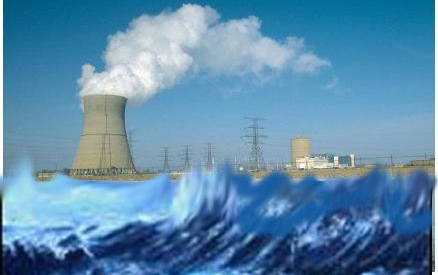 Britain had to close down its Dungeness nuclear power plant for 5 months, for fear of flooding.
Floods in Britain: a sign of things to come? http://www.enn.com/ecosystems/article/47190 21 Mar 14, A new investigation of long-term weather records suggests that the recent flooding in the south of England could signal the onset of climate change. The research, from UWE Bristol, Loughborough University and the University of East Anglia has produced a new index of flooding trends called the Fluvial Flood Indices. This enables widespread flooding and weather patterns to be viewed in the context of the last 150 years, revealing that four of the six most severe flood episodes since 1871 have occurred in the last 30 years. The new index was developed by Professor Rob Wilby from Loughborough University and Associate Professor Nevil Quinn from UWE Bristol, and was published in the Journal of Hydrology last year. With the collaboration of Dr. Colin Harpham from the University of East Anglia, the index has been updated to cover the most recent flooding.
The indices match weather patterns and river flow data collected over the last 60 years to reconstruct the likelihood of widespread flooding in Britain back as far as the 1870s. The index is broken down by British region and updated weekly from atmospheric pressure data.
Professor Quinn, who is a hydrologist and specialist in flood risk management, said, “One of the greatest difficulties in flood estimation is that recorded flood data are rare — very few stations were operating prior to 1950. The index is based on the association between the atmospheric pressure patterns at the time and the concurrent recorded flood events. Since we have a classification of atmospheric pressure patterns called Lamb Weather Types going back to 1871 we can contextualize floods in relation to a much longer period.”
The indices reveal that the sequences of weather leading to the recent floods in southern England occur on average once every 25 years. The worst flooding suggested by the series happened in 1872, with later flood-rich episodes in the 1950s, 1980s and 2000s. Professor Wilby said, “The extraordinary events in 1872 show the extent to which flood severity varies from one decade to the next. This flooding was so significant it was even captured in a painting by Monet. However, to experience four of the six most severe episodes in the last 30 years is disconcerting. Such a flood-rich period in the context of a 144-year record is very unusual and linked to the large number of cyclones passing over the country.”
It is envisaged researchers and agencies interested in tracking long-term changes in weather patterns linked to widespread flooding could use the indices.
Read more at ENN affiliate Click Green.
New Mexico site still touted as dump for high level nuclear waste

that they should stop making the stuff, as it has no place to go!
WIPP still considered for high-level waste By John Fleck / Journal Staff Writer , March 20, 2014 Despite last month’s radiation leak at the Waste Isolation Pilot Plant, researchers continue to look at the possibility of using WIPP or a facility like it to dispose of high level nuclear waste, a panel of waste experts was told Wednesday at a meeting in Albuquerque. But the leak has been a major setback to the idea.
Rod Ewing, chairman of the U.S. Nuclear Waste Technical Review Board, made clear at the outset of a previously scheduled meeting that the Valentine’s Day WIPP leak was not the reason for the long-scheduled session. But as Ewing and the other panel members discussed broad nuclear waste policy questions and technical issues, WIPP’s recent problems kept intruding on the discussion.
The meeting’s primary purpose was to look at lessons learned at WIPP that might be applied to the disposal of other nuclear waste. In particular, a number of experts talked about the suitability of WIPP or something like it for the disposal of high-level radioactive waste – things like spent nuclear power plant fuel that currently has no place to go……….http://www.abqjournal.com/371437/news/wipp-still-considered-for-highlevel-waste.html
New Mexico nuclear waste may go to Texas
 Nuclear waste from New Mexico lab may go to Texas Chron, By JERI CLAUSING and BETSY BLANEY, Associated Press | March 20, 2014 ALBUQUERQUE, N.M. (AP) — With the government’s only permanent nuclear waste dump shuttered indefinitely by back-to-back accidents, officials are making plans to ship radioactive waste from Los Alamos National Laboratory to rural West Texas.
The Department of Energy and the operator of the Waste Isolation Pilot Plant near Carlsbad in southeastern New Mexico say they have signed an agreement with Waste Control Specialists to truck the waste to its site in Andrews County.
The agreement will help Los Alamos meet a June deadline for getting the last of thousands of barrels of plutonium-contaminated clothing, tools, rags and other debris off its northern New Mexico campus before wildfire season hits its peak.
The waste, which is shipped and stored in huge sealed canisters, would come back to New Mexico for final disposal once the Waste Isolation Pilot Plant reopens……..
The West Texas site has in the past taken some less toxic waste from Los Alamos, but the Waste Isolation Pilot Plant is the nation’s only permanent repository for low-level radioactive waste from nuclear weapons facilities.
Waste Control Specialists is licensed to take radioactive materials such as uranium, plutonium and thorium from commercial power plants, academic institutions and medical schools, as well as some DOE waste. It is also the burial ground for dirt from a Hudson River Superfund site that’s tainted with PCBs, or polychlorinated biphenyls.
Chuck McDonald, a spokesman for the plant, said federal officials are working with regulators at the Texas Commission on Environmental Quality to make sure that storing the Los Alamos waste is allowable under its permits.
The state of New Mexico pressured Los Alamos to get the waste off its campus in the northern New Mexico mountains following a massive 2011 wildfire that lapped at the edges of lab property. The waste from decades of bomb building has been stored outside on a mesa. Following the Waste Isolation Pilot Plant shutdown, the state and Sen. Tom Udall, D-N.M., emphasized that the deadline was non-negotiable.
“Removing waste from the mesa in Los Alamos before fire season is critical to ensure safety in the greater Los Alamos community,” Udall said in a statement Thursday. “I’m pleased we have a temporary solution that will ensure there will not be any significant disruption in cleanup efforts.”……
More releases of Plutonium and Americium from New Mexico nuclear waste site
WIPP officials admit new release of Plutonium and Americium — More expected in future — Nearly double levels seen after February leak — 61 DPM on March 11 vs. 36 DPM in February http://enenews.com/wipp-officials-admit-new-radioactive-release-nearly-double-levels-seen-after-february-leak-61-dpm-on-march-11-vs-36-dpm-in-february?utm_source=feedburner&utm_medium=email&utm_campaign=Feed%3A+ENENews+%28Energy+News%29
|
AP, Mar. 19, 2014: New air sampling data from southeastern New Mexico’s troubled nuclear waste dump indicates there has been another small radiation release. […] they believe the contamination is from previous deposits on the inner surface of exhaust ductwork. […] Officials say occasional low-level releases are anticipated, but they should be well within safe limits.
|
Las Cruces Sun, Mar. 18, 2014 (emphasis added): DOE: Another radiation release reported at WIPP […] Samples collected from the ventilation exhaust recorded 61 disintegrations per minute of americium. DPM measures the amount of radioactive contamination from alpha and beta rays in an area. […] The DOE believes the most recent contamination was residual radioactive particles that were trapped in the ventilation system from the initial radiation leak. […] The DOE said it anticipates additional low-level releases on occasion, but officials expect radiation in the environment will remain at safe levels. New Mexico Environment Department Secretary Ryan Flynn said the state was briefed of the news Tuesday morning and thinks there is nothing to worry about at this time. “The level they detected is low and we don’t believe there was any risk to public health or the environment but we need to investigate more,” he said. […] Department of Energy officials were not available for comment.
Albuquerque Journal, Mar. 19, 2014: One air sample collected March 11 from the ventilation exhaust showed increased levels of americium […] In a statement, WIPP called the release “expected, given the amount of contamination captured by the WIPP ventilation system during the February 14 radiation release event.” Engineers say the contamination comes from previous deposits inside the exhaust ducts, WIPP reported. […] WIPP said it doesn’t expect the release to impact the health of workers, the public or the environment.
KVIA News, Mar. 18, 2014: “This is expected given the amount of contamination captured by the WIPP ventilation system during the February 14 radiation release event,” WIPP’s March 18 statement reads.
Las Cruces Sun, Mar. 18, 2014: Increased radiation in Carlsbad not related to WIPP incidents — Radiation levels appear to be on the rise in Carlsbad and around the Waste Isolation Pilot Plant. Air monitoring results since last month’s radiation leak appear to show the amount of radiation trending upward near Carlsbad, but Department of Energy officials say there is no proof it is related to the leak. A DOE air monitor stationed on Carlsbad’s eastern border, near the Bureau of Land Management office on Greene Street, has shown an uptick of radiation from 1.6 disintegrations per minute (DPM) on Feb. 18, to 7.1 DPM as recently as March 4. […] The initial radiation leak registered at 36 DPM at the WIPP site […]
Ocean radiation soon to reach USA’s West Coast
Scientists Expect Traces of Ocean Radiation Soon Science Tech By Jeff Barnard
The March 2011 tsunami off Japan flooded the Fukushima Dai-Ichi nuclear plant, causing radiation-contaminated water to spill into the Pacific. Airborne radiation was detected in milk and rainwater in the U.S. soon afterward. Now, scientists are using a network of volunteers to measure radiation at beaches along the U.S. West Coast. Continue reading |
|||

Climate change bad for nuclear industry: floods disrupt uranium mining
Thursday March 20, 2014, The World Nuclear Association reported that melting snow is to blame for the disruption of a number of uranium operations in Southern Kazakhstan.
According to the WNA:
National atomic company Kazatomprom reported that snow melt has damaged roads near the village of Taykonur in the Sozak region of South Kazakhstan oblast. This has restricted access of vehicles delivering chemical reagents to the Inkai in-situ leach (ISL) uranium mine and processing plant in central Kazakhstan. The Inkai project is owned and operated by Joint Venture Inkai, which is 60% owned by Canada’s Cameco and 40% by Kazatomprom.
Renewed demand for solar PV in China

 Solar PV rebounds as demand comes back with ‘a vengeance’ SMH, March 20, 2014 Solar manufacturers are returning to profit as demand in China soaks up a supply glut that gutted margins for more than two years.
The largest solar-panel maker Yingli Green Energy said it expects to be profitable in the third quarter. It joins peers including JinkoSolar, Trina Solar and JA Solar in guiding investors to expect both income and higher shipments in 2014.
Climbing demand for solar panels is countering a global oversupply of production capacity that erased profits across the industry and bankrupted more than a dozen companies. Developers installed 37.5 gigawatts of panels worldwide last year, up 22 per cent from 2012, and that figure may increase as much as 39 per cent this year, according to data compiled by Bloomberg.
That growth is starting to “sponge up” much of the glut, especially among Chinese manufacturers, that resulted from a buildup in the late 2000s, Pavel Molchanov, an analyst at Raymond James & Associates in Houston, said in an interview. “That has made a real dent in the overcapacity.”
The largest solar manufacturers have cut expenses and are poised to take advantage of growth this year, said Nimal Vallipuram, an analyst at Gilford Securities Inc. in New York.
“They continue to do very well at reducing the costs and their volume is going up very strongly,” he said. “Demand has come back with a vengeance.” http://www.smh.com.au/business/carbon-economy/solar-pv-rebounds-as-demand-comes-back–with-a-vengeance-20140320-353ir.html
Stanford Uni research finds wind farms provide a surplus of clean reliable energy
 Wind farms can provide society a surplus of reliable clean energy, Science Daily, March 20, 2014 Source: Stanford University
Summary:
Researchers have found that the wind industry can easily afford the energetic cost of building batteries and other grid-scale storage technologies. However, for the solar industry, scientists found that more work is needed to make grid-scale storage energetically sustainable. e worldwide demand for solar and wind power continues to skyrocket. Since 2009, global solar photovoltaic installations have increased about 40 percent a year on average, and the installed capacity of wind turbines has doubled.
The dramatic growth of the wind and solar industries has led utilities to begin testing large-scale technologies capable of storing surplus clean electricity and delivering it on demand when sunlight and wind are in short supply.
Now a team of Stanford researchers has looked at the “energetic cost” of manufacturing batteries and other storage technologies for the electrical grid. At issue is whether renewable energy supplies, such as wind power and solar photovoltaics, produce enough energy to fuel both their own growth and the growth of the necessary energy storage industry………..
One advantage of wind over solar power is that it has an enormous energy return on investment, Benson explained. “Within a few months, a wind turbine generates enough electricity to pay back all of the energy it took to build it,” she said. “But some photovoltaics have an energy payback time of almost two years. To sustainably support grid-scale storage will require continued reductions in the amount of fossil fuel used to manufacture photovoltaic cells.”
Other costs
The Stanford team’s primary focus was on the energetic cost of deploying storage on wind and solar farms. The researchers did not calculate how much energy would be required to build and replace grid-scale batteries every few years, nor did they consider the financial cost of building and installing large storage systems on the grid.
“People often ask, is storage a good or bad solution for intermittent renewable energy?” Benson said. “That question turns out to be way too simplistic. It’s neither good nor bad. Although grid-scale storage of wind power might not be cost effective compared to buying power from the grid, it is energetically affordable, even with the wind industry growing at a double-digit pace.
“The solar industry needs to continue to reduce the amount of energy it needs to build photovoltaic modules before it can afford as much storage as wind can today.”http://www.sciencedaily.com/releases/2014/03/140320140854.htm
UK Chancellor Osborne is two faced, pretending to support renewable energy
Budget 2014: Osborne’s actions on renewables speak louder than his words
New housing may bring a rise in domestic installations, but the renewable energy industry still awaits a long-term plan Guardian, Richard Hiblen 21 March 14, There were few surprises for energy watchers in yesterday’s budget annoucement. We’d already heard about the chancellor’s proposed freeze in carbon price support (CPS) at £18 per tonne of CO2 from 2016 to 2019; no doubt it will be a welcome relief to the large coal power generators, and good news for energy-intensive industries. But it will surely have a detrimental effect on the growth of renewable energy.
George Osborne may well say there is no change in this government’s ambition for deployment of new renewable energy generation, but his actions speak louder than words. When there is a further £60m funding for innovation and adoption of carbon-capturing technologies, it points towards a reduction in emissions and meeting targets using fossil fuels rather than investing in a long-term renewable energy strategy.
There is further help for companies involved with oil and gas exploration in terms of tax reductions, which again signals a direction of travel away from a low carbon economy and the renewable energy industry. The focus for government seems to be in keeping the lights on at the lowest possible cost rather than building a sustainable future for our energy market.
Osborne may well think he is “committed to growth in low-carbon technologies” but this budget produced nothing to support that statement. It refers to a “levy control framework” being in place to achieve the necessary investment into meeting renewable energy targets, but freezing the CPS offers little to no incentive to invest……..http://www.theguardian.com/big-energy-debate/budget-2014-george-osborne-renewable-energyGuardian,
Rokkasho a big-box store for nuclear terrorists.

After spending tens of billions of dollars and decades on breeder-related programs, Tom Cochran said, countries find it hard to pull the plug.
“You have an entrenched bureaucracy and an entrenched research and development community and commercial interests invested in breeder technology, and these guys don’t go away,” Cochran said. “They’re believers … and they’re not going to give up. The really true believers don’t give up.”……..
“Stealing a weapon is too hard,” Cochran said. “But there is no big risk in fuel assemblies, or in taking things from a bulk handling facility that can be used to make weapons.” In this view, Rokkasho is a kind of big-box store for would-be nuclear terrorists.
A Washington-based physicist and nuclear contrarian, Cochran helped kill a vast plutonium-based nuclear industrial complex back in the 1970s, and now he’s at it again — lecturing at symposia, standing up at official meetings, and confronting nuclear industry representatives with warnings about how commercializing plutonium will put the public at enormous risk.
Where the story ends isn’t clear. But the stakes are large. Continue reading
China’s nuclear power ambitions fading?
Why China’s nuclear energy ambitions are falling flat http://qz.com/189731/why-chinas-nuclear-energy-ambitions-are-falling-flat/ By Lily Kuo @lilkuo March 19, 2014 At a time when other countries are scaling back their nuclear energy programs, China has been plowing ahead. Its largest nuclear energy companies are considering initial public offerings to raise over $2 billion, and Chinese researchers are racing to build the world’s first nuclear plant that runs on thorium. China’s nuclear reactors account for almost 40% of the world’s total. This year alone, the country plans to add 8.6 gigawatts of nuclear power capability—almost as much as the United Kingdom’s annual nuclear power capacity.
Thus, nuclear power’s contribution to China’s goal of reducing its reliance on coal—and, crucially, reducing the air pollution that is choking many of its major cities and contributing to global warming—is likely to be modest for decades to come.
Nuclear power has been underwhelming in China for many of the same reasons it has struggled elsewhere: it’s technically difficult, expensive, and resisted by parts of the public. Because nuclear power plants take so long to build, and China’s energy demands are imminent, other forms of renewable energy like wind and hydropower have taken precedence. (Nuclear reactors typically require at least six years to build, compared to around two years for geothermal power plants and just a few months for wind farms.)
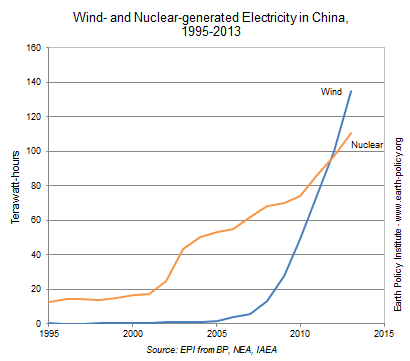
Engineering problems and delays are also a major culprit, and may prevent China from meeting its scaled-down nuclear power goals. As Grist points out, even if all Chinese nuclear capacity currently under construction were to become operational in the next six years, China would have reached only 45 gigawatts by 2020, well shy of its 58 gigawatts goal. Advanced plants that could bring higher efficiency, like a thorium reactor, will still require years of work to resolve engineering issues, researchers say.
Moreover, one of the benefits of nuclear power is that it can be installed close to where it is in demand—in contrast to wind and hydropower—lessening the distance that electricity has to travel along a power grid where some of the power is inevitably lost. But China is spending over 1 trillion yuan ($162.8 billion) to upgrade and expand its grid. As of last year, 84% of the country’s wind capacity was connected to the grid, from 72% in 2011, and the amount of wind-generated electricity wasted in transfer has fallen to 11% from 16% over the same period,according to Fitch Ratings.
William Magwood ‘a tool of the nuclear industry’ to head OECD’s Nuclear Energy Agency
 Democrat Magwood Stepping Down From Nuclear Panel abc news, WASHINGTON March 19, 2014 (AP) By MATTHEW DALY Associated Press William Magwood, a member of the Nuclear Regulatory Commission whose criticism helped lead to the ouster of the agency’s former chairman, said Wednesday he soon will be leaving the five-member commission.
Magwood, 52, a Democrat, has served on the NRC since 2010. He was one of four commissioners — two Democrats and two Republicans — who wrote to the White House in 2011, complaining that then-NRC Chairman Gregory Jaczko was a bully responsible for a tense and unsettled work environment, and that women at the NRC felt particularly threatened.
The letter said the four commissioners had “grave concerns” about Jaczko, adding that his bullying style was “causing serious damage” to the agency’s mission to protect health and safety at the nation’s 104 commercial nuclear reactors…….
Magwood is set to start in September as director general of the Paris-based Nuclear Energy Agency, an arm of the Organization for Economic Cooperation and Development, an intergovernmental organization of 31 countries in Europe, North America and Asia……..
it was his public criticism of Jaczko that drew the most attention on Capitol Hill and at the White House…….
Magwood disputed a claim by Senate Majority Leader Harry Reid, D-Nev., that the allegations against Jaczko were politically motivated. Jaczko worked for Reid before taking over as NRC chairman in 2009, and Reid expressed strong support for Jaczko throughout his tenure……
In an interview with the Huffington Post after Jaczko’s resignation, Reid lashed out at Magwood, calling him “a treacherous, miserable liar” who had deceived Reid about opposing Yucca Mountain. “He’s a first-class rat … (and) a tool of the nuclear industry,” Reid said.
Magwood declined to comment Wednesday.
Before joining the NRC, Magwood served in the Clinton administration, where he headed the Energy Department’s Office of Nuclear Energy. He also was a top official at the Edison Electric Institute, a trade association representing the electric industry, and worked at Westinghouse Electric Corp.http://abcnews.go.com/Politics/wireStory/democrat-magwood-stepping-nuclear-panel-22972523
Mysterious plume over old New Mexico nuclear bomb test site
 Weather experts baffled by mystery plume on New Mexico radar near 1945 nuclear bomb test site (EXCELLENT PICTURES) http://www.dailymail.co.uk/news/article-2584235/Weather-experts-baffled-mystery-plume-New-Mexico-radar-near-1945-nuclear-bomb-test-site.html
There is speculation that the cloud could be the result of a weapons test
But the U.S. has not done A-bomb tests since the Test Ban Treaty in 1992
Plume originated from White Sands Missile Range in Socorro county
By DAILY MAIL REPORTER, 19 March 2014 A mystery ‘storm cloud’ caught on weather radar after erupting off a U.S. military missile testing ground in New Mexico has left weather experts baffled.
Conspiracy theorists have speculated that the plume-like cloud, which seems to appear out of nowhere, could have been kicked up by the explosion from an unreported weapons test.
Deepening the mystery, U.S. National Weather Service offices in Albuquerque and El Paso have confirmed the reading, but say they have no idea where it could have come from. The plume first appeared at sunset on Monday evening over the part of the vast White Sands Missile Range in east Socorro county, close to the ‘Trinity Site’ where the first atomic bomb was detonated in 1945.
It was spotted in publicly accessible radar data by a blogger, who tracked its progress and has published his findings in two YouTube videos and a blog post.
-
Archives
- February 2026 (228)
- January 2026 (308)
- December 2025 (358)
- November 2025 (359)
- October 2025 (376)
- September 2025 (258)
- August 2025 (319)
- July 2025 (230)
- June 2025 (348)
- May 2025 (261)
- April 2025 (305)
- March 2025 (319)
-
Categories
- 1
- 1 NUCLEAR ISSUES
- business and costs
- climate change
- culture and arts
- ENERGY
- environment
- health
- history
- indigenous issues
- Legal
- marketing of nuclear
- media
- opposition to nuclear
- PERSONAL STORIES
- politics
- politics international
- Religion and ethics
- safety
- secrets,lies and civil liberties
- spinbuster
- technology
- Uranium
- wastes
- weapons and war
- Women
- 2 WORLD
- ACTION
- AFRICA
- Atrocities
- AUSTRALIA
- Christina's notes
- Christina's themes
- culture and arts
- Events
- Fuk 2022
- Fuk 2023
- Fukushima 2017
- Fukushima 2018
- fukushima 2019
- Fukushima 2020
- Fukushima 2021
- general
- global warming
- Humour (God we need it)
- Nuclear
- RARE EARTHS
- Reference
- resources – print
- Resources -audiovicual
- Weekly Newsletter
- World
- World Nuclear
- YouTube
-
RSS
Entries RSS
Comments RSS
 nuclear-news