Insidious censorship of scientists studying nuclear radiation to Japan
Another example of ☢ scientists being told to “SHUT UP” by Gov’t.

Scientists studying radiation in Japan are subject to ‘insidious censorship’
http://www. naturalnews.com/044414_insidious_censorship_radiation_Japan.html
Sunday, March 23, 2014 by: L.J. Devon, Staff Writer n order to appease the fears of the public and maintain order, leaders of government institutions often restrict valuable and alarming information from broadcast or publication. This censorship keeps the masses unaware but cooperative, as the truth is picked through and decimated. Such leaders are often timid and tend to uphold the status quo. They will typically refrain from riling people up so as not to disturb the powers of special interest that could shutter their career and livelihood.
While vital information is picked apart and wrought with censorship, people may suffer from the consequences of not knowing and not being able to take action.
Scientist finds alarming initial Fukushima cesium-137 measurements but is censored
When the Fukushima nuclear crisis began in March 2011, much censorship was placed on…
View original post 634 more words
Three Mile Island nuclear accident: 35 years later the lies continue
Three Mile Island – 35 years on http://www.theecologist.org/News/news_analysis/2334940/three_mile_island_35_years_on.html Linda Pentz Gunter 28th March 2014 Thirty-five years ago today the USA had its worst ever civilian nuclear accident with a reactor meltdown at Three Mile Island. Linda Pentz Gunter reports on the lies and cover ups about the true scale of the radiation release and its impacts on human health. Today marks 35 years since the meltdown at Unit 2 of the Three Mile Island (TMI) nuclear power plant near Harrisburg, Pennsylvania. Despite the long passage of time, myths and misinformation about the disaster still abound. Many questions may remain permanently unanswered.
The consequences of the TMI disaster were made more serious because, early on, emergency planning officials were repeatedly misinformed about the disaster’s progression and kept in the dark about the need for public protective actions.
Ironically, despite today’s popular ‘too much information’ shorthand, TMI is a story of ‘too little information’. What the public believes about TMI is far removed from what really happened. Continue reading
Thorium – the nuclear power fuel of the perpetual future
Clamping down on tweets Mar 26th 2014, by Economist.com Thorium the wonder fuel of Tomorrowland by Oliver Morton HOW the Doppler effect helped locate the likely remains of MH370, why thorium will not be the fuel of tomorrow and how Turkey (tried to) shut Twitter down

Japan’s ploy to return Fukushima evacuees – delaying radiation data

 Withholding of radiation readings exposes gov’t push for evacuees’ return, Mainichi, 29 Mar 14, Recent revelations that a Cabinet Office team delayed the release of radiation measurements from three Fukushima Prefecture areas, planning to release them with lower, recalculated results, have exposed a government push to have residents’ return to nuclear disaster-hit areas.
Experts have raised questions about the government’s move, suggesting that officials intended to send residents back to those areas from the outset and that they manipulated data to achieve that purpose.
The three areas — the Miyakoji district of the city of Tamura, the village of Kawauchi and the village of Iitate — remain subject to evacuation orders imposed after the 2011 Fukushima No. 1 nuclear plant meltdowns. The government plans to lift these orders in the near future. According to one source familiar with the measurement process, the original radiation exposure readings from new, individual dosimeters were higher than expected, prompting the Cabinet Office team to withhold the results. Officials feared the higher readings would discourage residents from returning……… http://mainichi.jp/english/english/perspectives/news/20140327p2a00m0na009000c.html
How to limit your exposure to electromagnetic radiation
Waves of uncertainty over wi-fi Stuff.co.nz 29 March 14“……..CUT BACK ON YOUR EXPOSURE
MOBILES AND DEVICES
Before buying a cellphone or internet-capable device, check out its SAR (specific absorption rate) rating – though in New Zealand you’ll likely have to go online for this information. The SAR measures how much the device’s emissions are absorbed by the body. Lower ratings indicate lower absorption.
Ensure your mobile has flight mode and use this as often as you can, including overnight, and when carrying it close to your body.
For long computing tasks, select a wired desktop or plugged-in laptop, rather than a wireless tablet.
Avoid holding a laptop or device on your lap or stomach – use a table instead, unless it’s in flight mode.
When you can, choose a text over a call. Keep phone calls to a minimum or use a hands-free kit.
Keep calls to a minimum where reception is bad – when a mobile is far from a cell tower, it has to boost its signal to connect.
Choose a wired mouse and keyboard.
CORDLESS PHONES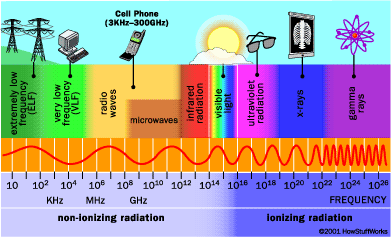
If possible, choose corded devices, or purchase one with speaker-phone capabilities.
Keep the main transmitting base of the cordless phone away from bedrooms and desks.
Keep calls short.
WI-FI
When installing a transmitting unit, ask for it to be put up high, such as on the wall or a shelf, away from bedrooms or where people sit.
Only turn the system on when you’re using it. Make sure the router is turned off overnight, especially.
Choose software on a laptop rather than cloud-computing technology such as Google Docs, if you’re using wi-fi. Typing in a Google Docs word processing means a wi-fi signal is sent with every single keystroke.http://www.stuff.co.nz/dominion-post/news/9882716/Waves-of-uncertainty-over-wi-fi
How the Intergovernmental Panel on Climate Change works
 Explainer: how are IPCC reports written? , The Conversation, 29 March 14 David Karoly, Professor of Atmospheric Science at University of Melbourne This week in Yokohama, Japan, a group of scientists and representatives of more than 120 governments are meeting to approve the report Climate Change 2014: Impacts, Adaptation and Vulnerability. They will also agree on its Summary for Policymakers – an arduous process of negotiation and line-by-line approval. On Monday they will release it to the media and public.
This is the second part of the Assessment Report of the IPCC. It follows last September’s release of the first part, Climate Change 2013: The Physical Science Basis.
The IPCC was established in 1988 to undertake comprehensive assessments of the scientific basis of climate change and the impacts and future risks to different sectors and regions. It also assesses the options for adapting to these impacts, and opportunities to mitigate climate change.
The IPCC is the accepted global authority on climate change. A recent explainer on The Conversation has described the structure of the IPCC and how it works.
It has three “Working Groups”: one on Climate Change Science; one on Impacts, Adaptation and Vulnerability; and one that deals with Mitigation of Climate Change. They work together to prepare comprehensive Assessment Reports roughly once every six years. The IPCC Third Assessment Report was released in 2001 and the Fourth Assessment Report in 2007.
Now we are in the middle of the release of the various parts of the Fifth Assessment Report, one from each Working Group and finally the Synthesis Report, to be released later this year.

How are the reports written?

The IPCC assessments are written by hundreds of leading scientists who volunteer their time. They undertake comprehensive assessments of the scientific literature across a very wide range of topics relevant to climate change. The reports are required to present policy-relevant information, but it must be presented in a policy-neutral manner, so there are no recommendations in any IPCC assessment.
Each part of the report goes through three stages of drafting and review by experts and governments. All review comments and the responses from the authors on how they addressed the comments are made public. This review process is more open and comprehensive than for any other scientific publication or assessment, including the peer-reviewed science publications on which the reports are based.
The final stage, the approval of the Summary for Policymakers, is often misunderstood. The government representatives go through the final draft line by line, seeking to ensure that the text is scientifically accurate, that any uncertainties are carefully explained, and that the language is as clear as possible. The authors of the chapters ensure their scientific accuracy and can veto any text that they consider to be inaccurate. Every line is approved by consensus by the representatives of all the governments present. It takes a long time.
A very helpful explainer on how to read an IPCC report was published on The Conversation last September.http://theconversation.com/explainer-how-are-ipcc-reports-written-24641
Declassified information on suspected Israeli theft of nuclear weapons material
 Secrets About Suspected Israeli Theft of U.S. Weapons-Grade Nuclear Material Declassified Global Research, 27 Mar 14, On March 18, 2014 ISCAP, the highest declassification authority in the U.S., released 84 pages (PDF) of formerly secret information about investigations into the illegal diversion of weapons-grade nuclear material from a Pennsylvania plant into the clandestine Israeli nuclear weapons program. Files now available to the public from IRmep’s ISCAP process include:…….http://www.globalresearch.ca/secrets-about-suspected-israeli-theft-of-u-s-weapons-grade-nuclear-material-declassified/5375720?utm_source=rss&utm_medium=rss&utm_campaign=secrets-about-suspected-israeli-theft-of-u-s-weapons-grade-nuclear-material-declassified
What to do with 40,000 depleted uranium rounds scattered around Serbia?
 Serbian Minister, UN representatives discuss depleted uranium http://inserbia.info/today/2014/03/serbias-minister-un-representatives-discuss-depleted-uranium-sites/sites BELGRADE – Serbia’s Minister without portfolio for Kosovo-Metohija Aleksandar Vulin has discussed with UN representatives in Belgrade the progress made in research on locations in Serbia where higher levels of depleted uranium have been detected. Vulin on Thursday met with Peter Due, the Representative of the UN Secretary-General and Head of the UN Office in Belgrade, and UN Resident Coordinator Irena Vojackova-Solorano, the Serbian government’s Office for Kosovo-Metohija said in a statement.
Following field research in 1999 and 2002, the UN Environment Programme (UNEP) published reports on locations with higher levels of depleted uranium, the statement said.
During the 1999 bombing campaign, NATO forces used banned depleted uranium ammunition and Yugoslav Forces figures said that 30,000 to 50,000 rounds of depleted uranium ammunition were scattered on 112 locations across the country, but mostly in Kosovo-Metohija.
On the 15th anniversary of the bombing of the Federal Republic of Yugoslavia, Vulin discussed with the UN representatives the progress made in research on locations with higher depleted uranium levels in the territory of central Serbia, but also in Kosovo-Metohija.
Such research is helpful not only to Serbia, but also to other countries, Minister Vulin said.
Vojackova-Solorano said that the reports were the first of their kind and that the time has come to monitor the situation again, especially if the Serbian government has evidence of an impact of the bombing campaign on the health of the population in Serbia, the statement said.
She said that the UN agency will strive to provide support to Serbia’s health care system in the coming years.
Due also inquired about the progress in the technical negotiations on establishing the community of Serb municipalities and organising judicial authorities in northern Kosovo-Metohija.
Minister Vulin reiterated that any armed force in Kosovo-Metohija other than Kfor – the force envisioned by UN Security Council Resolution 1244 – is absolutely unacceptable to Serbia.
Call to keep renewable energy target, and close nuclear power – 30.000 Germans march
 GERMANY: As the German government comes close to completing its draft for a new Renewable Energy Act, intended to be implemented as soon as August, demonstrations in support of wind and renewables continue. Around 30,000 people took to the streets in seven major German cities to show their support for renewable energies and opposition against coal, nuclear and gas fracking on 22 March, reported environment and nature protection organisation Bund on the same day……..http://www.windpowermonthly.com/article/1286689/german-wind-protests-continue
New IPCC climate report coming up
 Explainer: how are IPCC reports written? , The Conversation, 29 March 14 David Karoly, Professor of Atmospheric Science at University of Melbourne #………This week, the IPCC has been meeting to approve the second part of its Fifth Assessment Report – the volume that covers “Impacts, Adaptation and Vulnerability”. This assesses the impacts of climate change and vulnerabilities to these impacts, as well as options for how we can adapt to minimize the impacts.
It considers a wider range of sectors than previous reports, as well as more regions of the globe. This means that this Impacts Assessment has twice as many chapters and is nearly twice as long as the previous IPCC Working Group 2 report in 2007.
The different sectors include water resources, terrestrial, coastal and ocean systems, food production, urban and rural areas, human health and human security, as well as approaches to adaptation and multi-sector risks and vulnerabilities. The regions include each of the continents, plus the poles, small islands, and the oceans.
The IPCC has worked hard to include a broader and more representative group as authors. Working Group 2’s writing team consists of 310 scientists from 73 countries, divided into Coordinating Lead Authors, Lead Authors and Review Editors. Most have not previously been involved in any of these roles in the past decade. Some 40% of the writing team come from developing countries and economies in transition.
When the report comes out on Monday, make sure to read its Summary for Policymakers (as well as The Conversation’s IPCC coverage).http://theconversation.com/explainer-how-are-ipcc-reports-written-24641
Seven months ahead of schedule, Bavarian nuclear reactor is shut down
EON notified the Bundesnetzagentur regulator and grid operator TenneT TSO GmbH of its plan to close the 1,275-megawatt Grafenrheinfeld plant at the end of May 2015 “because of its lack of profitability,” the Dusseldorf-based utility said in a statement.
“The continued operation of nuclear power stations in Germany only makes economic sense if they can operate for a sufficient length of time without the burden of the nuclear-fuel tax,” EON said in the statement. The early shutting of Grafenrheinfeld is “unavoidable.”
North Korea’s hostile response to South Korea
N Korea Assaults South Leader Over Nuclear Remarks Liberty Voice, by Fern  Remedi-Brown on March 29, 2014. South Korea President Park Geun-hye has been on a mission to reunify with North Korea. On March 24 the South Korean leader met at The Hague with U.S. President Barack Obama and Japanese Prime Minister Shinzo Abe. In the meeting, the leaders of the three countries pledged to cooperate vis à vis N Korea’s nuclear and missile programs. In The Hague, Ms. Park gave a speech, warning that the North’s nuclear devices could land in the hands of radical extremists. In response to her remarks, the North’s leader, Kim Jong-un, verbally assaulted her, likening her to a “peasant woman” who was “blabbering.” He also said she was a pawn in the hands of the U.S. and that she must learn to cease such reckless babble………http://guardianlv.com/2014/03/n-korea-assaults-south-leader-over-nuclear-remarks/
South Korea offers aid to North Korea
 South Korea proposes aid for North if it halts nuclear arms programme First Post, Mar 29, 2014 SEOUL (Reuters) – South Korean President Park Geun-hye proposed a broad range of economic aid for impoverished North Korea on Friday if it agrees to give up its nuclear programme. It was not immediately clear how the North would respond to the proposal, made in a speech in Dresden, Germany, but it has repeatedly rejected the idea of abandoning its nuclear programme, which it says is a necessary deterrent against U.S. hostility.
…………. http://www.firstpost.com/world/south-korea-proposes-aid-for-north-if-it-halts-nuclear-arms-programme-1455913.html?utm_source=ref_article
Be cautious with devices that give off electromagnetic radiation
Waves of uncertainty over wi-fi Stuff.co.nz 29 March 14“……..CUT BACK ON YOUR EXPOSURE
MOBILES AND DEVICES
Before buying a cellphone or internet-capable device, check out its SAR (specific absorption rate) rating – though in New Zealand you’ll likely have to go online for this information. The SAR measures how much the device’s emissions are absorbed by the body. Lower ratings indicate lower absorption.
Ensure your mobile has flight mode and use this as often as you can, including overnight, and when carrying it close to your body.
For long computing tasks, select a wired desktop or plugged-in laptop, rather than a wireless tablet.
Avoid holding a laptop or device on your lap or stomach – use a table instead, unless it’s in flight mode.
When you can, choose a text over a call. Keep phone calls to a minimum or use a hands-free kit.
Keep calls to a minimum where reception is bad – when a mobile is far from a cell tower, it has to boost its signal to connect.
Choose a wired mouse and keyboard.
CORDLESS PHONES
If possible, choose corded devices, or purchase one with speaker-phone capabilities.
Keep the main transmitting base of the cordless phone away from bedrooms and desks.
Keep calls short.
WI-FI
When installing a transmitting unit, ask for it to be put up high, such as on the wall or a shelf, away from bedrooms or where people sit.
Only turn the system on when you’re using it. Make sure the router is turned off overnight, especially.
Choose software on a laptop rather than cloud-computing technology such as Google Docs, if you’re using wi-fi. Typing in a Google Docs word processing means a wi-fi signal is sent with every single keystroke.http://www.stuff.co.nz/dominion-post/news/9882716/Waves-of-uncertainty-over-wi-fi
Uranium mining – environmental racism
Uranium Mining http://www.berkeleydailyplanet.com/issue/2014-03-28/article/41964?headline=Uranium-Mining—-By-Tejinder-Uberoi March 28, 2014 In a stark example of environmental racism, Native Indians have become the target of toxic uranium mining. Energy Fuels Resources recently obtained federal approval to reopen a mine in close proximity to the Grand Canyon’s popular South Rim entrance.
 Environmental activists have joined forces with Native Navajos to protest the decision siting serious health risks. Earlier uranium mining has scarred the landscape and left deposits of radioactive waste from 1,000 closed mines. The mining companies failed to adequately remove the radioactive wastes which have resulted in a dramatic increase in cancer and other serious ailments.
One native Indian activist, Klee Benally, remarked that “this is really a slow genocide of the people, not just indigenous people of this region, but it’s estimated that there are over 10 million people who are residing within 50 miles of abandoned uranium mines.” The long term impact of contaminated water seepage into groundwater and its impact on wildlife have been ignored. The five-year cleanup plan initiated by the EPA has also been ignored.
San Francisco Peaks, an area considered sacred by 13 Native tribes, has been severely impacted; to compound health concerns is the practice of using treated sewage water to make snow at the popular Snow bowl resort. The future of indigenous tribes has been railroaded over the interests of corporate greed and government watchdogs have fallen asleep at the wheel.
1 This Month

of the week – Shut Down Drone Warfare!


Tell the Ukrainian Government to Drop Prosecution of Peace Activist Yurii Sheliazhenko

Petition to revoke the licensing of the Near Surface Nuclear Disposal Facility (NSDF) at Chalk River. https://www.ourcommons.ca/petitions/en/Petition/Details?Petition=e-7247
To see nuclear-related stories in greater depth and intensity – go to https://nuclearinformation.wordpress.com
-
Archives
- April 2026 (57)
- March 2026 (251)
- February 2026 (268)
- January 2026 (308)
- December 2025 (358)
- November 2025 (359)
- October 2025 (376)
- September 2025 (257)
- August 2025 (319)
- July 2025 (230)
- June 2025 (348)
- May 2025 (261)
-
Categories
- 1
- 1 NUCLEAR ISSUES
- business and costs
- climate change
- culture and arts
- ENERGY
- environment
- health
- history
- indigenous issues
- Legal
- marketing of nuclear
- media
- opposition to nuclear
- PERSONAL STORIES
- politics
- politics international
- Religion and ethics
- safety
- secrets,lies and civil liberties
- spinbuster
- technology
- Uranium
- wastes
- weapons and war
- Women
- 2 WORLD
- ACTION
- AFRICA
- Atrocities
- AUSTRALIA
- Christina's notes
- Christina's themes
- culture and arts
- Events
- Fuk 2022
- Fuk 2023
- Fukushima 2017
- Fukushima 2018
- fukushima 2019
- Fukushima 2020
- Fukushima 2021
- general
- global warming
- Humour (God we need it)
- Nuclear
- RARE EARTHS
- Reference
- resources – print
- Resources -audiovicual
- Weekly Newsletter
- World
- World Nuclear
- YouTube
-
RSS
Entries RSS
Comments RSS
 nuclear-news