11 workers at Hanford nuclear waste facility hospitalised with ?radiation-caused illness
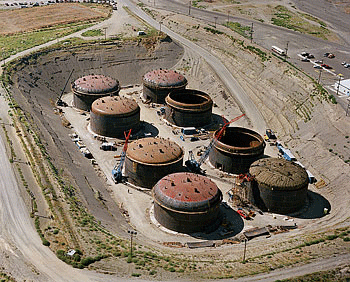 TV: 11 workers at U.S. nuclear site transported to medical facilities — Suffering nose bleeds, chest pains, coughing up blood — Multiple locations evacuated — Persistent symptoms “extremely unusual” — Workers: “The place is falling apart… serious problems out there” (VIDEO) http://enenews.com/tv-11-workers-at-u-s-nuclear-site-transported-to-medical-facilities-suffering-nose-bleeds-chest-pains-coughing-up-blood-multiple-locations-evacuated-persistant- KING 5 News Susannah Frame, Mar. 25, 2014: Hanford sources tell the KING 5 Investigators that at least 11 people have gotten sick in the last six days after breathing in toxic fumes while working near underground tanks holding hazardous nuclear waste. […] The first two workers to fall ill in the last week breathed in fumes that “tasted like copper” on Wednesday, March 19. […] both are still suffering effects of breathing in the vapors: headache, chest pain, difficulty breathing, nose bleeds and sore throats. One employee has coughed up blood. Sources who work in this area of Hanford tell KING […] this is “extremely unusual” to have symptoms persist this long. The next batch of employees to get sick breathed in fumes today, Tuesday, March 25. Four WRPS employees breathed in vapors at 9:00 am and were immediately transported to a medical facility […] the tank farm, identified as AY-AZ farm was evacuated […] Immediately afterward two employees from what’s known as the industrial hygiene department of WRPS [Washington River Protection Solutions], who monitor chemical exposures, were sent out to investigate and they too, had reactions to the fumes and were transported to the onsite medical facility. […] Sources tell KING 5 that three additional employees got sick from ingesting fumes later on Tuesday. TheseWRPS employees were working in a different portion of the tank farm […] about 8 to 10 miles from the AY-AZ farm. That location was also deemed a Vapor Control Zone and was evacuated. Sources say two were transported to the hospital by ambulance and one was transported to the HPMC.
Residents encouraged to return to Fukushima areas where radiation is high: data is withheld
nside Source: Gov’t officials are withholding Fukushima radiation data — Levels much higher than 
 Iexpected — Releasing numbers would “have a huge impact” — Over 2,000 millisieverts per year where residents are being encouraged to return http://enenews.com/inside-source-govt-officials-are-withholding-fukushima-radiation-data-levels-much-higher-than-expected-releasing-numbers-would-have-a-huge-impact-over-2000-millisieverts-per-year-wher?utm_source=feedburner&utm_medium=email&utm_campaign=Feed%3A+ENENews+%28Energy+News%29
Mainichi,Mar. 25, 2014: A Cabinet Office team has delayed the release of radiation measurements from three Fukushima Prefecture municipalities, and plans to release them later with lower, recalculated results, the Mainichi learned on March 24. […] According to one source, the original measurements were higher than expected, prompting the Cabinet Office team […] to hold the results back over worries they would discourage residents from returning. The Mainichi has acquired documents drawn up in November last year detailing the radiation measurements and intended for release. The documents, however, were never made public. According to this and other sources, the measurements were taken in September last year in the city of Tamura’s Miyakoji district, the village of Kawauchi and the village of Iitate […] According to an inside source, the Cabinet Office team had noticed that measurements taken with older dosimeters distributed by Fukushima Prefecture municipalities to residents showed radiation measurements much lower than those recorded by aerial surveys. The Cabinet Office team had planned to release the latest measurements […] putting special emphasis on how low the figures were. The new results, however, were significantly higher than expected, with the largest gap coming in Kawauchi. There, the Cabinet Office team had predicted radiation doses of 1-2 millisieverts per day, but the data showed doses at between 2.6 and 6.6 millisieverts. Cabinet Office team members apparently said that the numbers would “have a huge impact” […] and release of the results was put off. At the request of the Cabinet Office team, the JAEA and NIRS then recalculated the results by ditching the assumption that people would be outside eight hours a day […] Under these new assumptions, a farmer was now expected to spend around six hours a day outdoors.
Atsuo Tamura, official on the Cabinet Office team: “We did not hold the results back because they were too high. We did so because it was necessary to look into whether the assumptions for residents’ lifestyle patterns matched reality.”
Shinzo Kimura, associate professor of radiation and hygiene at Dokkyo Medical University: “The assumption of eight hours a day outside, 16 hours inside is commonly used, and it is strange to change it. I can’t see it as anything but them fiddling with the numbers to make them come out as they wanted.”
Mexico worried about the risks from USA’s radiation leak from New Mexico nuclear waste facility
Health & Environment
U.S. radiation leak concerns Mexicans
Juárez officials expected to meet with U.S. representatives on March 26 or 27 to discuss ongoing issues from February 14 incident
by Kent Paterson, Frontera NorteSur // March 25, 2014 Serious problems at a U.S. Department of Energy (DOE) nuclear waste dump in southeastern New Mexico have caught the eyes of the press and government officials in Ciudad Juarez, Mexico……Since February 14, additional radiation releases connected to the original one have been reported, even as more workers are still awaiting test results for possible radiation exposure during the first event. ……
Opened in 1999 after years of protests and litigation by environmentalists, WIPP is carved out of underground salt beds where low-level, or transuranic waste, from Cold War nuclear weapons programs is shipped for permanent burial. Transported from different sites across the United States, the disposed items contaminated with plutonium and other radioactive elements include clothing, tools, rags, soil and other materials, according to the DOE.
By 2011, WIPP had handled 10,000 shipments of transuranic waste. A private contractor, Nuclear Waste Partnership, operates the underground repository for the federal government…….
public doubts about the gravity of the February 14 incident persist due to incomplete contaminant data reporting, the slowness in getting all the potentially exposed workers tested and informed, spotty or contradictory statements by regulatory officials, and uncertainties over the origin of the radiation leak and how far an area it has impacted……
In mid-March, Farok Sharif was sacked as head of Nuclear Waste Partnership and Bob McQuinn named the new company president and WIPP project manager.
Mexican whistle-blower Bernardo Salas Mar, a former employee of the Laguna Verde nuclear power plant in Veracruz, said important bits of information need to be confirmed about theWIPP radiation release like the wind patterns at the time of the incident and the possible geographic scope of the spread of contaminants.
“The answer to these questions will lend knowledge to the damage that could have been caused,” Salas said. “After (radiation) ingestion or incorporation into the human organism, 10 or 15 years or more pass before the appearance of some kind of cancer.”
If plutonium and americium were indeed released into the larger environment, “the surrounding population should take precautions in order to avoid exposure to these contaminants,” he added…..
Back in the 1990s, Ciudad Juarez and U.S. environmentalists from the Rio Bravo Ecological Alliance took a stand against WIPPbased partly on concerns that the underground storage facility would eventually contaminate the Pecos River Basin and the Rio Grande.
February’s events have refocused public attention on not only the safety of current operations at WIPP, but plans to expand and streamline the depository’s storage capacity and even accept high-level waste from commercial operations …….
On February 28, representatives of 30 New Mexico citizen groups wrote to Flynn requesting that the Martinez administration cabinet official take precisely the action he did three weeks later.
“Once the radiation leak investigation and recovery occur, we would urge NMED to re-evaluate the draft permit in light of what is learned and make needed changes to protect public health and the environment before issuing a new draft permit for public review and comment,” the groups urged.
Signing on to the letter, among others, were representatives of Citizens for Alternatives to Radioactive Dumping, Laguna and Acoma Coalition for Safe Environment, New Mexico Environmental Law Center, Southwest Research and Information Center, Post-1971 Uranium Workers Committee, Albuquerque Mennonite Church, Concerned Citizens of Wagon Mound and Mora County, and Alliance for Environmental Strategies.
Dr. Mariana Chew, environmental engineer and longtime environmental activist in the Paso del Norte region, contended that a cross-border, information-credibility gap existed with regards to WIPP……Albuquerque and Santa Fe community meetings are sponsored by the Concerned Citizens for Nuclear Safety, Southwest Research and Information Center, Citizens for Alternatives to Radio Dumping and Nuclear Watch New Mexico.
“The same thing always happens. It happened with Asarco (ex-El Paso smelter) and other environmental disasters that weren’t made known to the public,” Chew was quoted in the daily Norte. “Given the history, this radiation shouldn’t be taken lightly. Whenever something happens, that’s when you hear about it.”
Additional Sources:…….http://newspapertree.com/articles/2014/03/25/us-radiation-leak-concerns-mexicans
Propaganda for Thorium nuclear reactors is no more than a distraction from the real plight of the entire nuclear industry
All in all, it rather looks like the nuclear industry, failing terribly to provide a reliable and affordable energy source, is trying to divert our attention from its scandals and incompetence to a distant, rosy dream. Not bad PR but not  much else.
The mythologies of thorium and uranium http://funologist.org/2014/03/26/the-mythologies-of-thorium-and-uranium by Jan Beránek – March 24, 2014 Thorium and uranium represent the heaviest naturally occurring elements on Earth. Both were named after ancient gods: Uranus was the principal Greek god of the sky while Thor was the Norse (and broadly Germanic) god of a thunder.
There’s a modern mythology surrounding thorium and uranium too, such as the currently very popular suggestion that thorium can replace uranium and deliver much better (safer, cheaper, fuel abundant) nuclear energy.
Well, we’ve heard all these things from advocates of nuclear energy before, haven’t we? Weren’t we told in the 50’s, 60’s, 70’s, 80’s, 90’s and even until recently that all these miracles would actually be delivered by uranium fueled reactors? Yeah, something obviously went wrong because none of those dreams actually came true, despite half a century’s worth of effort and hundreds of billions in subsidies poured into the nuclear industry.
What are the chances that replacing the Greek god with a Germanic one will help? Would Thor take his powerful hammer and nail it all down? Not likely.
Thorium technology is in principal based on nuclear fission and therefore keeps fission’s inherent problems. While it partially addresses some of the downsides of current commercial reactors based on uranium (plutonium) fuel, such as limited reserves of uranium and unwanted production of plutonium and transuranic isotopes, it still has significant issues related to fuel mining and fabrication, reactor safety, production of dangerous waste, and the hazards of the proliferation of nuclear weapons.
Let’s look more closely at some of the hopeful claims around thorium.
Safer reactors? The risks inherent in nuclear reactors are due to the massive concentrations of radioactive materials and the huge amount of heat they produce (which is actually needed to generate electricity). No matter if the fuel is based on uranium or thorium, if it’s solid or liquid, this characteristic alone will inevitably continue to be the Achilles heel of any nuclear reactor. As you can read in the Union of Concerned Scientists’ briefing on this issue, the truth is that the U.S. Department of Energy concluded in 2009 after a review that “the choice between uranium-based fuel and thorium-based fuel is seen basically as one of preference, with no fundamental difference in addressing the nuclear power issues [of waste management, proliferation risk, safety, security, economics, and sustainability].”
Less nuclear waste? It’s obvious that fission applied to different nuclear fuel results in a different composition of radioactive waste. But it’s still radioactive waste and whether the waste produced by thorium reactors is less problematic (because there’s no plutonium in it) remains a question. Spent thorium fuel still contains long-lived isotopes such as proactinium-231 (with a half-life 32,000 years which is even longer than plutonium Pu-239) which implies the need for long term management in timescales comparable to typical high level waste from uranium reactors. Not surprisingly, a chart published in Nuclear Engineering International magazine in November 2009 shows that the radiotoxicity of spent thorium fuel is actually higher than uranium spent fuel over the long term, ie after first 10,000 years:
No proliferation? Yes, thorium can’t itself be used to build nuclear weapons but it can’t be used directly as a nuclear fuel either. In fact, it has to be first converted into the fissile uranium isotope, U-233. That’s an isotope that is suitable for nuclear weapons. The US successfully detonated a nuclear bomb containing U-233 in 1955.
Even the UK Department of Energy and Climate Change commissioned a report which concluded in 2012 that the claims by thorium proponents who say that the radioactive chemical element makes it impossible to build a bomb from nuclear waste, leaves less hazardous waste than uranium reactors, and that it runs more efficiently, are “overstated”.
Thorium reactors exist only in blueprints and early experiments, which means there could be other issues not yet detected that would complicate their large scale implementation. In any case, this also means that it would take much longer than a decade before thorium reactors would potentially become available for a larger commercial deployment.
Recent studies, like the one published by the Norwegian thorium commission, while being supportive of the concept, also conclude that there are many uncertainties and problems related to it. It notes that Norwegian thorium reserves are of limited economic attractiveness compared to other sources; that accelerator-based reactors will be viable in the distant future at best; that thorium reactors would create nuclear waste problems; and that any of this will require massive international research.
Related to this is thorium’s unknown economic performance. Experts suggest that one of the key reasons why thorium reactors are not being developed is that they cannot compete economically with uranium fuel-based reactors, due to more complicated fuel fabrication and processing. And current pressurized water reactors are already uncompetitive. With investment costs of current reactor technology easily reaching 8,000 USD/kW of installed capacity, it is difficult to imagine that thorium reactors would be developed and built in foreseeable future.
All in all, it rather looks like the nuclear industry, failing terribly to provide a reliable and affordable energy source, is trying to divert our attention from its scandals and incompetence to a distant, rosy dream. Not bad PR but not much else.
While we are once again told to dream about a bright nuclear future, modern renewable energy technologies are already cheaper and upscaled well beyond nuclear: in 2013, while only 4,000 MW was globally installed in four single reactors, installations of wind and solar combined reached 80,000 MW. Those newly added capacities of wind and solar alone will generate, on an annual basis, as much electricity as twenty large reactors.
Let’s not get distracted. Let’s not waste even more time, money and brainpower on trying to make the impossible: a nuclear energy source that would actually really work. The future is renewable, and that’s where we need to go as quickly as possible.
The life of a Fukushima nuclear clean-up worker, shown in Manga art
Former Fukushima worker depicts life inside crippled nuclear plant in manga http://japandailypress.com/former-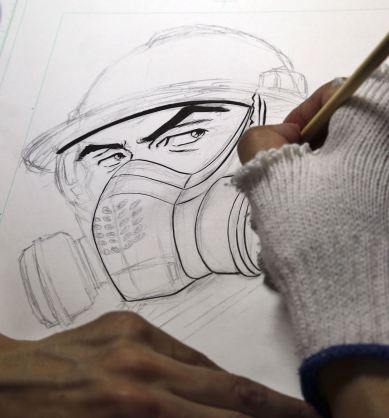 fukushima-worker-depicts-life-inside-crippled-nuclear-plant-in-manga-2646389/We’re used to having superheroes, athletes, samurai, chefs, and even taxmen, depicted in mangaseries, but would you be interested in reading about the “adventures” of nuclear plant workers? Well, if it depicts life at the crippledFukushima Daiichi nuclear plant, then maybe there is enough of an audience for this unique kind of story.
He then decided to write and draw the story of what he and the other workers experienced everyday. His first episode was published in the weekly manga magazine Morning, and even won a newcomer award for the 49-year-old artist. He is expected to release the next few episodes as a book next month, and his publisher Kodansha Ltd. is planning on turning it into a series. However, Tatsuta emphasizes that his story is not meant to take any side in the ongoing debate about the need for nuclear power vs the safety of the public. He also doesn’t mean to glorify nuclear plant workers, but said they deserve to earn more than what they’re getting, around $80-$200 a day, given the hazardous nature of their job. Tokyo Electric Power Co (TEPCO), the operator of the nuclear plant, refused to make any statement about the book, but spokesman Koichiro Shiraki said, “It’s just a manga.”
Read the entire first chapter of 1F, for free, translated into English on the series’ Facebook page (first 4 pages shown below in the original article.).
Obama stresses the importance of nuclear terrorism risk to New York and other cities
Obama says he’s more worried about the possibility of ‘nuclear weapon going off in Manhattan’ than  Russian threat
The President says the Russians ‘don’t pose the No. 1 national security threat to the United States,’ despite the Kremlin’s land grab of Crimea.
New Yorkers got a chilling wake up call Tuesday about just how badly terrorists want to strike the city.
The warning came straight from the top: President Obama.
During a news conference in Europe, Obama said he’s far more worried about the possibility of a nuclear weapon exploding in New York City than he is about the threat posed by Russia following its invasion of Ukraine.
“Russia is a regional power that is threatening some of its immediate neighbors, not out of strength, but out of weakness,” Obama said in The Hague, Netherlands.
“Russia’s actions are a problem. They don’t pose the No. 1 national security threat to the United States,” the President added……..
Anti-terrorism officials have long considered the detonation of a nuclear device in a major U.S. city the nation’s worst-case terror scenario.
Since 2007, the Department of Homeland Security has poured more than $118 million into the NYPD-led Securing the Cities nuclear detection program.The program pays for sensors — some stationary, some so small they are worn by first responders — that can detect unusual radiation as far as 150 miles from midtown Manhattan.
The sensors target both Hiroshima-style nuclear devices as well as “dirty” bombs — which use traditional explosives to spread radioactive material………http://www.nydailynews.com/news/politics/obama-warns-russia-ukraine-advance-article-1.1734113
Slowly, some progress on Nuclear Security
 Measured Progress on Nuclear Security

NYT, By THE EDITORIAL BOARDMARCH 25, 2014 Although the summit meeting was overshadowed by the crisis in Ukraine, 53 international leaders in The Hague this week made important progress on securing nuclear materials around the world and keeping them out of the hands of terrorist groups like Al Qaeda. There is still a long way to go to address the challenges of a world awash in nuclear materials and weapons, but many countries are taking constructive action……..At this week’s summit meeting, only 35 of the 53countries agreed to enact into their laws internationalguidelines on nuclear security like criminalizing unauthorized acts involving nuclear materials. What is needed are binding international legal standards, applicable to all, and a treaty to ban the production of fissile material altogether.http://www.nytimes.com/2014/03/26/opinion/measured-progress-on-nuclear-security.html?_r=0
India launches long range missile from underwater
INDIA TEST FIRES LONG RANGE N-MISSILE, Greater Kashmir, New Delhi, Mar 25: India has successfully test-fired a nuclear-capable ballistic missile launched from an underwater platform with a range of over 2,000 kms.
The missile, which can be launched from submarines, was test-fired yesterday in the Bay of Bengal and all parameters were met, Defence Ministry sources said.
This is the longest range missile in the underwater category to have been developed by India. With this development, India has developed the capability of launching long-range nuclear-capable missile from surface, air and underwater…….
Community speak ups forcibly to Panel on decommissioning of San Onofre nuclear plant
San Onofre panel hears from community Orange County Register 25 Mar 14,A Community  Engagement Panel tasked with helping guide Southern California Edison’s dismantling of the shuttered San Onofre Nuclear Generating Station got an earful from the public Tuesday night and raised questions of its own.
Most of the two dozen speakers who addressed the panel during a three-hour meeting at the San Clemente Community Center were activists urging the members to stress safety over efforts to save money……..
Edison appointed the panel to provide a public sounding board during what could be a 20-year decommissioning. Everyone agreed that safe storage of nuclear waste is the challenge, as the federal government hasn’t fulfilled a decades-old promise to provide permanent storage in a remote location.
“I’m concerned it will never be moved,” said San Diego County Supervisor Bill Horn, a panel member questioning how safe long-term on-site storage would be, particularly with I-5 and Southern California’s rail line close by.
“You, in my minds, are the guardians of the future of Southern California,” activist Marni Magda from Laguna Beach told the panel. Jenifer Massey of San Clemente and others suggested not waiting for the federal government and appealing instead to California to solve its own dilemma by establishing a remote site within the state……..
Palmisano described a process for decommissioning to nearly 200 people gathered at the Community Center.
“This is a huge engineering project,” said David Victor, chairman of the panel. “It seems to be as difficult to dismantle a plant as it is to build one in the first place.”
Victor said there will be some aspects where the panel can provide valuable input while other aspects will be constrained by the regulatory process – the U.S. Nuclear Regulatory Commission and California Public Utilities Commission.
Victor said the next meeting will be sometime in May at a site to be announced.http://www.ocregister.com/articles/panel-606987-san-community.html
Did Yulia Tymoshenko really say ‘nuclear weapons’ should be used to kill Russians ?
In latest wiretapping leak, Yulia Tymoshenko appears to say ‘nuclear weapons’ should be used to kill Russians http://www.washingtonpost.com/blogs/worldviews/wp/2014/03/25/in-latest-wiretapping- leak-yulia-tymoshenko-appears-to-say-nuclear-weapons-should-be-used-to-kill-russians/
-
 BY ADAM TAYLOR
 -
March 25 On Monday night, a leaked recording purporting to be of former Ukrainian PrMinister Yulia Tymoshenko appeared on the video sharing Web site YouTube.
According to the Moscow Times, the recording, apparently made March 8, details a conversation between Tymoshenko and Nestor Shufrych from Ukraine’s National Security Council, and has Tymoshenko suggesting that Ukrainians should kill Russians, and, in particular, Russian President Vladimir Putin. The recording, which may have been altered, also apparently features Tymoshenko suggesting that the 8 million Russians living in Ukraine should be killed with “nuclear weapons.”
- The video containing the recording was initially uploaded to a YouTube account under the name Sergiy Vechirko, and has since been widely shared on pro-Kremlin media outlets, with Russia Today producing its own version with translation:
- While the Moscow Times reports that Shufrych has denied the recording is real, a tweet from Tymoshenko appears to suggest she believes at least part of it is:

Internal radiation to 142 Fukushima workers wrongly estimated – seriously underestimated
Wrong radiation exposure readings found for 142 Fukushima workers http://ajw.asahi.com/article/ 0311disaster/fukushima/AJ201403260046March 26, 2014
By TOMOHIRO YAMAMOTO/ Staff Writer
Tokyo Electric Power Co. underestimated internal radiation doses of 142 individuals who worked at its Fukushima No. 1 nuclear power plant immediately after the triple meltdown three years ago, according to the health ministry.
Also on March 25, the ministry said it instructed TEPCO to strictly monitor the health of workers according to established procedure.
The ministry said it revised the workers’ radiation exposure records upward by an average of 5.86 millisieverts. In one exceptional case, the radiation dose was amended by an additional 89.83 millisieverts, from 90.27 millisieverts to 180.10 millisieverts, exceeding the government-set limit of 100 millisieverts over five years.
The TEPCO employee continued to work at nuclear facilities because the utility believed the person’s radiation dose was well under the limit, according to ministry officials.
The health ministry also said an additional two individuals exceeded the legal annual limit of 50 millisieverts due to the new findings.
Twenty-four of the 142 individuals whose records were revised upward were TEPCO employees. The other 118 were contractors from 18 partner firms.The government has examined the records of 1,536 of the 7,529 employees and contractors who worked at the plant between March and April in 2011. It did so after discovering in late January that TEPCO had used inadequate methods to estimate some workers’ radiation doses while rechecking TEPCO’s health management of workers.
The utility, for example, underestimated internal doses of those who had taken iodine tablets to protect their thyroid glands from radiation exposure. It remains unclear whether and how much the agent had reduced exposure levels.
Serious radioactive contamination to render New Mexico nuclear waste facility unusable
Radiation Expert: 5 types of plutonium were released from WIPP; Officials not informing public —  Caldicott: “I predict that facility will never be able to be used again”; Inhaling a millionth of a gram of plutonium will induce lung cancer (AUDIO) http://enenews.com/radiation-expert-5-types-of-plutonium-were-released-from-wipp-officials-not-informing-public-caldicott-i-predict-that-facility-will-never-be-able-to-be-used-again-inhaling-a-millionth-of-a?utm_source=feedburner&utm_medium=email&utm_campaign=Feed%3A+EN
KUNM, Mar. 24, 2014: The director of an organization that evaluated the WIPP site for over 25 years said officials aren’t doing enough to inform New Mexicans. […] “I just can’t stress the importance of DOE being available to respond to detailed questions that people have,” [Dr. Bob Neill] said. “There’s no substitute for direct communication.” Immediately after the leak was discovered, the public should have been given a detailed explanation of what was released, said Dr. Neill, who received his degree in radiological medicine. Americium 241 and plutonium 239 were mentioned. “But there are four other radio-isotopes of plutonium, namely the 238, 240, the beta and 241,” he said. “They’re all bone-seekers. So you want to be able to report all the values—how each one may have contributed. It’s just essential.” […] “It’s so important to answer people’s questions—and not just people in Carlsbad, but throughout the state and elsewhere,” he said. As for the leak itself, he said all of the possible causes of the failure at WIPP must be considered, and a response system should be designed accordingly.
Interview with Dr. Helen Caldicott,, March 2014 ): One of the repositories for very, very dangerous radioactive waste plutonium, americium, etc. has just leaked radiation all around the area in Carlsbad, New Mexico. One microgram of plutonium, a millionth of a gram of plutonium, if inhaled will induce lung cancer. It’s extraordinarily radioactive. So they thought this would be safe storing radiation in salt mines, but something happened, one of the casks blew up or part of the ceiling fell on the casks, we do not know. But I predict that that facility will never be able to be used again, it will be so contaminated.
Despite all the hype, uranium industry is looking sick
Uranium Week: Another Broker Downgrades Price Forecasts Ninemsn-Mar 24, 2014 Only four  transactions totalling 500,000lbs of U3O8 equivalent were conducted in the spot uranium market last week. Industry consultant TradeTech notes year to date volumes, at just 7.4mlbs, are down 32% on the same time last year. The ongoing lack of buyer urgency saw TradeTech’s spot price indicator fall another US15c to US$34.60/lb.
Critical to global demand-supply is the restart of Japanese reactors, progress in which has been slower than the broker expected.
So far 17 of Japan’s 44 idled reactors have applied to the regulator for restart,……
Brokers have long seen the first Japanese restarts as the impetus for the uranium market to overcome its malaise, but even with the first of these in sight a well supplied market has meant little price improvement.
As a result, Merrills has lowered its 2014 spot price forecast by 3.2% ….There were no transactions in the term market last week and TradeTech’s term price indicators remain unchanged at US$37.75/lb (mid) and US$50.00/lb (long)……..http://finance.ninemsn.com.au/article.aspx?id=8819579
USA’s Treasure Island homes to be tested for ionising radiation
Navy to test Treasure Island homes for radiation,SF Gate Marisa Lagos Updated 7:19 am, Tuesday, March 25, 2014 The U.S. Navy will test all of the homes on Treasure Island for elevated radiation levels in response to increasing public concern over the island’s safety after the discoveries in recent years of radioactive items buried near housing……..
Critics have questioned whether the city should have moved people onto the island in the first place. While the Navy knew it would need to undertake an environmental cleanup before the island could be developed, the military and city of San Francisco didn’t wait for that cleanup to be completed before moving people there: About 2,000 families have lived in former military housing on the island and nearby Yerba Buena Island since 1999.
The Navy didn’t publicly acknowledge that there was radiological contamination until 2007 but has long known about other contaminants in the housing area, including asbestos and lead paint in the half-century-old homes and the arsenic, pesticides, lead, PCBs and other chemicals left over in the soil from when the housing area was used as a trash pit…..
The Navy said the radiation is left over from the decontamination of radioactive ships and from dials, gauges and deck markers left behind from a time when the military used radioactive paint to make objects glow in the dark.http://www.sfgate.com/bayarea/article/Navy-to-test-Treasure-Island-homes-for-radiation-5345049.php
Fukushima radiation decontamination system not working
Fukushima decontamination system down
March 26, 2014 The operator of Japan’s crippled Fukushima nuclear plant says it has shut down a key decontamination system used to clean radiation-tainted water, just hours after it came back online.
Tokyo Electric Power (TEPCO) switched off its Advanced Liquid Processing System (ALPS) after workers discovered leaks ‘seeping’ from a tank late on Monday.
About eight litres of tainted water is believed to have leaked out, a company spokesman said. He says there are no immediate safety risk as the water has been recovered.
The suspension came just six hours after the embattled operator switched back on two of three lines in the system, which cleans radiation-tainted water used to cool the reactors damaged by Japan’s devastating 2011 quake-tsunami disaster.
The whole system was shut down last Wednesday after TEPCO discovered a defect. The firm has repeatedly switched the system off over a series of glitches since trial operations began a year ago.
TEPCO is struggling to handle a huge – and growing – volume of contaminated water at Fukushima……
There are about 436,000 cubic metres of contaminated water stored at the site in about 1,200 purpose-built tanks……http://www.skynews.com.au/world/article.aspx?id=961162
1 This Month
To see nuclear-related stories in greater depth and intensity – go to https://nuclearinformation.wordpress.com/
12 February – Webinar The Big Push: New Nuclear Projects in Canada
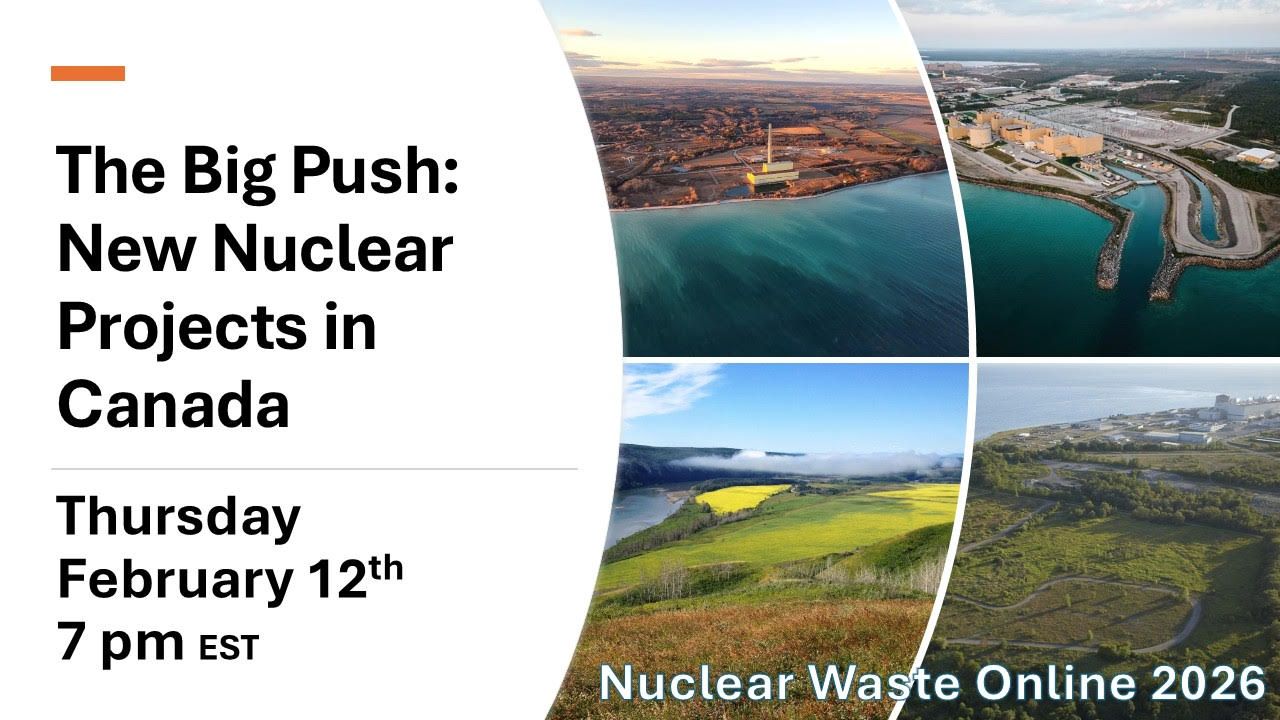
Thursday, February 12, 7 pm Eastern | 2nd of 4 sessions in the 2026 Nuclear Waste Online webinar series
Join a webinar on the push for new nuclear generation in Canada. Go to Northwatch.org to register or use the registration link https://us02web.zoom.us/webinar/register/WN_ZfWOf1GITqSRIZX8CB-A9w
-
Archives
- February 2026 (105)
- January 2026 (308)
- December 2025 (358)
- November 2025 (359)
- October 2025 (376)
- September 2025 (258)
- August 2025 (319)
- July 2025 (230)
- June 2025 (348)
- May 2025 (261)
- April 2025 (305)
- March 2025 (319)
-
Categories
- 1
- 1 NUCLEAR ISSUES
- business and costs
- climate change
- culture and arts
- ENERGY
- environment
- health
- history
- indigenous issues
- Legal
- marketing of nuclear
- media
- opposition to nuclear
- PERSONAL STORIES
- politics
- politics international
- Religion and ethics
- safety
- secrets,lies and civil liberties
- spinbuster
- technology
- Uranium
- wastes
- weapons and war
- Women
- 2 WORLD
- ACTION
- AFRICA
- Atrocities
- AUSTRALIA
- Christina's notes
- Christina's themes
- culture and arts
- Events
- Fuk 2022
- Fuk 2023
- Fukushima 2017
- Fukushima 2018
- fukushima 2019
- Fukushima 2020
- Fukushima 2021
- general
- global warming
- Humour (God we need it)
- Nuclear
- RARE EARTHS
- Reference
- resources – print
- Resources -audiovicual
- Weekly Newsletter
- World
- World Nuclear
- YouTube
-
RSS
Entries RSS
Comments RSS
 nuclear-news