Climate change bad for nuclear industry? Britain will get more floods
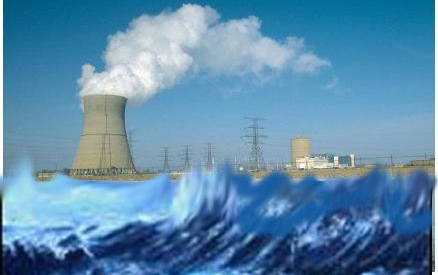 Britain had to close down its Dungeness nuclear power plant for 5 months, for fear of flooding.
Floods in Britain: a sign of things to  come? http://www.enn.com/ecosystems/article/47190 21 Mar 14, A new investigation of long-term weather records suggests that the recent flooding in the south of England could signal the onset of climate change. The research, from UWE Bristol, Loughborough University and the University of East Anglia has produced a new index of flooding trends called the Fluvial Flood Indices. This enables widespread flooding and weather patterns to be viewed in the context of the last 150 years, revealing that four of the six most severe flood episodes since 1871 have occurred in the last 30 years. The new index was developed by Professor Rob Wilby from Loughborough University and Associate Professor Nevil Quinn from UWE Bristol, and was published in the Journal of Hydrology last year. With the collaboration of Dr. Colin Harpham from the University of East Anglia, the index has been updated to cover the most recent flooding.
The indices match weather patterns and river flow data collected over the last 60 years to reconstruct the likelihood of widespread flooding in Britain back as far as the 1870s. The index is broken down by British region and updated weekly from atmospheric pressure data.
Professor Quinn, who is a hydrologist and specialist in flood risk management, said, “One of the greatest difficulties in flood estimation is that recorded flood data are rare — very few stations were operating prior to 1950. The index is based on the association between the atmospheric pressure patterns at the time and the concurrent recorded flood events. Since we have a classification of atmospheric pressure patterns called Lamb Weather Types going back to 1871 we can contextualize floods in relation to a much longer period.”
The indices reveal that the sequences of weather leading to the recent floods in southern England occur on average once every 25 years. The worst flooding suggested by the series happened in 1872, with later flood-rich episodes in the 1950s, 1980s and 2000s. Professor Wilby said, “The extraordinary events in 1872 show the extent to which flood severity varies from one decade to the next. This flooding was so significant it was even captured in a painting by Monet. However, to experience four of the six most severe episodes in the last 30 years is disconcerting. Such a flood-rich period in the context of a 144-year record is very unusual and linked to the large number of cyclones passing over the country.”
It is envisaged researchers and agencies interested in tracking long-term changes in weather patterns linked to widespread flooding could use the indices.
Read more at ENN affiliate Click Green.
No comments yet.
1 This Month


Tell the Ukrainian Government to Drop Prosecution of Peace Activist Yurii Sheliazhenko

Petition to revoke the licensing of the Near Surface Nuclear Disposal Facility (NSDF) at Chalk River. https://www.ourcommons.ca/petitions/en/Petition/Details?Petition=e-7247


of the week – STOP SMALL MODULAR REACTORS IN CANADA
To see nuclear-related stories in greater depth and intensity – go to https://nuclearinformation.wordpress.com
-
Archives
- March 2026 (193)
- February 2026 (268)
- January 2026 (308)
- December 2025 (358)
- November 2025 (359)
- October 2025 (376)
- September 2025 (258)
- August 2025 (319)
- July 2025 (230)
- June 2025 (348)
- May 2025 (261)
- April 2025 (305)
-
Categories
- 1
- 1 NUCLEAR ISSUES
- business and costs
- climate change
- culture and arts
- ENERGY
- environment
- health
- history
- indigenous issues
- Legal
- marketing of nuclear
- media
- opposition to nuclear
- PERSONAL STORIES
- politics
- politics international
- Religion and ethics
- safety
- secrets,lies and civil liberties
- spinbuster
- technology
- Uranium
- wastes
- weapons and war
- Women
- 2 WORLD
- ACTION
- AFRICA
- Atrocities
- AUSTRALIA
- Christina's notes
- Christina's themes
- culture and arts
- Events
- Fuk 2022
- Fuk 2023
- Fukushima 2017
- Fukushima 2018
- fukushima 2019
- Fukushima 2020
- Fukushima 2021
- general
- global warming
- Humour (God we need it)
- Nuclear
- RARE EARTHS
- Reference
- resources – print
- Resources -audiovicual
- Weekly Newsletter
- World
- World Nuclear
- YouTube
-
RSS
Entries RSS
Comments RSS
 nuclear-news
Leave a comment