China’s nuclear power ambitions fading?
 Why China’s nuclear energy ambitions are falling flat http://qz.com/189731/why-chinas-nuclear-energy-ambitions-are-falling-flat/ By Lily Kuo @lilkuo March 19, 2014 At a time when other countries are scaling back their nuclear energy programs, China has been plowing ahead. Its largest nuclear energy companies are considering initial public offerings to raise over $2 billion, and Chinese researchers are racing to build the world’s first nuclear plant that runs on thorium. China’s nuclear reactors account for almost 40% of the world’s total. This year alone, the country plans to add 8.6 gigawatts of nuclear power capability—almost as much as the United Kingdom’s annual nuclear power capacity.
Thus, nuclear power’s contribution to China’s goal of reducing its reliance on coal—and, crucially, reducing the air pollution that is choking many of its major cities and contributing to global warming—is likely to be modest for decades to come.
Nuclear power has been underwhelming in China for many of the same reasons it has struggled elsewhere: it’s technically difficult, expensive, and resisted by parts of the public. Because nuclear power plants take so long to build, and China’s energy demands are imminent, other forms of renewable energy like wind and hydropower have taken precedence. (Nuclear reactors typically require at least six years to build, compared to around two years for geothermal power plants and just a few months for wind farms.)
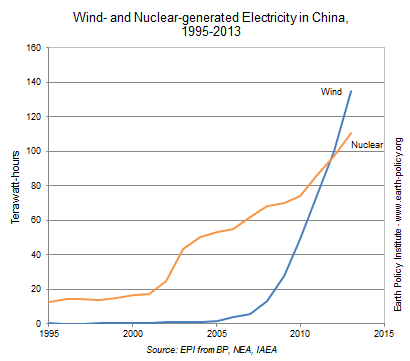
Engineering problems and delays are also a major culprit, and may prevent China from meeting its scaled-down nuclear power goals. As Grist points out, even if all Chinese nuclear capacity currently under construction were to become operational in the next six years, China would have reached only 45 gigawatts by 2020, well shy of its 58 gigawatts goal. Advanced plants that could bring higher efficiency, like a thorium reactor, will still require years of work to resolve engineering issues, researchers say.
Moreover, one of the benefits of nuclear power is that it can be installed close to where it is in demand—in contrast to wind and hydropower—lessening the distance that electricity has to travel along a power grid where some of the power is inevitably lost. But China is spending over 1 trillion yuan ($162.8 billion) to upgrade and expand its grid. As of last year, 84% of the country’s wind capacity was connected to the grid, from 72% in 2011, and the amount of wind-generated electricity wasted in transfer has fallen to 11% from 16% over the same period,according to Fitch Ratings.
No comments yet.
1 This Month


Tell the Ukrainian Government to Drop Prosecution of Peace Activist Yurii Sheliazhenko

Petition to revoke the licensing of the Near Surface Nuclear Disposal Facility (NSDF) at Chalk River. https://www.ourcommons.ca/petitions/en/Petition/Details?Petition=e-7247


of the week – STOP SMALL MODULAR REACTORS IN CANADA
To see nuclear-related stories in greater depth and intensity – go to https://nuclearinformation.wordpress.com
-
Archives
- March 2026 (193)
- February 2026 (268)
- January 2026 (308)
- December 2025 (358)
- November 2025 (359)
- October 2025 (376)
- September 2025 (258)
- August 2025 (319)
- July 2025 (230)
- June 2025 (348)
- May 2025 (261)
- April 2025 (305)
-
Categories
- 1
- 1 NUCLEAR ISSUES
- business and costs
- climate change
- culture and arts
- ENERGY
- environment
- health
- history
- indigenous issues
- Legal
- marketing of nuclear
- media
- opposition to nuclear
- PERSONAL STORIES
- politics
- politics international
- Religion and ethics
- safety
- secrets,lies and civil liberties
- spinbuster
- technology
- Uranium
- wastes
- weapons and war
- Women
- 2 WORLD
- ACTION
- AFRICA
- Atrocities
- AUSTRALIA
- Christina's notes
- Christina's themes
- culture and arts
- Events
- Fuk 2022
- Fuk 2023
- Fukushima 2017
- Fukushima 2018
- fukushima 2019
- Fukushima 2020
- Fukushima 2021
- general
- global warming
- Humour (God we need it)
- Nuclear
- RARE EARTHS
- Reference
- resources – print
- Resources -audiovicual
- Weekly Newsletter
- World
- World Nuclear
- YouTube
-
RSS
Entries RSS
Comments RSS
 nuclear-news
Leave a comment