Rokkasho a big-box store for nuclear terrorists.

After spending tens of billions of dollars and decades on breeder-related programs, Tom Cochran said, countries find it hard to pull the plug.
“You have an entrenched bureaucracy and an entrenched research and development community and commercial interests invested in breeder technology, and these guys don’t go away,” Cochran said. “They’re believers … and they’re not going to give up. The really true believers don’t give up.”……..
“Stealing a weapon is too hard,” Cochran said. “But there is no big risk in fuel assemblies, or in taking things from a bulk handling facility that can be used to make weapons.” In this view, Rokkasho is a kind of big-box store for would-be nuclear terrorists.
A Washington-based physicist and nuclear contrarian, Cochran helped kill a vast plutonium-based nuclear industrial complex back in the 1970s, and now he’s at it again — lecturing at symposia, standing up at official meetings, and confronting nuclear industry representatives with warnings about how commercializing plutonium will put the public at enormous risk.
Where the story ends isn’t clear. But the stakes are large. Continue reading
China’s nuclear power ambitions fading?
 Why China’s nuclear energy ambitions are falling flat http://qz.com/189731/why-chinas-nuclear-energy-ambitions-are-falling-flat/ By Lily Kuo @lilkuo March 19, 2014 At a time when other countries are scaling back their nuclear energy programs, China has been plowing ahead. Its largest nuclear energy companies are considering initial public offerings to raise over $2 billion, and Chinese researchers are racing to build the world’s first nuclear plant that runs on thorium. China’s nuclear reactors account for almost 40% of the world’s total. This year alone, the country plans to add 8.6 gigawatts of nuclear power capability—almost as much as the United Kingdom’s annual nuclear power capacity.
Thus, nuclear power’s contribution to China’s goal of reducing its reliance on coal—and, crucially, reducing the air pollution that is choking many of its major cities and contributing to global warming—is likely to be modest for decades to come.
Nuclear power has been underwhelming in China for many of the same reasons it has struggled elsewhere: it’s technically difficult, expensive, and resisted by parts of the public. Because nuclear power plants take so long to build, and China’s energy demands are imminent, other forms of renewable energy like wind and hydropower have taken precedence. (Nuclear reactors typically require at least six years to build, compared to around two years for geothermal power plants and just a few months for wind farms.)
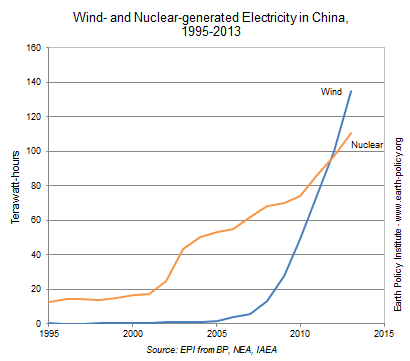
Engineering problems and delays are also a major culprit, and may prevent China from meeting its scaled-down nuclear power goals. As Grist points out, even if all Chinese nuclear capacity currently under construction were to become operational in the next six years, China would have reached only 45 gigawatts by 2020, well shy of its 58 gigawatts goal. Advanced plants that could bring higher efficiency, like a thorium reactor, will still require years of work to resolve engineering issues, researchers say.
Moreover, one of the benefits of nuclear power is that it can be installed close to where it is in demand—in contrast to wind and hydropower—lessening the distance that electricity has to travel along a power grid where some of the power is inevitably lost. But China is spending over 1 trillion yuan ($162.8 billion) to upgrade and expand its grid. As of last year, 84% of the country’s wind capacity was connected to the grid, from 72% in 2011, and the amount of wind-generated electricity wasted in transfer has fallen to 11% from 16% over the same period,according to Fitch Ratings.
William Magwood ‘a tool of the nuclear industry’ to head OECD’s Nuclear Energy Agency
 Democrat Magwood Stepping Down From Nuclear Panel abc news, WASHINGTON March 19, 2014 (AP) By MATTHEW DALY Associated Press William Magwood, a member of the Nuclear Regulatory Commission whose criticism helped lead to the ouster of the agency’s former chairman, said Wednesday he soon will be leaving the five-member commission.
Magwood, 52, a Democrat, has served on the NRC since 2010. He was one of four commissioners — two Democrats and two Republicans — who wrote to the White House in 2011, complaining that then-NRC Chairman Gregory Jaczko was a bully responsible for a tense and unsettled work environment, and that women at the NRC felt particularly threatened.
The letter said the four commissioners had “grave concerns” about Jaczko, adding that his bullying style was “causing serious damage” to the agency’s mission to protect health and safety at the nation’s 104 commercial nuclear reactors…….
Magwood is set to start in September as director general of the Paris-based Nuclear Energy Agency, an arm of the Organization for Economic Cooperation and Development, an intergovernmental organization of 31 countries in Europe, North America and Asia……..
it was his public criticism of Jaczko that drew the most attention on Capitol Hill and at the White House…….
Magwood disputed a claim by Senate Majority Leader Harry Reid, D-Nev., that the allegations against Jaczko were politically motivated. Jaczko worked for Reid before taking over as NRC chairman in 2009, and Reid expressed strong support for Jaczko throughout his tenure……
In an interview with the Huffington Post after Jaczko’s resignation, Reid lashed out at Magwood, calling him “a treacherous, miserable liar” who had deceived Reid about opposing Yucca Mountain. “He’s a first-class rat … (and) a tool of the nuclear industry,” Reid said.
Magwood declined to comment Wednesday.
Before joining the NRC, Magwood served in the Clinton administration, where he headed the Energy Department’s Office of Nuclear Energy. He also was a top official at the Edison Electric Institute, a trade association representing the electric industry, and worked at Westinghouse Electric Corp.http://abcnews.go.com/Politics/wireStory/democrat-magwood-stepping-nuclear-panel-22972523
Mysterious plume over old New Mexico nuclear bomb test site
 Weather experts baffled by mystery plume on New Mexico radar near 1945 nuclear bomb test site (EXCELLENT PICTURES) http://www.dailymail.co.uk/news/article-2584235/Weather-experts-baffled-mystery-plume-New-Mexico-radar-near-1945-nuclear-bomb-test-site.html
There is speculation that the cloud could be the result of a weapons test
But the U.S. has not done A-bomb tests since the Test Ban Treaty in 1992
Plume originated from White Sands Missile Range in Socorro county
By DAILY MAIL REPORTER, 19 March 2014 A mystery ‘storm cloud’ caught on weather radar after erupting off a U.S. military missile testing ground in New Mexico has left weather experts baffled.
Conspiracy theorists have speculated that the plume-like cloud, which seems to appear out of nowhere, could have been kicked up by the explosion from an unreported weapons test.
Deepening the mystery, U.S. National Weather Service offices in Albuquerque and El Paso have confirmed the reading, but say they have no idea where it could have come from. The plume first appeared at sunset on Monday evening over the part of the vast White Sands Missile Range in east Socorro county, close to the ‘Trinity Site’ where the first atomic bomb was detonated in 1945.
It was spotted in publicly accessible radar data by a blogger, who tracked its progress and has published his findings in two YouTube videos and a blog post.
New Mexico nuclear waste facility has a second radiation leak
 Second radiation leak detected at New Mexico nuclear waste site About one month after radiation leaks were reported at the United States’ first nuclear waste repository, a second release has been detected in the air by Department of Energy officials. Rt.com 19 Mar 14, According to the Associated Press, air-monitoring stations near the Waste Isolation Pilot Plant (WIPP) near Carlsbad, New Mexico, have picked up elevated radiation readings, suggesting another small batch of radiation has been released into the air.
The WIPP – one of the world’s three deep nuclear repositories – has been shut down since February, when a sharp rise in radiation levels was linked to a leak in one of the underground tunnels storing radioactive waste about 600 meters underground. This radiation eventually made it into the plant’s surrounding area and was detected in the air by nearby monitoring stations…….One watchdog group, Southwest Research and Information Center, said plans to expand the plant’s operations could have led to lax security measures, and has labeled the WIPP a failure in terms of safety……http://rt.com/usa/second-radiation-leak-new-mexico-913/
Nuclear power is getting just too expensive for South Africa
 Nuclear development in South Africa likely on hold unless funds incorporated from private sector, Enformable Lucas W Hixson 19 Mar 14 South African President Jacob Zuma and Energy Minister Ben Martins have continuously committed the nation to build up a nuclear industry.
The government has adopted a 20-year Integrated Resource Plan (IRP) which says that coal, nuclear, hydro, shale gas, and renewable energy are all included in potential generation methods of increasing the nation’s power supply. The IRP is revised every two years, the latest update proposes that the nation delay construction of more nuclear plants and instead focus more on coal, hydro and gas.
Energy Minister Martins has said that South Africa’s goal is to be self-sufficient in all aspects of the nuclear energy industry, but there are concerns about whether South Africa’s construction industry is even large enough to handle the additional resources and manpower which would be required.
President Zuma announced that the South African government would work to procure 9,600 MW of energy from nuclear power, based on the IRP released in 2010. The new IRP said that little or no nuclear power will be required.
If President Zuma’s goal of installing 9,600 MW of nuclear energy, the government must find at least 1 trillion rand ($93.2 billion USD), to support a nuclear fleet of three new nuclear power plants in South Africa.
On Tuesday, Rob Adam, president of the Nuclear Industry Association of South Africa and director of the construction group Aveng, spoke at an energy conference in Johannesburg and told attendees that the government would likely be forced to incorporate funds from the private sector to invest in the nuclear industry in South Africa…….
Eskom is not currently fiscally stable enough to finance a nuclear power plant. According to experts in South Africa, given the nation’s tight fiscal budget, it is extremely unlikely that the government would be able to allocate any funds for the proposed nuclear build.
The nuclear proposal is seemingly causing a rift in the South African government. Some agencies like the departments of energy, public enterprises, trade and industry to name a few are big proponents of a nuclear build, while other agencies like the National Planning Commission and the treasury are concerned with the high costs of nuclear energy. http://enformable.com/2014/03/nuclear-development-south-africa-likely-hold-unless-funds-incorporated-private-sector/
Why plutonium is so dangerous
 A World Awash in a Nuclear Explosive? TruthOut, 19 March 2014 12:24 By Douglas Birch and R. Jeffrey Smith, Center for Public Integrity | Report Washington “……..Just a Few Pounds Worth of Plutonium? There’s been a ghoulish debate between officials and independent scientists about how much plutonium is needed to fuel a clandestine bomb. But both agree it’s not much.
The U.S. bomb that destroyed half of Nagasaki in 1945 had 6.2 kilograms of plutonium in it, or 13.6 pounds. But experts say it was over-engineered — only one kilogram fissioned, they concluded later.
The International Atomic Energy Agency nonetheless decided years ago that eight kilograms of plutonium, or 17.6 pounds, are needed to make a bomb and so that’s the quantity its monitoring is geared to stop from getting loose.
Cochran and his NRDC colleague Christopher Paine challenged the IAEA standard in 1995 with a study concluding that only 3 kilograms — 6.6 pounds — would be needed to fashion a “very respectable” bomb with the explosive power of a kiloton, or 1,000 tons of TNT. But no matter who is right, Rokkasho’s annual plutonium production would be enough for 1,000 weapons or more. Continue reading
More solar and wind energy on Europe’s grid: EDF cuts nuclear production
EDF Curbs Nuclear Generation to Allow for Wind and Solar on Grid Bloomberg, By Tara Patel Mar 19, 2014 Electricite de France SA, the world’s biggest nuclear operator, is having to cut production from its reactors to accommodate higher European wind and solar output, potentially curbing future earnings from atomic power.
The utility, whose 58 French reactors account for about three-quarters of the country’s electricity production, can lower the output of a 1,000-megawatt plant by four-fifths in about 20 minutes, Dominique Miniere, deputy director of engineering and production at EDF, said today.
“Varying output is doable,” Miniere said at a press conference in Paris. While total production isn’t affected in the short term, “we are doing this more and more often.”……http://www.bloomberg.com/news/2014-03-19/edf-curbs-nuclear-generation-to-allow-for-wind-and-solar-on-grid.html
Glencore gets the prize for the most worker deaths
Mining is work, not war, why 26 deaths? There is a remarkable, grim and thoroughly unacceptable statistic on page 16 of Glencore’s 2013 annual report. (subscribers only) Financial Review 19 Mar 14
The Coke Can Plutonium Experiment
On arrival at lecture halls, he would push his stand-in for plutonium into an empty Coke can he had sawn in half. During his talks, he would hold the can up so his audience could see it, and say the contents could incinerate a city. “A six-pack of these is a nuclear arsenal,” he would say.
 A World Awash in a Nuclear Explosive? TruthOut, 19 March 2014 12:24 By Douglas Birch and R. Jeffrey Smith, Center for Public Integrity | Report Washington #……..The Coke Can Experiment In the abstract, there’s plenty of alarm in official circles. “Just one nuclear weapon exploded in a city — be it New York or Moscow; Tokyo or Beijing; London or Paris — could kill hundreds of thousands of people,” President Barack Obama told the United Nations Security Council in September 2009. “And it would badly destabilize our security, our economies, and our very way of life.”
But Cochran has long criticized the effectiveness of one of Washington’s most costly and elaborate strategies to prevent such a catastrophe — a global effort to detect and capture illicit fissile materials at border crossings and major world ports.
Since 2003 the United States has spent more than $850 million on equipment and training for customs officials at 45 foreign ports so they can scan shipping containers to detect nuclear materials. It’s a daunting assignment. About 432 million shipping containers crisscrossed the oceans in 2009 alone. U.S. ports accept 15 million containers every year. Continue reading
1 This Month


Tell the Ukrainian Government to Drop Prosecution of Peace Activist Yurii Sheliazhenko

Petition to revoke the licensing of the Near Surface Nuclear Disposal Facility (NSDF) at Chalk River. https://www.ourcommons.ca/petitions/en/Petition/Details?Petition=e-7247


of the week – STOP SMALL MODULAR REACTORS IN CANADA
To see nuclear-related stories in greater depth and intensity – go to https://nuclearinformation.wordpress.com
-
Archives
- March 2026 (193)
- February 2026 (268)
- January 2026 (308)
- December 2025 (358)
- November 2025 (359)
- October 2025 (376)
- September 2025 (258)
- August 2025 (319)
- July 2025 (230)
- June 2025 (348)
- May 2025 (261)
- April 2025 (305)
-
Categories
- 1
- 1 NUCLEAR ISSUES
- business and costs
- climate change
- culture and arts
- ENERGY
- environment
- health
- history
- indigenous issues
- Legal
- marketing of nuclear
- media
- opposition to nuclear
- PERSONAL STORIES
- politics
- politics international
- Religion and ethics
- safety
- secrets,lies and civil liberties
- spinbuster
- technology
- Uranium
- wastes
- weapons and war
- Women
- 2 WORLD
- ACTION
- AFRICA
- Atrocities
- AUSTRALIA
- Christina's notes
- Christina's themes
- culture and arts
- Events
- Fuk 2022
- Fuk 2023
- Fukushima 2017
- Fukushima 2018
- fukushima 2019
- Fukushima 2020
- Fukushima 2021
- general
- global warming
- Humour (God we need it)
- Nuclear
- RARE EARTHS
- Reference
- resources – print
- Resources -audiovicual
- Weekly Newsletter
- World
- World Nuclear
- YouTube
-
RSS
Entries RSS
Comments RSS
 nuclear-news