Thorium Nuclear Information Resources
Factual info about the myth of Thorium being useful!

UPDATE (2012/05/02): Added IEER’s Some Characteristics of Uranium and Thorium
UPDATE (2012/04/29): Added the UK NNL report! Thanks DARyan!
There is a rash of misinformation on the net about the supposed merits of the ‘new’ nuclear energy source on the block, thorium. I am sure that in a perfect world where nobody lies, thorium would be the perfect answer to the world’s energy needs as is claimed. This is unfortunately not the case.
Apparently, every time there is a new nuclear catastrophe, the thorium ‘miracle’ is promoted again as the ‘savior’ for the world. The Fukushima nuclear radiation catastrophe was not unique and the thorium misinformation artists have come out in droves. It’s the nuclear industry’s defense mechanism – create a new ‘safety myth’ that regular people can latch onto.
In reality, the thorium nuclear fuel cycle has been under development since the very early days of the nuclear industry…
View original post 575 more words
The surreal problem of Chernobyl’s forests not decaying properly
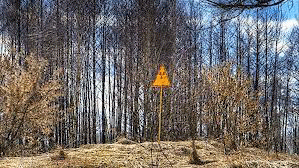 The Woods Around Chernobyl Aren’t Decaying GEOFF MANAUGH http://www.gizmodo.com.au/2014/03/the-woods-around-chernobyl-arent-
 decaying/ 19 Mar 14, Like a landscape of the undead, the woods outside Chernobyl are having trouble decomposing. The catastrophic meltdown and ensuing radiation blast of April 1986 has had long-term effects on the very soil and ground cover of the forested region, essentially leaving the dead trees and leaf litter unable to decompose. The result is a forest full of “petrified-looking pine trees” that no longer seem capable of rotting. Indeed, Smithsonian reports, “decomposers — organisms such as microbes, fungi and some types of insects that drive the process of decay — have also suffered from the contamination. These creatures are responsible for an essential component of any ecosystem: recycling organic matter back into the soil.”
All of that now has been slowed way down, as explored in a new study led by University of South Carolina biologist Timothy Mousseau, just published in Oecologica.Mouseeau and his colleagues explain that they would normally expect to see between 70 per cent and 90 per cent loss of dead plant matter over the course of a year as the discarded leaves and branches are consumed by local microbes; however, at the various test points they established throughout the Chernobyl forested region, the sampled vegetation had lost less than 40 per cent over the same time frame.
This means the woods are decaying approximately twice as slowly, stretching out their  period of decay for years, if not decades, and, in the process, piling up fuel for future forest fires.
As Smithsonian also mentions, this is perhaps the most worrisome aspect of all of this, and all the more reason to be concerned about the radioactive side-effects of such a fire: “Other studies have found that the Chernobyl area is at risk of fire, and 27 years’ worth of leaf litter, Mousseau and his colleagues think, would likely make a good fuel source for such a forest fire. This poses a more worrying problem than just environmental destruction: Fires can potentially redistribute radioactive contaminants to places outside of the exclusion zone, Mousseau says. ‘There is growing concern that there could be a catastrophic fire in the coming years,’ he says.”
Either way, there is something immensely surreal in this dream-like vision of a dead forest that simply cannot decay, its branches lifeless yet ever-present, petrified or fossilized in place, its carpet of leaves always growing deeper and seeming to never go away.
TEPCO leaves Fukushima to unskilled workers, pours resources into Kashiwazaki-Kariwa nuclear plant
- Destitute Left to Clean up Fukushima, The Age March 19, 2014 Hiroko Tabuchi Naraha, Japan: “Out of work? Nowhere to live? Nowhere to go? Nothing to eat?” the online ad reads. “Come to Fukushima.”
That grim posting is one of the starkest indications yet of an increasingly troubled search for workers willing to carry out the hazardous decommissioning at the Fukushima No.1 nuclear plant.
The plant’s operator, the Tokyo Electric Power Co., known as TEPCO, has been shifting its attention away, leaving the complex clean-up to an often badly managed, poorly trained, demoralised and sometimes unskilled work force. At the same time, the company is pouring its resources into another plant, Kashiwazaki-Kariwa, that it hopes to restart this year as part of the government’s push to return to nuclear energy three years after the disaster.
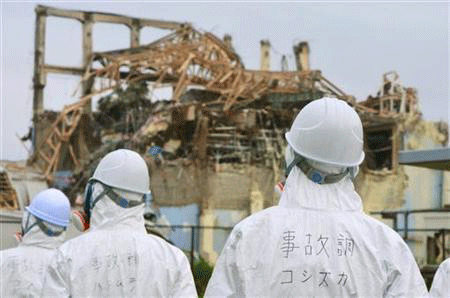
Regulators, contractors and more than 20 current and former workers interviewed in recent months say the deteriorating labour conditions are a prime cause of a string of large leaks of contaminated water and other embarrassing errors that have already damaged the environment and, in some cases, put workers in danger. Continue reading
Greenpeace Activists invade French nuclear power plant
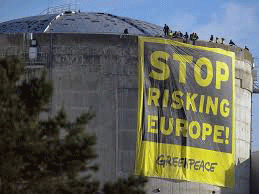 Activists breach French nuclear plant Sky News, , Tuesday March 18, 2014 Dozens of Greenpeace activists have snuck into a nuclear power plant in eastern France at dawn.
It’s the latest break-in by the environmental group to highlight alleged security weaknesses at atomic facilities.
The activists broke into the Fessenheim plant and hung a banner reading ‘Stop risking Europe’ on the side of one of its reactors.
They did this ‘to denounce the risk of French nuclear power for the whole of Europe,’ the group said in a statement on Tuesday…….
Police detained 56 activists, he said, but 20 remained on top of the dome of one of the reactors as a police helicopter hovered above.
France, the world’s most nuclear-dependent country, operates 58 reactors and has been a leading international proponent of atomic energy.
But in a deal with the Greens before the 2012 parliamentary and presidential elections, President Francois Hollande’s Socialist party promised to cut reliance on nuclear energy from more than 75 per cent to 50 per cent by shutting 24 reactors by 2025.
Hollande has pledged to close Fessenheim, which was commissioned in 1977, by the end of 2016.
The plant, located on the banks of the Rhine, is close to the Swiss and German borders and is considered vulnerable to seismic activity and flooding.
The Greenpeace protest stunt comes ahead of a meeting by European leaders to discuss the future of the continent’s energy policy.
Greenpeace wants Hollande and German Chancellor Angela Merkel to push Europe towards a real energy transition, complaining that France relies too much on nuclear power, and Germany on coal, for electricity supplies. http://www.skynews.com.au/world/article.aspx?id=959316
Decades to solve problems of Thorium nuclear reactors
 South China Morning Post, 19 March 14 ……….Researchers working on the project said they were under unprecedented “war-like” pressure to succeed and some of the technical challenges they faced were difficult, if not impossible to solve in such a short period.
They would also probably face opposition from sections of the Chinese public after the nuclear disaster at Fukushima in Japan….One of the technical difficulties is that the molten salt produces highly corrosive chemicals such as fluoride that could damage the reactor.
The power plant would also have to operate at extremely high temperatures, raising concerns about safety. In addition, researchers have limited knowledge of how to use thorium.
“We are still in the dark about the physical and chemical nature of thorium in many ways,” said Li. “There are so many problems to deal with but so little time.”
Western countries such as the United States have experimented with thorium reactors but gave up on the technology because of the engineering difficulties………
One of the technical difficulties is that the molten salt produces highly corrosive chemicals such as fluoride that could damage the reactor.
The power plant would also have to operate at extremely high temperatures, raising concerns about safety. In addition, researchers have limited knowledge of how to use thorium.
“We are still in the dark about the physical and chemical nature of thorium in many ways,” said Li. “There are so many problems to deal with but so little time.”
Western countries such as the United States have experimented with thorium reactors but gave up on the technology because of the engineering difficulties……The thorium reactors would need years, if not decades, to overcome the corrosion issue and the stability of accelerator-driven plants was also in doubt, he said.
“These projects are beautiful to scientists, but nightmarish to engineers,” he said…….After the Fukushima nuclear disaster three years ago, the central government withheld approval for new nuclear plants.
Part of the resistance came from the public, as many people were worried that nuclear plants would cause more serious contamination than the pollution created by coal-fired stations, Gu said.
Government agencies such as the Ministry of Water Resources also opposed the construction of nuclear plants in land-locked areas over concerns that radioactive waste would worsen river pollution.
Ukraine crisis is not disturbing positive talks between Iran and West
 West Sees Unity on Iran Despite Crisis in Ukraine NYT, By ALISSA J. RUBIN and RICK GLADSTONE MARCH 18, 2014 VIENNA — Talks on a permanent nuclear agreement with Iran resumed in Vienna on Tuesday, heavily shadowed by the Ukraine crisis between the West and Russia. But European and American officials said their differences with the Kremlin had no effect on the unified position they all take aimed at ensuring the Iranians can never make atomic bombs……..
Michael Mann, a spokesman for Catherine Ashton, the European Union’s top foreign policy official, who is the lead negotiator for the P5-plus-1 group, told reporters that he had not seen “any negative effect” on the talks attributable to the Ukraine crisis……http://www.nytimes.com/2014/03/19/world/europe/iran-nuclear-talks.html?_r=0
Activists organising “Run Away From Nuclear” in Taipei
 Activists call for participation in anti-nuclear run, Taipei Times, By Lee I-chia Staff reporter, 19 Mar 14 A number of public figures, including a film director, performers and an Olympic bronze medalist, yesterday urged the public to participate in an anti-nuclear road run in Taipei slated for Saturday next week.
The event, dubbed “Run Away From Nuclear” (核輻大逃殺) and sponsored by the Anti-nuclear Alliance of Fathers, the Taiwan Environmental Protection Union and the Democratic Progressive Party, is a 5km road-running event that will begin at 7am from Ketagalan Boulevard. The run will simulate a mass of people escaping from radiation after a nuclear accident.
At a press conference yesterday, film director Ko I-chen (柯一正), actor Ralf Chiu (邱彥翔) and Chi Cheng (紀政), the 1968 Olympics bronze-medal winner in the women’s 80m hurdles, called for more people to sign up before registration ends tomorrow.
Also making the call was Hsu Wen-lin (許文麟), who uses a wheelchair after having broken his spine……http://www.taipeitimes.com/News/taiwan/archives/2014/03/19/2003586037
Shhh don’t let on – fear of flood shuts UK nuclear plant for 5 months
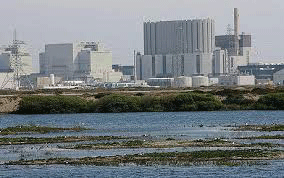 Dungeness nuclear power station quietly taken offline for five months over fears of Fukushima-style flood disaster, The Independent 19 Mar 14, The energy giant EDF has been accused of playing down the threat of flooding at Dungeness after it emerged that one of the nuclear power plant’s reactors was quietly shut down for five months last year after experts identified risk of a Fukushima-style disaster.
EDF closed the reactor on the Kent coast on 22 May to allow work on a new flood protection wall, after alerting the Office of Nuclear Regulation that without urgent work the site was at risk of being inundated by sea water.
The reactor – which should provide power for about 750,000 homes – did not reopen again until 15 October.
The closure of the 550-megawatt reactor – one of two at Dungeness – followed an internal EDF report which found that the shingle bank sea defences were “not as robust as previously thought”, raising fears that they could be overwhelmed in extreme weather, according to the ClickGreen website, which first reported the closure……..
There was no clear explanation of the remarkable length of the outage, which was not widely reported.
Stephen Thomas, professor of energy policy at the University of Greenwich, said: “EDF should have made more of an announcement. If a plant closes for five months it is not just fiddling about, it is something serious and EDF can’t pretend it’s not.
“I think there is a bad attitude in this country that we must not frighten the horses. But playing it down is the wrong way – we need to be told the truth,” Professor Thomas added. He calculates that the five-month closure could have cost EDF around £100m in lost electricity revenue, while the group would have saved very little in the way of expenses, still having to pay wages and maintain the reactor.
Friends of the Earth climate campaigner Guy Shrubsole added: “It’s astounding that the shutdown of EDF’s reactor wasn’t better publicised and calls into question the transparency of the nuclear industry.”……… http://www.independent.co.uk/news/uk/home-news/exclusive-dungeness-nuclear-power-station-quietly-taken-offline-for-five-months-over-fears-of-fukushimastyle-flood-disaster-9200494.html
France’s nuclear electricity costing industry 35% more does Germany’s electricity
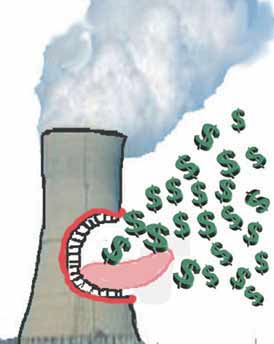
 France’s Industrial Giants Call for Price Cap on Nuclear http://www.bloomberg.com/news/2014-03-17/france-s-industrial-giants-call-for-price-cap-on-nuclear.html by Tara Patel Mar 17, 2014 France’s biggest electricity users urged the government to cap Electricite de France SA (EDF)’s wholesale nuclear-power price at the current level to help industrial consumers compete with German rivals.
The competitiveness of large French power consumers has “dropped off in a way that is extremely worrying,” the Uniden lobby group said today in a statement. The regulated rate is set at 42 euros ($58.50) a megawatt-hour. Uniden has written a position paper in response to a state consultation on power prices. While the body’s 41 members, which include PSA Peugeot Citroen (UG) and Total SA (FP), strive to compete with foreign peers, EDF has embarked on a cost-cutting drive as spending increases to maintain and upgrade its 58 reactors.
France has said it will announce any revisions to the power rate or the way it’s calculated at the end of the month. The government already forces state-controlled EDF to sell about a quarter of its nuclear output to other French distributors to increase domestic competition. The country gets about three-quarters of its power production from EDF’s atomic fleet.
Large German industrial power users will pay 35 percent less for their electricity next year than those in France, Uniden said. “Even more preoccupying” is France’s inability to compete with North America, where the boom in shale gas has lowered the cost of energy supply, it said.
EDF, based in Paris, has said it can’t make ends meet unless it gets permission to raise the price of wholesale nuclear power. “One can’t demand of a company to sell a quarter of its output below cost in the long term,” Chief Executive Officer Henri Proglio said last month. The regulated rate helps EDF make “a step toward” meeting its costs of 50 euros a megawatt-hour, he said. Uniden called for tighter control of EDF’s costs and more “visibility” on the power price over the next five years.
The world won’t survive a nuclear W.W.III.
 A Nuclear War Would Be Insane, OpEdNews 3/18/2014 By Dave Lefcourt Let’s get to the point fundamentally and unmistakably, a nuclear war would be insane.
Ever since the Cuban missile crisis in 1962, President Kennedy knew it and so did his counterpart Nikita Khrushchev in the Soviet Union. Even Stalin, probably the most brutal man ever never considered it.
That’s why in the cold war between the U.S. and the USSR, MAD, mutually assured destruction were the operative words and the primary reason a nuclear conflagration never occurred because such a war was unwinnable and to contemplate winning such a war was insane.
Yes tough guy Donald Rumsfeld as secretary of defense talked of using tactical bunker busting nuclear weapons but the use of any nuclear weapons began and ended with the U.S. dropping two atomic bombs on Japan in August 1945. Continue reading
The need for the West and Iran to negotiate in good faith
 Iran keeps its word – the west should do the same Ft.com By Javad Zarif, 18 Mar 14, Pursuing atomic weapons would put the country’s national security in jeopardy, writes Javad Zarif A
At last it seems realistic to hope for a resolution to the unnecessary crisis surrounding Iran’s peaceful nuclear programme. In large part that is because attitudes towards my country are changing. It is now recognised that Iranian scientists have mastered nuclear technology – and it is widely accepted that the knowledge we have attained cannot be wished away.
There is also a growing appreciation that Iran does not have any interest in nuclear weapons. True, we live in a volatile neighbourhood. Yet we have always been clear that pursuing nuclear weapons – or even being wrongly suspected of doing so – would put our national security in jeopardy. A
t last it seems realistic to hope for a resolution to the unnecessary crisis surrounding Iran’s peaceful nuclear programme. In large part that is because attitudes towards my country are changing. It is now recognised that Iranian scientists have mastered nuclear technology – and it is widely accepted that the knowledge we have attained cannot be wished away.
There is also a growing appreciation that Iran does not have any interest in nuclear weapons. True, we live in a volatile neighbourhood. Yet we have always been clear that pursuing nuclear weapons – or even being wrongly suspected of doing so – would put our national security in jeopardy…….http://www.ft.com/intl/cms/s/0/3c53cf60-ae8e-11e3-8e41-00144feab7de.html
China’s concern over Japan’s plutonium and enriched uranium

 Japan and China’s Dispute Goes Nuclear, The Diplomat, Japan and China’s bitter PR campaign has now entered the nuclear realm. By Zachary Keck March 18, 2014 Japan and China appear to be trading nuclear barbs with one another.
For some weeks now, China has been raising concerns about the amount of enriched uranium and weapons-grade plutonium Japan currently stockpiles. “We continue to urge the Japanese government to take a responsible attitude and explain itself to international community,” a Chinese Foreign Ministry spokesperson said at the end of last month.
The following week, the same spokesperson asked: “Has Japan kept an excessive amount of sensitive nuclear material that is beyond its actual needs? Does one need so much sensitive nuclear material for peaceful use? Should one keep excessive weapons-grade nuclear material?” He added: “More importantly, does Japan have higher-enriched and weapons-grade uranium, and how much does it have? What are those used for? How can Japan ensure a balance between the demand and supply of nuclear materials? These are the real concerns and questions of the international community.”
Japan has one of the most advanced civilian nuclear programs of any country without nuclear weapons.According to NBC News, Tokyo has 9 tons of plutonium stockpiled in different places throughout Japan, while 35 tons of Japanese plutonium is stockpiled in different countries in Europe. Only about 5 to 10 kilograms is needed to produce a nuclear weapon. Japan also has an additional 1.2 tons of enriched uranium. It is also building a fast-breeder plutonium reactor in Rokkasho that will produce 8 tons of plutonium annually.
Many experts believe that Japan could produce nuclear weapons within 6 months of deciding to do so, and some believe that Tokyo is pursuing a “nuclear hedging” strategy. Japan has done little to mollify these concerns. In fact, it has often encouraged them, with a Japanese official recently saying off the record that “Japan already has the technical capability [to build a nuclear bomb], and has had it since the 1980s.”
Having a “bomb in the basement” largely suits Japan’s interests in its competition with China. …….http://thediplomat.com/2014/03/japan-and-chinas-dispute-goes-nuclear/
Asia could become the epicentre of another nuclear catastrophe
 A need to address nuclear dangers, The Star, BY NOBUMASA AKIYAMA, SHAHRIMAN LOCKMAN, TANYA OGILVIE-WHITE, MANPREET SETHI, AND CHAN-HOON SHIN 19 March 14, There is no option but to cooperate, to prevent Asia from becoming an epicentre of another nuclear catastrophe.
IT’S no secret that nuclear dangers are mounting in Asia. Nuclear weapons arsenals are growing, nuclear power programmes are expanding, and fissile and radioactive materials – which could be used to target innocents anywhere – are used, stored and transported throughout our region, sometimes in insecure conditions.
It’s a discomfiting picture, and contrary to what sceptics would have us believe, it’s not an exaggerated one. We should be putting pressure on our political leaders to accept their responsibility to address our concerns before a nuclear catastrophe happens.
Next week, an opportunity exists for them to be pro-active in the face of nuclear dangers as leaders from around the world gather in the Netherlands at the world’s third Nuclear Security Summit to discuss and agree on actions that should be taken to reduce nuclear risks across the globe. What are these risks?
Let’s travel across the Asian nuclear landscape with our eyes wide open.
First stop: Pakistan, a nuclear-armed state with the world’s fastest growing nuclear arsenal and military stockpile of highly enriched uranium (HEU) and plutonium (Pu).
It is believed that there are sympathisers of extremist groups amongst its military, and a number of terrorist organisations operating from its soil.
The risks of nuclear sabotage and theft at Pakistan’s military and civilian sites must not be underestimated.
Heading south to India, the nuclear landscape is marginally better. New Delhi too is in the process of building its credible deterrence and the stockpile of weapons-usable HEU and Pu is growing.
India also has an ambitious nuclear power programme with twenty-one nuclear power reactors already operational, more being built, and also a new reprocessing facility at Kalpakkam……Onward to China…….the Korean peninsula……, Japan…. Despite the difficult political climate, there is no option but to cooperate, to prevent Asia from becoming an epicentre of another nuclear catastrophe.
Each state, whether it is a nuclear weapon state or not, should make extraordinary efforts to increase national accountability for their nuclear programmes according to accepted international benchmarks. http://www.thestar.com.my/News/Nation/2014/03/19/A-need-to-address-nuclear-dangers/
European Union working through the costs associated with renewable energy introduction
EU mulls aid to industries to cope with cost of renewable energy SMH, March 18, 2014 The European Union is considering allowing state aid to 62 energy-intensive industries including aluminium- and petroleum-product manufacturers to help with the cost of boosting renewable energy, a draft EU document showed.
The European Commission, the EU regulatory arm, will approve support in the form of reductions in environmental taxes if the beneficiaries cover at least 20 per cent of the additional costs, according to state-aid guidelines for 2014-2020 obtained by Bloomberg News. Continue reading
1 This Month


Tell the Ukrainian Government to Drop Prosecution of Peace Activist Yurii Sheliazhenko

Petition to revoke the licensing of the Near Surface Nuclear Disposal Facility (NSDF) at Chalk River. https://www.ourcommons.ca/petitions/en/Petition/Details?Petition=e-7247


of the week – STOP SMALL MODULAR REACTORS IN CANADA
To see nuclear-related stories in greater depth and intensity – go to https://nuclearinformation.wordpress.com
-
Archives
- March 2026 (176)
- February 2026 (268)
- January 2026 (308)
- December 2025 (358)
- November 2025 (359)
- October 2025 (376)
- September 2025 (258)
- August 2025 (319)
- July 2025 (230)
- June 2025 (348)
- May 2025 (261)
- April 2025 (305)
-
Categories
- 1
- 1 NUCLEAR ISSUES
- business and costs
- climate change
- culture and arts
- ENERGY
- environment
- health
- history
- indigenous issues
- Legal
- marketing of nuclear
- media
- opposition to nuclear
- PERSONAL STORIES
- politics
- politics international
- Religion and ethics
- safety
- secrets,lies and civil liberties
- spinbuster
- technology
- Uranium
- wastes
- weapons and war
- Women
- 2 WORLD
- ACTION
- AFRICA
- Atrocities
- AUSTRALIA
- Christina's notes
- Christina's themes
- culture and arts
- Events
- Fuk 2022
- Fuk 2023
- Fukushima 2017
- Fukushima 2018
- fukushima 2019
- Fukushima 2020
- Fukushima 2021
- general
- global warming
- Humour (God we need it)
- Nuclear
- RARE EARTHS
- Reference
- resources – print
- Resources -audiovicual
- Weekly Newsletter
- World
- World Nuclear
- YouTube
-
RSS
Entries RSS
Comments RSS
 nuclear-news