Remembrance and anti-nuclear rallies mark anniversary of Japan’s tsunami
Japan marks 3rd anniversary of tsunami Sky News, Tuesday March 11, 2014 Japan is marking the third anniversary of the quake-tsunami disaster which swept away 18,000 victims, destroyed coastal communities, and sparked a nuclear emergency that forced a re-think on atomic power.
Remembrance ceremonies will be held on Tuesday in towns and cities around the disaster zone and in the capital Tokyo, where Emperor Akihito and Empress Michiko are to lead tributes to those who lost their lives in Japan’s worst peace-time disaster………
The crippled plant remains volatile and experts say the complicated decommissioning process will take decades, as fears persist over the long-term health effects of leaked radiation. The accident forced tens of thousands to flee from areas around the shattered site……..
Former Prime Ministers of Japan warn against restarting nuclear power
Fukushima disaster: Plan to send residents home three years after nuclear accident labelled ‘irresponsible’ ABC News By North Asia correspondent Matthew Carney 11 Mar 14″…….Turning reactors back on ‘a risk not worth taking’
The Abe government has said it is in the best interest of the economy to once again make nuclear power the core source of Japan’s energy.
It is worried that the reliance on imported coal and gas is threatening the country’s fragile economic recovery.
But a former prime minister, Morihiro Hosokawa, says it is a risk not worth taking.
“The causes of the accident haven’t been investigated properly. Contaminated water is still leaking, and compensation for victims hasn’t been sorted out,” he said. “I think in these circumstances it is very irresponsible to turn the reactors back on.”
He is backed by another former prime minister, Naoto Kan, who was in power at the time of the nuclear disaster in 2011.
Mr Kan says the current government does not understand the risk.
“They are trying to restart the nuclear reactors without learning the lessons of the March 11 accident,” he said. “If the accident had spread just a little further, then 50 million people around Tokyo would have been evacuated for a long time and that would have put Japan in chaos for 20 to 30 years.”
Mr Kan says no national evacuation plan has been developed, and in the rush to turn the reactors back on the government is ignoring the safety of the general public.”I submitted written questions to Prime Minister Abe and his response from the Nuclear Regulation Authority says it only decides on limited technical issues and won’t judge local disaster prevention plans; that is, whether residents can escape safely or whether the residents can ever return.
“It’s becoming clear they are trying to restart the reactors with no regard for people’s safety.” http://www.abc.net.au/news/2014-03-10/plan-to-send-residents-back-to-fukushima-meets-opposition/5311046
‘Atomic Abe’ taking Japan into a dangerous nuclear situation
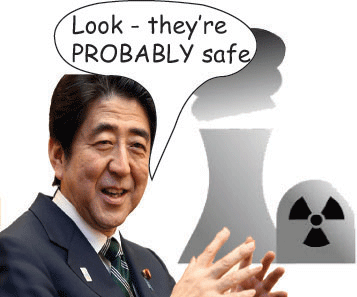 Nuclear energy costs still rising, three years on from Fukushima, SMH, 11 Mar 14 #……Atomic Abe The arrival of Abe as prime minister in December 2012, gave a boost to the pro-nuclear camp. Cutting energy costs is part of his plan to revitalize the economy.
Abe’s push on nuclear shows how polarizing the issue is in Japan.
At least three former prime ministers have publicly opposed the current premier on reactor restarts, including Junichiro Koizumi, Abe’s mentor and one of Japan’s most-popular postwar leaders. Naoto Kan, prime minister at the time of the 2011 quake, is another.
“The reason I’m against nuclear is that people cannot fully control it,” Kan told reporters in a briefing in December.
Industrial accidents can happen, but nothing on the scale of nuclear, he said. A worst-case scenario for Fukushima would have made a third of Japan’s land uninhabitable, Kan said. Opponents also point to the cost of nuclear accidents. The government has estimated it’ll take 11 trillion yen and 40 years to clean up the Fukushima site.
Japan Inc
The former prime ministers find themselves in an unusual place on the opposite side of the argument from Japan Inc.,……..http://www.smh.com.au/environment/nuclear-energy-costs-still-rising-three-years-on-from-fukushima-20140311-34ii6.html
Governor of Massachusetts concerned about safety of Pilgrim nuclear power plant
Massachusetts governor has nuclear plant concerns BOSTON (AP) 10 Mar 14— Gov. Deval Patrick pledged on Monday to write a letter to the Nuclear Regulatory Commission, expressing concerns about the safety of the Pilgrim nuclear power plant in Plymouth.
Patrick made the promise after meeting briefly with the head of a group of Cape Cod residents seeking to shut down the plant. The governor said he shares the group’s safety concerns about the plant and has expressed them both publicly and to the federal agency overseeing nuclear power in the past…….http://www.boston.com/news/local/massachusetts/2014/03/10/mass-gov-patrick-share-concerns-about-pilgrim/0hrvw2GFkygQxoXZ5sSjaO/story.html
Future is bright for renewable energy in Africa
Africa Has Bright Renewable Energy Future – Ernst & Young Report VENTURES AFRICA- 10 Mar 14 Africa is poised to overtake Europe as one of the key areas of growth in the production and use of renewable energy technologies, as the use of clean tech becomes more imperative to stem the tide of climate change all over the world.
Already, South Africa has been recognised as a significant hub for clean tech, having been voted for by the IHS as the best country in the world to locate clean technologies. Market experts have watched international developers and funders invest copiously in the South Africa’s renewable energy market, making it a hub for laudable renewable energy projects.
While African countries like Ethiopia and Kenya were identified as markets to watch this year alongside other emerging markets like Malaysia and Uruguay; the Ernst & Young Renewable Energy Attractiveness Index (RECAI) report noted that emerging markets are attracting about half of new investment in the sector, and investors will increasingly focus on those markets ………
Warren also stressed the need for increased investment in grid management, digitalized supply and demand management, distributed applications and the commercialization of storage technology in order to avoid transmission bottlenecks and intermittency challenges. http://www.ventures-africa.com/2014/03/africa-has-bright-renewable-energy-future-ernst-young-report/
Europe on track to meet its renewable energy target
EU edges towards renewable energy targets http://au.news.yahoo.com/thewest/business/world/a/21909665/eu-edges-towards-renewable-energy-targets/Brussels (AFP) – The European Union is making steady progress towards its 2020 renewable energy target, a key effort in curbing the greenhouse gas emissions blamed for global warming, official data showed Monday. Renewables — predominantly wind but including tidal and biomass sources as well — accounted for 14.1 percent of the EU’s energy consumption in 2012, up from 13 percent in 2011, the Eurostat statistics bureau said.
The EU has set itself a 20-percent target for renewable energy use by the year 2020, part of its overall “Europe 2020″ strategy of sustainable economic growth.
Eurostat said of the 28 member states, Sweden continues to lead the field, with 51 percent of its energy coming from renewables, up from almost 39 percent 10 years ago when the EU average was 8.3 percent. Latvia on 35.8 percent was the next best performer, followed by Finland on 34.3 percent and Austria 32.1 percent.
Among the lowest ranked were Malta at just 1.4 percent, Luxembourg with 3.1 percent, Britain with 4.2 percent and the Netherlands with 4.5 percent.
Inconsistency in Nuclear Plant Safety Enforcement
 Report: Inconsistent Nuclear Plant Safety Enforcement WLTX 19, Eric Connor, Greenville News, 10 Mar 14, Inconsistent enforcement by federal regulators stands in the way of protecting the public from the dangers of nuclear energy, across the country and at the Upstate’s Oconee Nuclear Station where concerns over fire and flood have hovered for decades, a nuclear watchdog group says in a new report………..The report — “The NRC and Nuclear Power Plant Safety in 2013: More Jekyll, Less Hyde” — lists 10 instances of what the group considers “near miss” events that required special inspections and posed higher-than-acceptable risks……..
The report’s author — Dave Lochbaum, a nuclear safety expert who once trained NRC inspectors — wrote that the NRC has been complicit in allowing utilities like Duke to ignore deadlines for years.
“What’s protecting the people around Oconee from fire risk? Luck,” Lochbaum wrote. “What’s protecting Oconee’s owner from the cost and bother of legally managing the fire risk? The NRC.”…….
Last year, The Greenville News reported on an NRC whistleblower’s analysis detailing dam concerns that spanned decades.
The NRC had held the analysis from public view on grounds that it contained security-related information, but the document has since been released in largely unedited form.
The News also reported on hundreds of internal emails that show NRC staffers expressing frustration over superiors they said were cowing to the industry instead of holding it accountable for the threat of a dam failure.
ust one month after the Fukushima meltdown, Lochbaum wrote, the NRC met with the public but didn’t mention the long-held concerns.
“The exact same flooding hazard that exists today at the Oconee nuclear plant was not mentioned by the NRC — so the public was actually misled into believing no such problems existed,” Lochbaum wrote………http://www.wltx.com/story/news/2014/03/10/safety-enforcement-at-nuclear-plants-inconsistent/6251227/
Effect of Japan’s move to restart nuclear power will ripple globally
Nuclear energy costs still rising, three years on from Fukushima, SMH, 11 Mar 14 “…..,.How Japan proceeds on nuclear will ripple beyond its own borders with nations in Europe and beyond wavering over whether to purse atomic power, Wade Allison, a physics professor at Oxford University, U.K., said during a recent Hamaoka visit.
“The world is looking at Japan and what you do with nuclear energy,” Allison said. “The faster Japan can turn the reactors on the better.”
That’s not the view of Japan’s citizens.
According to this month’s poll published by the Tokyo Shimbun newspaper, 69 percent of respondents said nuclear power should be phased out over time or immediately. The March 1 and 2 poll surveyed 3,000 people with a 58 percent response rate.
As the question of turning reactors back on continues to divide Japan, plant operators face other hurdles.
‘Toughest guidelines’
The Nuclear Regulation Authority was formed in September 2012 as an independent watchdog to replace the previous regulator. Its Chairman Shunichi Tanaka said the agency has “the world’s toughest guidelines” for operating nuclear plants……..http://www.smh.com.au/environment/nuclear-energy-costs-still-rising-three-years-on-from-fukushima-20140311-34ii6.html
Southern Alliance calls for public review before St. Lucie nuclear reactor can restart
Southern Alliance seeks public review before St. Lucie nuclear plant returns to service, Tampa Bay Times, Ivan Penn,10 Mar 14, The Southern Alliance for Clean Energy filed a petition Monday to block a St. Lucie nuclear reactor from returning to service until the public vets unusual wear inside the plant’s steam generators.
In a complaint to the U.S. Nuclear Regulatory Commission, the Southern Alliance accused the NRC of allowing unit two of the St. Lucie nuclear complex to operate outside of its license.
The Southern Alliance argued that plant owner Florida Power & Light omitted components without formal NRC approval, contributing to premature steam generator tube wear……..
The Southern Alliance, based in Knoxville, Tenn., is one of the organizations, along with the state Office of Public Counsel, the Florida Industrial Powers Users Group and the Florida Retail Federation, that routinely argues cases against utilities before the Public Service Commission.
Before St. Lucie returns to service, the Southern Alliance wants the NRC to hold public hearings………http://www.tampabay.com/news/business/energy/southern-alliance-seeks-public-review-before-st-lucie-2-returns-to-service/2169448
Next thing – a nuclear Ukraine?
Ukraine may have to go nuclear, says Kiev lawmaker, USA Today, KIEV, Ukraine 10 Mar — Ukraine may have to arm itself with nuclear weapons if the United States and other world powers refuse to enforce a security pact that obligates them to reverse the Moscow-backed takeover of Crimea, a member of the Ukraine parliament told USA TODAY…….http://www.usatoday.com/story/news/world/2014/03/10/ukraine-nuclear/6250815/
1 This Month

of the week – Shut Down Drone Warfare!


Tell the Ukrainian Government to Drop Prosecution of Peace Activist Yurii Sheliazhenko

Petition to revoke the licensing of the Near Surface Nuclear Disposal Facility (NSDF) at Chalk River. https://www.ourcommons.ca/petitions/en/Petition/Details?Petition=e-7247
To see nuclear-related stories in greater depth and intensity – go to https://nuclearinformation.wordpress.com
-
Archives
- April 2026 (57)
- March 2026 (251)
- February 2026 (268)
- January 2026 (308)
- December 2025 (358)
- November 2025 (359)
- October 2025 (376)
- September 2025 (257)
- August 2025 (319)
- July 2025 (230)
- June 2025 (348)
- May 2025 (261)
-
Categories
- 1
- 1 NUCLEAR ISSUES
- business and costs
- climate change
- culture and arts
- ENERGY
- environment
- health
- history
- indigenous issues
- Legal
- marketing of nuclear
- media
- opposition to nuclear
- PERSONAL STORIES
- politics
- politics international
- Religion and ethics
- safety
- secrets,lies and civil liberties
- spinbuster
- technology
- Uranium
- wastes
- weapons and war
- Women
- 2 WORLD
- ACTION
- AFRICA
- Atrocities
- AUSTRALIA
- Christina's notes
- Christina's themes
- culture and arts
- Events
- Fuk 2022
- Fuk 2023
- Fukushima 2017
- Fukushima 2018
- fukushima 2019
- Fukushima 2020
- Fukushima 2021
- general
- global warming
- Humour (God we need it)
- Nuclear
- RARE EARTHS
- Reference
- resources – print
- Resources -audiovicual
- Weekly Newsletter
- World
- World Nuclear
- YouTube
-
RSS
Entries RSS
Comments RSS
 nuclear-news