Economics, not health or safety. is killing nuclear power
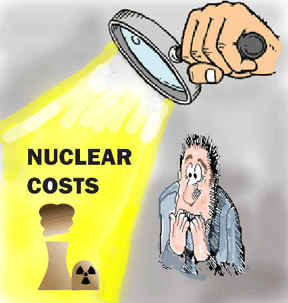 Missing from the entire debate about nuclear is the most important fact of all: Nuclear is dying due to poor economics, and the debate is already over as far as the market is concerned.
The Breakthrough Institute elects to ignore all of this real-world complexity and offer its own extremely distorted way of comparing power generation costs……
…….In short: Cost estimates for new nuclear plants are not credible. I have yet to find a single one that stood up to close scrutiny. And as far as I am aware, no nuclear plant has ever been built for close to its original cost estimate.
 The real reason to fight nuclear power has nothing to do with health risks, Quartz 9 Mar 4 By Chris Nelder June 17, 2013 Chris Nelder is an energy analyst, consultant and speaker who has written about energy and investing for more than a decade. Nuclear proponents are launching a full-court press for fresh investment in the technology. The release of the new film Pandora’s Promise, another editorialfrom ardent nuclear champions Michael Shellenberger and Ted Nordhaus of the Breakthrough Institute, and Paul Blustein’s recent piece in Quartz, “Everything you thought you knew about the risks of nuclear energy is wrong,” are part of an effort to put a new shine on a technology that once offered, but failed to deliver, electricity “too cheap to meter.”
The generally accepted way to compare the cost of various power generation technologies is a levelized cost of energy (LCOE) analysis. There are valid questions about this approach, which serious energy analysts continue to wrangle over. But for mere mortals and policy advocates, LCOE will have to do. There isn’t a better alternative.
As the Energy Information Administration (EIA) explained in the LCOE analysis section of the Annual Energy Outlook 2013:
[LCOE] represents the per-kilowatthour cost (in real dollars) of building and operating a generating plant over an assumed financial life and duty cycle. Key inputs to calculating levelized costs include overnight capital costs, fuel costs, fixed and variable operations and maintenance (O&M) costs, financing costs, and an assumed utilization rate for each plant type. The importance of the factors varies among the technologies. For technologies such as solar and wind generation that have no fuel costs and relatively small O&M costs, the levelized cost changes in rough proportion to the estimated overnight capital cost of generation capacity. For technologies with significant fuel cost, both fuel cost and overnight cost estimates significantly affect the levelized cost. The availability of various incentives, including state or federal tax credits, can also impact the calculation of levelized cost. …As with any projection, there is uncertainty about all of these factors and their values can vary regionally and across time as technologies evolve and fuel prices change.
Anyone who really wants to understand the costs of power generation should read that report, as it explains the many factors, assumptions and uncertainties that a good LCOE analysis entails…….
Recognizing these factors, EIA suggests a minimum cost for advanced nuclear of $104.40, an average of $108.40, and a maximum of $115.30/MWh.
Solar photovoltaics (PV) in 2018 would range from a minimum of $112.50, to an average of $144.30, to a maximum of $224.40/MWh.
Wind energy would range from a minimum of $73.50, to an average of $86.60, to a maximum of $99.80/MWh.
The Breakthrough Institute points to this same EIA analysis as proof that “solar costs substantially more than new nuclear construction,” which is correct if one only looks at the average prices. But it’s more complicated than that.
The EIA has historically overestimated the cost of renewables, and underestimated the cost of conventional fuels. The new 50-MW Macho Springs solar plant under construction by First Solar in New Mexico is will deliver power for $50.79/MWh under its Power Purchase Agreement (PPA), and other US solar projects have come in this year in the range of $70 to $90/MWh.
By those recent numbers, the cost of US solar PV is already as little as half that of advanced nuclear generation in 2018. Further, we should bear in mind that the cost of solar and wind is still falling, while the cost of nuclear keeps rising.
Comparing the cost of one power generation source to another can get much more complex still, including the crucial matter of commodity and construction costs between now and 2018—a subject fraught with uncertainty all on its own—and future policy deci..
sions.
The BTI’s duff maths
The Breakthrough Institute elects to ignore all of this real-world complexity and offer its own extremely distorted way of comparing power generation costs……
…….In short: Cost estimates for new nuclear plants are not credible. I have yet to find a single one that stood up to close scrutiny. And as far as I am aware, no nuclear plant has ever been built for close to its original cost estimate.
With numerous, highly transparent LCOE analyses available from EIA, NREL, and other agencies, why does the BTI ignore them in favor of their own, partial analysis, based on a developer’s cost estimate?
They appear to have begun with the predetermination that nuclear power is the only solution to distorted, and outright wrong pile of evidence to make their case.everything, and then rounded up a highly selective, http://qz.com/94817/the-real-reason-to-fight-nuclear-power-has-nothing-to-do-with-health-risks/
No comments yet.
1 This Month

of the week – Shut Down Drone Warfare!


Tell the Ukrainian Government to Drop Prosecution of Peace Activist Yurii Sheliazhenko

Petition to revoke the licensing of the Near Surface Nuclear Disposal Facility (NSDF) at Chalk River. https://www.ourcommons.ca/petitions/en/Petition/Details?Petition=e-7247
To see nuclear-related stories in greater depth and intensity – go to https://nuclearinformation.wordpress.com
-
Archives
- April 2026 (79)
- March 2026 (251)
- February 2026 (268)
- January 2026 (308)
- December 2025 (358)
- November 2025 (359)
- October 2025 (376)
- September 2025 (257)
- August 2025 (319)
- July 2025 (230)
- June 2025 (348)
- May 2025 (261)
-
Categories
- 1
- 1 NUCLEAR ISSUES
- business and costs
- climate change
- culture and arts
- ENERGY
- environment
- health
- history
- indigenous issues
- Legal
- marketing of nuclear
- media
- opposition to nuclear
- PERSONAL STORIES
- politics
- politics international
- Religion and ethics
- safety
- secrets,lies and civil liberties
- spinbuster
- technology
- Uranium
- wastes
- weapons and war
- Women
- 2 WORLD
- ACTION
- AFRICA
- Atrocities
- AUSTRALIA
- Christina's notes
- Christina's themes
- culture and arts
- Events
- Fuk 2022
- Fuk 2023
- Fukushima 2017
- Fukushima 2018
- fukushima 2019
- Fukushima 2020
- Fukushima 2021
- general
- global warming
- Humour (God we need it)
- Nuclear
- RARE EARTHS
- Reference
- resources – print
- Resources -audiovicual
- Weekly Newsletter
- World
- World Nuclear
- YouTube
-
RSS
Entries RSS
Comments RSS
 nuclear-news
Leave a comment