Ukraine crisis could lead to better understandng,or to nuclear war
Best And Worst Case Scenarios for Ukraine Crisis: World Peace And Nuclear War Seth Baum,Huffington Post,7 Mar 14 “………..The best case scenario has the Ukraine crisis being resolved diplomatically through increased Russia-Europe cooperation, which would be a big step towards world peace. The worst case scenario has the crisis escalating into nuclear war between the United States and Russia, causing human extinction.
We cannot rule out the possibility of it ending in direct nuclear war……….
And now for the best case scenario. There is compelling reason to believe that the Ukraine crisis could end with the world being much safer and at peace than it was before the crisis, if certain steps are taken. Perhaps these steps could have been taken without the crisis. But the crisis has done an excellent job at focusing global attention on Ukraine and its challenges. Let no crisis go to waste.
A nuclear war could also occur inadvertently, i.e. when a false alarm is misinterpreted as real, and nuclear weapons are launched in what is believed to be a counterattack……….http://www.huffingtonpost.com/seth-baum/best-and-worst-case-scena_b_4915315.html
High level radioactive wastes flow into Pacific – Fukushima nuclear disaster not under control
Japan Newspapers: It appears ‘high-level radioactive contaminated water’ is flowing into ocean at Fukushima — “Fear nuclear complex might not be scrapped” — Official admits disaster at plant “is barely being managed” http://enenews.com/japan-newspapers-it-appears-high-level-radioactive-contaminated-water-is-flowing-into-ocean-at-fukushima-fear-nuclear-complex-might-not-be-scrapped-govt-official-plant-is-barely-be?utm_source=feedburner&utm_medium=email&utm_campaign=Feed%3A+ENENews+%28En
Yomiuri Shimbun,, Mar. 6, 2014: Decommissioning operations […] are still in the earliest stages. […] radioactive substances continue to flow into the sea. It appears that high-level radioactive contaminated water from tunnels extending from the No. 1 to No. 4 reactor building is flowing into the sea. […] groundwater continues to flow into the reactor buildings […] There are now, all told, 1,000 storage tanks—far too many to manually inspect. […] Construction of some groundwater bypass wells has already been completed. The government and TEPCO are working together to explain the situation to local governments concerned in an effort to achieve understanding among local residents concerning discharges of water into the ocean.
See also: Asahi: Nothing done for years to stop highly radioactive leaking into Fukushima trenches — Water above 1 sievert per hour — Work “has not been done to this day because of difficulties involved”
Japan Times,, Mar. 6, 2014: Tepco haunted by mismanagement; Glaring errors have met utility’s cleanup effort at nearly every turn[…] “I think it is extremely important that workers assume the worst when instruments show abnormal movements, considering that the crippled plant is barely being managed,” one NRA official said. […] Tepco has not even finished testing a trouble-plagued system that is reportedly capable of removing 62 different types of radioactive material from the contaminated water[…] Akira Watanabe, a professor at Fukushima University, said local people are encouraged by the central government’s increased financial support as they fear the nuclear complex might not be scrapped should Tepco’s business conditions worsen. But Watanabe, who serves as a member of the NRA’s panel monitoring safety measures at Fukushima No. 1, is skeptical that government support alone will bring a change to the overall situation.
Europe’s nuclear industry headed for safety crises
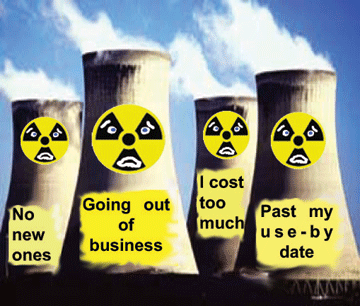 Greenpeace says nuclear risks rising in the EU n a new report, DW 7 Mar 14 Greenpeace is demanding immediate action to protect the bloc’s citizens from a rising risk of nuclear accidents. The environmental NGO has found out that many nuclear power plants in Europe are too old. Environmental organization Greenpeace says that the risk of a nuclear accident in Europe is on the rise. A new 146 page report, commissioned by the organization, finds that risk levels in Europe’s nuclear facilities are rising due to various reasons. The document cites the ongoing use of nuclear power plants beyond their original used-by date, as well as increased power demands in the bloc, as the main problems.
Currently in the European Union, Switzerland and the Ukraine there are 151 nuclear power plants in operation. Of those, 66 were built over 30 years ago and 25 of them were built over 35 years ago.
“If you consider that most of the reactors were planned to run for 30 years, then it’s clear that many of them are now exceeding their life span,” explains Greenpeace nuclear expert Tobias Riedel.
The problem with old power plants is not just that the component parts are getting more worn, say the experts. It’s also because of the lower technical and security requirements of the older power plants. ………http://www.dw.de/greenpeace-says-nuclear-risks-rising-in-the-eu/a-17481045
Hanford nuclear clean-up hampered by leak in massive waste tank
Leak in massive Hanford nuclear waste tank getting worse by SUSANNAH FRAME / KING 5 NewsNWCN.com March 6, 2014 RICHLAND, Wash. — Workers have found more waste leaking betw een the walls of a nuclear storage tank on the Hanford Nuclear Reservation.
The waste was found in a new place between the walls of one of the 28 double shell tanks at the site. The US Dept. of Energy, which owns Hanford, says the waste is covering an area of 7 feet by 21 inches. The double shell tanks were built to be the most robust tanks at Hanford. They were constructed with the intent to be able to safely store the dangerous wastes until the technology to permanently dispose of the liquids is developed. A leak in a double shell tank is seen as one of the biggest setbacks to the cleanup program at Hanford in the last decade……….http://www.nwcn.com/news/More-waste-leaking-between-walls-of-tank-248859301.html
Illinois’ 100% renewable energy
llinois commended for renewable energy CHICAGO — Illinois has more cities providing 100 percent renewable energy than any other state, which has reduced pollution by the equivalent of removing a million cars from the road over the past few years, according to a report released Friday by national and state environmental groups……http://www.dailyherald.com/article/20140307/business/140308679/
Useful discussions between Iran and world powers
Iran, world powers hold ‘substantive and useful’ nuclear talks BY FREDRIK DAHL (REUTERS) 7 Mar 14- IRAN AND SIX WORLD POWERS HELD “SUBSTANTIVE AND USEFUL” EXPERT-LEVEL TALKS OVER TEHRAN’S NUCLEAR PROGRAM THIS WEEK, THEY SAID ON FRIDAY, AHEAD OF A NEW ROUND OF POLITICAL NEGOTIATIONS LATER THIS MONTH.
Seeking to build on an interim agreement reached late last year in Geneva, Iran and the major powers aim to hammer out a final settlement of the decade-old dispute over the Islamic Republic’s atomic activities by late July.
Both sides have made clear their political will to reach a long-term accord and have scheduled a series of meetings in the coming months. But they also acknowledge that there are still big differences over the future scope of Iran’s nuclear program and that success is far from guaranteed………….http://www.reuters.com/article/2014/03/07/us-iran-nuclear-experts-idUSBREA260MF20140307
Electric utilities need new business plans as renewable energy use inreases
Let’s Celebrate, Not Lament, Renewables’ Disruption of Electric Utilities Rocky Mountain Institute, 7 mMarch 14 Rnewables are making headway in Europe and bringing a low-carbon electricity system to the forefront. Renewables were 69 percent of new capacity added in 2012 in Europe and 49 percent in the United States. Not surprisingly, this threatens utilities unwilling to let go of outmoded business models and fossil-fuel generation.
Laments for Europe’s money-losing electric utilities were featured in an October 2013 cover story in the Economist. It said Europe’s top 20 energy utilities have lost over half their 2008 value, or a half-trillion Euros—more than Europe’s banks lost. Many utilities therefore want renewable competition slowed or stopped. Indeed, some European giants, like Germany’s E.ON and RWE, are in real trouble, and five of Europe’s top ten utilities have suffered credit downgrades. So have some U.S. utilities—most recently Jersey Central Power & Light and Potomac Electric Power Co.—from the likes of Fitch, Moody’s, Standard & Poor’s, Credit Suisse, and others.
Should old, long- and often still-subsidized oligopolies be bailed out or shielded from competition when they bet against innovation and lose? Those big European utilities were supposed, but failed, to prepare for renewables by reinvesting their hundreds of billions of Euros’ windfall from billing customers for the first decade’s tradable carbon emission credits they’d been given for free. Now they’re griping that disruptive technologies are upending their old models—just as innovators had warned them for the past few decades.
Disruptive technologies are meant to upset the status quo to bring worthwhile change. Should we have rejected mobile phones because they threatened to displace landline phones? Didn’t digital cameras make film camOf course utility companies that refuse to let go of an archaic system are losing investors’ money. To be sure, some market reforms, like a well-designed, technology-neutral electric capacity market, could be worthwhile. But botched investment strategy should not be rewarded. Nor should shareholders be surprised that utility stocks no longer perform like bonds when twenty-first-century technology and speed collide with twentieth- and nineteenth-century institutions, rules, and cultures. Fortunately, those shareholders were already compensated for accepting well-known risks like new technologies, new environmental rules, and other regulatory and policy shifts—and they needn’t be paid twice.
RENEWABLES AREN’T THE ONLY CHALLENGE TO INCUMBENTS Continue reading
How wealthy conservatives use money to mould opinions about cl;imate change
How does conservative money work on climate change? Daniel Lippman, E&E reporter ClimateWire: Wednesday, March 5, 2014 Searching for a reason major climate change legislation hasn’t passed Congress yet?
You could do worse than start looking around Washington, D.C., with its endless think tanks, lobbying firms and trade groups, many of which have swung into action in the past to block such bills and stand ready to do so in the future.
A recent study published in the journal Climatic Change finds that much of the millions of dollars that funds these groups comes from secret sources, and a good portion of the rest is from publicity-shy conservative foundations and wealthy donors. Continue reading
Middle East resurgence of renewable energy
Renewable Energy in MENA Area to Double Next Year, Desertec Says Bloomberg, By Anthony DiPaola Mar 6, 2014 Clean-energy assets in the Middle East and North Africa will more than double in capacity by the end of next year, the Dii GmbH industry association said.
Solar and wind generation capacity will rise to 3.9 gigawatts in 2015 from more than 1.5 gigawatts now, Paul van Son, chief executive officer of the Munich-based trade association known as Desertec, said in an interview in Dubai March 4.
Governments are looking to clean energy to meet rising demand for power and to conserve fossil fuels for export. Oil-producing countries in the Persian Gulf plan to boost solar output, which will distribute renewable energy more evenly across the region, Van Son said. Most of the region’s green energy assets are wind plants in North Africa, he said…….
Desertec is developing a $30 million fund to promote start-up generation that would otherwise not find financing……http://www.bloomberg.com/news/2014-03-06/renewable-energy-in-mena-area-to-double-next-year-desertec-says.html
North Carolina looking towards more renewable enery, not nuclear or coal
Duke Energy spill illustrates need for renewable energy innovation The Chronicle,By Caeleigh Macneil | March 5, 2014 March 5, 2014 Several Duke Energy power plants have been cited for environmental violations since a pipe broke under a Duke Energy coal ash pond and leaked ash into Dan River in February………
North Carolina has been making significant steps in renewable energy production and investment and is ranked third in the country in utility-scale solar capacity in advanced development or under construction. In addition, the state has a 35 percent renewable energy tax credit that makes it cheaper to invest in renewables.
Furthermore, Gov. Pat McCrory is a strong supporter of solar energy.
“North Carolina is home to one of the fastest growing solar industries in our nation,” he said in a press release on his website. “It is important that we recognize the impact the solar industry is making in our state.”
Bigger renewable energy targets supported by 90% of Europeans
90% of Europeans support greater renewable energy targets, P Tech, 6 Mar 14 A survey conducted by the European Commission has found that 90% of citizens think it’s important for their government to aim for a greater share of renewable energy by 2030.
The Eurobarometer poll, published this week, also found that 49% of those asked thought it “very important” for governments to ask.
Support was highest in Cyprus, Greece and Malta and lowest in Bulgaria and Estonia.
The EU’s current 2020 target of sourcing 20% of its energy from renewables is made up of a patchwork of binding goals for each nation……The UK performed a u-turn this week. It had been the largest country in a group looking to remove the renewable target so that other low carbon technologies such as nuclear and carbon capture and storage could be used as well. Now it has said it backs a 27% renewable energy target for 2030, but that this should not be broken into national objectives. This is in line with the current proposals by the European Commission.
Critics said this target is unambitious and represents “business as usual”.http://www.pv-tech.org/news/90_of_europeans_support_greater_renewable_energy_targets
cocaine user in charge of nuclear reactor
N.J. nuclear reactor supervisor suspended after testing positive for cocaine use The unidentified PSEG Nuclear worker has been suspended indefinitely after the results of a random drug test came back earlier this week, a PSEG spokesman said Thursday.BY NINA GOLGOWSKI / NEW YORK DAILY NEWS THURSDAY, MARCH 6, 2014, A New Jersey nuclear reactor’s control room supervisor has been suspended after testing positive for cocaine use.
The unidentified PSEG Nuclear worker was suspended indefinitely after the results of a random drug test came back earlier this week, a PSEG Nuclear spokesman said Thursday……http://www.nydailynews.com/news/national/n-nuclear-supervisor-suspended-testing-positive-cocaine-article-1.1713598
TV: Is cracked dam a radioactive ticking time bomb?
TV: Is cracked dam a ticking time bomb? “Next 24-48 Hours Critical” — “Preparing for worst-case scenario” — No ‘immediate’ threat — Feds monitor structure, ‘sudden release’ possible — “Very few have faced this” — NPR: New photo shows ‘pronounced curve’ — Docks near Hanford nuke site closed (VIDEO & PHOTO) http://enenews.com/tv-is-cracked-dam-a-ticking-time-bomb-next-24-48-hours-critical-they-are-preparing-for-worst-case-scenario-no-immediate-threat-downstream-very-few-have-faced-this-before?utm_source=feedburner&utm_medium=email&utm_c
KAPP-TV, Mar. 4, 2014 (emphasis added): It’s been almost a week since workers at the Wanapum Dam made a startling discovery. A 65 foot crack along one of the spillways underwater […] The utility district says the crack poses no immediate threat to people living downstream.
KHQ, Mar. 3, 2014: As dozens of engineers and technical experts continue to inspect a 65-foot crack found Thursday in one of the 12 spillways of the Wanapum Dam, inspectors believe the risk of public danger is low, but they are preparing for the worst-case scenario.
Stephanie Vigil, KHQ anchor: Is the Wanapum Dam aticking time bomb? […] There was a hidden danger no one knew about until a few days ago.
KHQ,, Mar. 3, 2014: ‘The Next 24-48 Hours Are Critical’
Kelsey Watts, KHQ reporter: Federal officials, dozens of engineers and technical staff are on the ground with the top priority of stabilizing that compromised section.
Thomas Stredwick, Grant County PUD spokesperson: “It’s something that we haven’t faced before – and there are very few hydroelectric plants that have faced this before.”
Watts: Despite this 65 foot crack being discovered — one of the largest engineers are aware of here at one of the dams they operate –They say the risk to the public tonight is still very low. However they are monitoring this very closely in the coming days and weeks to determine what danger may exist for the people in this area.
Solar energy boom in USA
2013 A Record Year For Solar In The USA http://www.energymatters.com.au/index.php?main_page=news_article&article_id=4207 More solar has been installed in the USA in the last 18 months than in the three decades years prior.
According to GTM Research and the Solar Energy Industries Association’s (SEIA) Solar Market Insight Year in Review 2013, solar panel installations increased 41 percent in 2013 over 2012 to reach 4,751 megawatts (MW). Additionally, 410 MW of concentrating solar power (CSP) was made operational.
By the end of last year, more than 440,000 solar power systems were operating in the U.S.; totaling over 12,000 MW of PV and 918 MW of CSP. The market value of all PV installations completed last year has been estimated at $13.7 billion.
“2013 offered the U.S. solar market the first real glimpse of its path toward mainstream status,” said Shayle Kann, Senior Vice President at GTM Research.
Arizona – 700.7MW
North Carolina – 335.4MW
Massachusetts – 237.2MW
New Jersey – 235.6MW
Hawaii – 15-.6MW
Georgia – 90.9MW
Texas – 75.2MW
New York – 69.4MW
Colorado – 55.9MW
GTM Research forecasts 26 percent PV installation growth in 2014, with installations reaching nearly 6 GW. The sector to grow most rapidly will be the residential market.
Further detail from the U.S. Solar Market Insight: Year-in-Review 2013 report can be viewed here.
Solar power, the most rapidly growing source of renewable energy in America, is now generating enough electricity to power more than 2.2 million homes.
The final quarter of last year was the biggest quarter ever for PV installations in the USA; with 2,106 MW of capacity brought online, up 60 percent over the next best quarter (Q4 2012).
The 2013 top 10 solar states; based on the amount of capacity installed last year:
Japan;s radiation scanner speialised for babies
Fukushima Fallout: Japanese Scientists Develop World’s First Radiation Baby ScannerInternational Business Times,By Mary-Ann Russon , March 4, 2014 University of Tokyo scientists have built the world’s first whole body scanner capable of accurately measuring internal radiation exposure in babies and children living in the Fukushima Prefecture. The aim is to ease the worries of concerned parents.
- BABYSCAN iABYSCAN is a whole body scanner specially designed so that children can lie down and play or read a book while being scanned, and the machine is able to detect up to 50 Becquerels per body.
Due to their lower body mass, the radiation intake of a child, which would be an equilibrium level of 60 Becquerels, wouldn’t be picked up by the nuclear industry-grade whole body scanners currently deployed by the Japanese government, which are programmed to detect adult equilibrium levels of 250 Becquerels per body.
BABYSCAN is so sensitive that it can evenABYSCAN is a whole body scanner specially designed so that children can lie down and play or read a book while being scanned, and the machine is able to detect up to 50 Becquerels per body.
Due to their lower body mass, the radiation intake of a child, which would be an equilibrium level of 60 Becquerels, wouldn’t be picked up by the nuclear industry-grade whole body scanners currently deployed by the Japanese government, which are programmed to detect adult equilibrium levels of 250 Becquerels per body.
BABYSCAN is a whole body scanner specially designed so that children can lie down and play or read a book while being scanned, and the machine is able to detect up to 50 Becquerels per body.
Due to their lower body mass, the radiation intake of a child, which would be an equilibrium level of 60 Becquerels, wouldn’t be picked up by the nuclear industry-grade whole body scanners currently deployed by the Japanese government, which are programmed to detect adult equilibrium levels of 250 Becquerels per body.
BABYSCAN is a whole body scanner specially designed so that children can lie down and play or read a book while being scanned, and the machine is able to detect up to 50 Becquerels per body……..http://www.ibtimes.co.uk/fukushima-fallout-japanese-scientists-develop-worlds-first-radiation-baby-scanner-1438856In
1 This Month

of the week – Shut Down Drone Warfare!


Tell the Ukrainian Government to Drop Prosecution of Peace Activist Yurii Sheliazhenko

Petition to revoke the licensing of the Near Surface Nuclear Disposal Facility (NSDF) at Chalk River. https://www.ourcommons.ca/petitions/en/Petition/Details?Petition=e-7247
To see nuclear-related stories in greater depth and intensity – go to https://nuclearinformation.wordpress.com
-
Archives
- April 2026 (57)
- March 2026 (251)
- February 2026 (268)
- January 2026 (308)
- December 2025 (358)
- November 2025 (359)
- October 2025 (376)
- September 2025 (257)
- August 2025 (319)
- July 2025 (230)
- June 2025 (348)
- May 2025 (261)
-
Categories
- 1
- 1 NUCLEAR ISSUES
- business and costs
- climate change
- culture and arts
- ENERGY
- environment
- health
- history
- indigenous issues
- Legal
- marketing of nuclear
- media
- opposition to nuclear
- PERSONAL STORIES
- politics
- politics international
- Religion and ethics
- safety
- secrets,lies and civil liberties
- spinbuster
- technology
- Uranium
- wastes
- weapons and war
- Women
- 2 WORLD
- ACTION
- AFRICA
- Atrocities
- AUSTRALIA
- Christina's notes
- Christina's themes
- culture and arts
- Events
- Fuk 2022
- Fuk 2023
- Fukushima 2017
- Fukushima 2018
- fukushima 2019
- Fukushima 2020
- Fukushima 2021
- general
- global warming
- Humour (God we need it)
- Nuclear
- RARE EARTHS
- Reference
- resources – print
- Resources -audiovicual
- Weekly Newsletter
- World
- World Nuclear
- YouTube
-
RSS
Entries RSS
Comments RSS
 nuclear-news