Groundwater at Fukushima nuclear plant has record levels of cesium
 samples of water tested contained radioactive cesium at levels never seen before by the embattled utility.
Radioactive cesium levels “never seen before” at Fukushima — New record as amount in groundwater nearly doubles in 24 hours — Officials admit ‘may be new leak’ — IAEA urges ‘resumption’ of dumping contaminated water in ocean; ‘All options’ need to be on table (VIDEO) http://enenews.com/radioactive-cesium-spikes-over-past-24-hours-to-new-record-high-officials-admit-there-may-be-a-new-leak-iaea-urging-for-resumption-of-dumping-contaminated-water-into-ocean-all-options
AFP, Feb. 13, 2014: Fukushima should eye ‘controlled discharges’ in sea: IAEA — The [IAEA] urged Japan to consider “controlled discharges” into the sea of contaminated water […] “This would require considering all options, including the possible resumption of controlled discharges to the sea.” […] local fishermen, neighbouring countries and environmental groups all oppose the idea. […] radioactive groundwater […] leaking into the ocean [is] an ongoing problem that has stoked fears about dangers posed to marine life and the food chain. […]
Shanghai Daily, Feb. 13, 2014: TEPCO is still eyeing dumping toxic water into the Pacific Ocean as it fails to contain in makeshift storage tanks […] a massive daily influx of water needed to cool the battered reactors, while nuclear experts believe that other methods need to be traversed before contaminating the ocean. Dumping radioactive water into the ocean is of grave concern to local fisheries cooperatives as the potential for radioactive materials to spread to marine life remains a distinct possibility […] NRA Chairman Shunichi Tanaka […] said […] TEPCO is still utterly inept when it comes to taking accurate readings of radioactivity […] and “lacks a basic understanding of measuring and handling radiation.”
Xinhua, Feb. 13, 2014: [TEPCO] said Thursday that samples of water tested contained radioactive cesium at levels never seen before by the embattled utility. TEPCO [is] admitting there may be a new leak at the site of a well located just 50 meters from the adjacent Pacific […] [It] failed to locate the source of the leak, in another major failing […]
Tepco Handout, February 13, 2014: “The highest dose among the results previously announced” — Underground water at 130,000 Bq/L of Cs-134, 137. Previous record set Feb. 12 with 76,000 Bq/L of Cs-134, 137.
Legal cases loom for French govt over radiation caused illnesses from nuclear bomb testing
Map shows huge radiation spread from 1960s French nuclear tests,France 24, http://www.france24.com/en/20140214-map-shows-huge-radiation-spread-french-saharan-nuclear-tests/The radioactive spread from French nuclear tests in Algeria in the 1960s was much larger that the French army admitted at the time, stretching across all of West Africa and up to southern Europe, according to recently declassified documents
The documents were released in 2013 following appeals from military veterans who say their current ill health is linked to exposure to dangerous levels of radiation.
One map shows that 13 days after France detonated its first nuclear device – “Gerboise Bleue” (Blue Jerboa) – in February 1960, radioactive particles ranged from the Central African Republic to Sicily and southern Spain.
Gerboise Bleue, more than three times as powerful as the bomb dropped on Nagasaki in 1945, exploded in the sky above the Sahara Desert in southern Algeria. The test took place at the height of the former French colony’s independence struggle.
In the 1960s the norms governing acceptable levels of radiation were much less strict than they are now,” said Bruno Barillot, an expert in nuclear tests who is representing veterans’ groups. And the medical evidence we have now shows clearly that exposure to this radiation can set off serious illnesses more than three decades later,” he told French daily Le Parisien.
Barillot added that the declassified documents showed that the army at the time was aware that even the 1960s safety levels were largely surpassed and that significant quantities of airborne radioactive particles, particularly iodine 131 and caesium 137, could have been inhaled by large numbers of people in north Africa.
But he also complained that the government had been extremely selective in terms of what documents to release.Proof that France ignored or tried to hide the health effects of its nuclear testing could be extremely problematic for the French government.
There are already a number of civil cases lodged by Algerians against the French state.nd if it can be demonstrated that the fallout of the bomb tests spread dangerous levels radiation over large parts of North Africa, many more demands for compensation from individuals and from national governments could be in the pipeline.
Solar energy affordable now, nuclear fusion not likely to ever be
Would nuclear fusion be economically viable? THE WEEK, 14 Feb 14 Scientists have passed a crucial milestone on the road to nuclear fusion. But the final frontier for fusion isn’t scientific — it’s economic.

A team of scientists at the Lawrence Livermore National Laboratory in California announced Wednesday that they have reached a key milestone in the development of nuclear fusion. Nuclear fusion is the process of atomic nuclei fusing to form a larger atom, which is how the sun emits heat and light.
Writing in the journal Nature, the scientists declared that for the first time ever they had yielded more energy out of fusion than what was needed to create the reaction. They used 192 lasers to compress a pellet of fuel, generating a reaction in which more energy came out of the fuel core than went into it.
But the goal of “ignition” — which is when more energy is yielded than was consumed in the entireprocess — remains distant……However, even ignition is not enough. The final frontier for nuclear fusion is not scientific, but economic — meaning, when it can compete price-wise with the alternatives. And humans already have lots of energy options for the future……
The twilight of the fossil fuel age is being spent developing renewable forms of energy. Some are inherently small-scale in nature, like wind and hydroelectric power………… the Sun, which each year casts down much greater quantities of energy onto the Earth than the total amount of fossil fuel beneath its surface.
For photovoltaic energy, we have already passed the threshold of “ignition,” with solar panels capturing more energy than it takes to produce them. Furthermore, solar energy’s prices are falling so rapidly that it is becoming competitive with fossil fuels……..or most purposes, it all comes down to efficiency. We still don’t know how efficient nuclear fusion reactors will be in practice. Right now, we do know that solar energy is already viable.John Aziz http://theweek.com/article/index/256500/would-nuclear-fusion-be-economically-viable
Offensive headline about Japanese women draws protests
‘How to date Japanese women who haven’t been exposed to radiation’ ,global post,14 Feb 14 Readers weren’t too happy with South Korea’s Maxim after they published an article with the inflammatory headline………An inflammatory headline, to say the least, and one that Korean readers were quick to point out as inappropriate given the sensitive nature of Japan’s continuing recovery after the 2011 tsunami and Fukushima disaster.
Japan‘s media caught wind of the controversy this week, and the rest is viral history.
The original article on Japan Today has been removed, but we’ve captured the cached versionfor you.Maxim Korea’s editor-in-chief said the article, in the February issue of the magazine, was about how to get a Japanese girlfriend, regardless of her exposure to radiation, and he apologized (sort of) for preying on readers with an egregiously provocative headline. ………http://www.globalpost.com/dispatch/news/regions/asia-pacific/south-korea/140214/maxim-date-japanese-women-radiation-controversial-article
Diseconomics of nuclear power leading to more shutdowns
Group warns more nuclear power plants may shut down By Luther Turmelle, New Haven Register 02/14/14 The chief executive officer of a trade group representing the nuclear power industry warned Wall Street analysts Thursday that more power plants in the sector may be headed for shutdown…….Joel Gordes, a West Hartford-based energy consultant, said there are other issues beyond the way competitive power markets are structured that work against the long term viability of the nuclear power industry in the United States .
The ages of the existing plants isn’t conducive to attracting new investments,” Gordes said. “And (the nuclear accident) at Fukushima has created a whole new perspective on the nuclear industry.”
Another factor working against the long-term viability of nuclear power plants is the move toward distributed generation of power in the United States, he said. Distributed generation is a term used to describe the use of small-scale power producing technologies to generate electricity close to the end users of power.
“By their very nature, nuclear power plants require economies that only come in a very large scale,” Gordes said…http://www.nhregister.com/business/20140214/group-warns-more-nuclear-power-plants-may-shut-down
In space travel threats, radiation is the killer
How radiation rules Mars exploration PhsOrg. by Sheyna E. Gifford “…..we have known that space is a risky place to be, radiation being one of many reasons. We believed that once our explorers safely landed on Mars’ surface, the planet would provide shielding from the ravages of radiation. We didn’t how much, or how little, until very recently. Radiation and its variations impact not only the planning of human and robotic missions, but also the search for life taking place right now…….
Radiation and its variations impact not only the planning of human and robotic missions, but also the search for extraterrestrial life. Without a substantial atmospheric protection, powerful particles entering the air can penetrate straight into the Martian soil. On impacting the surface, the GCRs and SEPs from space produce cascades of other energetic particles. Of these newly produced particles, gamma rays and neutrons are easily capable of breaking molecular bonds in the soil, destroying evidence of past life, as well as any life that may be presenting trying to survive there…….
Deep space, the place of greatest exposure, remains an issue.
“Perhaps one of the areas they would be most vulnerable would be during a spacewalk [on the way] to Mars.”….Because of what we have learned, we can begin to establish weather prediction systems. We can tell explorers that there is an increased risk of cancer associated with a trip to Mars (approximately 5 percent over a lifetime).
In these ways, radiation rules the past, present and future of effective planetary exploration…….http://phys.org/news/2014-02-mars-exploration.html
Goldman Sachs geting out of failing uranium industry
Goldman Sachs Selling Uranium Trading Business Thursday February 13, 2014By Vivien Diniz Uranium Investing News Back in November, SparkSpread, an online energy publication, broke the news that Goldman Sachs (NYSE:GS) would be putting its uranium trading desk up for sale due to lax prices for the material and stricter regulations relating to the bank’s commodities activities.
At the time, Goldman said it had no intention of exiting the commodities business. Fast forward several months, and it looks like the bank is substantiating the rumor with the sale of its uranium trading business.
As Reuters states, very few people know that Goldman Sachs has been in the business of trading raw uranium, or yellowcake as it is known. But the bank can trace its uranium business back to an apartheid-era South Africa-based trading corporation that sold Iran its only source of foreign yellowcake over 35 years ago.
However, over the course of the last four years, the bank has been collecting low-grade stockpiles of the nuclear fuel through its nuclear trading desk, known as NUFCOR International. The news outlet writes that Goldman’s stockpiles are currently larger than those held by Iran, and big enough to run China’s nuclear plants for about a year. Beyond that, Goldman has a deal to market a large portion of uranium production from AngloGold Ashanti (NYSE:AU), one of South Africa’s largest miners.
Banks pulling out of commodities
Goldman Sachs entered the uranium trading business in 2009, along with Deutsche Bank (NYSE:DB), the second-largest bank in Europe, when supplies were tight and prices were ready to spike. However, since Fukushima, the uranium price hasn’t returned to its previous highs…..http://resourceinvestingnews.com/66677-goldman-sachs-selling-uranium-trading-business.html
Decommissioning nuclear reactors – costing $billions
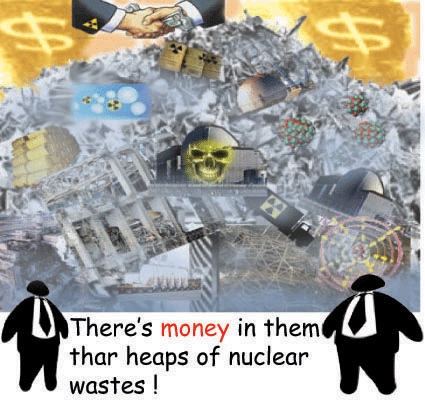 a new decommissioning industry is growing very rapidly.
The attraction for the industry is the enormous amount of taxpayers’ money that will have to be found to deal with the problem. Already the British Government is spending £3 billion (about AUD $5.57 billion) a year across 19 sites, just to begin a process that is expected to cost £100 billion. That is the Government’s own estimated cost of dismantling the old power plants, with the added cost of disposing of the waste.
Nuclear waste gets expensive Independent Australia,14 Feb 14 When countries embrace nuclear power to combat climate change the problem of disposing of the radioactive waste seems far away, but the costs will be enormous.Paul Brown from Climate News Network reports…….All governments who have nuclear power stations have to deal with practicalities and have a problem that so far is unresolved: how to get rid of all the radioactive waste their existing nuclear plants have produced.It is a contentious issue even in countries that are phasing out nuclear power, like Germany, because no communities want to be blighted by being a nation’s nuclear waste dump. But it is worse for countries that share this unresolved nuclear waste problem yet want to add to it by building a new generation of power stations.
An example is Britain, where the Government stated four years ago it was unacceptable to build a new generation of atomic power stations while having no depository to get rid of the existing waste.
It was confident its Nuclear Decommissioning Authority (NDA) would solve the problem of old power stations and increasing quantities of badly stored radioactive waste. The NDA has failed to do so. The stumbling block has been that, so far, no community in the United Kingdom has been prepared to accept a waste depository.
With 20 nuclear reactors already closed down because they are no longer economic or have safety problems, the issue is becoming urgent — but there is still no solution in sight……. Continue reading
Hypocrisy – Israel’s nuclear weapons arsenal
Gwynne Dyer: Israel’s hypocrisy on nuclear weapons ,straight.com, DAVID SHANKBONE 13 FEB 14 WHEN MORDECHAI VANUNU, a humble Israeli technician who worked for years at Israel’s secret nuclear site at Dimona, spilled the beans about Israel’s nuclear weapons in 1986, very bad things happened to him.
Governor opposed uranium mining
Thank Terry McAuliffe for Opposing Uranium Mining Over the last few months, Governor-Elect Terry McAuliffe has come out in strong opposition to lifting Virginia’s current moratorium on uranium mining. At a Veteran’s Day event in Norfolk, he stated, “I don’t support uranium mining. First and foremost as governor, my job is to make sure that our communities and our citizenry are safe. I’m not comfortable with the science to the point that I can say that with uranium mining, we would be safe. I’m afraid it would get into the drinking water.”
His concerns are validated by the studies that have cost us 3 million dollars over the last few years and have found that mining would be a significant threat to drinking water, public health, and local economies. Left behind would be huge volumes of radioactive and toxic waste, which has been linked to leukemia, kidney disease, and health problems for centuries in Virginia.,,,,,,, uranium mining. First and foremost as governor, my job is to make sure that our communities and our citizenry are safe. I’m not comfortable with the science to the point that I can say that with uranium mining, we would be safe. I’m afraid it would s concerns are validated by the studies that have cost us 3 million dollars over the last few years and have found that mining would be a significant threat to drinking water, public health, and local economies. Left behind would be huge volumes of radioactive and toxic waste, which has been linked to leukemia, kidney disease, and health problems for centuries in Virginia.get into the drinking water.”….ierraclub.org/site/Advocacy?pagename=homepage&page=UserAction&id=12339&autologin=true&s_src=313Z5000A1
£2m funding from nuclear weapons industry to Cambridge University
Revealed – Cambridge University’s £2m funding from nuclear weapons industry
by CHRIS HAVERG Scientists at Cambridge University received £2 million in funding from Britain’s nuclear weapons research organisation in the space of just two-and-a-half years.
Disarmament campaigners have criticised the grants, received by the Cavendish Laboratory in its status as one of five UK institutions boasting a ‘strategic alliance’ with the Atomic Weapons Establishment (AWE)…..
Simon Sedgwick-Jell, of Cambridge Green Party, called on the university to end the link.
He said: “As a world class institution that ought to be taking a lead in many areas, it would be better if the university did not have connections with the military side of the nuclear establishment. http://www.cambridge-news.co.uk/Education/Universities/Revealed-Cambridge-Universitys-2m-funding-from-nuclear-weapons-industry-20140212173350.htm#ixzz2tDkbfbU#
Japan’s election leaves the country still divided over nuclear power
Nuclear Issue in Limbo as Indecision Grips Japan NYT, TOKYO — Several industrialized countries have turned their backs on nuclear power as a result of the Fukushima nuclear disaster, including one that has already begun permanently shutting functioning plants. That country is not Japan.
“Germany chose to get rid of nuclear power because of Fukushima, while the United States is still in favor, but what about Japan, where the accident took place?” said Jun Tateno, who has written several books on nuclear power. “We still have not had a proper public debate about the most fundamental question: Do we want nuclear power’s low-cost electricity for growth, or do we want a safer, nuclear-free society?”
“The no-nukes candidates lost, but that doesn’t mean there is suddenly a consensus in favor of nuclear power,” said Shiro Asano, a retired professor of politics at Keio University.
Voters have chosen Mr. Abe’s pro-nuclear governing party in national elections, but then oppose an immediate restart of the plants in opinion polls.
That fuzzy message has left this consensus-driven country without a way forward, …..
Renewabe energy technologies, faster, safer. cleaner than proposed thorium nuclear reactors
Will Thorium Save Us From Climate Change? EcoWAtch,Dr. David Suzuki | February 11, 2014 “…….What are “safer nuclear power systems?” And are they the answer? Proposed technologies include smaller modular reactors, reactors that shut down automatically after an accident and molten salt reactors. …….One idea is to use thorium instead of uranium for reactor fuel. Thorium is more abundant than uranium. Unlike uranium, it’s not fissile; that is, it can’t be split to create a nuclear chain reaction, so it must be bred through nuclear reactors to produce fissile uranium……..
Although they may be better than today’s reactors, LFTRs still produce radioactive and corrosive materials, they can be used to produce weapons and we don’t know enough about the impacts of using fluoride salts. Fluoride will contain a nuclear reaction, but it can be highly toxic, and deadly as fluorine gas. And though the technology’s been around since the 1950s, it hasn’t been proven on a commercial scale. Countries including the U.S., China, France and Russia are pursuing it, but in 2010 the U.K.’s National Nuclear Laboratory reported that thorium claims are “overstated.”
It will also take a lot of time and money to get a large number of reactors on-stream—some say from 30 to 50 years. Given the urgent challenge of global warming, we don’t have that much time. Many argue that if renewables received the same level of government subsidies as the nuclear industry, we’d be ahead at lower costs. Thorium essentially just adds another fuel option to the nuclear mix and isn’t a significant departure from conventional nuclear. All nuclear power remains expensive, unwieldy and difficult to integrate with intermittent renewables—and carries risks for weapons proliferation……
investing in renewable energy and smart-grid technologies is a faster, more cost-effective and safer option than building new nuclear facilities, regardless of type. ……we must also build on the momentum of renewable energy development, which has been spurred by its safety, declining costs and proven effectiveness.http://ecowatch.com/2014/02/11/will-thorium-save-us-from-climate-change/
Fukushima prefecture and Germa state to co-operate on renewable energy
Fukushima signs renewable energy pact with German state Global Post 12 Feb 14 Fukushima Prefecture has signed an agreement with the German state of North Rhine-Westphalia to work together to promote the use of renewable energy.
The prefecture, which hosts Tokyo Electric Power Co.’s Fukushima Daiichi nuclear power plant crippled by the 2011 quake and tsunami, aims to introduce renewable energy technologies from Germany, a leader in the field, to realize a society not dependent on nuclear power……..
State environment minister Johannes Remmel said at the ceremony that Germany and Japan are technologically competent to accomplish worldwide success in the field of renewable energy.
Fukushima and North Rhine-Westphalia will host alternately trade fairs featuring renewable energy businesses and promote joint research among businesses in the next three years…….http://www.globalpost.com/dispatch/news/kyodo-news-international/140210/fukushima-signs-renewable-energy-pact-german-state
New book shows problems inherent in all nuclear power plants
the problems that led to the disaster at Fukushima Daiichi exist wherever reactors operate.
Fukushima: The Story Of A Nuclear Disaster’ Reveals New Insight Into Japanese Catastrophe International Business Times, By Roxanne Palmeron February 11 2014 The story of the 2011 catastrophe at Japan’s Fukushima Daiichi nuclear power plant unfolds in a new book-length account from the Union of Concerned Scientists, a nonprofit advocacy group.
“Fukushima: The Story of a Nuclear Disaster” (The New Press) was penned by David Lochbaum, head of the UCS’s Nuclear Safety Project (and a nuclear engineer for 17 years); Edwin Lyman, a senior scientist in UCS’s Global Security Program; and journalist Susan Stranahan, who led the Philadelphia Inquirer’s coverage of the Three Mile Island Accident in Dauphin, Pennsylvania (which earned the paper the 1980 Pulitzer Prize in local general reporting).
Lochbaum and his coauthors weave a fast-paced, detailed narrative that moves like a thriller — but with the consequences painfully real, and the potential for a sequel hanging on the horizon.
“Fukushima Daiichi unmasked the weaknesses of nuclear power plant design and the long-standing flaws in operations and regulatory oversight,” the authors write. “Although Japan must share the blame, this was not a Japanese nuclear accident; it was a nuclear accident that just happened to have occurred in Japan. The problems that led to the disaster at Fukushima Daiichi exist wherever reactors operate.”…….http://www.ibtimes.com/fukushima-story-nuclear-disaster-reveals-new-insight-japanese-catastrophe-1554714
1 This Month


18 March Webinar @ 1 PM EST: An Assessment of SMR Projects: The Case of Canada
register for the zoom:
https://us02web.zoom.us/webinar/register/WN_o8BIIOUvQ2ONJR1nta65DQ#/registration


of the week – STOP SMALL MODULAR REACTORS IN CANADA
To see nuclear-related stories in greater depth and intensity – go to https://nuclearinformation.wordpress.com
-
Archives
- March 2026 (129)
- February 2026 (268)
- January 2026 (308)
- December 2025 (358)
- November 2025 (359)
- October 2025 (376)
- September 2025 (258)
- August 2025 (319)
- July 2025 (230)
- June 2025 (348)
- May 2025 (261)
- April 2025 (305)
-
Categories
- 1
- 1 NUCLEAR ISSUES
- business and costs
- climate change
- culture and arts
- ENERGY
- environment
- health
- history
- indigenous issues
- Legal
- marketing of nuclear
- media
- opposition to nuclear
- PERSONAL STORIES
- politics
- politics international
- Religion and ethics
- safety
- secrets,lies and civil liberties
- spinbuster
- technology
- Uranium
- wastes
- weapons and war
- Women
- 2 WORLD
- ACTION
- AFRICA
- Atrocities
- AUSTRALIA
- Christina's notes
- Christina's themes
- culture and arts
- Events
- Fuk 2022
- Fuk 2023
- Fukushima 2017
- Fukushima 2018
- fukushima 2019
- Fukushima 2020
- Fukushima 2021
- general
- global warming
- Humour (God we need it)
- Nuclear
- RARE EARTHS
- Reference
- resources – print
- Resources -audiovicual
- Weekly Newsletter
- World
- World Nuclear
- YouTube
-
RSS
Entries RSS
Comments RSS
 nuclear-news