China’s repressive policies in Tibet
 Human Rights Watch chides China for enforcing highly repressive policies in Tibet http://tibet.net/2014/01/23/human-rights-watch-chides-china-for-enforcing-highly-repressive-policies-in-tibet-2/ DHARAMSHALA: China’s policies in Tibet once again came under criticism from Human Rights Watch, which says in annual report released on Tuesday that the Chinese government systematically suppresses Tibetan political, cultural, religious and socio-economic rights.
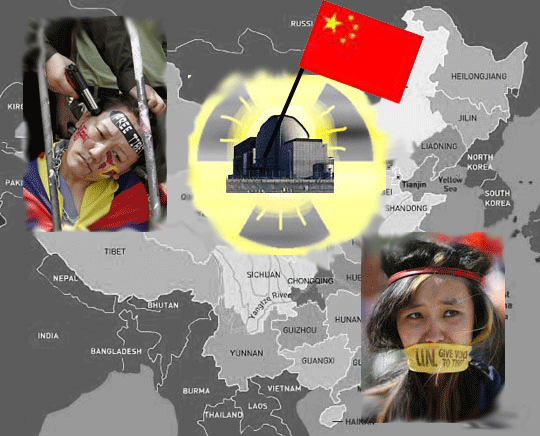 The Chinese government systematically suppresses Tibetan political, cultural, religious and socio-economic rights in the name of combating what it sees as separatist sentiment including non-violent advocacy for Tibetan independence, the Dalai Lama’s return, or opposition to government policy, the report said.
“Arbitrary arrest and imprisonment remains common, and torture and ill-treatment in detention is endemic. Fair trials are precluded by politicised judiciary overtly tasked with suppressing separatism,” it said.
“The Chinese government carries out involuntary population relocation and rehousing on a massive scale, and enforces highly repressive policies in ethnic minority areas in Tibet, Xinjiang, and Inner Mongolia,” Human Rights Watch said in its report.
“The government is also subjecting millions of Tibetans to a mass rehousing and relocation policy that radically changes their way of life and livelihoods, in some cases impoverishing them or making them dependent on state subsidies, about which they have no say. Since 2006, over two million Tibetans, both farmers and herders, have been involuntarily “rehoused”—through government ordered renovation or construction of new houses—in the TAR; hundreds of thousands of nomadic herders in the eastern part of the Tibetan plateau have been relocated or settled in “New Socialist Villages.” ( Tibet.Net report on mass relocation)
The report condemned the Chinese police firing on unarmed Tibetans who had gathered to celebrate the birthday of His Holiness the Dalai Lama on 6 July in Nyitso, Dawu Prefecture. Two people were reported to have died and several others injured in the firing.
It also noted that the Chinese government continues to impose many of the measures it introduced during its brutal crackdown on the widespread Tibetan protest in 2008. ”In an apparent effort to prevent a repetition of the popular protests of 2008, the government in 2013 maintained many of the measures it introduced during its brutal crackdown on the protest movement—a massive security presence composed largely of armed police forces, sharp restrictions on the movements of Tibetans within the Tibetan plateau, increased controls on monasteries, and a ban on foreign journalists in the Tibetan Autonomous Region (TAR) unless part of a government-organised tour. The government also took significant steps to implement a plan to station 20,000 new officials and Party cadres in the TAR, including in every village, to monitor the political views of all residents,” the report said.
The report also said that “the government censors the press, the Internet, print publications, and academic research, and justifies human rights abuses as necessary to preserve social stability.”
Against the backdrop of all the deteriorating human rights situation in Tibet, China was elected to the UN Human Rights Council during its 17th Universal Periodic Review (UPR) last year.
No comments yet.
1 This Month

of the week – Shut Down Drone Warfare!


Tell the Ukrainian Government to Drop Prosecution of Peace Activist Yurii Sheliazhenko

Petition to revoke the licensing of the Near Surface Nuclear Disposal Facility (NSDF) at Chalk River. https://www.ourcommons.ca/petitions/en/Petition/Details?Petition=e-7247
To see nuclear-related stories in greater depth and intensity – go to https://nuclearinformation.wordpress.com
-
Archives
- April 2026 (57)
- March 2026 (251)
- February 2026 (268)
- January 2026 (308)
- December 2025 (358)
- November 2025 (359)
- October 2025 (376)
- September 2025 (257)
- August 2025 (319)
- July 2025 (230)
- June 2025 (348)
- May 2025 (261)
-
Categories
- 1
- 1 NUCLEAR ISSUES
- business and costs
- climate change
- culture and arts
- ENERGY
- environment
- health
- history
- indigenous issues
- Legal
- marketing of nuclear
- media
- opposition to nuclear
- PERSONAL STORIES
- politics
- politics international
- Religion and ethics
- safety
- secrets,lies and civil liberties
- spinbuster
- technology
- Uranium
- wastes
- weapons and war
- Women
- 2 WORLD
- ACTION
- AFRICA
- Atrocities
- AUSTRALIA
- Christina's notes
- Christina's themes
- culture and arts
- Events
- Fuk 2022
- Fuk 2023
- Fukushima 2017
- Fukushima 2018
- fukushima 2019
- Fukushima 2020
- Fukushima 2021
- general
- global warming
- Humour (God we need it)
- Nuclear
- RARE EARTHS
- Reference
- resources – print
- Resources -audiovicual
- Weekly Newsletter
- World
- World Nuclear
- YouTube
-
RSS
Entries RSS
Comments RSS
 nuclear-news
Leave a comment