Increased renewable energy for New York State
 Plan Calls for Renewable Energy to Power NY State and More Carolyn Weaver VOA, December 31, 2013 NEW YORK — As worry grows over climate damage caused by carbon-based fuels like gas, oil and coal, some environmental engineering experts, such as Stanford University’s Mark Z. Jacobson, are offering new plans for energy independence via renewable power sources…….
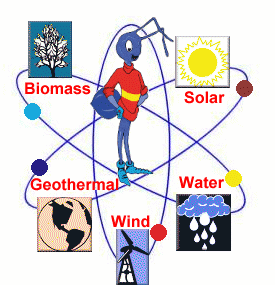
In their latest report, published in the journal Energy Policy, Jacobson and co-authors at Cornell University and the University of California, Davis, map out how New York State could transition to wind, water and solar power by 2030. They calculate there would be enough energy left over to power every vehicle in the state as well, and that 4,000 fewer people would die each year from disease caused by air pollution in New York State.
“There are a lot of industries that look unfavorably upon this plan, because they don’t benefit from it,” he said. “We’re excluding fossil energy, so gas, coal and oil, but we’re also excluding nuclear power and biofuels, even technologies such as coal with carbon capture, because they’re not as good as what we’re looking at.”
Nuclear energy is excluded, Jacobson said, because of the growing energy costs in mining and refining uranium, a non-renewable resource, and the risk it could add to nuclear weapons proliferation.
“Plus, one-and-a-half-percent of all nuclear reactors ever built have melted down to some degree, and this results in risk for another type of disaster, which you don’t have with wind or solar power,” he added…http://www.voanews.com/content/plan-calls-for-renewable-energy-to-power-ny-state-and-more/1821117.html
Fukushima’s Deadly Legacy -“Fukushima And The Privatization Of Risk”
 Nuclear Technology: Lasting Damage To Life’s Genetic Integrity And Heritage Book Review of Fukushima And The Privatization Of Risk by Majia Holmer Nadesan Richard Wilcox, Ph.D.Activist Post , 30 Dec 13“…………Fukushima’s Deadly Legacy Given the well financed campaign by the nuclear industry to downplay nuclear disasters, Nadesan’s analysis of radiation risks is indispensable.
The era of atmospheric testing of nuclear devices (A la Slim Pickens’ beloved mushroom cloud) which occurred mainly in the 1950s, totaled over 500 above ground detonations. This became a cause for grave concern among conscientious scientists and the public.
The 1956 U.S. Academy of Science report, “Biological Effects of Atomic Radiation” (aka the “BEAR” report) is cited by Nadesan “to demonstrate that geneticists warned decades ago of the potential for significant intergenerational health and reproductive risk from nuclear weapons and energy-sourced radiation exposure, but their warnings were discounted” due to “perceived national security benefits” by the nuclear priesthood of scientists and policy makers.
The BEAR report– which was written by highly credentialed scientists that were nevertheless under attack from the nuclear-military proponent sector– states after careful consideration that “even very small amounts of radiation unquestionably have the power to injure hereditary materials” in humans and other organisms. Nadesan summarizes some of the main points of BEAR:
Radiations cause mutations. Mutations affect those hereditary traits which a person passes on to his children and subsequent generations….
Practically all radiation-induced mutations which have effects large enough to be detected are harmful. A small but not negligible part of this harm would appear in the first generation of the offspring of the person who received the radiation. Most of the harm, however, would remain unnoticed, for a shorter or longer time, in the genetic constitution of the successive generations of offspring….
Any radiation dose, however small, can induce some mutations….
Like radiation-induced mutations, nearly all spontaneous mutations with detectable effects are harmful….
Additional radiation (i.e., radiation over and above the irreducible minimum due to natural causes) produces additional mutations (over and above spontaneous mutations)….
What counts, from the point of view of genetic damage, is not the rate [of exposure to radiation]; it is the total accumulated dose to reproductive cells of the individual from the beginning of his life up to the time the child is conceived….
Nadesan highlights radiation effects on children and cites the work of Ernest Sternglass who in 1969 “publicized his research by arguing…that radioactive fallout from atmospheric testing had caused the death of 375,000 infants” and “countless fetal deaths” from 1951 to 1966.
……… The Dangers Of Ionizing Radiation
One of the arguments often marshaled by nuclear apologists is that natural background radiation is not bad for you, ergo radiation released from nuclear fission processes is also safe.
However, Nadesan points out that “mitochondrial DNA is particularly vulnerable to disruption by ionizing radiation, even among people acculturated to relatively high levels of natural (not human produced) background exposure.” She found that in one study “children exposed to higher than ordinary gamma radiation…. found a 12 percent increase in childhood leukemia for every millisievert of natural gamma-radiation dose to bone marrow.” Iran is often mentioned by nuclear apologists as evidence that high background radiation is totally safe, and yet a study found that “higher rates of mitochondrial DNA mutations correlated with higher background exposure” and affected the genomic integrity of future generations of offspring…….http://www.activistpost.com/2013/12/nuclear-technology-lasting-damage-to.html
Power utilities determined to stop small scale renewable energy
The goal of utility companies, on the whole, is to work to ensure that a new model of decentralized renewable energy distribution does not emerge.
It’s an issue of the private good versus the public good: profit vs. what benefits the public commons and life on earth
Monopolistic Utilities Know Renewable Energy Will Cut Their Profits, So They Stall It MARK KARLIN, EDITOR OF BUZZFLASH AT TRUTHOUT, 31 Dec 13 There’s one overwhelming dirigible-size reason for-profit (and often monopolistic) utility companies — that transmit and sell most of America’s energy — generally discourage, if not crush, residen ial solar (and other renewable) energy: fear of large scale loss of profit……..
for-profit utility companies were dragged kicking and screaming into the concept of allowing renewable households and industries to sell their excess energy back via transmission lines (known as hooking up to the grid). Why might you ask would a for-profit utility company be against households or industries becoming so successful in renewable energy that they are generating excess power?
Simply put, for every household or industry that becomes self-sustainable with renewable energy, the for-profit utility loses a customer, which is the same as saying losing profit. For every renewable house or industry that uses net-metering to send excess energy over the transmission grid of the utility, the utility is losing both a customer and weakening its energy monopoly.
The primary and ossified model of electric utilities is centralized monopolization of energy transmission (which again only relatively recently has been challenged through both consumer and “electrical energy buyer” lobbies — which is another issue largely unrelated to renewables). Furthermore, as “Solartopia” author Harvey Wasserman notes, the utilities are members of the same industrial fraternity as the fossil fuel and nuclear plant generators — sometimes doubling up as in the case of utility-owned nuclear power plants.
The goal of utility companies, on the whole, is to work to ensure that a new model of decentralized renewable energy distribution does not emerge. If it did, the for-profit utility companies that get their way in so many state legislatures, not to mention favors from the federal government, would become extinct.
Their only hope to survive in the longterm is to monopolize the power grid long enough to build renewable energy sources that they own and distribute — and only, for the most part, when they run out of fossil fuel (if the earth is still around) — and that do not come from external sources such as solar-equipped businesses and homes. Only a few utilities have begun to understand this and start weaning themselves off of fossil fuel, but in the meantime they need to keep homes and businesses from independently establishing renewable electrical cooperatives — and the way to do that — they think — is to stop current customers from converting to independent renewable energy.
That’s the story, whatever shills for the industry or technocrat electrical engineers might say. It’s an issue of the private good versus the public good: profit vs. what benefits the public commons and life on earth…… http://truth-out.org/buzzflash/commentary/item/18391-for-profit-utility-companies-residential-renewable-energy-as-their-ruin
France wants UK to subsidise France’s technology, even as it is taxing its own reactors to downgrade them
France, which plans to tax nuclear generation, is pushing the U.K. to subsidize it.
U.K. Builds Nuclear Plants While France Scales Back The British and French have swapped nuclear energy postures IEEE Spectrum, By Peter Fairley 27 Dec 2013 Nations that are considering nuclear energy must grapple with its high capital costs and Fukushima-scale risk. An energy-policy riptide along the English Channel shows how unpredictable the calculations can be: Both France and the United Kingdom have scrapped fundamental planks in their energy policies, with one ramping up and the other dialing down.
 In the U.K., where Margaret Thatcher set off a global movement by deregulating the power industry, the current prime minister is offering subsidies to attract financing for new nuclear reactors. Across the water, France, which staked its economic future on nuclear power a generation ago, is now planning that technology’s decline. These policy shifts have been in the works since 2012, but they are coming to a head as both governments put the finishing touches on sweeping energy-reform legislation.
 A coalition composed of Socialists and the staunchly antinuclear Greens vows to scale back France’s reliance on nuclear power from more than three-quarters of electricity at present to roughly one-half by 2025, delivering on a 2012 election promise made by President François Hollande.
Legislation to be introduced early in 2014 could include a new nuclear electricity tax, which would help subsidize an accelerated transition toward renewables. A third-generation reactor under construction in Normandy since 2007 could be the country’s last.
The British government plans to sustain or even enhance nuclear’s role, which was 19 percent of generation in 2012, by proffering taxpayer dollars. Its plan is to inspire construction of a new generation of reactors—enough to provide up to 16 gigawatts of new generation by 2025—by guaranteeing a base price for the electricity. If market pricing falls below that threshold, a government-backed “contract for difference” would make up the shortfall.
There is another layer of irony in the cross-Channel nuclear-policy split: France, which plans to tax nuclear generation, is pushing the U.K. to subsidize it. State-owned utility Électricité de France (EDF) wants to build two 1600-megawatt reactors at Hinkley Point on England’s southwest coast, where two 1970s-era reactors could shut down as early as 2023. But EDF insists that without the contract-for-difference guarantee, U.K. power prices, as well as carbon credits that the plant would earn, are too low and uncertain to justify the £16 billion (US $26 billion) investment……
Fouquet predicts that legal challenges against the U.K. subsidy from competing generators will take years to resolve, denying investors such as EDF the certainty they need to start building. So in the end, the British and French may go their separate ways on nuclear policy, but their reliance on nuclear power may yet fade away in harmony. http://spectrum.ieee.org/energy/nuclear/uk-builds-nuclear-plants-while-france-scales-back
Occasionally, some of your visitors may see an advertisement here.
On the assassinations of Iran’s nuclear scientists
How the IAEA Basically Helped Assassinate Iranian Nuclear Scientists By Global Research News December 29, 2013 “……In the fifth attack of its kind, terrorists killed a 32-year-old Iranian scientist, Mostafa Ahmadi Roshan, and his driver on January 11, 2012.
The blast took place on the second anniversary of the martyrdom of Iranian university professor and nuclear scientist, Massoud Ali Mohammadi, who was also assassinated in a terrorist bomb attack in Tehran in January 2010.
The assassination method used in the bombing was similar to the 2010 terrorist bomb attacks against the then university professor, Fereidoun Abbassi Davani – the former head of Iran’s Atomic Energy Organization – and his colleague Majid Shahriari. While Abbasi Davani survived the attack, Shahriari was martyred……..
Over the course of the investigations, all other elements behind the assassination of Iranian scientists Massoud Ali-Mohammadi, Majid Shahriari and Mostafa Ahmadi Roshan as well as Reza Qashqaei (Roshan’s driver) have been apprehended, the statement read.
Some of the perpetrators of the assassination of Dr. Fereydoun Abbasi are among those arrested, the ministry added.
The statement said Iran’s Intelligence Ministry has detected some of Mossad’s bases within the territories of one of Iran’s Western neighbors, which provided training and logistic support to the terrorist networks…….http://www.globalresearch.ca/the-iaea-basically-helped-assassinate-iranian-nuclear-scientists/5362939
Dire health consequences predicted from Fukushima nuclear disaster
Experts: Fukushima disaster victims to include up to 600,000 deaths, over 100,000 still-births, and over 100,000 children with genetic deformations http://enenews.com/experts-fukushima-victims-to-include-up-to-300000-deaths-over-100000-still-births-and-over-100000-children-with-genetic-deformations
| Anna Sablina, cancer researcher and assistant professor at University of Leuven, Dec. 26, 2013: […] in case of such high radioactive dose and exposure it obviously can increase a probability of cancer development especially thyroid cancer and leukemia. […] We can always compare what people already know about the Chernobyl accident because it is a quite similar situation [to Fukushima] […] the only problem in the Chernobyl area is a really increased rate of thyroid cancer especially for kids. More than 5,000 kids there diagnosed the thyroid cancer after Chernobyl, so I would say it probably could be the same case as in Japan. And for the rest it is a bit difficult to say […] I think most of the time the only people who were directly involved in cleaning up and fixing the accident could have a really increased rate of cancer but for the rest it will be really difficult to say […] |
Health consequences of chronic internal contaminations by radionuclides (pdf) IRSN (Radio-protection agency of France), 2005: The IRSN then recommends then to initiate in-depth researches in order to improve the knowledge in the area of health consequences of chronic internal contaminations […] not only focusing to cancers but also to the other types of effects and to all tissues. The main criticism to the current system is that it is mainly […] relating to the probability for a cancer or severe hereditary effects to occur [and] does not incorporate other pathologies and, in fact, researches conducted during the past years in radiotoxicology basically focused to the occurrence of cancers while neglecting other effects. It is now important to fill the gaps in this area and to describe all biological and health effects that may occur after a chronic contamination by radionuclides.
Decommissioning problems with Vermont Yankee Nuclear reactor
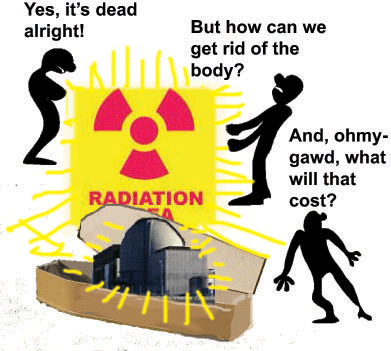 RECAP 2013: VERMONT YANKEE, RENEWABLE ENERGY CAPS AND WIND PROJECTS STIR CONTROVERSY HTTP://VTDIGGER.ORG/2013/12/29/RECAP-2013-VERMONT-YANKEE-RENEWABLE-ENERGY-CAPS-WIND-PROJECTS-STIR-CONTROVERSY/ JOHN HERRICK DEC. 29, 2013 VERMONT YANKEE, THE STATE’S ONLY NUCLEAR REACTOR, DOMINATED HEADLINES THIS YEAR.
Entergy Corp., the company that runs the reactor, is plagued by financial problems, and operating the Vermont plant was an expense it could no longer afford. In late August, Entergy announced it would close the plant, ironically just days after the Louisiana corporation won a long-running court battle with the state over the right continue operating the Vernon facility for an additional 20 years.
Entergy amended its application with the Public Service Board and is now seeking a one year license to operate the plant through the end of 2014, when Vermont Yankee is slated to close.
The board held off from ruling on the relicensure case at the request of the Shumlin administration while state officials settled differences over decommissioning, the economic impact of the plant closure, hot water discharges into the Connecticut River and a generation tax.
Many of those issues were resolved when the state and Entergy reached an agreement last week that sets a decommissioning completion date of 10 to 15 years, decades sooner than required by the federal Nuclear Regulatory Commission’s 60-year timeframe. Entergy also agreed to pay millions of dollars in payments to the state in tax revenues and in support for regional economic development efforts. In addition, the agreement settled all pending federal litigation.
The settlement is contingent on the Public Service Board approving the plant’s certificate of public good before March 31, 2014.
There are other outstanding issues that have yet to be resolved. The two parties disagree over whether Entergy’s Decommissioning Trust Fund is sufficient to support decommissioning. In addition, the state and the company do not yet have a common understanding of how the site will be restored. Entergy must file a decommissioning plan with the NRC after the plant is closed.
The state is concerned that the 42-year old merchant plant’s worsening financial foundation could compromise the operational safety of the facility in the near term and the decommissioning process over the long haul.
It is unclear what the plant will do with 530 tons of radioactive waste stored on the premises. Vermont Yankee has 3,879 fuel rod assemblies submerged in a spent fuel pool that was originally designed to hold about 350. Spent fuel rods must be kept under water to prevent them from igniting, but once they are cooled, they can be transferred into long-term cement “dry casks.” Vermont Yankee will need 58 casks in all. Right now, the facility has 13. Each cask costs about $1 million.
The agreement requires that all the spent nuclear fuel stored on site pools be placed in dry cask storage, which Gov. Peter Shumlin said could take up to seven years.
Entergy’s decision to close Vermont Yankee was the result of declining wholesale market prices and competition with natural gas. Merchant plants are investor-funded; early this year a Swiss financial services firm UBS Securities downgraded Entergy Corp.’s stock and urged investors to sell.
The downgrade came on the heels of a report by UBS Securities that found Entergy “is unlikely to generate any meaningful cash” from wholesale commodities in 2013 and 2014.
Entergy’s nuclear fleet includes the Pilgrim Nuclear Power Station in Massachusetts, Vermont Yankee in Vermont, Indian Point Energy Center and the James A. Fitzpatrick Nuclear Power Plant in New York, and the Palisades Power Plant in Michigan.
Tennessee Valley Authority increasing renewable energy programs
TVA moves forward with Plans to Increase Solar Energy Capacity, Expand Renewable Programs http://www.clarksvilleonline.com/2013/12/29/tva-moves-forward-plans-increase-solar-energy-capacity-expand-renewable-programs/ December 29, 2013 Chattanooga, TN – The Tennessee Valley Authority is taking steps that could significantly increase TVA’s solar energy capacity in 2014 while ensuring TVA’s green power programs remain sustainable and cost effective.
TVA is offering a total of 126 megawatts of renewable capacity in the coming year through a variety of power-purchasing programs for homes, businesses and commercial installations, marking a 7 percent increase over 2013.
TVA will be adding capacity and reducing pricing incentives to reflect lower technology costs for generators and to support lower electric rates for the Tennessee Valley’s 9 million residents.
TVA is revising its three renewable energy programs particularly in response to increasingly popular solar energy, with a majority of new capacity offered at prices competitive with TVA’s wholesale costs.
TVA currently has 128 megawatts of operating or committed solar projects under contract at more than 2,000 locations across the region. TVA’s renewables portfolio also includes 1,500 megawatts from wind and 60 megawatts from biomass.
“Demand for our renewables programs is strong,” said Patty West, director of TVA’s Renewable Energy Programs. “We are working with our local power companies to direct capacity to the most cost-effective programs and streamlining the processes for these programs to make it easier for participants.
“The cost of renewable technologies, especially solar, is dropping dramatically,” she said. “TVA is aligning its program offerings with those declining costs. That means that Valley residents will pay less for renewable energy.”
(table) TVA is doubling the residential capacity set aside in its most popular program, Green Power Providers. TVA is making 10 megawatts of capacity available for these small renewable projects of less than 50 kilowatts.
Capacity also is being increased for mid-size solar projects by 60 percent in the Solar Solutions Initiative program, which focuses on installations from 50 kilowatts to 1 megawatt in size, and encourages use of local installers to support local economies.
TVA will offer 16 megawatts of SSI capacity in 2014, up from 10 megawatts in 2013. TVA also will extend the program, originally a two-year pilot program, for two more years to 2015.
With 2014 incentives, TVA will pay 14 cents per kilowatt for solar energy through Green Power Providers and 10 cents per kilowatt through the Solar Solutions Initiative, a price reduction of 26 percent and 17 percent, respectively, from 2013.
TVA continues to offer 100 megawatts of capacity available in the Renewable Standard Offer program, which supports large projects between 1 megawatt and 20 megawatts. For 2014, all 100 megawatts of available capacity will be allowed for any of the qualified technologies, including wind, solar and biomass projects. TVA will continue to purchase output at prices competitive with the market.
“We are providing consumers with a renewable energy program that builds upon the success of earlier programs,” West said. “These programs balance low-cost and cleaner energy resulting in a renewable portfolio that is good for all 9 million consumers in the Valley.”
About the Tennessee Valley Authority
The Tennessee Valley Authority is a corporate agency of the United States that provides electricity for business customers and local power distributors serving 9 million people in parts of seven southeastern states. TVA receives no taxpayer funding, deriving virtually all of its revenues from sales of electricity.
In addition to operating and investing its revenues in its electric system, TVA provides flood control, navigation and land management for the Tennessee River system and assists local power companies and state and local governments with economic development and job creation.
42.4% of Spain’s power supplied by renewable energy in 2013
Renewable Energy Supplied 42.4% Of Spain’s Power In 2013 Renewable Energy News 30 Dec 13 Renewable energy provided 42.4% of the electricity demand in Spain this year, 10.5 percentage points higher than in 2012.According to figures released by Red Eléctrica in its Spanish Electricity System Preliminary Report 2013; wind power contributed most to the annual electricity demand coverage with a share of 21.1%.This was 3 percent higher than in 2012 and just above nuclear power electricity generation.
Other wind related records tumbled this year, included maximum availability of instantaneous power on February 6 (17,056 MW).
This year saw 173 MW of wind power capacity installed in Spain and 440 MW of solar energy technologies – 140 MW of solar PV and 300 MW of solar thermoelectric. With these sources incorporated, renewables now represent 49.1% of the total installed power capacity on the Spanish peninsula…….http://www.energymatters.com.au/index.php?main_page=news_article&article_id=4099
USA sailors continuing legal action against TEPCO, over their radiation expossure
Reagan sailors press on in radiation lawsuit Navy Times, 28 Dec 13 By Meghann Myers 71 who served during 2011 aid mission suing Japanese power company Dec. 28, 2013 – A group of sailors who were aboard the aircraft carrier Ronald Reagan as it rendered aid in the aftermath of the Fukushima nuclear power plant meltdown in Japan nearly three years ago are taking another shot at a lawsuit over the health problems they say they’ve suffered since their radiation exposure.
Their attorney, California environmental law expert Paul C. Garner, has until Jan. 6 to amend their complaint against the Tokyo Electric Power Co. and resubmit it for a judge’s ruling.
“What we say is this: The TEPCO people knew what was happening there,” Garner told Navy Times. “They certainly knew the severity of what was happening, because now you have radiological releases into the environment … and the tsunami just washed it all in, and washed it all out, and the Reagan was in the backwash.”……http://www.navytimes.com/article/20131228/NEWS08/312280004/Reagan-sailors-press-radiation-lawsuit
Poor prospects for uranium mining in Black Hills, South Dakota
History shows uranium mine could face voter whims, Argus Leader, 28 Dec 13 Statewide initiated ballot measures previously defeated plans to develop former munitions depot near Edgemont The opponents of a uranium mining proposal in the southern Black Hills say they have an ace in the hole if efforts to block the project at the state and national levels are unsuccessful.
That ace in the hole? The people of South Dakota.
The opponents of Powertech Uranium Corp.’s application to mine about 15 miles northwest of Edgemont have vowed that they will take the issue directly to the people in the form of an initiated measure. That would happen if Powertech wins the appropriate permits to begin a process known as in-situ leach mining.
It’s not an idle threat.
Three times in the past 30 years, opponents of controversial projects near Edgemont have collected enough signatures to force statewide votes. The results in each case have favored project opponents…….
Powertech has applied for a license from the Nuclear Regulatory Commission to recover uranium at the Dewey-Burdock site, which was the location for uranium pit mining in the 1950s until 1973. The company also has applied with the Environmental Protection Agency for a permit to inject water used in the mining process into deep underground wells.
The company also must get mining and water rights permits from the state. Hearings for those permits started earlier this fall, but both state boards decided to postpone any further hearings until after the EPA and NRC have made determinations about Powertech’s proposal.
In-situ leach mining is a process in which oxygenated water is injected into underground geologic formations that contain uranium. The water solution dissolves the uranium, and the uranium laden water is pumped back to the surface where the uranium is extracted and sent for processing to become nuclear fuel.
The water is re-injected into the geologic formation, and the cycle continues until there is no longer enough recoverable uranium in the well area.
Opponents fear that the in-situ leach well fields will contaminate drinking water with radioactive uranium and other chemicals freed by the mining process…..
India and nuclear terrorism
Nuclear Terrorism in India? http://the-mound-of-sound.blogspot.com.au/2013/12/nuclear-terrorism-in-india.html Most of us don’t spend a lot of time focusing on terrorism in India. You might not have even heard of the Indian Mujahideen or “IM”. As you might have guessed from the name, it’s an Islamist extremist outfit bent on teaching those Hindus a thing or two. According to The Times of India, one of IM’s leaders was intent on detonating a nuclear weapon in Surat.
Bhatkal was arrested on August 27 in Pokhra, Nepal and has been constantly questioned by the
NIA, Intelligence Bureau and police of several states. TOI has accessed the interrogation report.Bhatkal told the interrogators that he had asked his Pakistan-based boss,
Riyaz Bhatkal, over phone whether the latter could arrange a small “nuclear bomb”. According to him, Riyaz responded, “Anything can be arranged in Pakistan”.“Riyaz told me Muslims would also die in that (nuclear bomb blast), to which I said that we would paste posters in mosques asking every Muslim to quietly evacuate their families from the city,” Yasin said, according to the report.
Fortunately Indian security types snatched Yasin off the streets in time. Just the thought of the Indian-Pakistani nuclear exchange this would likely trigger is horrific.
The unpalatable facts on the Fukushima radiation situation
Putting Fukushima In Perspective, http://www.marketoracle.co.uk/Article43766.html The Market Oracle, Dec 29, 2013 There was no background radioactive cesium before above-ground nuclear testing and nuclear accidents started.
Wikipedia provides some details on the distribution of cesium-137 due to human activities:………………And Fukushima radiation has arrived on the West Coast years earlier than predicted.)
The Canadian government has confirmed in October that Fukushima radiation will exceed “levels higher than maximum fallout” from the nuclear tests.
The party line from the Japanese, Canadian and American governments are that these are safe levels of radiation. Given that those countries have tried to ban investigative journalismand have tried to cover up the scope of the Fukushima disaster, people may want toinvestigate for ourselves.
For example, Gundersen notes that the U.S. government flew helicopters with special radiation testing equipment 90 days after the Fukushima meltdown happened. The government said it was just doing a routine “background radiation” check, but that it was really measuring the amount of “hot particles” in the Seattle area (starting at 27:00). Hot particles are inhaled and become very dangerous “internal emitters”. The government then covered up the results on the basis of “national security”.
As the Washington Department of Health noted at the time:
A helicopter flying over some urban areas of King and Pierce counties will gather radiological readings July 11-28, 2011. [Seattle is in King County.] The U.S. Department of Energy’s Remote Sensing Laboratory Aerial Measurement System will collect baseline levels of radioactive materials.
**Some of the data may be withheld for national security purposes.
Similarly, the Department of Homeland Security and National Nuclear Security Administration sent low-flying helicopters over the San Francisco Bay Area in 2012 to test for radiation. But they have not released the results.
Indeed, residents of Seattle breathed in 5 hot particles each day in April of 2011 … a full 50% of what Tokyo residents were breathing at the time:
After all, the reactors at Fukushima literally exploded … and ejected cladding from the reactors and fuel particles. And see this.
Gundersen says that geiger counters don’t measure hot particles. Unless the government or nuclear scientists measure and share their data, we are in the dark as to what’s really going on.
http://www.washingtonsblog.com/
Washington’s Blog strives to provide real-time, well-researched and actionable information.
We at Washington’s Blog have an insatiable curiosity for new discoveries, new information and new insights.
Despite our passion for what’s new, there are themes that we keep reporting on year after year, as they reflect a bigger picture which remains fairly constant, or the root causes of our problems which have still not been addressed, or potentially powerful solutions which have still never been tried.
© 2013 Copyright washingtonsblog – All Rights Reserved Disclaimer: The above is a matter of opinion provided for general information purposes only and is not intended as investment advice. Information and analysis above are derived from sources and utilising methods believed to be reliable, but we cannot accept responsibility for any losses you may incur as a result of this analysis. Individuals should consult with their personal financial advisors.
Tepco needs restart of Kashiwazaki-Kariwa nuclear plant to save itself financially
TEPCO turnaround hinges on nuclear plant restart http://the-japan-news.com/news/article/0000901829 30 Dec 13, An envisioned turnaround of Tokyo Electric Power Co. hinges on the restart of a nuclear power plant for which the firm has failed to gain consent from local authorities.
A special rehabilitation plan submitted Friday envisions that TEPCO will swing back to a recurring profit of about ¥100 billion in fiscal 2014 if the firm can restart reactors at the Kashiwazaki-Kariwa power plant in Niigata Prefecture from July 2014. The plant’s restart will help TEPCO slash fuel costs, which nearly doubled to ¥2.79 trillion in fiscal 2012 from fiscal 2010.
In fiscal 2013, the costs have stayed high as all the firm’s reactors have remained halted following the nuclear accident at its Fukushima No. 1 power plant in March 2011.
To help offset the fuel cost increase, TEPCO has slashed jobs and taken other rationalization measures. Personnel costs for fiscal 2012 fell about 20 percent from the fiscal 2010 level to ¥345.8 billion.
But a TEPCO executive said, “No matter how many restructuring measures we take, we cannot achieve a turnaround unless we trim fuel costs.”
TEPCO has applied for Nuclear Regulation Authority safety checks for the Kashiwazaki-Kariwa power station’s Nos. 6 and 7 reactors, which have an output capacity of 1.35 million kilowatts each, aiming to restart both in July 2014.
USA’s deteriorating nuclear missile force
U.S. nuclear missiles a force in much distress kdhnews.com, 30 Dec 13 WASHINGTON — Hundreds of nuclear missiles that stood war-ready for decades in underground silos along remote stretches of America, silent and unseen, packed with almost unimaginable destructive power, are a force in distress, if not in decline.
They are still a fearsome superpower symbol, primed to unleash nuclear hell on a moment’s notice at any hour of any day, capable of obliterating people and places halfway around the globe if a president so orders.
But the number of intercontinental ballistic missiles is dwindling, their future defense role is in doubt, and missteps and leadership lapses documented by The Associated Press this year raised questions about how the force is managed.
The AP revealed one missile officer’s lament of “rot” inside the force, and an independent assessment for the Air Force found signs of “burnout” among missile launch crews…….
At the core of the ICBM problem is the reality that the U.S. sees less use for nuclear weapons and aims to one day eliminate them, possibly starting with the missiles. The trend is clear, advanced by President Barack Obama’s declared vision of a nuclear weapons-free world………http://kdhnews.com/military/u-s-nuclear-missiles-a-force-in-much-distress/article_8332fbde-7042-11e3-8788-001a4bcf6878.html
1 This Month





PLEASE OPPOSE HR 8255 AND S.3639 – bills would accelerate satellite deployment, with no environmental review or safeguards – https://ncstd5li.quorum.us/campaign/169331/
To see nuclear-related stories in greater depth and intensity – go to https://nuclearinformation.wordpress.com
-
Archives
- October 2026 (49)
- September 2026 (339)
- August 2026 (330)
- July 2026 (355)
- June 2026 (287)
- May 2026 (306)
- April 2026 (356)
- March 2026 (251)
- February 2026 (267)
- January 2026 (308)
- December 2025 (358)
- November 2025 (359)
-
Categories
- 1
- 1 NUCLEAR ISSUES
- business and costs
- climate change
- culture and arts
- ENERGY
- environment
- health
- history
- indigenous issues
- Legal
- marketing of nuclear
- media
- opposition to nuclear
- PERSONAL STORIES
- politics
- politics international
- Religion and ethics
- safety
- secrets,lies and civil liberties
- spinbuster
- technology
- Uranium
- wastes
- weapons and war
- Women
- 2 WORLD
- ACTION
- AFRICA
- Atrocities
- AUSTRALIA
- Christina's notes
- Christina's themes
- culture and arts
- Events
- Fuk 2022
- Fuk 2023
- Fukushima 2017
- Fukushima 2018
- fukushima 2019
- Fukushima 2020
- Fukushima 2021
- general
- global warming
- Humour (God we need it)
- Nuclear
- RARE EARTHS
- Reference
- resources – print
- Resources -audiovicual
- Weekly Newsletter
- World
- World Nuclear
- YouTube
-
RSS
Entries RSS
Comments RSS

