Japanese govt to select places for nuclear waste permanent dump
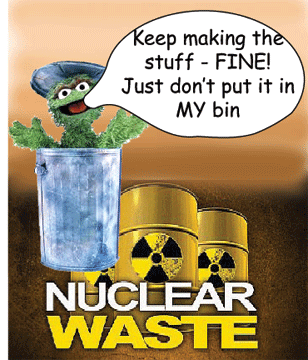 Japan Takes Nuclear Storage Hunt Into Own Hands http://online.wsj.com/news/articles/SB1000142405270230394950457926348056235159 4 Regional Governments Express No Interest By MARI IWATA Dec. 17, 2013 TOKYO—Japan has decided to take matters into its own hands to find appropriate domestic locations to permanently store highly radioactive nuclear waste, after waiting in vain for more than a decade for an offer from a regional government. “The government will play an active role in choosing a permanent place,” Industry Minister Toshimitsu Motegi told reporters at a regular news conference Tuesday. “We’ll abandon the current system of waiting for volunteers to raise their hands.”
Japan, which currently doesn’t have any final disposal sites for high level radioactive waste, has 17,000 metric tons of domestically spent nuclear fuel that dates back to the 1970s.
Most of the current waste is stored in a facility in Rokkasho, a small village in Aomori prefecture in northern Japan, where it is mixed with liquid glass to let it consolidate in big cylindrical bins.
The prefecture only allowed the facility to be established after the government promised the fuel would be moved elsewhere 30 to 50 years later.
Under the new system, which will take effect in April, the government will come up with a list of places that would be suitable for permanent storage. It will use scientific data that takes geological and seismological concerns under consideration, radioactive waste management director Masao Ito said at a separate news conference later in the day.
He said details such as when the list will be disclosed or how many candidates will be on the list are still undecided. Since the government would first need permission from any prospective location before storing the waste there, finding a municipality willing to house the controversial, dangerous materials is likely to be a significant problem.
“We don’t plan to take too long, as we learned our lesson from the fact that there has been no progress in about a decade,” Mr. Ito said.The nuclear waste problem has been exacerbated by the accident at Fukushima in March 2011.
Japan started in 2002 inviting municipalities to indicate whether they were interested in storing highly radioactive nuclear waste permanently and offered accompanying subsidies for applying.
The government was offering ¥1 billion ($9.7 million) to go through the first paper screening, which wouldn’t require a firm commitment to store the waste. Only the small town of Toyo in Kochi prefecture, western Japan, officially submitted its candidacy to the government in 2007. But the town quickly withdrew its application after the local population expressed fierce opposition to the idea.
Among major nuclear power using countries, only Finland and Sweden have decided where to permanently store nuclear waste.
No comments yet.
1 This Month


Tell the Ukrainian Government to Drop Prosecution of Peace Activist Yurii Sheliazhenko

Petition to revoke the licensing of the Near Surface Nuclear Disposal Facility (NSDF) at Chalk River. https://www.ourcommons.ca/petitions/en/Petition/Details?Petition=e-7247


of the week – STOP SMALL MODULAR REACTORS IN CANADA
To see nuclear-related stories in greater depth and intensity – go to https://nuclearinformation.wordpress.com
-
Archives
- March 2026 (193)
- February 2026 (268)
- January 2026 (308)
- December 2025 (358)
- November 2025 (359)
- October 2025 (376)
- September 2025 (258)
- August 2025 (319)
- July 2025 (230)
- June 2025 (348)
- May 2025 (261)
- April 2025 (305)
-
Categories
- 1
- 1 NUCLEAR ISSUES
- business and costs
- climate change
- culture and arts
- ENERGY
- environment
- health
- history
- indigenous issues
- Legal
- marketing of nuclear
- media
- opposition to nuclear
- PERSONAL STORIES
- politics
- politics international
- Religion and ethics
- safety
- secrets,lies and civil liberties
- spinbuster
- technology
- Uranium
- wastes
- weapons and war
- Women
- 2 WORLD
- ACTION
- AFRICA
- Atrocities
- AUSTRALIA
- Christina's notes
- Christina's themes
- culture and arts
- Events
- Fuk 2022
- Fuk 2023
- Fukushima 2017
- Fukushima 2018
- fukushima 2019
- Fukushima 2020
- Fukushima 2021
- general
- global warming
- Humour (God we need it)
- Nuclear
- RARE EARTHS
- Reference
- resources – print
- Resources -audiovicual
- Weekly Newsletter
- World
- World Nuclear
- YouTube
-
RSS
Entries RSS
Comments RSS
 nuclear-news
Leave a comment