Anxiety surrounds plan to clean up Hanford’s radioactive trash
serious questions were raised last year after Walter Tamosaitis, one of the scientific chiefs of the project, disclosed that the innovative technology for mixing the waste in processing tanks could cause dangerous buildups of explosive hydrogen gas and might allow plutonium clumps to form.
 Doubts grow about plan to dispose of Hanford’s radioactive waste, LA Times 28 Nov 13 Experts raise concerns about the complex technology intended to turn 56 million gallons of radioactive sludge at the former Hanford nuclear facility into glass and prepare it for safe burial. By Ralph Vartabedian November 29, 2013, RICHLAND, Wash. — On a wind-swept plateau, underground steel tanks that hold the nation’s most deadly radioactive waste are slowly rotting. The soil deep under the desert brush is being fouled with plutonium, cesium and other material so toxic that it could deliver a lethal dose of radiation to a nearby person in minutes.
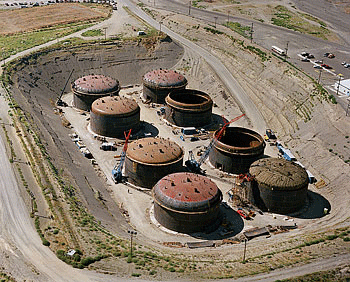
The aging tanks at the former Hanford nuclear weapons complex contain 56 million gallons of sludge, the byproduct of several decades of nuclear weapons production, and they represent one of the nation’s most treacherous environmental threats.
Energy Department officials have repeatedly assured the public that they have the advanced technology needed to safely dispose of the waste. An industrial city has been under development here for 24 years, designed to transform the sludge into solid glass and prepare it for permanent burial.
But with $13 billion already spent, there are serious doubts that the highly complex technology will even work or that the current plan can clean up all the waste. Alarmed at warnings raised by outside experts and some of the project’s own engineers, Department of Energy officials last year ordered a halt to construction on the most important parts of the waste treatment plant.
“They are missing one important target after another,” said Sen. Ron Wyden (D-Ore.), chairman of the Energy and Natural Resources Committee. “It feels like we are going around in circles.”……….
Many of the problems stem from the decision to launch construction of the plant even before engineers had completed the design. The job of turning waste as thick as peanut butter into glass is at the leading edge of nuclear chemistry, a job made difficult by the complex mixture of wastes that were fed into the underground tanks by some of the nation’s largest industrial corporations under a cloak of government secrecy.
The basic plan is to pump the waste into a pre-treatment plant, a factory larger than a football field and 12 stories tall, that would filter and chemically separate the waste into two streams of high- and low-level radioactivity. Then, two other plants would “vitrify,” or glassify, the waste. One would produce highly radioactive glass destined for a future geological repository, and the other a lower radioactive glass that could be buried at Hanford.
But serious questions were raised last year after Walter Tamosaitis, one of the scientific chiefs of the project, disclosed that the innovative technology for mixing the waste in processing tanks could cause dangerous buildups of explosive hydrogen gas and might allow plutonium clumps to form……. http://www.latimes.com/nation/la-na-hanford-nuclear-risks-20131130,0,5013027.story#axzz2m8Dynzbj
No comments yet.
1 This Month


Tell the Ukrainian Government to Drop Prosecution of Peace Activist Yurii Sheliazhenko

Petition to revoke the licensing of the Near Surface Nuclear Disposal Facility (NSDF) at Chalk River. https://www.ourcommons.ca/petitions/en/Petition/Details?Petition=e-7247


of the week – STOP SMALL MODULAR REACTORS IN CANADA
To see nuclear-related stories in greater depth and intensity – go to https://nuclearinformation.wordpress.com
-
Archives
- March 2026 (204)
- February 2026 (268)
- January 2026 (308)
- December 2025 (358)
- November 2025 (359)
- October 2025 (376)
- September 2025 (258)
- August 2025 (319)
- July 2025 (230)
- June 2025 (348)
- May 2025 (261)
- April 2025 (305)
-
Categories
- 1
- 1 NUCLEAR ISSUES
- business and costs
- climate change
- culture and arts
- ENERGY
- environment
- health
- history
- indigenous issues
- Legal
- marketing of nuclear
- media
- opposition to nuclear
- PERSONAL STORIES
- politics
- politics international
- Religion and ethics
- safety
- secrets,lies and civil liberties
- spinbuster
- technology
- Uranium
- wastes
- weapons and war
- Women
- 2 WORLD
- ACTION
- AFRICA
- Atrocities
- AUSTRALIA
- Christina's notes
- Christina's themes
- culture and arts
- Events
- Fuk 2022
- Fuk 2023
- Fukushima 2017
- Fukushima 2018
- fukushima 2019
- Fukushima 2020
- Fukushima 2021
- general
- global warming
- Humour (God we need it)
- Nuclear
- RARE EARTHS
- Reference
- resources – print
- Resources -audiovicual
- Weekly Newsletter
- World
- World Nuclear
- YouTube
-
RSS
Entries RSS
Comments RSS
 nuclear-news
Leave a comment