Nuclear notes for the week

Christina Macpherson’s websites & blogs
Nuclear industry market – future is not looking too good. The World Bank is investing in renewable energy, but definitely will not invest in nuclear energy. Warren Buffett’s going strongly for renewable energy. Goldman Sachs gets out of the uranium market.
Japan. As the perilous removal of nuclear fuel rods goes on at Fukushima, Japan introduces a new secrecy law, much to public and journalists’ anxiety.
UK. UK government wins court case to keep secret the documents on the radiation poisoning of Russian agent Alexander Litvinenko. Surviving UK nuclear veterans still fighting for justice
Getting ready for Christmas – trashy useless gifts to help trash the planet.
Women’s and community groups angered at Japan’s new secrecy law
Yuri Horie, [ ed: I have doubts on this name – it might be incorrect] president of the Japan Federation of Women’s Organizations (Fudanren), said, “We must not allow for a repeat of the mistake that lead to the war with women’s eyes, ears and mouths shut off.”

 Fukushima residents furious at lower house passage of contentious secrecy bill – Mainichi, 27 Nov 13, FUKUSHIMA — Residents here are angry over the ruling bloc’s railroading of a highly controversial state secrets protection bill through the House of Representatives on the evening of Nov. 26 — just one day after voicing strong opposition to the legislation at a public hearing.
At the lower house special committee’s public hearing on the legislation held in Fukushima on Nov. 25, all of the seven local residents who were invited to state their opinions voiced opposition to or concerns about the government-sponsored secrecy bill. They voiced fear that information related to the Fukushima nuclear disaster could be designated as “special secrets.” Their opinions, however, were not reflected in Diet deliberations. Therefore, they became infuriated at the quick-and-dirty passage of the bill through the lower house. One of the residents angrily said, “How far are they going to go in fooling us?” Continue reading
The road to fascism – Japan’s new secrecy law
 Secrecy law approved in Japan — AP: Prison for ‘inappropriate reporting’ — Official: We’re on path to be fascist state — Fear Fukushima cover-ups to worsen http://enenews.com/secrecy-law-approved-by-japan-lawmakers-ap-prison-for-inappropriate-reporting-official-were-on-path-to-be-fascist-state-fear-of-more-fukushima-cover-ups
 Associated Press, Nov. 26, 2013: Japan’s more powerful lower house of Parliament approved a state secrecy bill late Tuesday […] Critics say it might sway authorities to withhold more information about nuclear power plants […] The move is welcomed by the United States […] lawyer Hiroyasu Maki said the bill’s definition of secrets is so vague and broad that it could easily be expanded to include radiation data […] Journalists who obtain information “inappropriately” or “wrongfully” can get up to five years in prison, prompting criticism that it would make officials more secretive and intimidate the media. Attempted leaks or inappropriate reporting, complicity or solicitation are also considered illegal. […] Japan’s proposed law also designates the prime minister as a third-party overseer.
BBC, Nov. 26, 2013: Japan approves new state secrecy bill to combat leaks […] The bill now goes to the upper house, where it is also likely to be passed.
The Australian, Nov. 25, 2013: Japanese press baulks at push for ‘fascist’ secrecy laws Continue reading
We don’t do nuclear investment – says World Bank
 World Bank says no nuclear investment http://www.skynews.com.au/businessnews/article.aspx?
 id=928794 November 28, 2013 The World Bank and United Nations have appealed for billions of dollars to provide electricity for the poorest nations but say there will be no investment in nuclear power.
‘We don’t do nuclear energy,’ said World Bank president Jim Yong Kim on Wednesday, as he and UN leader Ban Ki-moon outlined efforts to make sure all people have access to electricity by 2030. Kim said $US600-800 ($A659-878) billion a year will be needed to meet the campaign target of universal access to electricity, doubling energy efficiency and doubling the share of renewable energy by 2030. In some countries, only 10 per cent of the population has electricity.
So far, the campaign has a pledge of one billion US dollars from the OPEC Fund for International Development, Bank of America has raised $US500 million through the world’s first ‘green bond’ and Norway has committed to spend two billion krone (US$325 million) on renewable energy efforts in 2014.
Kim said the World Bank is preparing energy plans for 42 countries that would be ready in June, but said any money raised would only go to new power sources. ’Nuclear power from country to country is an extremely political issue,’ Kim told reporters.
‘The World Bank Group does not engage in providing support for nuclear power. We think that this is an extremely difficult conversation that every country is continuing to have. ’And because we are really not in that business our focus is on finding ways of working in hydro electric power in geo-thermal, in solar, in wind,’ he said.
‘We are really focusing on increasing investment in those modalities and we don’t do nuclear energy.’
Kim highlighted private financing for power expansion in Nigeria and Ivory Coast and said efforts were being made to launch a similar deal for Myanmar, where the government has launched major reform efforts. ’We are working and moving very quickly to try to ensure that Myanmar experiences a clear democracy dividend,’ Kim said. The World Bank chief said it had been difficult to find long term capital for poorer countries but insisted: ‘We will show investors that sustainable energy is an opportunity they cannot afford to miss.’
The future of the uranium market melting away
 Of course, the nuclear lobby is well-heeled and has its silver-tongued apologists who will do their best to discredit such stories. Beyond the despicable aspects of this, you should consider, from an investment point of view, the risk that the industry loses control of the public relations battle as more stories emerge – and legal consequences ensue……uranium stocks are a no-go as a long-term investment.
Meltdown Coming? The Uranium Story You Haven’t Heard Money 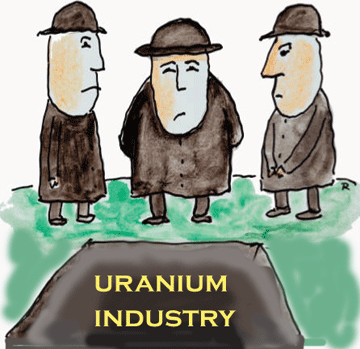 Morning 27 November 2013 by Chris Mayer “……You remember the nuclear disaster at Fukushima? It was a horrible human tragedy that is still playing out – and in ways I am sure you will be surprised to learn.
The disaster also set back the so-called nuclear renaissance that was then in swing. Uranium prices fell like a piano tumbling down a flight of stairs, only recently crashing down to five-year lows and laying waste to uranium stocks.
But it’s been over two years since the meltdown at Fukushima, and memory is short. Here is Barron’s over the weekend, on its optimistic appraisal of Cameco, the world’s largest publicly traded producer of uranium:
‘Cameco shares recently rallied after stronger-than-expected third-quarter earnings, but are still flat for the year. They fetch just 15.2 times what the company has earned, well below its decade median of 24 times, and the low-cost producer generated net profit margins near 22% even when uranium prices slumped. Improving prices can only energize the stock.‘
Among the ‘reasons for optimism‘, Barron’s included ‘gradual progress toward the cleanup in Japan‘.
Barron’s piece inspired me to write to you today. As a long-term investor, I am not tempted – at all – by the apparent bargain in uranium stocks. Continue reading
UK government wins case to keep secret of Litvinenko radiation poisoning


The Guardian and other media groups had intervened in the case at an earlier stage to argue that open justice would be damaged if relevant material was not released.
There is due to be a pre-inquest review on Friday to prepare for further hearings if there is to be no public inquiry.
Alexander Litvinenko inquest: high court halts lifting of secrecy order http://www.theguardian.com/world/2013/nov/27/alexander-litvinenko-inquest-secrecy-order William Hague successfuly argues that airing secret documents about former KGB spy would harm national security Owen Bowcott, legal affairs correspondent theguardian.com, Wednesday 27 November 2013 Lawyers for the Foreign Office have succeeded in overturning a coroner’s ruling that secret documents should be released for the inquest into the death of the former Russian dissident and KGB spy Alexander Litvinenko.
In a unanimous decision, three judges at the high court accepted that the foreign secretary, William Hague, should not have to reveal material relating to the 2006 poisoning of Litvinenko on the grounds that it would be a risk to national security.
 Litvinenko, 43, consumed radioactive polonium-210 while drinking tea during a meeting with former Russian security colleagues at the Millennium hotel in Grosvenor Square, central London. He died three weeks later.
In May this year, the assistant coroner Sir Robert Owen agreed to exclude material from the inquest that suggested Russian state agencies were involved in Litvinenko’s death. He also agreed to keep secret evidence that considered whether or not the UK authorities could have prevented Litvinenko’s 2006 murder.
- But he said summaries of other documents should be disclosed despite an application by the Foreign Office that they should all be subject to a public interest immunity (PII) certificate. The coroner ruled that disclosure was necessary for a “fair and meaningful” inquest. Continue reading
Intrepid Medha Patkar aims to stop nuclear power project in Srikakulam district of Andhra Pradesh.
 Medha Patkar raises pitch against proposed nuclear plant in AP Zee News, November 27, 2013, Srikakulam (AP): Activist Medha Patkar has opposed a nuclear power plant coming up at Kovvada village in Srikakulam district of Andhra Pradesh.
She was addressing a meeting of local fishermen who are opposing the project, fearing displacement.
“The government’s move of ordering acquisition of about 2,000 acres of land for the nuclear plant is nothing but violation of human rights,” she alleged.
Local leaders have alleged that around 9,000 local fishermen families will lose their livelihood if the project comes up. ……….http://zeenews.india.com/news/andhra-pradesh/medha-patkar-raises-pitch-against-proposed-nuclear-plant-in-ap_892835.html
Surviving UK nuclear veterans still fighting for justice
Veterans exposed to radioactive fallout take fight for justice to Number 10 NUCLEAR test veterans took their fight for justice to Downing Street yesterday more than 50 years after they were exposed to radioactive fallout. Express, 27 Nov 13 They are demanding formal recognition of their plight and the creation of a £25 million Government-funded Benevolent Fund to meet their medical needs.
Yet Britain is at the bottom of an international table for helping the veterans of nuclear countries. Even the Isle of Man has gone further than London.
More than 20,000 servicemen took part in the British Nuclear Test programme in the 1950s and 1960s but only about 3,000 are left alive…….. Continue reading
See 10 trailers from the Uranium Film Festival
 10 Trailers From the Uranium Film Festival, Coming to Indian Country http://indiancountrytodaymedianetwork.com/2013/11/27/10-trailers-uranium-film-festival-coming-indian-country-152442 ICTMN Staff 11/27/13The Uranium Film Festival was founded in 2011 in Rio de Janeiro to promote films that address nuclear power, nuclear war, and the troubling legacy that this powerful, terrible use of technology leaves behind. Beginning today, the Uranium Film Festival hits the United States with screenings in and near Indian Country. On November 27 and 28, a selection of eye-opening films will show at the Guild Cinema in Albuquerque; on November 30 and December 1, the Center for Contemporary Arts Cinematheque in Santa Fe will host the Festival; and on December 2-4 the Festival will have its concluding run in Window Rock, at the Navajo Nation Museum.
Below are 8 trailers for films showing in the Uranium Film Festival.
Nuclear Savage: The Islands of Secret Project 4.1(showing in Albuquerque, Santa Fe, and Window Rock)
The Atomic States of America(showing in Albuquerque and Window Rock)
The Ultimate Wish: Ending the Nuclear Age(showing in Albuquerque and Window Rock)
Atomic Bombs on the Planet Earth(showing in Santa Fe) — full film:
Not for Public Release: A Nuclear Incident in Lock Haven(showing in Santa Fe)
Ground Zero – Sacred Ground(showing in Window Rock)
Herr Hoppe and the Nuclear Waste(showing in Window Rock)
The Four Corners: A National Sacrifice Area?(showing in Window Rock)…..
Renewable energy agreement between India andBelgium
India, Belgium agree to promote renewable energy cooperation By PTI | 27 Nov, 2013, NEW DELHI: India and Belgium agreed to strengthen, promote and develop renewable energy cooperation besides exploring joint research opportunities in the sector. The decision was made during a bilateral meeting between New and Renewable Energy minister Farooq Abdullah and Princess Astrid of Belgium. Princess Astrid is currently on a visit to India as head of a large Belgian Economic Mission.
“After detailed discussions, the two sides agreed to start work on a MoU in the field of renewable energy between both the governments in order to strengthen, promote and develop renewable energy cooperation between the two countries on the basis of equality and mutual benefit,” it said.
Briefing the visiting delegation on the energy situation in India and rapid growth in this sector, Abdullah spoke about India’s plan of adding over 30GW of renewable energy in its energy mix in the next five years.
Offering all possible assistance to enhance cooperation in this sector, Abdullah also highlighted India’s conducive and investor friendly policy framework for promoting renewable energy in a big way. The minister also talked about the success of the wind programme as well as the significant cost reductions in solar energy through the Jawahar Lal Nehru National Solar Mission. http://economictimes.indiatimes.com/articleshow/26476932.cms?utm_source=contentofinterest&utm_medium=text&utm_campaign=cppst
Bible-bashing climate change and evolution – an American phenomenon
How did these issues get wrapped up together? On its face, there isn’t a clear reason—other than a marriage of convenience—why attacks on evolution and attacks on climate change ought to travel side by side. After all, we know why people deny evolution: Religion, especially the fundamentalist kind. And we know why people deny global warming: Free market ideology and libertarianism. These are not, last I checked, the same thing. (If anything, libertarians may be the most religiously skeptical group on the political right.)
And yet clearly there’s a relationship between the two issue stances. If you’re in doubt, watch this Climate Desk video of a number of members of Congress citing religion in the context of questioning global warming:
Using the Bible to Resist Climate Action: A Supercut
Indeed, recent research suggests that Christian “end times” believers are less likely to see a need for action on global warming……. http://www.motherjones.com/blue-marble/2013/11/why-climate-change-skeptics-evolution-deniers-joined-forces
Warren Buffett is going for Renewable Energy
 Here’s What Warren Buffett Thinks About Renewable Energy The Motley Fool By Jason Hall | November 27, 2013 |
“Rule No. 1: Never Lose Money. Rule No. 2: Never Forget Rule No. 1.”
–Warren Buffett
Warren Buffett is famous for both his legendary investing acumen, and his simple, straightforward investing advice. For years, alternative energy has been viewed as non-competitive with traditional energy production from coal and other fossil fuels, making them money-losers for most investors.
Buffett’s own Berkshire Hathaway (NYSE: BRK-B ) subsidiary MidAmerican Energy is heavily investing in alternative energy sources, including both wind and solar. And considering that MidAmerican produces more than $1.2 billion in annual “ammo” for Buffett’s “elephant gun,” the story on renewables is clearly changing.
Should investors follow t… (registered readers only) http://www.fool.com/investing/general/2013/11/27/when-it-comes-to-renewable-energy-buffetts-not-blo.aspx
GE Hitachi Nuclear Energy wants to build a laser uranium enrichment facility in Kentucky
GE Hitachi, Energy Dept. in talks over Ky. uranium Chron, By DYLAN LOVAN and ROGER ALFORD, Associated Press | November 27, 2013 LOUISVILLE, Ky. (AP) — The U.S. Department of Energy said Wednesday that it is entering negotiations with General Electric’s nuclear division on a proposal to replace an aging uranium enrichment plant in Kentucky with a new facility.
GE Hitachi Nuclear Energy wants to build a laser enrichment facility that would make use of the depleted uranium kept at the Paducah Gaseous Diffusion Plant. The Energy Department announced that it has selected GE Hitachi to begin exclusive negotiations for the sale of the uranium inventory.
GE Hitachi spokesman Chris White said Global Laser Enrichment that uses a unique laser technology would extract natural uranium from Paducah’s stores of depleted tails. The uranium would be used to fuel commercial nuclear reactors in the U.S., he said.
The negotiations are just beginning and there is no timetable on building a new plant, White said…….http://www.chron.com/business/energy/article/GE-Hitachi-Energy-Dept-in-talks-over-Ky-uranium-5017015.php
Connection between breast cancer and cell phone radiation?
This website is focussed on the nuclear industry, and energy issues. While ionising radiation is a proven cancer-causer, there is debate about electromagnetic radiation. More research should go into that issue.
 Cell phone radiation breast cancer link – New study raises grave concerns, November 27, 2013 by: Lloyd Burrell (NaturalNews) A new study raises concerns of a possible association between cell phone radiation exposure and breast cancer in young women.
The research team, led by Dr. Lisa Bailey, a former president of the American Cancer Society’s California Division and one of California’s top breast surgeons, studied four young women – aged from 21 to 39 years old – with multifocal invasive breast cancer.
The researchers observed that all the patients developed tumors in areas of their breasts next to where they carried their cell phones, often for up to 10 hours per day, for several years. None of the patients had a family history of breast cancer. They all tested negative for BRCA1 and BRCA2 – breast cancer genes linked to about one-half of breast cancer cases – and they had no other known breast cancer risks.
Imaging of the young girls’ breasts revealed a clustering of multiple tumor foci in the part of the breast directly under where their cell phones touched their body……….
Studies show that other EMF exposures from similar, supposedly harmless, everyday appliances and devices can also be dangerous. The recently published “BioInitiative Report 2012” concluded, “there is sufficient evidence from in vitro and animal studies, from human biomarker studies, from occupational and light-at-night studies, and a single longitudinal study with appropriate collection of urine samples to conclude that high MF (magnetic field) exposure may be a risk factor for breast cancer.” The report’s authors went on to say that “there is rather strong evidence from case-control studies that longterm, high occupational exposure (over 10 milliGauss) to ELF (Extremely low frequency) magnetic fields is a risk factor for breast cancer.”………
1 This Month

of the week – Shut Down Drone Warfare!


Tell the Ukrainian Government to Drop Prosecution of Peace Activist Yurii Sheliazhenko

Petition to revoke the licensing of the Near Surface Nuclear Disposal Facility (NSDF) at Chalk River. https://www.ourcommons.ca/petitions/en/Petition/Details?Petition=e-7247
To see nuclear-related stories in greater depth and intensity – go to https://nuclearinformation.wordpress.com
-
Archives
- April 2026 (57)
- March 2026 (251)
- February 2026 (268)
- January 2026 (308)
- December 2025 (358)
- November 2025 (359)
- October 2025 (376)
- September 2025 (257)
- August 2025 (319)
- July 2025 (230)
- June 2025 (348)
- May 2025 (261)
-
Categories
- 1
- 1 NUCLEAR ISSUES
- business and costs
- climate change
- culture and arts
- ENERGY
- environment
- health
- history
- indigenous issues
- Legal
- marketing of nuclear
- media
- opposition to nuclear
- PERSONAL STORIES
- politics
- politics international
- Religion and ethics
- safety
- secrets,lies and civil liberties
- spinbuster
- technology
- Uranium
- wastes
- weapons and war
- Women
- 2 WORLD
- ACTION
- AFRICA
- Atrocities
- AUSTRALIA
- Christina's notes
- Christina's themes
- culture and arts
- Events
- Fuk 2022
- Fuk 2023
- Fukushima 2017
- Fukushima 2018
- fukushima 2019
- Fukushima 2020
- Fukushima 2021
- general
- global warming
- Humour (God we need it)
- Nuclear
- RARE EARTHS
- Reference
- resources – print
- Resources -audiovicual
- Weekly Newsletter
- World
- World Nuclear
- YouTube
-
RSS
Entries RSS
Comments RSS
 nuclear-news