No, Pandora, the slump in nuclear energy is due to economics, not anti-nuclear protestors
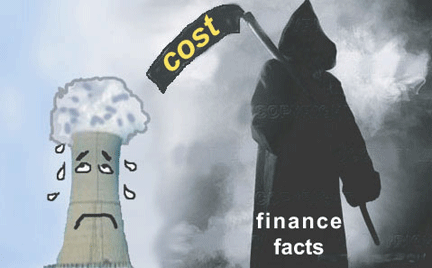 Most of the new plants announced with such enthusiasm have been cancelled or deferred indefinitely. Those that have commenced construction have run over time and over budget, exactly as happened in the last big nuclear boom of the 1970s.
the fact that the world has not turned to nuclear power as a solution to climate change is a matter of economics. much of the current demand for “baseload” power is an artifact of pricing systems designed for coal, and may disappear as prices become more cost-reflective.
 Reviving nuclear power debates is a distraction. We need to use less energy, The Guardian, John Quiggin, 8 Nov 13 The documentary Pandora’s Promise presents an environmentalist case for nuclear power. But why has the world has not turned to it as a solution? It’s a matter of economics There’s been a lot of buzz recently about a new film by controversialist documentary-maker, Robert Stone, Pandora’s Promise…..
The only surprising thing about this film is the release date. The makers and participants are apparently unaware that the rest of the world had this debate 10 to 15 years ago, and that, for the most part, the advocates of nuclear power were victorious. Environmentalists largely abandoned anti-nuclear campaigns and focused their energy on attempts to reduce the use of fossil fuels, and promote energy efficiency and renewable energy sources. While most environmentalists remained sceptical of, or opposed to, nuclear power, the end of active opposition paved the way for a range of pro-nuclear policy initiatives…..
In the years after the signing of the Kyoto protocol, most major countries, including the US, UK, Japan, China and India adopted or reinforced policies supporting nuclear power. Some European countries, notably including Austria and Germany, went the other way. Even in Europe, however, the long-stalled industry was revived with the start of construction on new plants in France and Finland.
The really big developments were in the US. The Energy Policy Act of 2005, passed with bipartisan support and building on earlier initiatives of the Bush Administration, offered the nuclear power industry a range of incentives and subsidies that the developers of wind and solar power could only dream of. It includes authorising cost-overrun support of up to $2bn total for up to six new nuclear power plants, the extension of the Price-Anderson Nuclear Industries Indemnity Act through 2025, andhuge loan guarantees. The shift in policy attitudes was widely acclaimed as heralding a “nuclear renaissance”, with dozens of new plants being announced in the US and many more worldwide.
So, why, a decade later, must a film like Pandora’s Promise campaign in favour of nuclear power? The answer is that the nuclear “renaissance” turned out to be more like a return to the nuclear dark ages of the 1980s and 1990s.
Most of the new plants announced with such enthusiasm have been cancelled or deferred indefinitely. Those that have commenced construction have run over time and over budget, exactly as happened in the last big nuclear boom of the 1970s. The poster child is the Olkiluoto plant in Finland, originally announced in 2000, with a completion date of 2009 and a cost of 3bn euros. The current estimated completion date is 2015, and the cost has blown out to 8.5bn. A French plant with a similar design is having the same problems .
In the US, only four new plants are being built, all at existing sites, and all behind time and over budget. It seems unlikely that any new projects will be undertaken much before 2020. Innovative ideas like small modular reactors are being explored, but any substantial application is decades away. The situation appears somewhat better in China and India, although past experience with construction projects in these countries has raised safety concerns. And even in these countries, targets for nuclear power expansion are being scaled back while those for renewable energy are being increased.
So, the fact that the world has not turned to nuclear power as a solution to climate change is a matter of economics. much of the current demand for “baseload” power is an artifact of pricing systems designed for coal, and may disappear as prices become more cost-reflective.
To put the point more sharply, if we are convinced by the arguments of Pandora’s Promise, what would the makers of the film have us do? Stop protesting against nuclear power? Most of us did so decades ago. Abandon restrictions on uranium mining and export? The Australian government has done so already, with barely a peep of protest. The only remaining restrictions on exports to India relate to concerns about nuclear weapons proliferation, not nuclear energy, and seem likely to be dropped in any case. Give nuclear power a level playing field to compete against renewables? In the US at least, nuclear power is already treated more favourably than alternatives, leaving aside the massive subsidies already handed out in the 20th century. The same is true in many other countries that have sought, with limited success, to promote a nuclear renaissance.
Having done all of these things, the unfortunate facts are unchanged. The problem of climate change is not going away, and, in the absence of massive subsidies, no one is going to build nuclear power plants on a scale sufficient to make much of a difference. To address the problem of climate change, we need to use less energy, use it more efficiently and generate it more sustainably. Reviving 20th century debates about nuclear power is just a distraction. http://www.theguardian.com/commentisfree/2013/nov/08/reviving-nuclear-power-debates-is-a-distraction-we-need-to-use-less-energy
No comments yet.
1 This Month

of the week – Shut Down Drone Warfare!


Tell the Ukrainian Government to Drop Prosecution of Peace Activist Yurii Sheliazhenko

Petition to revoke the licensing of the Near Surface Nuclear Disposal Facility (NSDF) at Chalk River. https://www.ourcommons.ca/petitions/en/Petition/Details?Petition=e-7247
To see nuclear-related stories in greater depth and intensity – go to https://nuclearinformation.wordpress.com
-
Archives
- April 2026 (103)
- March 2026 (251)
- February 2026 (268)
- January 2026 (308)
- December 2025 (358)
- November 2025 (359)
- October 2025 (376)
- September 2025 (257)
- August 2025 (319)
- July 2025 (230)
- June 2025 (348)
- May 2025 (261)
-
Categories
- 1
- 1 NUCLEAR ISSUES
- business and costs
- climate change
- culture and arts
- ENERGY
- environment
- health
- history
- indigenous issues
- Legal
- marketing of nuclear
- media
- opposition to nuclear
- PERSONAL STORIES
- politics
- politics international
- Religion and ethics
- safety
- secrets,lies and civil liberties
- spinbuster
- technology
- Uranium
- wastes
- weapons and war
- Women
- 2 WORLD
- ACTION
- AFRICA
- Atrocities
- AUSTRALIA
- Christina's notes
- Christina's themes
- culture and arts
- Events
- Fuk 2022
- Fuk 2023
- Fukushima 2017
- Fukushima 2018
- fukushima 2019
- Fukushima 2020
- Fukushima 2021
- general
- global warming
- Humour (God we need it)
- Nuclear
- RARE EARTHS
- Reference
- resources – print
- Resources -audiovicual
- Weekly Newsletter
- World
- World Nuclear
- YouTube
-
RSS
Entries RSS
Comments RSS
 nuclear-news
Leave a comment