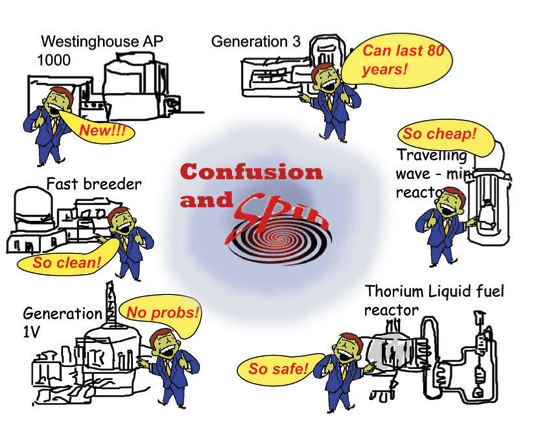
Pandora’s misleading spin about Integral Fast Nuclear Reactors (IFRs)
 Other Department of Energy studies showed that pyroprocessing, by generating large quantities of low-level nuclear waste and contaminated uranium, greatly increases the volume of nuclear waste requiring disposal, contradicting “Pandora’s Promise’s” claim it would reduce the amount of waste.
Scientist: Film hypes the promise of advanced nuclear technology By Edwin Lyman, CNN November 7, 2013 In his zeal to promote nuclear power, filmmaker Robert Stone inserted numerous half-truths and less-than-half-truths in his new documentary “Pandora’s Promise,” One of Stone’s more misleading allegations was that scientists at a U.S. research facility, the Argonne National Laboratory, were on the verge of developing a breakthrough technology that could solve nuclear power’s numerous problems when the Clinton administration and its allies in Congress shut the program in 1994 for purely political reasons.
Like the story of Pandora itself, the tale of the integral fast reactor (IFR) — or at least the version presented in the movie — is more myth than reality. In the final assessment, the concept’s drawbacks greatly outweighed its advantages. The government had sound reasons to stanch the flow of taxpayer dollars to a costly, flawed project that also was undermining U.S. efforts to reduce the risks of nuclear terrorism and proliferation around the world…….
What did “Pandora’s Promise” leave out? First, it does not clearly explain what a “fast reactor” is and how it differs from the water-cooled reactors in use today. Most operating reactors use a type of fuel called “low-enriched” uranium, which cannot be used directly to make a nuclear weapon and poses a low security risk. The spent fuel from these water-cooled reactors contains weapon-usable plutonium as a byproduct, but it is very hard to make into a bomb because it is mixed with uranium and highly radioactive fission products.
Fast reactors, on the other hand, are far more dangerous because they typically require fuels made from plutonium or “highly enriched” uranium that can be used to make nuclear weapons.
In fact, fast reactors can be operated as “breeders” that produce more plutonium than they consume. To produce the large quantities of plutonium needed to fuel fast reactors, spent fuel from conventional reactors has to be reprocessed — chemically processed to separate plutonium from the other constituents. Facilities that produce plutonium fuel must have strong protections against diversion and theft. All too often, however, security at such facilities is inadequate.
In the IFR concept, which was never actually realized in practice, reactor-spent fuel would be reprocessed using a technology called pyroprocessing, and the extracted plutonium would be fabricated into new fuel. IFR advocates have long asserted that pyroprocessing is not a proliferation risk because the plutonium it separates is not completely purified.
But a 2008 U.S. Department of Energy review — which confirmed many previous studies — concluded that pyroprocessing and similar technologies would “greatly reduce barriers to theft, misuse or further processing, even without separation of pure plutonium.” Continue reading
Consortium cleaning up Sellafied radioactive mess has been wildly over-spending
 Sellafield nuclear complex clean-up contract winner criticised on spending Margaret Hodge and KPMG, working for the Nuclear Decommissioning Authority, accuse group of overspending Terry Macalister The Guardian, Saturday 9 November 2013 A five-year extension to the Sellafield nuclear decommissioning contract worth £5bn was handed to a private consortium even though its performance had been fiercely criticised by accountants.
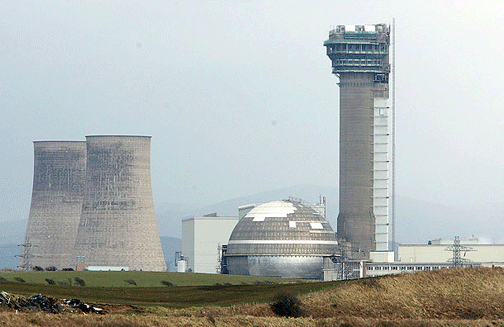 KPMG, working for the Nuclear Decommissioning Authority, accused the clean-up group of overspending, failure to reach operational targets and weak leadership at the atomic complex in Cumbria, according to documents seen by the Guardian.
Margaret Hodge, who chairs the parliament’s public accounts committee, said that in the light of the critical review it was “inexplicable” that the NDA was prepared to reward the Nuclear Management Partners (NMP) consortium for spending cash “like confetti”.
She also complained the critical KPMG report was not shown to her committee or the National Audit Office until the last minute. It had only been sent to the spending watchdogs via a member of the public who conducted a freedom of information request. “But having looked at the report it is inexplicable that the NDA would continue with this consortium after such a hugely critical assessment,” she added.
The NMP decommissioning consortium comprises Areva, the French engineering firm that is also working on the new Hinkley Point power station, in Somerset, which also includes URS of the US and Amec of Britain.
KPMG says it went through 28 out of 154 “bid commitments” at Sellafield and found 30% were deemed fully achieved and 4% partially achieved. KPMG added: “There is still considerable uncertainty in schedules and costs of the projects that account for 26% of annual spending” while the site manager “does not bear risks for delays and cost increases”.
There had been widespread speculation that the consortium would either see the renewal time shortened or be stripped of the work, which would be handed back to the public sector. But the decommissioning authority nevertheless gave the go-ahead to a further five years in October….http://www.theguardian.com/politics/2013/nov/08/sellafield-nuclear-margaret-hodge-kpmg-overspending
Computer worm Stuxnet ‘badly infected’ Russian nuclear power plant
 Stuxnet infected Russian nuclear plant By Darren Pauli on Nov 8, 2013 Jumped airgap, Kaspersky boss says. http://www.scmagazine.com.au/News/363578,stuxnet-infected-russian-nuclear-plant.aspx Stuxnet had ‘badly infected’ the internal network of a Russian nuclear plant after the sophisticated malware caused chaos in Iran’s nuclear facilities in
  Natanz.
The malware, widely considered to have been developed by the US Government as a means to disrupt Iran’s nuclear enrichment plans, had crossed a physically separated ‘air-gapped’ network in the Russian plant after it was carried across on a USB device.
Eugene Kaspersky, the charismatic boss of the Russian antivirus company bearing his name, said a staffer at the unnamed nuclear plant informed him of the infection. “[The staffer said] their nuclear plant network which was disconnected from the internet … was badly infected by Stuxnet,” Kaspersky said.
“So unfortunately these people who were responsible for offensive technologies, they recognise cyber weapons as an opportunity.” But USB devices were used to ferry malware cross a far greater air-gap: Russian astronauts had carried a virus on removable media to the International Space Station infecting machines there, Kaspersky said.
In a presentation given at the Canberra Press Club designed to give mainstream journalists a broad overview of the state of information security, the chief executive offered his view of the state of online crime and state-sponsored espionage. “All the data is stolen,” Kaspersky said. “At least twice.”
He said sophisticated malware like Gauss, Flame and Red October were rare and would require around $10 million to build.
Such malware had infected Saudi Aramco knocking it offline for two weeks, Kaspersky noted. Half of all malware was written in Chinese, according to Kaspersky. About a third was written in Spanish or Portuguese, followed by Russian-coded malware that was less prevalent but the most sophisticated in the world, he said.
He said Chinese malware appeared to ‘not care’ about operational security because researchers regularly found personal photos and social networking accounts on servers used in attack campaigns.
No, Pandora, the slump in nuclear energy is due to economics, not anti-nuclear protestors
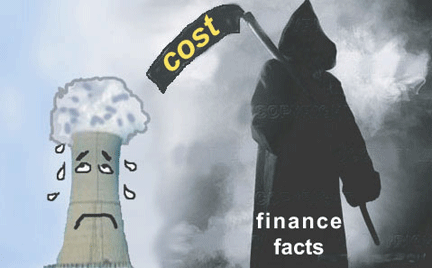 Most of the new plants announced with such enthusiasm have been cancelled or deferred indefinitely. Those that have commenced construction have run over time and over budget, exactly as happened in the last big nuclear boom of the 1970s.
the fact that the world has not turned to nuclear power as a solution to climate change is a matter of economics. much of the current demand for “baseload” power is an artifact of pricing systems designed for coal, and may disappear as prices become more cost-reflective.
Reviving nuclear power debates is a distraction. We need to use less energy, The Guardian, John Quiggin, 8 Nov 13 The documentary Pandora’s Promise presents an environmentalist case for nuclear power. But why has the world has not turned to it as a solution? It’s a matter of economics There’s been a lot of buzz recently about a new film by controversialist documentary-maker, Robert Stone, Pandora’s Promise…..
The only surprising thing about this film is the release date. The makers and participants are apparently unaware that the rest of the world had this debate 10 to 15 years ago, and that, for the most part, the advocates of nuclear power were victorious. Environmentalists largely abandoned anti-nuclear campaigns and focused their energy on attempts to reduce the use of fossil fuels, and promote energy efficiency and renewable energy sources. While most environmentalists remained sceptical of, or opposed to, nuclear power, the end of active opposition paved the way for a range of pro-nuclear policy initiatives….. Continue reading
Solar power with diesel backup – a financial boon to mining sites
Of the 400 operating mine sites in Australia, 170 are either off-grid or connected to a smaller distribution network and needing to supply their own electricity. Natural gas and diesel dominate as fuel supplies for electricity generation and other energy uses. Rising prices of both of these fuels are leading mining companies to consider alternatives.
In South Africa, reliability of electricity supply has been a major issue for the mining sector, with electricity shortages in 2008 severely impacting operations and financial performance at a number of mine sites. The South African Government is addressing electricity supply issues through a renewable energy procurement programme….
Renewable energy, and in particular solar photovoltaic (PV), can offer significant benefits to mining companies. The unit cost of energy from solar PV is now below $US200/MWh in many locations compared to typical diesel generation costs of around $US300/MWh. This provides an opportunity for mining companies to reduce energy costs by reducing diesel consumption and maintenance costs with solar generation, particularly at sites with high day-time loads. The diesel engines are retained for night-time generation and as backup to the solar panels. Their operating life is also extended through lower annual operating hours.
Mining operations are strongly influenced by international commodity prices and operational focus can change rapidly in response to market signals. Diesel generators support this flexibility through their modularity and ability to be relocated to other sites if required. Solar modules also offer a degree of flexibility. With simple foundation systems and electrical reticulation, solar installations can theoretically be redeployed to other sites if mining operations need to close down. Recent trends in lease financing of solar modules provide further alignment with mining operations.
As panel prices continue to decrease and panel efficiency continues to increase, expect to see greater focus on renewable energy as a strategic consideration for mining operations. http://sourceable.net/grid-renewables-mining-energy-price-certainty/
1 This Month

of the week – Shut Down Drone Warfare!


Tell the Ukrainian Government to Drop Prosecution of Peace Activist Yurii Sheliazhenko

Petition to revoke the licensing of the Near Surface Nuclear Disposal Facility (NSDF) at Chalk River. https://www.ourcommons.ca/petitions/en/Petition/Details?Petition=e-7247
To see nuclear-related stories in greater depth and intensity – go to https://nuclearinformation.wordpress.com
-
Archives
- April 2026 (103)
- March 2026 (251)
- February 2026 (268)
- January 2026 (308)
- December 2025 (358)
- November 2025 (359)
- October 2025 (376)
- September 2025 (257)
- August 2025 (319)
- July 2025 (230)
- June 2025 (348)
- May 2025 (261)
-
Categories
- 1
- 1 NUCLEAR ISSUES
- business and costs
- climate change
- culture and arts
- ENERGY
- environment
- health
- history
- indigenous issues
- Legal
- marketing of nuclear
- media
- opposition to nuclear
- PERSONAL STORIES
- politics
- politics international
- Religion and ethics
- safety
- secrets,lies and civil liberties
- spinbuster
- technology
- Uranium
- wastes
- weapons and war
- Women
- 2 WORLD
- ACTION
- AFRICA
- Atrocities
- AUSTRALIA
- Christina's notes
- Christina's themes
- culture and arts
- Events
- Fuk 2022
- Fuk 2023
- Fukushima 2017
- Fukushima 2018
- fukushima 2019
- Fukushima 2020
- Fukushima 2021
- general
- global warming
- Humour (God we need it)
- Nuclear
- RARE EARTHS
- Reference
- resources – print
- Resources -audiovicual
- Weekly Newsletter
- World
- World Nuclear
- YouTube
-
RSS
Entries RSS
Comments RSS
 nuclear-news