Unusual cancers in Xinjiang, China’s nuclear test area
 China’s top-secret nuclear base to be revived as £30m Communist Party theme park, Telegraph, 7 Nov 13 One of China’s most secret military compounds is undergoing an unlikely transformation into a “red tourism” theme park for Communist Party aficionados By Tom Phillips, Red Mountain Command Base, Xinjiang“………According to a report by the Stockholm International Peace Research Institute earlier this year, China now possesses around 250 of the world’s estimated 17,270 nuclear weapons and and appears to be expanding its nuclear arsenal…….
A “Political Department Exhibit Hall” will display the official narrative but there is no indication its displays will delve into the long-hidden controversies surrounding the tests’ human cost.
 As early as 1981 Beijing-based diplomats began whispering about fears of a hidden nuclear catastrophe in Xinjiang.
Citing one local official, Canada’s Globe and Mail reported “lung, liver and skin cancer has greatly increased in the area, touching off increased fears of [nuclear] contamination”. A number of cancer patients had been sent to Beijing for “special study”, the newspaper added.
In the absence of any public investigation such concerns have persisted. In 1998, a team of Channel Four journalists accused Beijing of a systematic cover-up after they obtained evidence pointing to a dramatic rise in the number of cancer cases in the region since 1965, the year after China’s first nuclear test.
“Basically, cancer is everywhere in Xinjiang,” one local doctor told the programme, adding: “We can’t do research into it. It’s not allowed.”
Beijing rejected that report as “sheer fabrication”. But a 2008 study by a Japanese scholar claimed up to 190,000 people may have died from illnesses linked to radiation.
Local officials say there is no risk of lingering radiation at the Red Mountain theme park and some tourists are already making the pilgrimage to the birthplace of China’s nuclear arsenal….. http://www.telegraph.co.uk/news/worldnews/asia/china/10433364/Chinas-top-secret-nuclear-base-to-be-revived-as-30m-Communist-Party-theme-park.html
Film “Pandora’s Promise” – a flawed love song to nuclear power
 Nuclear energy film overstates positives, underplays negatives By Ralph Cavanagh and Tom Cochran, CNN November 6, 2013 – Editor’s note: Ralph Cavanagh is co-director of the Natural Resources Defense Council’s energy program and formerly served as a member of the U.S. Secretary of Energy’s Advisory Board. Tom Cochran is an expert on nuclear energy and an NRDC consultant. He sits on three subcommittees of U.S. Department of Energy’s Nuclear Energy Advisory Committee.
The new film “Pandora’s Promise” is a love song to nuclear power that claims to be a documentary, but like all good propaganda it omits key parts of the story, overstates the positives and underplays the negatives.
Built around the (false) proposition that improved quality of life requires commensurate growth in energy use (a recurring visual theme is a globe that glows brighter and brighter), the movie presents nuclear power as the only plausible solution to global warming.
No American utility today would consider building a new nuclear power plant without massive government support. Of 29 power plants on the drawing boards in 2009, only a handful are going forward, with government help, and even those are experiencing delays and cost overruns.
No major U.S. environmental group endorses nuclear power as a solution to climate change caused by fossil fuels, but this movie lionizes environmental activists who have become nuclear power enthusiasts, led by Michael Shellenberger and Stewart Brand. Shellenberger notes in the film that he at one time worked for NRDC and other major environmental groups in a consulting role. Their narratives are juxtaposed against unflattering, decades-old clips of veteran anti-nuclear activists like Helen Caldicott, Jane Fonda and Ralph Nader, suggesting that being pro-nuke is modern and hip……..
James Hansen certainly would not agree, however, with the film’s curt dismissal of the potential contributions of energy efficiency and renewable energy resources to meeting global energy needs….
Dismissing facts
Meanwhile, the movie contends that anti-nuclear activists have grossly overstated radiation risks, even as it overlooks scientific findings from, for example, the World Health Organization on actual impacts of radiation releases.
The film also dismisses energy efficiency in light of the allegedly inherent energy intensity of modern life, perpetuating the decade-old urban myth that a smartphone uses as much electricity as a refrigerator. (Repeated demonstrations show that if you take everything into account, a smartphone and the cloud data it uses only represent 15-20% as much electricity as an average refrigerator.)………http://edition.cnn.com/2013/11/06/opinion/pandora-nuclear-energy-opinion-cavanagh-cochran/
The murder of former Palestinian leader Arafat, by radioactive polonium
10 Worst Cases of Radiation Poisoning ABC News, By SUSAN DONALDSON JAMES (@SusanDJames) Nov. 7, 2013 This week, former Palestinian leader Yassar Arafat’s death was in the news in a case of suspected radiation poisoning. Swiss scientists announced they had found 18 times the normal levels of polonium in Yasser Arafat’s rib, pelvis and in soil stained with his decaying organs, concluding that he was poisoned…….
Medical Report: Yasser Arafat may have been poisoned with polonium
USA nuclear plants likely to be shutting down in a ‘domino effect’
 6 Nuclear Plants That Could Be Next To Shut Down Forbes, 7 Nov 13 “…..“In the last year, U.S. utilities have closed or announced plans to close five nuclear reactors in addition to the canceled development plans,” according to Morningstar’s Utilities Outlook for November, “leading to speculation that prolonged low gas prices could drive more plant closures given the high maintenance capital investment requirements.”Below is a list of operating nuclear plants that Morningstar analysts believe are most exposed to the possibility of closure. The list does not include disabled plants, like Fort Calhoun in Nebraska, that are offline and may never reopen. And it does not include plants already scheduled for closure, like Exelon’s Oyster Creek plant in New Jersey.
1. Indian Point: Less than 50 miles north of Manhattan, the reactors at Entergy’s Indian Point Energy Center face a tough political fight for relicensing. One license has expired, and that reactor is operating under an allowance from the Nuclear Regulatory Commission. Another license is due to expire in 2015. New York Gov. Andrew Cuomo opposes relicensing. Outgoing New York Mayor Michael Bloomberg has defended the plant, based on the impact closure could have on New Yorkers’ electric bills. Mayor-elect Bill DeBlasio has called for a gradual decommissioning as alternative power sources come online, which isn’t how the process works. Ultimately, the decision rests not with local officials, but with the NRC.
2. Ginna Nuclear Generating Station: On the south shore of Lake Ontario near Rochester, NY, Ginna is a single-reactor plant that faces fresh competition from wind turbines, falling power prices, and, like Indian Point, a political climate hostile to nuclear reactors. “Upstate New York off-peak power prices have fallen to $32 per megawatt hour as of mid-2013 from $55/MWh in 2008,” according to Morningstar. Ginna is owned jointly by Exelon and Électricité de France.
3. James A. Fitzpatrick Nuclear Power Plant: Another plant on the south shore of Lake Ontario in New York, FitzPatrick faces the same challenges as Ginna, but it’s also an older boiling-water reactor that may need upgrades. “Fitzpatrick’s operating license expires in 2034, but its revenue-sharing agreement with the New York Power Authority expires in December 2014, and unfavorable contract renewal negotiations could lead Entergy to shut the plant.”
4. Three Mile Island: Most of the shale gas boom in America is happening in the Marcellus region of Western Pennsylvania, according to the Energy Information Agency, which means Exelon’s infamous Three Mile Island plant now has to compete with an abundance of gas never before seen in its lifetime. Several large, high-efficiency gas power plants are planned for the region.
5. Davis Besse Nuclear Power Station: FirstEnergy’s plant near Toledo is not far from the Marcellus Shale formation and all that cheap natural ga. After Indian Point, it’s the next power plant up for license renewal— in 2017. “We expect strong opposition from some parties,” says Morningstar. “It has a tarnished reputation after an extended outage in 2002-04 due to corrosion in the reactor vessel head and several smaller issues since then.”
6. Pilgrim Nuclear Generating Station: Entergy’s Pilgrim plant in Plymouth, Mass., just survived a contentious license renewal process and was granted a new lease on life through 2032. But it may not survive the energy economy in which it now must compete. “Entergy is not obligated to operate it for that long and could exit if power prices sink much further,” Morningstar says. The old boiling water reactor is more expensive to operate than newer designs.
Reactors recently closed or scheduled for closure:
- Vermont Yankee, Vermont
- San Onofre, California
- Kewaunee, Wisconsin
- Crystal River, Florida
- Oyster Creek, New Jersey….. http://www.forbes.com/sites/jeffmcmahon/2013/11/07/6-nuclear-plants-that-may-be-next-to-shut-down/
Secrecy still surround China’s revamped nuclear test base

 China’s top-secret nuclear base to be revived as £30m Communist Party theme park, Telegraph, 7 Nov 13 One of China’s most secret military compounds is undergoing an unlikely transformation into a “red tourism” theme park for Communist Party aficionados By Tom Phillips, Red Mountain Command Base, Xinjiang
“…… Nearly half a century ago, the base was one of the most highly classified locations on earth: a heavily-guarded compound in Xinjiang province where scientists toiled day and night to catapult Chairman Mao’s China into the nuclear elite, alongside the US, the USSR, France and Britain.
With the US and the Soviet Union locked in a Cold War arms race, Mao decided China needed a bomb of its own to fend off what he saw as imperialist bullying.
And it was here, on the sand-swept fringes of the Taklamakan desert, that some of China’s most brilliant military and scientific minds gathered to plot a nuclear revolution of almost inconceivable speed that would change their country forever.
In 1964, just five years after the command centre was set up, PLA scientists detonated China’s first atom bomb at a nearby testing site – a 22-kiloton blast that set the desert sky alight and sparked jubilant celebrations in Beijing.
Today, almost 50 years on, the top-secret facility where the test was partly conceived lies largely abandoned…….Extraordinarily, after years of neglect, plans are now afoot to transform this scruffy compound into a 300 million yuan (£30 million) “red tourism” destination. Continue reading
Temporary nuclear deal between USA and Iran
 US and Iran close to temporary nuclear deal SMH, November 7, 2013 Michael R. Gordon Geneva: On the eve of a new round of talks between world powers and Iran, a senior Obama administration official said on Wednesday that the United States was prepared to offer Iran limited relief from economic sanctions if Tehran agreed to halt its nuclear program and reversed part of it.
The official said that suspending Iran’s nuclear efforts, perhaps for six months, would give negotiators time to pursue a comprehensive agreement.
“Put simply, what we’re looking for now is a first phase, a first step, an initial understanding that stops Iran’s nuclear program from moving forward for the first time in decades and that potentially rolls part of it back,” the administration official told reporters on the condition of anonymity because of diplomatic concerns.
The official said that the details of such a step had already been discussed by international and Iranian officials and suggested that it might be agreed on as early as this week. It would likely include constraints on the level of Iran’s uranium enrichment, the country’s stockpiles of nuclear material and the abilities of its nuclear facilities, added the official, who declined to provide further details. It would also involve verification measures……….
The duration of Iran’s halt on nuclear activity under the agreement has not been finalised, but Western officials said that a six-month suspension was being considered.
The US official would not say specifically what sanctions might be eased but suggested that the degree of relief would depend on the constraints Iran was willing to accept.
Does China have secret tunnels of nuclear warheads?
China ‘hiding up to 3,000 nuclear warheads in secret tunnels’, Telegraph, 01 Dec 2011
An unconventional project by US university students has concluded that China’s nuclear arsenal could be many times larger than current estimates, drawing the attention of Pentagon analysts. The Washington Post reported on Tuesday that Georgetown University students under the instruction of a former Pentagon official have assembled the largest body of public knowledge yet about a vast network of secret tunnels dug by China’s secretive Second Artillery Corps, responsible for nuclear warheads.
The 363-page study has not yet been published, but has already sparked a congressional hearing and been circulated among top US defence officials, including the Air Force vice chief of staff, the Post reported…….. the students were able to obtain a 400-page manual produced by the Second Artillery and usually only available to Chinese military personnel.The students’ professor, Phillip Karber, 65, spent the Cold War as a top strategist reporting directly to the secretary of defence and the chairman of the Joint Chiefs of Staff, the Post said.
Karber said that – based on the study of the tunnels – China could have up to 3,000 nuclear warheads, far higher than the current estimates, which range from 80 to 400, according to the Post.
US officials could not immediately be reached to comment on the report. http://www.telegraph.co.uk/news/worldnews/asia/china/8927580/China-hiding-up-to-3000-nuclear-warheads-in-secret-tunnels.html
Saskatechewan embroiled in dangerous nuclear politics
 AUDIO: Saskatchewan’s Nuclear Addiction Contaminates Both Politics and the People http://www.globalresearch.ca/saskatchewans-nuclear-addiction-contaminates-both-politics-and-the-people/5355042?utm_source=rss&utm_medium=rss&utm_campaign=saskatchewans-nuclear-addiction-contaminates-both-politics-and-the-peopleGlobal Research News Hour Episode 42 By Michael Welch Global Research, November 07, 2013
Saskatoon is the headquarters of Cameco. Formed from the merger of two Crown Corporations in 1988, and ultimitely privatized in 2002, Cameco is one of the world’s largest Uranium producers accounting for 14% of overall world production.[3][4]
Saskatoon is also the headquarters of Areva Resources Canada Inc, a uranium mining, milling, and exploration company.[5]
To say that the nuclear sector in Saskatchewan has influence would be an understatement. For government officials, the nuclear industry represents a significant economic lever involving not only mining, but fueling of future tar sands projects.
Concerns however have arisen about the ways in which the sector is skewing initiatives in the public interest.
In a 2012 article for Briarpatch Magazine, D’Arcy Hande presented his research outlining how the nuclear industry, the government, and the University of Saskatchewan have all colluded to ensure the continued expansion and protection of uranium development in the face of public disapproval. Hande outlines a climate of corporatism nullifying critical
appraisals of Saskatchewan’s nuclear ambitions, and exposes conflicts of interest at the government and university level.
Hande spoke to the Global Research News Hour about how this collusion came about.
About 2 million spent nuclear fuel rods sit above ground at nuclear sites in Eastern Canada. The Nuclear Waste Management Organization (NWMO) has a plan to turn Northern Saskatchewan into a long-term repository for these nuclear wastes.
Three communities – Creighton, English River, and Pinehouse, after being subjected to bribes and intense lobbying, have signed on to this plan.
The Committee for Future Generations was formed in May of 2011 to monitor and resist this plan. One of its representatives, Candyce Paul, who lives in one of the affected communities spoke to us in Saskatoon about her concerns about the plan, the crackdown on dissenting voices, and the stakes both for her community, and for the wider region.
Partial Transcript of interview with Candyce Paul………
On Integral Fast Reactor and France “Pandora’s Promise” gets it wrong
Nuclear energy film overstates positives, underplays negatives By Ralph Cavanagh and Tom Cochran, CNN November 6, 2013 – “………The still-unrealized Integral Fast Reactor is the real star of the film, along with the nation of France, whose nuclear generation program is extolled as “one of the most inspiring stories ever” (“the trains are electric powered, they have clean air, and they have the cheapest electricity in Europe”). Nuclear power debates are the only places where you will ever see those at the conservative edge of the political spectrum argue that the United States should reorganize its economy to be more like France.
The Clinton administration killed the Integral Fast Reactor in 1994 because of concern over the potential diversion of the plutonium fuel by terrorists and non-nuclear weapon states of concern. Yet the film’s closing argument is that a “fourth-generation” reactor modeled on the Integral Fast Reactor will sweep the globe, burning waste created by the first three generations and “solving” the nagging problem of long-term disposal of nuclear waste. The film fails to mention that this would take hundreds to thousands of plutonium-fueled reactors operating over hundreds of years, resulting most likely in an increase in the releases of radioactivity to the environment as a consequence of operations by the Integral Fast Reactor’s fuel processing and fabricating facilities.
The film invokes Bill Gates as one of many forward-thinking new investors in nuclear innovation, but surely even Gates would recoil from the Integral Fast Reactor’s poor economic outlook compared to conventional reactors and the financial risks associated with building just one Integral Fast Reactor, let alone a global fleet of them. The film fails to acknowledge that the flagship fast reactor development efforts in the United States, France, Germany, Japan and Italy all failed, and that fast reactors were abandoned by both the U.S. and Soviet navies, hardly a strong selling point for resurrecting the Integral Fast Reactor program………..http://edition.cnn.com/2013/11/06/opinion/pandora-nuclear-energy-opinion-cavanagh-cochran/
Dr Helen Caldicott on Fukushima radiation, nuclear fusion, renewable energy
 ‘Any country with a nuclear plant is a bomb factory’ Dr Helen Caldicott is one of the most articulate and passionate advocates of citizen action to remedy the nuclear and environmental crises. Rt.com November 07, 2013 There are countries who are selling nuclear reactors all around the world, which means they are not only selling cancer and leukemia to the future generations, but also atomic bombs, anti-nuclear advocate Dr. Helen Caldicott said in RT’s Google Hangout.
During the hangout, Helen Caldicott, answered a variety of RT readers’ questions on topics, ranging from those of immediate importance, like the Fukushima crisis, to the prospects of humanity living through the nuclear age.
Q: Should we all move to Africa in case TEPCO fails to remove the spent fuel rods?
A ……….. we’re facing a potential catastrophe in terms of public health. People should know, though, that it takes a long time to get cancer after you’ve inhaled, breathed in or eaten radioactive materials, like, anytime from two to 80 years. But it is a very serious situation.
‘No food testing in Japan, govt lying to you’
Q: I live in Tokyo and worry about health impact. When it comes to only cesium, soils here contain 100 becquerels per kilogram of cesium-134 and 137, and about 20 per cent of foods have a few becquerels per kilogram to 10 becquerels per kilogram. Please let me know your opinion on health impact and the reasons you think so.
HC: First of all, parts of Tokyo are extremely radioactive. They’ve taken dirt from the streets, moss from the roofs, and dust from vacuum cleaners inside apartments. And in some cases there are very high measurements of cesium and strontium and other such elements, literally over a hundred elements in the fallout apart from cesium-137 and 134. People in Tokyo, actually, many of them, are at great risk. That’s number one.
Number two, it’s very difficult to know what to eat in Japan because you can’t taste or smell or see radioactive elements in your food. And each dose of radiation that you get adds to the risk of getting cancer. And as you eat more and more radioactive food, more radioactivity builds up in various organs of your body. There is little testing of food in Japan, the government is lying to you, and they are encouraging the farmers in Fukushima to grow their food, which is really criminal because there’s a hell of a lot of fallout on the ground, in Fukushima, and the radiation concentrates back from the soil into rice, green vegetables, milk, meat, and the like.
They are even promoting the Fukushima food in Korea when I was there, and in Taiwan, but also in Tokyo and other places, also in markets in England, so the situation is very grim. And I think if I lived in Tokyo, I would move south. And I would be very, very careful about what I eat. I would only eat food coming from the south of Japan, and I wouldn’t eat any fish because they are pouring huge amounts of radiation into the Pacific Ocean every day. And you don’t know which fish are radioactive and which are not. ……….
‘We’re living with impending catastrophe every day’
Q: Do you see faster progress on the construction of fusion reactors?
HC: No, fusion reactors are a dream for the physicists, they haven’t been able to construct a fusion reactor, I think that will never happen. But as Einstein said, the answers to today’s problems will not be produced by the same technology that caused them. We’ve got to change the way we think. And what Einstein said – the splitting of the atom changed everything, all reality, save man’s mode of thinking. Thus, we drift towards unparalleled catastrophe. He was right so many years ago – why do we keep doing it? ………
Q: Nuclear is the only option if you want clear skies. Nuclear is big in Europe. If you don’t want nuclear, you must have dirty coal-powered stations, there’s no free choice…
HC: That’s not true! If you download the study called ‘Carbon-Free, Nuclear-Free’ from the internet, the study that I commissioned and organized several years ago with a brilliant physicist called Arjun Makhijani, it shows that all energy for Europe and for America, for every country, can be now supplied by renewable energy.
Each day renewable energy gets cheaper and cheaper; cheaper by far than nuclear. We mustn’t burn coal, you’re absolutely right, but for God’s sake, why don’t the countries of the world stop subsidizing nuclear, stop subsidizing fossil fuels, and cover every house with solar panels, solar hot water system, solar thermal systems like they’ve constructed in Spain, windmills? I’ve just been in Germany and Austria, and lots of farmhouses are now covered with solar panels. Germany is moving fast with renewables. [As for] Denmark, 40 percent of its electricity comes from wind. http://rt.com/op-edge/nuclear-energy-threat-risks-342/#_=_
USA ramps up killing capabilities with new version of B61 nuclear bomb
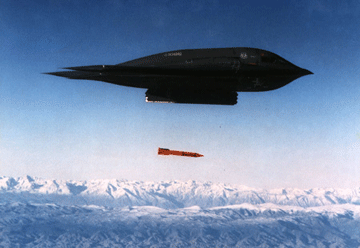 America’s Killing Machine: “Life Extension” of the B61-12 Nuclear Bomb By Hans M. Kristensen Global Research, November 07, 2013 With every official statement about the B61 nuclear bomb life-extension program, the capabilities of the new version (B61-12) appear to be increasing.
Previously, officials from the DOD, STRATCOM, and NNSA said the program is a consolidation of the B61-3, B61-4, B61-7, and B61-10 gravity bombs that would provide no additional military capabilities beyond those weapons.
This pledge echoed the 2010 Nuclear Posture Review, which states: “Life Extension Programs (LEPs)…will not support new military missions or provide for new military capabilities.”
Yet the addition of a guided tail kit will increase the accuracy of the B61-12 compared with the other weapons and provide new warfighting capabilities. The tail kit is necessary, officials say, for the 50-kilotons B61-12 (with a reused B61-4 warhead) to be able to hold at risk the same targets as the 360-kilotons B61-7 warhead. But in Europe, where the B61-7 has never been deployed, the guided tail kit will be a significant boost of the military capabilities – an improvement that doesn’t fit the promise of reducing the role of nuclear weapons.
More recently we also learned that the guided tail kit will provide the B61-12 with a “modest standoff capability,” something the current B61 versions don’t have.
And during yesterday’s hearing in the House Armed Services Committee’s Subcommittee on Strategic Forces, defense officials said the B61-12 would also replace the B61-11, a single-yield 400-kiloton nuclear earth-penetrating bomb introduced in 1997, and the B83-1, a strategic bomb with variable yields up to 1,200 kilotons.
If so, the military capabilities of the B61-12 will be able to cover the entire range of military targeting missions for gravity bombs, ranging from the lowest yield of the B61-4 (0.3 kilotons) to the 1,200-kiloton B83-1 as well as the nuclear earth-penetration mission of the B61-11.
That’s quite an achievement for a weapon that just a few years ago was described simply as a refurbishment of four old B61s. Now the B61-12 has become the all-in-one nuclear bomb on steroids, spanning the full spectrum of gravity bomb missions anywhere.
That has some pretty significant implications in Europe where the United States has never deployed bombs with the military capabilities of the B61-7, B61-11 and B83-1. And it opens up a portfolio of enhanced targeting options with less radioactive fallout – more useable nuclear strike scenarios. Not bad for a simple life-extension, but less clear why it is needed and how it fits U.S. and NATO promises to reduce the role of nuclear weapons and seek “bold reductions” in U.S. and Russian nuclear weapons in Europe.
The Magic Reduction Bomb
During yesterday’s hearing, the military and nuclear lab officials portrayed the B61-12 as key to future reductions and modifications of the nuclear stockpile………
To me, the willingness to trade all gravity bombs for the B61-12 is a tacit admission that most of the existing weapons are not needed but offered as sweeteners to “sell” the expensive program to Congress and the public.
Except for Representatives Loretta Sanchez and John Garamendi, none of the members that had shown up for the hearing asked any critical or difficult questions. Instead they appeared to invite the views that they knew the witnesses had anyway. There were no independent witnesses at the hearing, which appeared to be intended as a pushback against efforts in the Senate to scale back the B61-12 program.
There are no targets for the B61-12 that cannot be held at risk with ballistic or cruise missiles. And it is unlikely that there are any nuclear bombs deployed in Europe a decade from now. Instead, a basic gravity bomb capability on the B-2 and next-generation bomber could be achieved with a simpler and cheaper non-nuclear life-extension of the B61 as proposed by Senator Dianne Feinstein. http://www.globalresearch.ca/americas-killing-machine-life-extension-of-the-b61-12-nuclear-bomb/5357155
Divisive film at least opens up discussion on nuclear power
Why Divisive Pro-Nuclear Power Film ‘Pandora’s Promise’ is the Right Kind of Doc for CNN to Air, Indiewire, BY ALISON WILLMORE NOVEMBER 7, 2013 “…………”Pandora’s Promise” has its series of experts calmly countering anti-nuclear power arguments, sometimes while posed in the midst of natural landscapes. But its claim that “to be anti-nuclear is basically to be in favor of burning fossil fuels” is a shaky one — not the least because it’s based on the idea that conservation and curbing energy use on any global scale is off the table, as is larger reliance on alternative energy sources like wind and solar power which are by nature sporadic and requiring of some kind of backup, like oil.
Dubious claims about Pakistan sending nuclear weapons to Saudi Arabia
Does Pakistan have nuclear weapons ready to ship to Saudi Arabia? A new BBC report says they are packed and ready to go osted by Julian Borger Friday 8 November 2013 theguardian.comIt has long been rumoured, and often reported, that in return for bankrolling the Pakistani nuclear weapons project, Saudi Arabia has a claim on some of those weapons in time of need. It has never been proved though, nor has it ever been clear how such a deal would work. Continue reading
Uranium workers unhappy with safety arrangements
A Fridge Full of Uranium for Honeywell Employees, In These Times, BY MIKE ELK 7 Nov 13 On Monday, a Nuclear Regulatory Commission (NRC) team arrived at Honeywell’s Metropolis, Ill., uranium conversion plant to do a routine weeklong inspection. Recently, workers at the plant have alleged that the employee refrigerator in the control room of the main processing building has repeatedly tested positive for dangerous levels of uranium.
But because Honeywell will not allow a qualified union worker to accompany NRC representatives on their inspections if the workers are on layoff, the union claims that the company is putting them and the local community at risk.
During the last few years, the plant has faced problems with federal authorities over a series of safety issues. In March 2011, after an investigation by the Environmental Proection Agency (EPA), Honeywell pleaded guilty to one felony offense for knowingly storing hazardous radioactive waste without a permit in violation of the Resource Conservation and Recovery Act (RCRA)” and paid an $11.9 million fine to the federal government. Two months later, OSHA officially cited the company for 17 serious violations for the accidental release of toxic hydrogen fluoride (HF) gas directly into the atmosphere outside of the plant in December 2010.
Members of United Steel Workers Local 7-699, which represents workers at the Metropolis plant, claim that having a specifically designated worker present during inspections was the key to at least some of the company’s citations in 2011. The plant, workers say, is large and complex. Though inspectors are highly trained, they may miss small but crucial details during their visits. Union representatives, they say, can point out problems known to workers that regulatory officials may otherwise overlook.
So when workers found out that the union’s elected representative, USW Local 7-699 President Stephen Lech, would not be allowed to go on the NRC inspections because he is on what the union labels a “punitive” layoff, they were outraged. As union president, they say, Lech talks to more members of the union and has a more in-depth knowledge of safety issues than anyone else…….http://inthesetimes.com/working/entry/15848/honeywell_employees_west_texas_regulation_uranium_fridge/
1 This Month

Petition to revoke the licensing of the Near Surface Nuclear Disposal Facility (NSDF) at Chalk River. https://www.ourcommons.ca/petitions/en/Petition/Details?Petition=e-7247


of the week – STOP SMALL MODULAR REACTORS IN CANADA
To see nuclear-related stories in greater depth and intensity – go to https://nuclearinformation.wordpress.com
-
Archives
- March 2026 (152)
- February 2026 (268)
- January 2026 (308)
- December 2025 (358)
- November 2025 (359)
- October 2025 (376)
- September 2025 (258)
- August 2025 (319)
- July 2025 (230)
- June 2025 (348)
- May 2025 (261)
- April 2025 (305)
-
Categories
- 1
- 1 NUCLEAR ISSUES
- business and costs
- climate change
- culture and arts
- ENERGY
- environment
- health
- history
- indigenous issues
- Legal
- marketing of nuclear
- media
- opposition to nuclear
- PERSONAL STORIES
- politics
- politics international
- Religion and ethics
- safety
- secrets,lies and civil liberties
- spinbuster
- technology
- Uranium
- wastes
- weapons and war
- Women
- 2 WORLD
- ACTION
- AFRICA
- Atrocities
- AUSTRALIA
- Christina's notes
- Christina's themes
- culture and arts
- Events
- Fuk 2022
- Fuk 2023
- Fukushima 2017
- Fukushima 2018
- fukushima 2019
- Fukushima 2020
- Fukushima 2021
- general
- global warming
- Humour (God we need it)
- Nuclear
- RARE EARTHS
- Reference
- resources – print
- Resources -audiovicual
- Weekly Newsletter
- World
- World Nuclear
- YouTube
-
RSS
Entries RSS
Comments RSS
 nuclear-news