Public and scientists do not believe Shinzo Abe’s statement that Fukushima nuclear radiation is controlled
For former nuclear engineer Michael Friedlander, who describes himself as “an avid supporter of responsible nuclear power,” these comments are damaging to the atomic industry.
“It’s a very Japanese way of handling the situation, the authorities telling everybody that everything’s OK, don’t worry, we’re in control,” Friedlander said in an interview from Hong Kong.
Abe’s comments haven’t persuaded the Japanese public. A Kyodo News poll conducted Oct. 26 and Oct. 27 found that 83 percent of respondents said they didn’t believe his “under control” statement.
The residents of Namie, a town 8 kilometers from the Fukushima nuclear station that was evacuated, said that Abe is making “irresponsible comments.
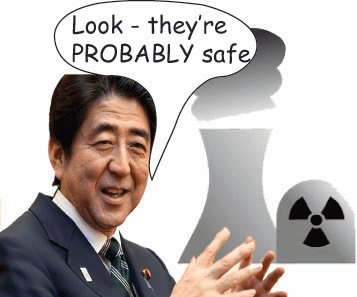 Abe’s stance on Fukushima water fuels skepticism Claim radioactivity contained scoffed at by public, scientists The Columbian, By Tsuyoshi Inajima and Yuriy Humber, Bloomberg News November 2, 2013, TOKYO — Japan’s Prime Minister Shinzo Abe says radioactive water flowing into the sea from the crippled Fukushima atomic station is being contained within the plant’s harbor, a view maintained by operator Tokyo Electric Power Co.
Marine scientists, Fukushima residents and Japan’s general public don’t agree. What’s more, the harbor is designed to take advantage of tidal flushing, which pushes warmer water out to sea after it has circulated through reactor cooling systems.
“If he means that radioactive water is completely contained in the harbor, it’s wrong,” Jun Misonou, senior researcher at the Marine Ecology Research Institute, said in an interview. The state-sponsored institute was set up 38 years ago to monitor water discharges into the sea from Japan’s power plants.
Abe repeated that the radiation is contained in the harbor on Oct. 16 in a parliamentary response to questions from the opposition Democratic Party of Japan. This debate has dogged him since his Sept. 7 speech to the International Olympic Committee, when he said the nuclear disaster is “under control.” The next day, Tokyo won hosting rights for the 2020 Summer Olympic Games.
Tokyo Electric spent more than two years denying that contaminated water was leaking into the sea from the plant 137 miles northeast of Tokyo.
In August, it did an about-face and said about 400 tons of groundwater containing radioactive particles was in an uncontrolled discharge into the sea each day. It also said it didn’t know when the leaks began and that the effect of radioactive water is contained within the harbor. The company is looking at several engineering solutions to stop the groundwater.
The utility’s own estimates show that every day much of the water in the man-made harbor, which is 1 kilometer long and 600 meters at its widest point, is flushed out into the wider Pacific Ocean.
About 40 percent of water inside the harbor is exchanged every day with the rise and fall of the tides, Yusuke Kunikage, a spokesman for the utility, said in a phone interview, citing the company’s estimate. The situation is under control because effects of the radioactive water leaks have been “limited” based on the utility’s samples from outside the harbor, he said.
Marine researcher Misonou said sea radiation levels did drop in areas monitored by the institute in the year following the March 2011 earthquake and tsunami that caused reactor meltdowns. But the pace of decline in radiation levels in recent months has been slower than expected, indicating radioactive water discharge from the Fukushima site into the Pacific Ocean continues, Misonou said.
“We believe that the impact on the surrounding waters is limited to the area within the port of the power plant, and that judging by the result of our monitoring three kilometers offshore, there has been no impact on the water or the wider ocean,” Tokyo Electric President Naomi Hirose said in a video message posted on the company’s website.
For former nuclear engineer Michael Friedlander, who describes himself as “an avid supporter of responsible nuclear power,” these comments are damaging to the atomic industry.
“It’s a very Japanese way of handling the situation, the authorities telling everybody that everything’s OK, don’t worry, we’re in control,” Friedlander said in an interview from Hong Kong.
Scientists know very little about the effects of low-level radiation on human bodies and to allow an uncontrolled flow of contaminated water into the ocean is unprofessional, said Friedlander, who spent 13 years operating U.S. nuclear plants, including the Crystal River Station in Florida……..
The assertions of containment by Abe’s government and the company are “not true to science,” said Ken Buesseler, a senior researcher at the Woods Hole Oceanographic Institution, the world’s largest private nonprofit oceanographic research institution. In an interview last month, Buesseler said that water samples he took show radioactive elements from the station many kilometers from the coast.
Buesseler emphasized that the isotopes he found are not at dangerous levels, but repeated the same theme as Friedlander: Saying the radiation remains in the harbor hinders the science to investigate what is getting out and whether it poses a threat.
Strontium-90, for example, binds to bone tissue and has been linked to cancers such as leukemia. Strontium can enter the food chain through fish, Buesseler said.
Abe’s comments haven’t persuaded the Japanese public. A Kyodo News poll conducted Oct. 26 and Oct. 27 found that 83 percent of respondents said they didn’t believe his “under control” statement.
The residents of Namie, a town 8 kilometers from the Fukushima nuclear station that was evacuated, said that Abe is making “irresponsible comments.” http://www.columbian.com/news/2013/nov/02/abes-stance-fukushima-water-fuels-skepticism/
No comments yet.
1 This Month

of the week – Shut Down Drone Warfare!


Tell the Ukrainian Government to Drop Prosecution of Peace Activist Yurii Sheliazhenko

Petition to revoke the licensing of the Near Surface Nuclear Disposal Facility (NSDF) at Chalk River. https://www.ourcommons.ca/petitions/en/Petition/Details?Petition=e-7247
To see nuclear-related stories in greater depth and intensity – go to https://nuclearinformation.wordpress.com
-
Archives
- April 2026 (103)
- March 2026 (251)
- February 2026 (268)
- January 2026 (308)
- December 2025 (358)
- November 2025 (359)
- October 2025 (376)
- September 2025 (257)
- August 2025 (319)
- July 2025 (230)
- June 2025 (348)
- May 2025 (261)
-
Categories
- 1
- 1 NUCLEAR ISSUES
- business and costs
- climate change
- culture and arts
- ENERGY
- environment
- health
- history
- indigenous issues
- Legal
- marketing of nuclear
- media
- opposition to nuclear
- PERSONAL STORIES
- politics
- politics international
- Religion and ethics
- safety
- secrets,lies and civil liberties
- spinbuster
- technology
- Uranium
- wastes
- weapons and war
- Women
- 2 WORLD
- ACTION
- AFRICA
- Atrocities
- AUSTRALIA
- Christina's notes
- Christina's themes
- culture and arts
- Events
- Fuk 2022
- Fuk 2023
- Fukushima 2017
- Fukushima 2018
- fukushima 2019
- Fukushima 2020
- Fukushima 2021
- general
- global warming
- Humour (God we need it)
- Nuclear
- RARE EARTHS
- Reference
- resources – print
- Resources -audiovicual
- Weekly Newsletter
- World
- World Nuclear
- YouTube
-
RSS
Entries RSS
Comments RSS
 nuclear-news
Leave a comment