Financial reality makes UK’s new nuclear not look too good
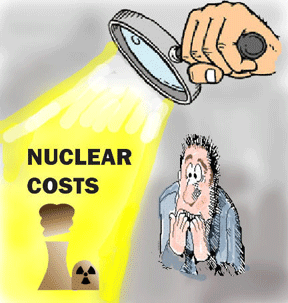 The government has also already committed itself to providing financial guarantees of £10bn to cover the building of Hinkley Point, something not available to builders of solar or wind arrays.
Even Nick Butler, a former energy adviser to No 10 and a supporter of nuclear, believes the price is far too high. In a recent blog he warned: “Lower sources of power are available and have been rejected. When deals do not match the interests of both sides – producers and consumers – at a point of mutual advantage, they tend to unravel.”
 China’s need for nuclear power leads Britain to revive outdated technology , Terry Macalister, The Guardian, Sunday 20 October 2013 Critics say the new plant in Somerset will be heavily subsidised and cushioned from financial reality.
- The signing of a nuclear deal between EDF and the government is a landmark event for power generation. Today’s go-ahead for the Hinkley Point C plant shows ministers are prepared to commit Britain to provide decades of guaranteed financial returns (paid for by you and me as energy users) to companies in return for winning huge slugs of investment for new power stations…..
- Ministers insist that the commitment to provide Hinkley Point with a guaranteed price of around double the market rate is not a subsidy. The final figure of £92.50 is a considerable step up from the £80 per MWhr said to be on the table when negotiations began in earnest, and that figure is said by some calculations to be worth around £80bn in guaranteed revenues, the cost of nine Olympics.
- Critics will accuse the government of providing subsidies to an old technology that should not need handouts, while pointing out the safety dangers and the unsolved waste disposal problems raised by new nuclear. Questions will also be asked about the wisdom of providing a country alleged to be involved in cyber-spying, access to sensitive energy infrastructure via the involvement of a state-owned firm……..
- Supporters of nuclear in Britain were keen to ensure that an existing industry – that arguably first started here and had operated largely trouble free since the 1950s – could gain a new lease of life. The expectations of Blair and others in the early days have been fulfilled then, even after the Fukushima accident in Japan – but only in principle. In practice, new nuclear was meant to be built by the private sector, without subsidy and only after a solution was found about where to store high-level nuclear waste.
- A decision on which community would be willing to host a deep-level waste repository is as far away as ever after plans for the north west were scotched by Cumbria County Council. The new plant in Somerset will be owned, built and operated by EDF – 85% owned by the French state – with the help of China General Nuclear Power Group, which is 100% owned by the Beijing government. It will be capable of generating 3,200 MW, around one seventh of UK needs, compared to say the London Array off the coast of Kent, the world’s biggest wind farm, which has a maximum capacity of 1,000 MW.
- The subsidy levels for onshore wind (£100 per MWhr) is close to that for the new Hinkley Point plant and much higher for offshore wind (£150). But these figures are set to fall. Craig Bennett, director of policy at Friends of the Earth, said it was astonishing that the government was planning such a long-term subsidy for foreign nuclear operators. “This is just another big bailout. Its an unbelievable wasted opportunity to spend this money in this way when the UK itself is an acknowledged leader in energy efficiency. Why give subsidies to an industry where we are not the leader any more?” he said.Other supporters of renewable energy point out that public support is needed because these are new technologies which are coming down in price all the time. Nuclear cannot claim either, they say, and there are still questions on whether the European Commission will accept these payments.
The government has also already committed itself to providing financial guarantees of £10bn to cover the building of Hinkley Point, something not available to builders of solar or wind arrays.
Even Nick Butler, a former energy adviser to No 10 and a supporter of nuclear, believes the price is far too high. In a recent blog he warned: “Lower sources of power are available and have been rejected. When deals do not match the interests of both sides – producers and consumers – at a point of mutual advantage, they tend to unravel.”
No comments yet.
1 This Month


Tell the Ukrainian Government to Drop Prosecution of Peace Activist Yurii Sheliazhenko

Petition to revoke the licensing of the Near Surface Nuclear Disposal Facility (NSDF) at Chalk River. https://www.ourcommons.ca/petitions/en/Petition/Details?Petition=e-7247


of the week – STOP SMALL MODULAR REACTORS IN CANADA
To see nuclear-related stories in greater depth and intensity – go to https://nuclearinformation.wordpress.com
-
Archives
- March 2026 (193)
- February 2026 (268)
- January 2026 (308)
- December 2025 (358)
- November 2025 (359)
- October 2025 (376)
- September 2025 (258)
- August 2025 (319)
- July 2025 (230)
- June 2025 (348)
- May 2025 (261)
- April 2025 (305)
-
Categories
- 1
- 1 NUCLEAR ISSUES
- business and costs
- climate change
- culture and arts
- ENERGY
- environment
- health
- history
- indigenous issues
- Legal
- marketing of nuclear
- media
- opposition to nuclear
- PERSONAL STORIES
- politics
- politics international
- Religion and ethics
- safety
- secrets,lies and civil liberties
- spinbuster
- technology
- Uranium
- wastes
- weapons and war
- Women
- 2 WORLD
- ACTION
- AFRICA
- Atrocities
- AUSTRALIA
- Christina's notes
- Christina's themes
- culture and arts
- Events
- Fuk 2022
- Fuk 2023
- Fukushima 2017
- Fukushima 2018
- fukushima 2019
- Fukushima 2020
- Fukushima 2021
- general
- global warming
- Humour (God we need it)
- Nuclear
- RARE EARTHS
- Reference
- resources – print
- Resources -audiovicual
- Weekly Newsletter
- World
- World Nuclear
- YouTube
-
RSS
Entries RSS
Comments RSS
 nuclear-news
Leave a comment