White males dominate the media
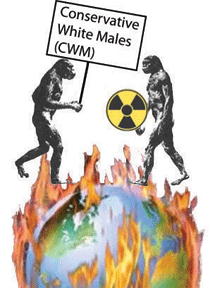 If there are plenty of women working as correspondents and reporters, then relatively few female opinion writers and editors, then this indicates a problem in the industry
A study by Women in Journalism earlier this year found that across national newspapers, 78% of bylined front page stories were written by men, and of those quoted as experts or sources in lead stories, 84% were men. The Women’s Media Centre in the United States, on conducting similar research reported that during the 2012 presidential election, 75% of front page bylined articles at top newspapers were written by men and that women made up a mere 14% of Sunday TV talk show interviewees, and 29% of “roundtable” guests. Women in Journalism were quick to highlight one of the most worrying aspects of this imbalance: most stories involving women in the four week period surveyed, portrayed them as either victims or celebrities.
While the gender gap in print is insidious, in broadcast media it’s glaringly obvious
Women in journalism: not a trivial subject,Open Democracy, DAWN FOSTER 14 October 2013 The biggest newspapers in the United States, Britain and Europe still reserve pages of the most serious political and foreign policy analysis for older white men.
Can girls even find Syria on a map? Jill Filipovic’s (tongue in cheek) rejoinder on the Guardian website last month aimed to poke fun at the bias in commissioning opinion pieces on foreign policy issues, noting the heavy weighting towards male bylines on the pages of the New York Times and the Washington Post. Filipovic’s piece swiftly garnered a huge response online, and an article from Buzzfeed’s Sheera Frenkel, claiming that most correspondents covering the Syrian conflict were women. Filipovic’s central argument wasn’t disputed by Frenkel – the vast majority of opinion writers embraced across the global media continue to be male.
This matters, because it frames the national debate, and in the case of Syria, influences political decision on military intervention, purporting to be a bell-weather for public opinion at large. If there are plenty of women working as correspondents and reporters, then relatively few female opinion writers and editors, then this indicates a problem in the industry. Women may be blogging more, make up more than 50% of Twitter users, and piling into varieties of journalism, but the biggest newspapers in the United States, Britain and Europe still reserve pages of the most serious political and foreign policy analysis for older men, and unsurprisingly, they’re usually white.
A study by Women in Journalism earlier this year found that across national newspapers, 78% of bylined front page stories were written by men, and of those quoted as experts or sources in lead stories, 84% were men. The Women’s Media Centre in the United States, on conducting similar research reported that during the 2012 presidential election, 75% of front page bylined articles at top newspapers were written by men and that women made up a mere 14% of Sunday TV talk show interviewees, and 29% of “roundtable” guests. Women in Journalism were quick to highlight one of the most worrying aspects of this imbalance: most stories involving women in the four week period surveyed, portrayed them as either victims or celebrities.
While the gender gap in print is insidious, in broadcast media it’s glaringly obvious where radio stations and TV programmes are failing. BBC Radio 4‘s “Today” programme, long criticised for a dearth of female guests, provoked outrage when, during a segment on breast cancer, they admitted on air they’d failed to find any women to discuss the issue. Instead, they asked a male guest to “imagine” he was female for the purpose of the discussion. It was this that prompted Caroline Criado-Perez to launch The Women’s Room – an online database of female journalists listed by expertise.
Helen Zaltzman, a broadcaster and podcaster who produces the pressure group Sound Women’s podcast points out “Only around 1 in 5 presenters on British radio is female, yet slightly more than half the audience is. And who knows what proportion of those on-air voices are allowed to do more than laugh sycophantically at their male co-presenter’s jokes? It would be great if, whenever jobs opened up, execs resolved to give more of them to people who aren’t white men”. Many female journalists discuss the struggle to get their voices heard on news coverage of any issue that isn’t seen to be “soft” or a gender issue. On foreign policy, there’s a running joke amongst female journalists that every story on the Middle East has a woefully ill-informed male commentator decisively informing presenters “it’s too early to say” in answer to any question that can’t be easily bluffed – there’s a tendency for men to put themselves forward as knowledgeable on all manner of subjects, and producers to accept this authority, whereas women tend to focus on areas of specific expertise……
The problems facing women’s representation in media increase with age too, no more so than in broadcasting. After Miriam O’Reilly won a legal battle against the BBC, proving she was unfairly dismissed from her role as a presenter on Countryfile, the broadcaster commissioned a survey, with NatCen on the portrayal of age across its channels. The study found that, unsurprisingly, younger people were most often shown on its programmes, but that there was a particular dearth of middle-aged and older women across all genres of shows.
The hackneyed, but immortal, presenting trope of a greying, middle-aged man, flanked by a heavily groomed woman half his age is a case in point – Andrew Neil’s broadcasting career seems in no danger of waning as the wrinkles increase, but for women across British TV channels, the march towards their forties signals an employment precipice. In their report on ageism and media, Women in Journalism found 60% of women over 45 felt they’d experienced ageism. Women are finding doors closed to them at the exact point men are still developing their careers and entering the most senior levels of journalism…….http://www.opendemocracy.net/5050/dawn-foster/women-in-journalism-not-trivial-subject
No comments yet.
1 This Month

of the week – Shut Down Drone Warfare!


Tell the Ukrainian Government to Drop Prosecution of Peace Activist Yurii Sheliazhenko

Petition to revoke the licensing of the Near Surface Nuclear Disposal Facility (NSDF) at Chalk River. https://www.ourcommons.ca/petitions/en/Petition/Details?Petition=e-7247
To see nuclear-related stories in greater depth and intensity – go to https://nuclearinformation.wordpress.com
-
Archives
- April 2026 (7)
- March 2026 (251)
- February 2026 (268)
- January 2026 (308)
- December 2025 (358)
- November 2025 (359)
- October 2025 (376)
- September 2025 (257)
- August 2025 (319)
- July 2025 (230)
- June 2025 (348)
- May 2025 (261)
-
Categories
- 1
- 1 NUCLEAR ISSUES
- business and costs
- climate change
- culture and arts
- ENERGY
- environment
- health
- history
- indigenous issues
- Legal
- marketing of nuclear
- media
- opposition to nuclear
- PERSONAL STORIES
- politics
- politics international
- Religion and ethics
- safety
- secrets,lies and civil liberties
- spinbuster
- technology
- Uranium
- wastes
- weapons and war
- Women
- 2 WORLD
- ACTION
- AFRICA
- Atrocities
- AUSTRALIA
- Christina's notes
- Christina's themes
- culture and arts
- Events
- Fuk 2022
- Fuk 2023
- Fukushima 2017
- Fukushima 2018
- fukushima 2019
- Fukushima 2020
- Fukushima 2021
- general
- global warming
- Humour (God we need it)
- Nuclear
- RARE EARTHS
- Reference
- resources – print
- Resources -audiovicual
- Weekly Newsletter
- World
- World Nuclear
- YouTube
-
RSS
Entries RSS
Comments RSS
 nuclear-news
Leave a comment