Possible Olympics site in Tokyo has high radiation levels
 “Saying there is no problem without even measuring for radiation is the same response as the Democratic Party of Japan government immediately after the Fukushima nuclear accident”
“As host nation for the Olympics, it is imperative that radiation levels at the venues be released to the world”
Asahi: High radiation levels found at possible Olympic sites — Japan Professor: Radioactive materials have spread throughout greater Tokyo; Region remains in “emergency situation”? http://enenews.com/asahi-high-radiation-levels-found-at-possible-olympic-sites-japan-professor-radioactive-materials-have-spread-throughout-greater-tokyo-region-remains-in-emergency-situation
Title: High radiation levels found at possible Olympic sites; Tokyo dismisses data
Source: Asahi Shimbun (Weekly Aera)
Author: Shoji Nomura
Date: October 8, 2013
A citizens group said it measured high radiation levels at candidate venues for the 2020 Tokyo Olympics, but the metropolitan government disputes the data and the International Olympic Committee has shown little interest. […]
The group said some of the potential venues for the Summer Games had radiation levels exceeding the Tokyo metropolitan government’s standards for decontamination […] Continue reading
Indian Point Nuclear Plant emergency procedures won’t be good enough

 Former NRC Chair: Emergency Plans Won’t Protect Residents from Radiation Huff Post , Roger Witherspoon, 8 Oct 13 The former head of the Nuclear Regulatory Commission said yesterday that emergency plans for a catastrophic event at the
  Indian Point nuclear power plant are not designed to ensure that residents will escape unhealthy doses of radiation and it would be best if the plant closes down.
Gregory Jaczko, who led the five-member commission during the triple meltdown of Japan’s Fukushima Daiichi nuclear station and resigned last year after intense clashes with the industry and the other four commissioners, said in a wide-ranging interview that:
- Emergency plans for Indian Point only teach officials how to make the best decisions in a bad situation and minimize the extent of contamination for those within 10 miles of the Hudson River site. The plans will do nothing to protect the 21 million people living within 50 miles, including New York City, northern New Jersey, eastern Pennsylvania, and western Connecticut.
- With the exception of Allison M. Macfarlane, his replacement as NRC Chair, the four commissioners “were brought onto the commission because they were more interested in looking at the impact of regulations on the industry rather than on the possible impact on the safety of the public.”
- The agency’s risk assessment, which undergirds its regulatory structure and determines what practices are safe, is seriously flawed because of a basic assumption that worst case scenarios cannot happen. As a result, there is little thought given to the consequences of accidents — even though it is certain that some will occur.
- Because the consequences of a meltdown at Indian Point are incalculably catastrophic, it would be best if the plant were closed. Continue reading
Australian rare earths company Lynas still in trouble in Malaysia
Residents though remain highly sceptical and opposition candidates running on an anti-Lynas platform won a raft of seats around the plant, in the May general election.
Lynas lost more than $107 million last financial year, and has informed the market that it’s set to report another quarter of reduced output, as it continues to work on the plant’s operational issues.
Deutsche Bank’s Chris Terry says the company’s share price is now around 40 cents, compared with its peak value of $2.30 in early 2011
Australian rare earths miner Lynas Corporation sparks fresh anger in Malaysia ABC News, Kate Arnott for Newsline 9 Oct 13Australian rare earths miner Lynas Corporation is refusing to publicly disclose the location of a permanent waste storage facility for its processing plant in Malaysia.
Earlier this year, Lynas started commercial production of rare earths, which are used in a wide range of high tech equipment, but the plant on the east coast of peninsular Malaysia has been plagued by operational problems. Continue reading
Radiation exposure to 6 Fukushima workers following pipe incident
6 Fukushima workers exposed to radiation after pipe incident Rt.com October 09, 2013 Six people working at the site of crippled Fukushima power plant have been exposed to radiation after one of them mistakenly removed a pipe connected to a contaminated water treatment system. It’s the second incident at Fukushima in three days.
The accidental pipe detachment on Wednesday resulted in the leak of several tons of water, which Fukushima operator TEPCO uses to cool the reactors. ……http://rt.com/news/fukushima-leak-radiation-workers-919/
Mururoa’s atomic test victims neglected by France
Fritch Wants To Revisit Moruroa Nuclear Testing Issues http://pidp.eastwestcenter.org/pireport/2013/October/10-09-10.htm Pacific Islands Report Territorial assembly president: compensation laws don’t work WELLINGTON, New Zealand (Radio New Zealand International, Oct. 8, 2013) – The president of French Polynesia’s territorial assembly says the 2010 French nuclear test compensation law is not working, echoing the findings of a fresh French senate report on the issue.
Speaking on local television, Edouard Fritch says the issue needs to be revisited because too few people claiming to have suffered poor health and seeking compensation have their application recognised.
Mr. Fritch says the president, Gaston Flosse, turned to the French president, Francois Hollande, last week to point to the territory’s difficulties in dealing with cancer sufferers.
He says at the time of the weapons tests, the French Polynesian leaders like him and Mr. Flosse were assured by France that the tests were clean, but he says now they know that they were mistaken.
Last week, Mr. Flosse visited the Moruroa test site and said he was assured there was no problem with radioactivity nor any risk of the atoll collapsing.
Radio New Zealand International: www.rnzi.com
Nuclear industry doesn’t like electricity pricing to shift according to demand
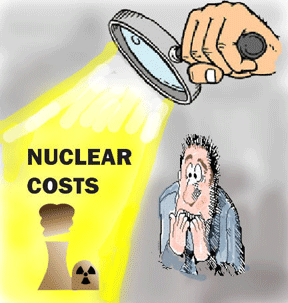 Nuclear Plants Vexed at Prices That Shift as Demand Does NYT, By MATTHEW L. WALD October 8, 2013“……Today energy in most of the United States is priced hourly in a deregulated market far different from the one of regulated power plant construction that ushered in the nation’s reactors in the 1960s and 1970s. Generators — whether coal-fired plants, wind farms or reactors — are paid varying amounts over the course of the day, but in periods of light demand and high winds the price goes below zero, so generators have to pay to put kilowatt-hours on the grid and hope to make up for the loss at other times. Only wind generators, which earn a subsidy per kilowatt-hour generated, make money in that situation.
Decisions about new generating stations are being made by entrepreneurs rather than public utilities, he said, and entrepreneurs are unlikely to do what the utilities used to: commit to expensive generating stations that could take a decade to build.
In fact, the only places in the United States where new reactors are under construction are states like South Carolina and Georgia, where the decisions are still made by public utilities commissions and big utilities, not small companies judging market conditions and then building modest “merchant” generators……
It is bad enough for nuclear operators that the market does not favor new reactor construction, but lately evidence is mounting that it is also undermining the viability of old ones, they say…….http://www.nytimes.com/2013/10/09/business/energy-environment/nuclear-plants-vexed-at-prices-that-shift-as-demand-does.html
Delays loom for Turkey’s nuclear power project
Turkey’s first nuclear power plant likely to be delayed By Humeyra Pamuk and Orhan Coskun ANKARA | Tue Oct 8, (Reuters) – Turkey’s first nuclear power plant is likely to be delayed by at least a year, a source close to the plans said on Tuesday, as bureaucratic hurdles hamper the $20 billion project….. its first planned 4,800 megawatt (MW) plant, being built by Russia’s Rosatom, is already falling behind schedule, with the first reactor unlikely to be operational by 2019 as planned.
“Production in 2019 is not possible. 2020 is more likely,” one source close to the project told Reuters, noting that a nuclear reactor on this scale would need a test period of at least six to 12 months before it could be fully operational…..http://www.reuters.com/article/2013/10/08/us-turkey-nuclear-delay-idUSBRE9970D120131008
USA govt shutdown could send nuclear workers home
Gov’t workers at nuclear reactors could be furloughed By Greg Suskin WSOCTV.com YORK COUNTY, S.C. 9 Oct 13, — As the government shutdown continues, thousands more federal workers are about to clock out.The Nuclear Regulatory Commission, which watches over the nation’s 100 nuclear reactors, has announced furloughs.
If the government shutdown doesn’t end by Thursday, about 3,600 employees will be sent home. ……http://www.wsoctv.com/news/news/local/govt-workers-nuclear-reactors-could-be-furloughed/nbJgk/
UK company Magnox wants to prolong use of aged nuclear recator
 Magnox moves to extend lifetime of UK’s oldest nuclear reactor LONDON | Tue Oct 8, 2013 Oct 8 (Reuters) – Magnox Limited, the owner of Britain’s oldest nuclear power reactor, has submitted a proposal to the country’s nuclear regulator to extend the unit’s lifetime by 15 months to December 2015.
The 42-year old Wylfa 1 nuclear reactor in Wales is scheduled to shut down at the end of September 2014, but its operator has submitted a document to the Office for Nuclear Regulation (ONR) proposing to prolong operations…….http://in.reuters.com/article/2013/10/08/britain-nuclear-wylfa-idINL6N0HY21720131008
Iran says can prove nuclear program isn’t for bomb
Iran: We can ‘clearly prove’ nuclear program isn’t for bomb Iran’s parliament speaker to CNN: West should allow enrichment for civilian purposes. By JPOST.COM STAFF10/09/2013 03 Iranian Parliament Speaker Ali Larijani on Tuesday told CNN that Tehran was serious about resolving its nuclear issue, and was seeking to come to an agreement shortly given that the West would agree to let Iran to enrich nuclear fuel for civilian purposes. Larijani told Amanpour that Iran can “clearly show and prove” to world powers that it was not developing a nuclear bomb……..
“From Iran’s side, I can say that we are ready,” Larijani, speaking from Geneva, told CNN’s Chrisitan Amanpour. http://www.jpost.com/Iranian-Threat/News/Iran-We-can-clearly-prove-nuclear-program-isnt-developing-bomb-328211
The lose-lose situation – nuclear weapons
POV: Nuclear Armament Is a Lose/Lose Even unused, nuclear weapons damage the lives of millions BU Today, 10.09.2013 By Neal Leavitt Amartya Sen is a Nobel Prize–winning economist and philosopher who is best known for his writings on famine and human development. His approach to the broader questions of foreign policy—including his commitment to nuclear disarmament—have not received as much attention, but they should.
In his essay “India and the Bomb,” Sen notes that military spending does not occur in a vacuum. A nation cannot increase spending on its armed forces and expect no response. Instead, one nation’s decision to increase its military spending will affect its neighbors. “Why,” these other heads of state might wonder, “is my neighbor developing or purchasing incredibly lethal arms? What is my neighbor planning to do with these new capabilities?” And if these persons are sufficiently alarmed, they might direct more resources to their own armed forces. The development or purchase of weapons in one country can have a cascading effect.
The key insight of Sen’s foreign policy lies here. In Sen’s words, one must take “into account the responses from others that would be generated by one’s pursuit of military strength.” Escalating actions almost inevitably lead to escalating “counteractions,” he says. This is not just an abstract and theoretical claim. Sen describes how the conflict between India and Pakistan morphed into a potential nuclear catastrophe through each nation’s commitment to a nuclear weapons program. Sen also discusses the Cuban missile crisis of 1962, when the Soviet Union and the United States came very close to ending human life.
There is nothing theoretical about these events. But the problem is not limited to the destructive potential of arms races in general—or nuclear weapons proliferation in particular. Sen also notes that a government must divert a large amount of society’s resources away from other vitally important social goals to construct “the bomb.”……
How much money has the United States spent on its nuclear weapons program since its inception? Or Russia? Or the other nuclear powers of the world? Or the states that might be seeking, but do not yet possess, nuclear weapons? And what opportunities have been lost because of these commitments? The answer to these questions is clearly: way too much. A program of nuclear disarmament—coupled with the redirection of this spending to global development goals, such as mandatory, universal primary schooling—clearly has a lot going for it. A less militaristic foreign policy can accomplish much. http://www.bu.edu/today/2013/pov-nuclear-armament-is-a-lose-lose/
1 This Month
15 October. Joint Appeal for Nuclear Abolition Day -presentation to the UN on October 15 will be live on UNWebTV
Endorse the Nuclear Abolition Day Appeal
23-25 October – on Zoom – World BEYOND War’s annual global conference

To see nuclear-related stories in greater depth and intensity – go to https://nuclearinformation.wordpress.com
-
Archives
- October 2026 (149)
- September 2026 (339)
- August 2026 (330)
- July 2026 (355)
- June 2026 (287)
- May 2026 (306)
- April 2026 (356)
- March 2026 (251)
- February 2026 (267)
- January 2026 (308)
- December 2025 (358)
- November 2025 (359)
-
Categories
- 1
- 1 NUCLEAR ISSUES
- business and costs
- climate change
- culture and arts
- ENERGY
- environment
- health
- history
- indigenous issues
- Legal
- marketing of nuclear
- media
- opposition to nuclear
- PERSONAL STORIES
- politics
- politics international
- Religion and ethics
- safety
- secrets,lies and civil liberties
- spinbuster
- technology
- Uranium
- wastes
- weapons and war
- Women
- 2 WORLD
- ACTION
- AFRICA
- Atrocities
- AUSTRALIA
- Christina's notes
- Christina's themes
- culture and arts
- Events
- Fuk 2022
- Fuk 2023
- Fukushima 2017
- Fukushima 2018
- fukushima 2019
- Fukushima 2020
- Fukushima 2021
- general
- global warming
- Humour (God we need it)
- Nuclear
- RARE EARTHS
- Reference
- resources – print
- Resources -audiovicual
- Weekly Newsletter
- World
- World Nuclear
- YouTube
-
RSS
Entries RSS
Comments RSS

