Cancer causing radiation in fish must be increasing
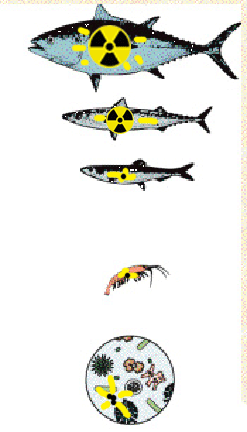 Report raises fresh concerns about radiation levels in Japanese fish Canada AM: Cancer-causing radiation in fish Gordon Edwards of the Canadian Coalition for Nuclear Responsibility discusses the danger, and whether the information will prompt changes. CTVNews.ca Staff
Monday, October 7, 2013
Two and a half years after the Fukushima nuclear plant disaster in Japan, concerns are again being raised about radiation levels in fish caught in the Pacific Ocean.
A report by the Vancouver weekly newspaper, The Georgia Straight, suggests at least 800 people worldwide could develop cancer from eating fish caught in Japan’s waters – and about half of those cases will be fatal.
About 500 of the cancers will occur in Japan, while 75 will be due to Japanese fish exports to other countries, including Canada, the newspaper estimates. It also quotes several nuclear experts who say that estimate is likely conservative and the real toll could be closer to 80,000 cancers.
Gordon Edwards, president of the Canadian Coalition for Nuclear Responsibility, notes that the estimate is based only on the fish that has been eaten up to now.
“People are going to continue to consume these fish and the toll could rise higher,” he told CTV’s Canada AM Monday from Montreal……..
Some fish samples tested to date have had very high levels of radiation: one sea bass sample collected in July, for example, had 1,000 becquerels per kilogram of cesium.While Canadians are exposed to radiation every day from the sun and the environment, Edwards notes that radioactive cesium doesn’t exist in nature at all and it’s not known if there is any safe level.
“The background level is zero. So this is all comes from the Fukushima disaster,” he said of the fish.The Canadian Food Inspection Agency tested fish exports from Japan for several months, but dropped the testing in June 2011, just three months after the disaster.
Edwards says he does not understand why the CFIA is not taking the issue more seriously.”Canadian authorities are really doing us all a disservice by not following and monitoring this much more closely. They’re treating it as though it’s a kind of ho-hum situation, but in fact, it was a major event worldwide,” he said.
“And it should be studied very more carefully because that’s the only way we’re going to learn what the effects of this may be for the future.” http://canadaam.ctvnews.ca/report-raises-fresh-concerns-about-radiation-levels-in-japanese-fish-1.1486514#ixzz2hAEyiUbR
No comments yet.
1 This Month



Tell the Ukrainian Government to Drop Prosecution of Peace Activist Yurii Sheliazhenko

Petition to revoke the licensing of the Near Surface Nuclear Disposal Facility (NSDF) at Chalk River. https://www.ourcommons.ca/petitions/en/Petition/Details?Petition=e-7247


of the week – STOP SMALL MODULAR REACTORS IN CANADA
To see nuclear-related stories in greater depth and intensity – go to https://nuclearinformation.wordpress.com
-
Archives
- March 2026 (222)
- February 2026 (268)
- January 2026 (308)
- December 2025 (358)
- November 2025 (359)
- October 2025 (376)
- September 2025 (258)
- August 2025 (319)
- July 2025 (230)
- June 2025 (348)
- May 2025 (261)
- April 2025 (305)
-
Categories
- 1
- 1 NUCLEAR ISSUES
- business and costs
- climate change
- culture and arts
- ENERGY
- environment
- health
- history
- indigenous issues
- Legal
- marketing of nuclear
- media
- opposition to nuclear
- PERSONAL STORIES
- politics
- politics international
- Religion and ethics
- safety
- secrets,lies and civil liberties
- spinbuster
- technology
- Uranium
- wastes
- weapons and war
- Women
- 2 WORLD
- ACTION
- AFRICA
- Atrocities
- AUSTRALIA
- Christina's notes
- Christina's themes
- culture and arts
- Events
- Fuk 2022
- Fuk 2023
- Fukushima 2017
- Fukushima 2018
- fukushima 2019
- Fukushima 2020
- Fukushima 2021
- general
- global warming
- Humour (God we need it)
- Nuclear
- RARE EARTHS
- Reference
- resources – print
- Resources -audiovicual
- Weekly Newsletter
- World
- World Nuclear
- YouTube
-
RSS
Entries RSS
Comments RSS
 nuclear-news
Leave a comment