Fukushima’s small level of radiation in fish can still cause cancers
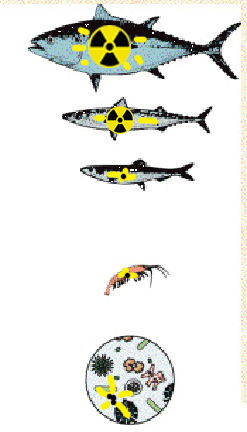 the radiation detected can still cause cancer, according to the U.S. Environmental Protection Agency’s cancer-risk formula, a leading international standard for forecasting cancer risks from radiation.
Cancer risk linked to radiation levels in fish species after Fukushima http://www.straight.com/life/497651/cancer-risk-linked-radiation-levels-fish-species-after-fukushima
In July this year, a sea bass caught in Japan had 1,000 becquerels per kilogram of radioactive cesium—10 times Japan’s ceiling of 100 becquerels per kilo in food. It was the second-highest amount found in a sea bass since the disaster occurred.
And in February, a greenling in the harbour of the Fukushima plant had a record 740,000 becquerels per kilo of cesium—7,400 times Japan’s ceiling. Two in five fish tested in July had detectable levels of cesium 134 or cesium 137, radioactive isotopes released from Fukushima.
On average, fish in the 33,000 tests since March 2011 had 18 becquerels per kilo of cesium. In March and April 2011, fish also had 65 becquerels per kilo of iodine 131. (The Straight didn’t count in these averages any fish caught in Fukushima prefecture, where most species are banned from the market.)
Fish caught far out in the Pacific had an average of two becquerels of cesium per kilo.
The Straight used these levels to determine how much radiation the public has been exposed to in Japan and elsewhere, based on fishery data from the United Nations’ Food and Agriculture Organization.
The average radiation levels are below Japan’s ceiling and Health Canada’s much higher ceiling of 1,000 becquerels per kilo for cesium and iodine 131.
But the radiation detected can still cause cancer, according to the U.S. Environmental Protection Agency’s cancer-risk formula, a leading international standard for forecasting cancer risks from radiation. The
What’s more, the EPA formula underestimates cancer impacts because it doesn’t fully include all research on radiation impacts, in the estimate of Daniel Hirsch, a UC Santa Cruz nuclear expert.
(Also according to Hirsch, Health Canada uses a less accepted cancer-risk formula that underestimates the dangers even more.)
Hirsch helped preside over a study of nuclear-power workers in the 1990s that found cancer rates at least six to eight times higher than predicted by official formulas.
No comments yet.
1 This Month

of the week – Shut Down Drone Warfare!


Tell the Ukrainian Government to Drop Prosecution of Peace Activist Yurii Sheliazhenko

Petition to revoke the licensing of the Near Surface Nuclear Disposal Facility (NSDF) at Chalk River. https://www.ourcommons.ca/petitions/en/Petition/Details?Petition=e-7247
To see nuclear-related stories in greater depth and intensity – go to https://nuclearinformation.wordpress.com
-
Archives
- April 2026 (103)
- March 2026 (251)
- February 2026 (268)
- January 2026 (308)
- December 2025 (358)
- November 2025 (359)
- October 2025 (376)
- September 2025 (257)
- August 2025 (319)
- July 2025 (230)
- June 2025 (348)
- May 2025 (261)
-
Categories
- 1
- 1 NUCLEAR ISSUES
- business and costs
- climate change
- culture and arts
- ENERGY
- environment
- health
- history
- indigenous issues
- Legal
- marketing of nuclear
- media
- opposition to nuclear
- PERSONAL STORIES
- politics
- politics international
- Religion and ethics
- safety
- secrets,lies and civil liberties
- spinbuster
- technology
- Uranium
- wastes
- weapons and war
- Women
- 2 WORLD
- ACTION
- AFRICA
- Atrocities
- AUSTRALIA
- Christina's notes
- Christina's themes
- culture and arts
- Events
- Fuk 2022
- Fuk 2023
- Fukushima 2017
- Fukushima 2018
- fukushima 2019
- Fukushima 2020
- Fukushima 2021
- general
- global warming
- Humour (God we need it)
- Nuclear
- RARE EARTHS
- Reference
- resources – print
- Resources -audiovicual
- Weekly Newsletter
- World
- World Nuclear
- YouTube
-
RSS
Entries RSS
Comments RSS
 nuclear-news
Leave a comment