Acute danger of huge radiation release in TEPCO’s work on Fukushima Nuclear reactor no 4

 A Mistake Now Could Release 14,000 Times More Radiation than Hiroshima http://oilprice.com/Latest-Energy-News/World-News/A-Mistake-Now-Could-Release-14000-Times-More-Radiation-than-Hiroshima.html By James Burgess | Sat, 28 September 2013 Lately the bad news emanating from Japan is that the reactors at the Fukushima nuclear power plant have been leaking thousands of gallons of water ever since the earthquake that struck it in 2011. There is a high chance that the radioactive water could hit Korea, China, and the West Coast of North America, and it is only likely to get worse with time as Tepco, the Japanese utility and operator of the power plant, is unsure how to stop the leaks.
Now however there is worse news that could prove dangerous to much of the world, and again Tepco could be responsible.
At Fukushima, used nuclear fuel rods are stored in pools and, especially at reactor 4, some of these pools are damaged and at risk of completely breaking open in the event of another earthquake. If one of the pools were to collapse or catch fire, then the impacts would affect the world. Arnie Gunderson, a nuclear expert, and Helen Caldicott, a physician, have even suggested that if this occurs then people should evacuate the Northern Hemisphere. And Akio Matsumura, a former advisor for the UN, has called the situation “an issue of human survival.”
Tepco could be responsible for unleashing this devastation on the world as starting in November they have decided to begin an operation to remove 400 tonnes of fuel rod assemblies, on their own. Aworkforce of thousands is preparing to work on the fuel rod pools at the instable reactor 4 in order to relocate them to a safer location.
The spent fuel, which contains plutonium, one of the most deadly substances in the universe, will prove to be a very delicate procedure. If a fuel rod is broken, cracked, or dropped whilst being removed, then it could cause an explosion, a meltdown, or a fire; all of which would release radionuclides into the atmosphere, and result in the evacuation of Tokyo and much of Japan.
The more than 1,300 fuel rod assemblies tightly packed into the building at reactor 4 contain enough radiation equivalent to 14,000 times the radiation released during the atomic bomb dropped on Hiroshima in 1945.
Each fuel rod assembly weighs close to 300kg and measure 4.5 metres long. The reactor 4 building contains 1,331 of spent assemblies and 202 unused assemblies.
Working completely underwater, the fuel assemblies will be pulled off their racks where they are currently stored, and then inserted into a heavy steel chamber, which shields the radiation. Then they will be removed from the pool, lowered to ground level and transported across the plant to a storage pool in an undamaged building.
Toshio Kimura, a former technician at Tepco, said that “previously Previously it was a computer-controlled process that memorized the exact locations of the rods down to the millimeter and now they don’t have that. It has to be done manually so there is a high risk that they will drop and break one of the fuel rods.”
Whilst aware of the inherent dangers, Tepco is confident that it can carry out the operation safely.
Tepco doesn’t measure radiation accumulated on the bottom of the sea
 Tepco doesn’t measure radiation accumulated on the bottom of the sea http://fukushima-diary.com/2013/09/tepco-doesnt-measure-radiation-accumulated-on-the-bottom-of-the-sea/ by Mochizuki on September 29th, 2013 Following up this article.. Tepco “We don’t see Tokyo bay contamination” [URL]
Regarding the Pacific contamination, Tepco stated they analyze seawater but they take the samples only from the surface of the sea on 9/27/2013.
They commented when they collect seawater samples outside of Fukushima nuclear plant port, the samples are not taken from near the bottom of the sea.
Cesium-134/137 is assumed to be accumulated on the bottom of the sea, but Tepco doesn’t and is not planning to analyze it.
Even inside of the plant port, they collect the seawater samples mostly from the surface of the sea.
Tepco explained the measurement means was not decided by only Tepco, but also with the Fisheries Agency, Fukushima prefectural government and Ministry of Education, Culture, Sports, Science and Technology.
Also, Strontium-90 is water-soluble, so even if they analyze only the surface water, they can detect the marine contamination level.
According to Tepco and Japanese government, they don’t measure high level of radiation in their sampling points of the Pacific.
How concerned should we be about eating fish caught near Fukushima?
 Fukushima Radiation Risks from Eating Fish, Switchboard Matthew McKinzie’s Blog 24 sept 13
“……….CONCLUSIONS
For the foreseeable future, one should avoid eating fish caught near Fukushima. Buesseler says that during his own sampling survey in waters 30 to 600 kilometres from Fukushima in June 2011, three months after the meltdown, the highest levels he found were 3 Bq/liter of cesium-137. This suggests that the consumption of fish caught in these waters would not represent a significant risk to individuals.
There is not a significant radiological risk to individuals associated with consuming fish caught near the West coast of the United States and Hawaii.
Ken Buesseler notes that the north Pacific contains an estimated 100 PBq of cesium-137 from H-bomb testing in the 1960s, so the fallout from Fukushima is adding only a fraction of that. Total discharges from the Sellafield nuclear plant in the UK released 39 PBq over 40 years of operation, according to Buessler. http://switchboard.nrdc.org/blogs/mmckinzie/fukushima_radiation_risks_from.html
Legal opinion on Iran’s right to uranium enrichmen

 Iran’s right to uranium enrichment unquestionable: Intl. lawyer An international lawyer tells Press TV that Iran’s right to enrich uranium for peaceful purposes is unquestionable under the Non-Proliferation Treaty (NPT).Press TV 30 Sept 13
Alfred Lambremont Webre said Monday that Iranian officials have made it clear that they will not go after weapons-grade uranium enrichment, citing Leader of the Islamic Revolution Ayatollah Seyyed Ali Khamenei’s fatwa on the prohibition of nuclear arms production and development.
“I think things are very clear that statements have been made that Iran will not be going forward to enrich at weapons grade, which is over 90 percent. It will be doing under 20 percent down to 5 percent, which is enough for power enrichment,” he said.
“There is no question that under the NPT Iran has the right to enrich uranium of non-weapons grade, that is, of power-station grade, which you would say would be between 5 percent and certainly under 20 percent,” he added.
He said that there was no evidence that Iran was intending to develop nuclear weapons, adding the Islamic Republic was enriching for nuclear power as its “basic legal right.” …..http://www.presstv.ir/detail/2013/09/30/326923/iran-right-to-enrichment-unquestionable/
Spill of tonnes of radioactive water into Fukushima soil
 TEPCO Just Spilled Tonnes Of Radioactive Water Into Fukushima’s Soil http://www.gizmodo.com.au/2013/10/tepco-just-spilled-tons-of-radioactive-water-into-fukushimas-soil/ ADAM CLARK ESTES The operator of Japan’s infamously crippled Fukushima nuclear power plant recently attempted to move some radioactive water from one tank to another. In the process, it spilled four tonnes of deadly sludge.
To be fair, the four tons of water is just a drop in the bucket compared to the 300 tonnes that recently leaked from a nearby tank. And the radiation levels in the newly leaked water are relatively low compared to puddles they found forming outside the tanks about six weeks ago. TEPCO’s not in the clear yet, though. A tropical storm is on the way, which creates the potential for even more radioactive leaks.
It’s also worth remembering that this little leak pales in comparison to Fukushima’s bigger problems. Its primary leak is getting worse, and if something’s not done about it soon, it will continue to spread and contaminate the surrounding area. Recently, Japan’s government agreed to bankroll a massive project to build an underground ice wall to contain the leaked groundwater. Experts seem to agree that the plan is feasible. All TEPCO has to do is stop spilling radioactive water into the ground. [Reuters]
Astroturfing in North Dakota – sly underhand promotion of uranium mining interests
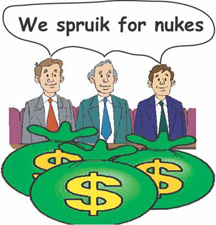
 Thoughts on the uranium debacle http://rapidcityjournal.com/news/local/communities/hot-springs/opinion/thoughts-on-the-uranium-debacle/article_f681dd4c-29ef-11e3-9acc-0019bb2963f4.html By Rebecca Leas, PhD 1 Oct 13 Unless you ‘ve been living in a cave, you know natural gas is the new major focus for energy. Natural gas has negatively affected the nuclear industry, resulting in decreased demand for uranium. Germany is nearly nuclear-free and other countries, including the United States, are closing down reactors. The U.S.’s reactors are in ill repair and very susceptible to weather events, earthquakes, and terrorism. Our storage of spent fuel is outdated, making our reactors very vulnerable. Europe uses a “HOSS” (Hardened On-Site Storage) system greatly reducing the risks.
The USA is shutting down reactors and has sufficient uranium available. France is perfecting a system of re-using uranium which will further decrease its demand.
Confusing the public are Powertech (PT) employees, shareholders and supporters writing Letters to the Editor, but not identifying themselves as such. This is important for the public to know. Continue reading
Renewable energy generation in UK breaking records
 Record high for UK renewables Renewable Energy Focus 01 October 2013 Statistics published today by the Department of Energy and Climate Change (DECC) showed that the amount of electricity generated from renewable energy sources in the UK reached a new record high of 15.5% of total electricity generation in the second quarter of this year.
“The fact that we have seen the record for renewables generation broken twice in the space of a few months shows for itself the progress being made in the race to decarbonise our economy and secure our future electricity supply.” http://www.renewableenergyfocus.com/view/34797/record-high-for-uk-renewables/
Deadly combination: radiation and trauma – new research
New findings on combined radiation injury from nuclear disaster Medical Xpress, 1 Oct 13 A nuclear bomb or nuclear reactor accident can produce a deadly combination of radiation exposure and injuries such as burns and trauma. Now the first study of its kind i n 50 years is providing new insights into this phenomenon, called combined radiation injury (CRI).
Researchers at Loyola University Chicago Stritch School of Medicine have shown how CRI causes the intestines to leak bacteria into surrounding tissue. The study also showed that radiation and burns have a synergistic effect that make them far more deadly when they act in combination.
The study is published in the October, 2013 issue of the journal Shock…….Normally, cells that line the lumen of the intestine prevent bacteria and bacterial products from leaking out. The cells are held together by “tight junctions.” Radiation can damage and kill these cells, and a burn injury can trigger an inflammatory response that breaks down tight junctions. This effectively opens up the protective lining, allowing bacterial products to leak out of the intestine. Such leaks can cause death by sepsis.
In the study, researchers found that combined radiation and thermal injury triggered 100 times greater leakage of bacteria across the intestinal lining than the leakage seen in control groups exposed to radiation alone, burn alone or no injury at all.
“To our knowledge, we are the first to present gastrointestinal findings of this nature in any CRI model, with the exception of early studies on CRI in the 1960s,” researchers wrote……. http://medicalxpress.com/news/2013-10-combined-injury-nuclear-disaster.html
Nuclear radiological attack will find USA cities unprepared
U.S. Cities Unprepared to Deal with Large-Scale Nuclear, Radiological Attack Washington Free Beacon 1 Oct 13 Watchdog group says federal government has offered little guidance to major cities Major U.S. cities lack the capabilities and know-how to effectively deal with the fallout from a large-scale nuclear and radiological attack by terrorists, according to the government’s top watchdog group.
The federal government has conducted “limited” planning and offered little guidance to major cities that are vulnerable to either a radiological or nuclear attack, according to a Monday report issued by the Government Accountability Office (GAO).
The disorganization and lack of preparedness could lead to a “disjointed” emergency response, increasing “the consequences,” fatalities, and economic toll of such a disaster, the report said.
These potentially catastrophic “gaps in early response abilities warrant federal attention,” the GAO said.
Most major cities admitted that while local emergency personnel could scramble to treat victims, they remain uncertain about how exactly to deal with such an attack and whether the federal government would come to their assistance.
There is currently “limited federal planning guidance related to the early response capabilities needed by cities for the large attack depicted in the national planning scenarios,” the GAO reported.
The GAO recommends that the Federal Emergency Management Agency (FEMA) “develop guidance to clarify the early response capabilities needed by cities for RDD [radiological dispersion device] and IND [improvised nuclear device] attacks.”……….
“10 of those cities were perceived as not being able to conduct any of the response activities for an [nuclear] attack without federal assistance.”
FEMA maintains that federal guidance would not be necessary despite the apparent lack of preparation and coordination with the federal government, according to the report………..
The GAO is warning congressional leaders that much more preparation and coordination is needed.
“A disjointed or untimely response could put many additional lives at risk, increase economic consequences, and undermine the public’s confidence in the federal, state, and local governments’ ability to respond to such a crisis,” the GAO wrote in a Monday letter to Sen. Tom Carper (D., Del.), chairman of the Senate Committee on Homeland Security and Governmental Affairs. http://freebeacon.com/u-s-cities-unprepared-to-deal-with-large-scale-nuclear-radiological-attack/
Importance of WATER: this will decide fate of nuclear power project
 Fate of proposed Green River nuclear power plant depends on water After 5 days of testimony, judge takes case under advisement By Amy Joi O’Donoghue, Deseret News Sunday, Sept. 29 2013
Summary
A five day trial concluded Friday in a Price courtroom. The judge will ultimately determine if the Utah state engineer’s decision to grant water to cool the reactors of a proposed nuclear power plant was justified. Multiple groups assert it was not…….http://www.deseretnews.com/article/865587330/Fate-of-proposed-Green-River-power-plant-depends-on-water.html
Nuclear catastrophe avoided in USA – so far
 We’re Incredibly Lucky There Hasn’t Been a U.S. Nuclear Catastrophe…Yet Atlantic Wire ERIC LEVENSON, 30 Sept 13 Know that popular Liberty Insurance Mutual commercial that jokingly shows people making small mistakes — dropping an air conditioning unit from an upper-story window or forgetting to put on the emergency brake — that destroy their cars? Funny, right? Now imagine that, but with nuclear weapons.
That’s the frightening picture that author Eric Schlosser paints in his new book Command and Control, a look at the many accidents involving nuclear weapons that almost led to massive destruction. His conclusion isn’t very comforting — it’s partly plain old luck that has kept an explosion from happening, one of several points he made in a phone interview with The Atlantic Wire………
The book is scarily full of stories like the Damascus Accident, which Schlosser worked to get declassified for the book. In another case, a B-52 plane exploded above North Carolina during a supposedly-routine flight, dropping two hydrogen bombs below. They failed to explode because of a single low-voltage switch, the last safety measure available for the explosives. Other gut-wrenching examples were reported in The New Yorker, Los Angeles Times, and The New York Times Book Review.
Just as we are lucky that none of these accidents ever resulted in an explosion, we’re equally lucky that no unhinged military members had a Dr. Strangelove-like desire to take nuclear action into their own hands, a possibility which, despite Air Force claims to the contrary, was very real. “The reality was until the early 1970s, there was nothing to prevent a bomber crew from just flying to the Soviet Union with their hydrogen bombs and dropping them,” Schlosser said. “There were no codes that they had to type in to unlock the bombs or unlock the missiles. So we’re glad that never happened but it’s a pretty risky way to manage a nuclear weapon.”
Even more disconcerting — two people in charge of safety protocols for nuclear weapons didn’t even know about all of these accidents until Schlosser told them. That’s because of the Air Force’s compartmentalized secrecy, which prevents the bomb users from interacting with its developers, Schlosser explained. “There were bomb handlers and pilots who didn’t realize some of the safety problems with the weapons, and there were weapons developers who didn’t realize how these weapons were being handled. And that’s a very bad combination,” he said.
And this isn’t just a historical problem; many of these same issues remain today. “I’m concerned about the arsenal right now, and the morale of the people who are running it, and some of the safety violations we’ve been having for the last two years,” Schlosser said. While his work highlights the potentially huge problems of human infallibility, the solutions he suggests don’t offer much. “But if we’re gonna have these weapons, we need to take care of them properly,” he said. Any other options? “Or just get rid of them.” http://www.theatlanticwire.com/national/2013/09/eric-schlosser-book-command-and-control-review-nuclear-explosion/69949/
Michigan politicians unhappy about Nuclear waste dump near great lakes
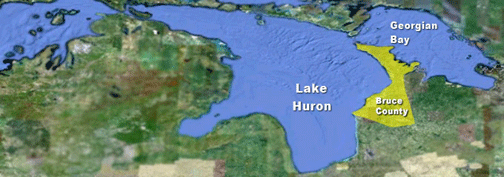 Michigan politicians voice concerns over burying nuclear waste near Kincardine CTV News September 30, 2013 Two American politicians made the trip to Kincardine Monday to share their opposition to burying nuclear waste near the Great Lakes.
“It’s just really astonishing to me that they would consider putting this type of nuclear waste so close to Lake Huron and to our Great Lakes. As I look out here, it’s just even more compelling of a case for me,” says Michigan State Representative Sarah Roberts.
Roberts and Michigan State Senator Hoon Yung Hopgood travelled to Bruce County to say Michigan doesn’t want nuclear waste permanently stored within 1.2 kilometres of the lake their share with Ontario. “In Michigan, every single person that I have talked to says ‘I cannot believe they are considering doing that,'” says Roberts.
Ontario Power Generation wants to bury 200,000 cubic metres of its low and intermediate level nuclear waste in an underground facility on the Bruce Power site…….
While there very well may be opposition in Michigan, it’s harder to find on this side of the border. Every mayor within 150 kilometres of the proposed site is favour of OPG’s plan, including Kincardine Mayor Larry Kraemer…… http://london.ctvnews.ca/michigan-politicians-voice-concerns-over-burying-nuclear-waste-near-kincardine-1.1477370#ixzz2gWBWQW7B
1 This Month


18 March Webinar @ 1 PM EST: An Assessment of SMR Projects: The Case of Canada
register for the zoom:
https://us02web.zoom.us/webinar/register/WN_o8BIIOUvQ2ONJR1nta65DQ#/registration


of the week – STOP SMALL MODULAR REACTORS IN CANADA
To see nuclear-related stories in greater depth and intensity – go to https://nuclearinformation.wordpress.com
-
Archives
- March 2026 (146)
- February 2026 (268)
- January 2026 (308)
- December 2025 (358)
- November 2025 (359)
- October 2025 (376)
- September 2025 (258)
- August 2025 (319)
- July 2025 (230)
- June 2025 (348)
- May 2025 (261)
- April 2025 (305)
-
Categories
- 1
- 1 NUCLEAR ISSUES
- business and costs
- climate change
- culture and arts
- ENERGY
- environment
- health
- history
- indigenous issues
- Legal
- marketing of nuclear
- media
- opposition to nuclear
- PERSONAL STORIES
- politics
- politics international
- Religion and ethics
- safety
- secrets,lies and civil liberties
- spinbuster
- technology
- Uranium
- wastes
- weapons and war
- Women
- 2 WORLD
- ACTION
- AFRICA
- Atrocities
- AUSTRALIA
- Christina's notes
- Christina's themes
- culture and arts
- Events
- Fuk 2022
- Fuk 2023
- Fukushima 2017
- Fukushima 2018
- fukushima 2019
- Fukushima 2020
- Fukushima 2021
- general
- global warming
- Humour (God we need it)
- Nuclear
- RARE EARTHS
- Reference
- resources – print
- Resources -audiovicual
- Weekly Newsletter
- World
- World Nuclear
- YouTube
-
RSS
Entries RSS
Comments RSS
 nuclear-news