Germany shows political success of its renewable energy transition
it is a clear signal that citizens are favouring a publicly owned, decentralised energy system with a leading role of renewables.”
The German result is likely to present good news. HSBC believes the IPCC report – despite its criticism in some quarters, and particularly by the fossil fuel lobby – could mark “a new phase in climate action”.
Germany votes for energy transition, and to buy back the grid http://reneweconomy.com.au/2013/germany-votes-for-energy-transition-and-to-buy-back-the-grid-50110 By Giles Parkinson on 25 September 2013
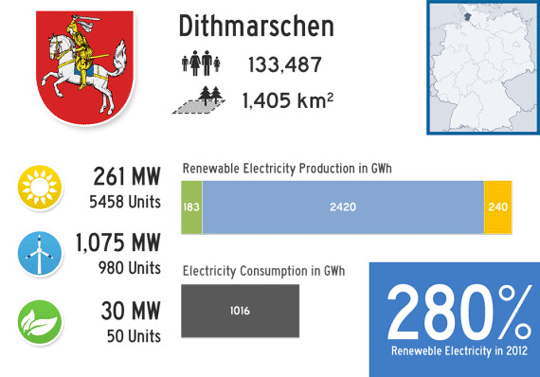
As the dust settles on the election results, and Chancellor Angela Merkel begins the process of selecting a new coalition partner, most observers are suggesting that the poll results are positive for Germany’s Energiewende, the ambitious energy transition program that aims to have Europe’s strongest industrial economy powered 50 per cent by renewables by 2030, and 80 per cent by 2050. (Below renewable energy in just one province of Germany 2012)
The biggest reason for this optimism is the disintegration of the right-wing FDP party, which polled so badly it will no longer have a seat in the lower house.
As a junior member of the ruling coalition with Merkel over the past four years, the FDP had wielded considerable ability to block progress on energy and climate policy and had, on ideological grounds – sought to block progress on carbon markets, and energy efficiency and renewable energy laws.
The poor performance of the FDP in state elections, where it lost power in Bavaria and Hessen, means that the balance in the crucial second chamber of the German parliament is now further tilting towards states in favour of the Energiewende.
However, one intriguing result of the election included a referendum in the state of Hamburg to buy back the lower power grid from Vattenfall, and turn it into a local municipal-based public utility.
The proposal gained a majority, despite active campaigning and a lavish budget against it by most major parties, including the centre left SDP, which rules in the state, Merkel’s centre right CDU and the FDP.
As one observer noted: “Regardless of whether this will mean much in terms of promoting renewables (almost everyone agrees it doesn’t), it is a clear signal that citizens are favouring a publicly owned, decentralised energy system with a leading role of renewables.”
That could be critical because one of the biggest issues confronting a “grand alliance” between Merkel’s CDU and the SPD is reform of the Erneuerbare-Energien-Gesetz (EEG), the renewable energy act which for the past 13 years has underpinned the transition, which has so far reached a level of 23 per cent renewables. The EEG surcharge in 2013 rose 47 per cent to 0.528c/kWh, about one fifth of electricity costs. That burden currently falls mostly on households, and Bloomberg New Energy Finance says a new Coalition would likely seek to remove some exemptions from businesses.
HSBC says that on energy, both parties essentially aim to increase the share of renewables in the electricity mix. However the conservatives want to keep exemptions (on taxation and grid fees) for energy-intensive manufacturing industries, while the SPD is aiming for lower electricity costs for private households and also wants to completely rework the renewables law (EEG).
Other analysts say that while both the CDU and SPF have strong ties to industrial lobbies, the local support for the Energiewende – as evidenced through the Hamburg vote – could be a powerful counterweight to big business lobby.
Hamburg is not the only city in Germany to want to buy back its grid. Berlin holds a similar vote next month, and nearly a dozen other municipalities have either voted for or are in the process of doing the same.
The states will be increasingly important in energy policy as many of the progressive states with a strong interest in local energy transition have greater power in second chamber of parliament, which is decisive for energy legislation.
Some analysts expect a new ministry of energy/energiewende to be created. This may help address some of the current tensions between the environment and economy ministries, but its direction will depend on who will lead it.
The Greens also polled poorly. Some are suggesting it was due to a poor strategic decision to downplay their core themes such as environment, energy, climate, and focus on tax hikes which they want to introduce to pay for better education.
Analysts at HSBC last week suggested that the election in Germany would be critical in unblocking domestic and European policies on renewables, carbon and efficiency.
It said September – with elections in Germany, Australia and the release of te IPCC report on Friday – would be critical for the progress of climate action.
The German result is likely to present good news. HSBC believes the IPCC report – despite its criticism in some quarters, and particularly by the fossil fuel lobby – could mark “a new phase in climate action”. HSBC says that would leave a Tony Abbott-led Australia distinguishing itself “as an exception to a broader trend to increased commitment, notably in the G-2 (China and the USA).”
No comments yet.
1 This Month

of the week – Shut Down Drone Warfare!


Tell the Ukrainian Government to Drop Prosecution of Peace Activist Yurii Sheliazhenko

Petition to revoke the licensing of the Near Surface Nuclear Disposal Facility (NSDF) at Chalk River. https://www.ourcommons.ca/petitions/en/Petition/Details?Petition=e-7247
To see nuclear-related stories in greater depth and intensity – go to https://nuclearinformation.wordpress.com
-
Archives
- April 2026 (57)
- March 2026 (251)
- February 2026 (268)
- January 2026 (308)
- December 2025 (358)
- November 2025 (359)
- October 2025 (376)
- September 2025 (257)
- August 2025 (319)
- July 2025 (230)
- June 2025 (348)
- May 2025 (261)
-
Categories
- 1
- 1 NUCLEAR ISSUES
- business and costs
- climate change
- culture and arts
- ENERGY
- environment
- health
- history
- indigenous issues
- Legal
- marketing of nuclear
- media
- opposition to nuclear
- PERSONAL STORIES
- politics
- politics international
- Religion and ethics
- safety
- secrets,lies and civil liberties
- spinbuster
- technology
- Uranium
- wastes
- weapons and war
- Women
- 2 WORLD
- ACTION
- AFRICA
- Atrocities
- AUSTRALIA
- Christina's notes
- Christina's themes
- culture and arts
- Events
- Fuk 2022
- Fuk 2023
- Fukushima 2017
- Fukushima 2018
- fukushima 2019
- Fukushima 2020
- Fukushima 2021
- general
- global warming
- Humour (God we need it)
- Nuclear
- RARE EARTHS
- Reference
- resources – print
- Resources -audiovicual
- Weekly Newsletter
- World
- World Nuclear
- YouTube
-
RSS
Entries RSS
Comments RSS
 nuclear-news
Leave a comment