A litany of bad news for the US nuclear industry
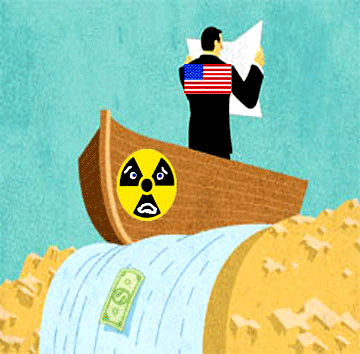 Wall Street firm Credit Suisse set the tone in February with a report that described the aging U.S. fleet of nuclear power plants as “facing declining performance, higher costs and inevitable mortality.
by Elizabeth Douglas, theguardian.com, Wednesday 25 September 2013 As the economics of building plants and maintaining old ones erode, some experts see little hope for an industry being touted by some as a climate savior.
A string of plant closures, project cancellations and other setbacks has raised new doubts about the future of nuclear power in the United States, but there’s disagreement about whether the retrenchment will be limited and temporary or the beginning of a broad and permanent decline.Renewed safety concerns and reinvigorated local opposition have played a role in the industry’s recent troubles. But the most potent foe—and the primary force behind the spate of closures and abandoned projects—is economic.The industry’s run of bad news includes:
• The early closure of four nuclear power plants. Two of the plants, theVermont Yankee reactor and Wisconsin’s Kewaunee reactor, were felled by stiff competition. One plant, San Onofre in California, was shuttered amid safety concerns and severely damaged steam generators. And the other, Florida’s Crystal River, was done in by structural damage.
• An announcement that Électricité de France SA, the world’s largest nuclear plant operator, would withdraw from its joint venture with Exelon Corp. The venture’s three nuclear plants—Calvert Cliffs in Maryland and New York’s R.E. Ginna and Nine Mile Point—will be run by Exelon. The French company had invested billions of dollars to expand into the United States.
• Duke Energy Corp.’s decision to shelve plans for two reactors in Levy County, Fla. (in addition to permanently closing Crystal River).
• A June 2012 court ruling that blocked the federal Nuclear Regulatory Commission from issuing new reactor licenses or renewals until it sufficiently assesses the risks of storing spent radioactive fuel at nuclear plant sites.
• The cancellation this year of at least five projects that would have boosted the power output of existing reactors.
• Long delays and billions of dollars in cost overruns for ongoing construction of new reactors in Georgia, South Carolina and Tennessee.
The blows to nuclear power’s prospects have come on many fronts, but it was the surprising spurt of plant closures that laid bare the industry’s worsening plight. The plant shutdowns are the first to hit the U.S. nuclear power market in 15 years, and the retirements don’t bode well for many of the nation’s 99 remaining power reactors.
Analysts say economic woes make at least 10 other plants vulnerable enough to follow suit. Almost all of those are among the nation’s 47 “merchant” nuclear plants, which, unlike regulated plants, operate in open markets and have to beat out other power suppliers to win customers and long-term supply contracts. The especially vulnerable facilities cited by analysts are at greater risk for closure because their power is too expensive to sell profitably in wholesale markets or because their output is too small or too unreliable to support rising operating and retrofit costs.
Wall Street firm Credit Suisse set the tone in February with a report that described the aging U.S. fleet of nuclear power plants as “facing declining performance, higher costs and inevitable mortality.” Given the outlook for age-related extra costs, new safety and security expenses, sluggish electricity demand and stiff competition from power plants burning cheaper natural gas, Credit Suisse said, “losing another 1-5 plants in 2013 would not shock us.”…………http://www.theguardian.com/environment/2013/sep/24/us-nuclear-power-closures
No comments yet.
1 This Month
Chernobyl: The Lost Tapes – A good documentary on Chernobyl on SBS available On Demand for the next 3 weeks– https://www.sbs.com.au/ondemand/tv-program/chernobyl-the-lost-tapes/2352741955560

of the week–London Campaign for Nuclear Disarmament

Tell the Ukrainian Government to Drop Prosecution of Peace Activist Yurii Sheliazhenko
To see nuclear-related stories in greater depth and intensity – go to https://nuclearinformation.wordpress.com
-
Archives
- April 2026 (114)
- March 2026 (251)
- February 2026 (268)
- January 2026 (308)
- December 2025 (358)
- November 2025 (359)
- October 2025 (376)
- September 2025 (257)
- August 2025 (319)
- July 2025 (230)
- June 2025 (348)
- May 2025 (261)
-
Categories
- 1
- 1 NUCLEAR ISSUES
- business and costs
- climate change
- culture and arts
- ENERGY
- environment
- health
- history
- indigenous issues
- Legal
- marketing of nuclear
- media
- opposition to nuclear
- PERSONAL STORIES
- politics
- politics international
- Religion and ethics
- safety
- secrets,lies and civil liberties
- spinbuster
- technology
- Uranium
- wastes
- weapons and war
- Women
- 2 WORLD
- ACTION
- AFRICA
- Atrocities
- AUSTRALIA
- Christina's notes
- Christina's themes
- culture and arts
- Events
- Fuk 2022
- Fuk 2023
- Fukushima 2017
- Fukushima 2018
- fukushima 2019
- Fukushima 2020
- Fukushima 2021
- general
- global warming
- Humour (God we need it)
- Nuclear
- RARE EARTHS
- Reference
- resources – print
- Resources -audiovicual
- Weekly Newsletter
- World
- World Nuclear
- YouTube
-
RSS
Entries RSS
Comments RSS
 nuclear-news
Leave a comment