USA’s cover-up of effects of depleted uranium on US soldiers
 The U.S. Army’s own contractor, Doug Rokke, who headed a clean up of depleted uranium (DU) after the first Gulf War stated, “Depleted uranium is a crime against God and humanity.” Mr. Rokke went on to state that when his crew went to the Gulf they were all very healthy people, yet after performing clean up operations, 30 members of his staff died and the majority of the others, to include Mr. Rokke himself, “developed serious health problems.
 The military is aware of depleted uranium’s harmful effects on the human genetic code.
The U.S. Military does not want the rest of the world to find out what we have done
Dangers and Health Effects of Depleted Uranium, Disabled World, Thomas C. Weiss, 4 Sept 13 “…….According to an article by Robert C. Koehler in 2007, the Veterans Administration presented figures of 205,000 soldiers who returned from wars in Iraq and Afghanistan. Of these soldiers, one-third have sought medical care for issues such as:
Perhaps the most compelling evidence of all is the sheer number of veterans of the Iraq and Afghanistan conflicts suffering physical ailments. In an April 12, 2007 article, Robert C. Koehler examined the issue:
- Malignant tumors (1,584)
- Mental disorders (73,157)
- Mystery conditions (67,743)
- Nervous system diseases (61,524)
- Musculoskeletal diseases (87,590)
- Digestive system diseases (63,002)
- Endocrinal and metabolic diseases (36,409)
Many times these conditions are lumped together under the convenient catch all heading of, ‘Gulf War Syndrome.’ It is very likely that at least some of these illnesses are caused by exposure to depleted uranium (DU). The effects of DU contamination may take up to 10 years to manifest and it is likely the number of veterans who will need medical care will be higher than from prior conflicts. Continue reading
Comprehensive Nuclear-Test-Ban Treaty Organization (CTBTO) works for peace with no nuclear testing
 Banning nuclear tests essential for global peace, says head of UN-backed treaty organization http://www.un.org/apps/news/story.asp?NewsID=45772&Cr=nuclear&Cr1=#.UijtKNJwonE 4 September 2013 – The new head of preparatory commission for a United Nations-backed treaty stressed today that banning nuclear tests is essential for international peace and security.
In a briefing to reporters in New York, the Executive Secretary of the Preparatory Commission for the Comprehensive Nuclear-Test-Ban Treaty Organization (CTBTO), Lassina Zerbo, underlined that countries who have not ratified the treaty should realize the treaty is in their national security interests as well being a vital part of achieving international peace.
“We are indeed working hard day in and day out to try to secure their ratification by building the framework that will give the trust necessary for these countries to understand that the ratification of this treaty is part of their own national security as well as the international peace and security,” Mr. Zerbo said.
Adopted by the General Assembly in 1996, the CTBT is the only treaty to ban all nuclear tests in all environments, for military or civilian purposes. It also has a unique global alarm system to detect nuclear explosions. While the treaty has been adopted, it has not yet entered into force.
The CTBTO is an independent international organization with its own membership and budget, but it has had a Relationship Agreement with the UN since 2000.
Out of a total listed number of 195 States, 183 have so far signed the CTBT and 159 have ratified it. For the treaty to enter into force, ratification is required from the so-called “Annex 2 States”. Of these, China, the Democratic People’s Republic of Korea, Egypt, India, Iran, Israel, Pakistan and the United States, have yet to ratify it.
The CTBTO is tasked with building up the treaty’s verification regime so that it is fully operational when the treaty enters into force, and with promoting signatures and ratifications.Mr. Zerbo said the CTBTO is working with officials at various levels in the countries that have yet to ratify the treaty to ensure they find the treaty verifiable, and find the technical and political means for ratification.
Secretary-General Ban Ki-moon has repeatedly called on States to ratify the CTBT stressing there are “no justifiable grounds for further delay in” preventing the treaty’s entry into force.
USA’s intense worry about nuclear Pakistan
 Pakistan and the Nuclear Nightmare FP, By Dan Twining , September 4, 2013 –The Washington Post has revealed the intense concern of the U.S. intelligence community about Pakistan’s nuclear weapons program. In addition to gaps in U.S. information about nuclear weapons storage and safeguards, American analysts are worried about the risk of terrorist attacks against nuclear facilities in Pakistan as well as the risk that individual Pakistani nuclear weapons handlers could go rogue in ways that endanger unified national control over these weapons of mass destruction.
These concerns raise a wider question for a U.S. national security establishment whose worst nightmares include the collapse of the Pakistani state — with all its implications for empowerment of terrorists, a regional explosion of violent extremism, war with India, and loss of control over the country’s nuclear weapons. That larger question is: Does Pakistan’s nuclear arsenal promote the country’s unity or its disaggregation?
This is a complicated puzzle, in part because nuclear war in South Asia may be more likely as long as nuclear weapons help hold Pakistan together and embolden its military leaders to pursue foreign adventures under the nuclear umbrella. So if we argue that nuclear weapons help maintain Pakistan’s integrity as a state — by empowering and cohering the Pakistani Army — they may at the same time undermine regional stability and security by making regional war more likely………http://shadow.foreignpolicy.com/posts/2013/09/04/pakistan_and_the_nuclear_nightmare
The tricky but lucrative business of shutting down dead nuclear raectors
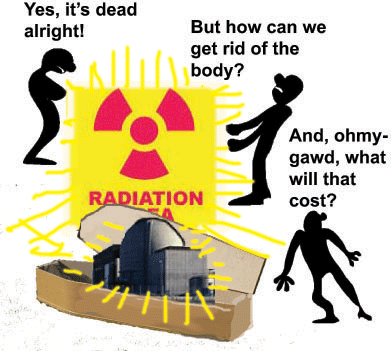 Nuclear Trashmen Gain From Record U.S. Reactor Shutdowns Bloomberg By Brian Wingfield – Sep 4, 2013 1:”……..Tricky Business The physical work involved in tearing down a nuclear plant takes about 10 years, according to John Hickman, a project manager in the U.S. Nuclear Regulatory Commission’s decommissioning branch. The agency gives reactor owners 60 years to complete decommissioning, which it defines as permanently removing a plant from service and reducing radioactivity enough for the property to be used for another purpose.
The NRC is now overseeing 14 commercial reactors that are in some phase of decommissioning, excluding those marked for closure in the last year. The first plant to deliver commercial power in the U.S. was a General Electric Co (GE).-designed unit near Fremont, California, which began service in 1957, according to the agency. It was also the first unit to be decommissioned, in 1963.
Razing a plant is tricky business. Radiation can seep into the concrete, pipes and metal of plant structures, and workers need to be able to break down the units without exposing themselves, or the public, to contamination. Plants often sit idle for decades before being torn down in order to let radioactive material decay. Continue reading
Japanese government keen for Olympic Games, no radiation worries about Tokyo
 Brushing aside radiation worry, Tokyo says it’s as safe as NYC http://www.sbs.com.au/news/article/2013/09/05/brushing-aside-radiation-worry-tokyo-says-its-safe-nyc BUENOS AIRES (Reuters) Reporting by Alexandra Ulmer; Editing by Ossian Shine- Tokyo’s Olympic bid chief on Wednesday played down fears the Fukushima water crisis could dent the city’s gambit to host the 2020 Summer Games, saying the Japanese capital is as safe as London, New York City and Paris. The International Olympic Committee (IOC) will vote on Saturday in Buenos Aires to decide whether Istanbul, Madrid or Tokyo will be awarded the world’s biggest and most expensive multi-event sporting extravaganza.
Japanese officials have been eager to show the spread of irradiated water is under control, even as radiation levels at parts of the Fukushima nuclear plant have spiked to record highs.
“Right now Tokyo’s radiation level is comparable to London, Paris and New York and here as well,” said bid leader Tsunekazu Takeda in Buenos Aires, making the case for the city alongside the honorary chairman of Toyota Motor Corp., Fujio Cho.
“It’s absolutely safe,” said Takeda, adding he had written a letter to IOC members to stress radiation wasn’t a threat to Tokyo, located some 230 km (140 miles) from the stricken plant.
Prime Minister Shinzo Abe, who has helped lead the campaign to host the Games, is due to fly in to the Argentine capital ahead of the high-stakes vote.
Japan’s government is in touch with experts in the United States and elsewhere on ways to control the Fukushima crisis, trade and economics minister Toshimitsu Motegi told Reuters earlier on Wednesday.
Depleted Uranium (DU) Health Concerns
Dangers and Health Effects of Depleted Uranium, Disabled World, Thomas C. Weiss, 4 Sept 13 “…………Health concerns and DU center around the effect on the human body of nano-sized ceramic particles of uranium oxide (U238) that are released into the air when DU munitions are used in battle. Dr. Rosalie Bertell presented a concise explanation of the potential dangers of exposure to depleted uranium (DU). Dr. Bertell stated, “Uranium oxide and its aerosol form are insoluble in water. The aerosol resists gravity, and is able to travel tens of kilometres in air. Once on the ground, it can be resuspended when the sand is disturbed by motion or wind. Once breathed in, the very small particles of uranium oxide, those which are 2.5 microns (one micron = one millionth of a meter) or less in diameter, could reside in the lungs for years, slowly passing through the lung tissue into the blood.” Continue reading
Southern California planning new energy system, with San Onofre closed
Post-nuclear power grid takes shape UT San Diego, By Morgan Lee SEPT. 4, 2013 Responding to the retirement of the San Onofre nuclear plant, energy authorities are closing in on California’s solution for ensuring power supplies to San Diego and the Los Angeles Basin, outlining a plan that will come under scrutiny Monday in Sacramento.
Under a 10-page draft plan, state regulators and Southern California utilities are weighing measures that might revive generators at the San Onofre site to ensure adequate electricity imports……..
Middle East nuclear conflagration risk, if USA attacks Syria
Moscow Says US Strike on Syria Threatens Nuclear Security http://en.ria.ru/russia/20130904/183168440/Moscow-Says-US-Strike-on-Syria-Threatens-Nuclear-Security.html MOSCOW, September 4 (RIA Novosti) – The Russian Foreign Ministry on Wednesday urged the International Atomic Energy Agency (IAEA) to analyze risks of a potential US military operation in Syria, saying such a strike would threaten nuclear security throughout the Middle East.
Ministry spokesman Alexander Lukashevich said in a statement that such an operation in Syria “might affect targets sensitive in terms of nuclear security and nuclear non-proliferation,” including the Miniature Neutron Source Reactor (MNSR) near Damascus.
He said “the consequences will be catastrophic” if the MNSR is hit by a US missile. Potential risks entail “possible contamination of adjacent territories with highly enriched uranium and radioactive decay products and the de-facto impossibility of ensuring control and safety of nuclear material at this object,” he said.
“In order to prevent events from taking a negative turn, we strongly urge the IAEA secretariat to promptly react to the situation and to present member states with an analysis of risks related to airstrikes on the MNSR and other objects in Syria,” the statement reads.
1 This Month
10 March A LIVE WEBINAR THE REAL EFFECTS OF NUCLEAR POWER
What the Industry Isn’t Telling Us
1:00 PM Mountain, 2 pm Central, 3 pm Eastern. Live on the Keepers of the Water Facebook page

18 March Webinar @ 1 PM EST: An Assessment of SMR Projects: The Case of Canada
register for the zoom:
https://us02web.zoom.us/webinar/register/WN_o8BIIOUvQ2ONJR1nta65DQ#/registration


of the week – STOP SMALL MODULAR REACTORS IN CANADA
To see nuclear-related stories in greater depth and intensity – go to https://nuclearinformation.wordpress.com
-
Archives
- February 2026 (268)
- January 2026 (308)
- December 2025 (358)
- November 2025 (359)
- October 2025 (376)
- September 2025 (258)
- August 2025 (319)
- July 2025 (230)
- June 2025 (348)
- May 2025 (261)
- April 2025 (305)
- March 2025 (319)
-
Categories
- 1
- 1 NUCLEAR ISSUES
- business and costs
- climate change
- culture and arts
- ENERGY
- environment
- health
- history
- indigenous issues
- Legal
- marketing of nuclear
- media
- opposition to nuclear
- PERSONAL STORIES
- politics
- politics international
- Religion and ethics
- safety
- secrets,lies and civil liberties
- spinbuster
- technology
- Uranium
- wastes
- weapons and war
- Women
- 2 WORLD
- ACTION
- AFRICA
- Atrocities
- AUSTRALIA
- Christina's notes
- Christina's themes
- culture and arts
- Events
- Fuk 2022
- Fuk 2023
- Fukushima 2017
- Fukushima 2018
- fukushima 2019
- Fukushima 2020
- Fukushima 2021
- general
- global warming
- Humour (God we need it)
- Nuclear
- RARE EARTHS
- Reference
- resources – print
- Resources -audiovicual
- Weekly Newsletter
- World
- World Nuclear
- YouTube
-
RSS
Entries RSS
Comments RSS
 nuclear-news