Nuclear news this week

Christina Macpherson’s websites & blogs
Well, from an Australian perspective, the Australian election might seem to be serious, but it pales into insignificance compared to what’s going on in Japan.
The Fukushima crisis is deepening,. More radioactive leaks found. The ground under the nuclear reactors is subsiding. Radioactivity levels are spiking high around Fukushima. They’re going to have to empty radioactive water into the sea – and that is disturbing Pacific neighbours. It is developing as an international problem (which it always was, really). They are going to build an ice wall under the reactors.
Prime Minister Abe has staked his reputation etc on accelerating Japan’s economy by restarting nuclear reactors, and marketing Japan’s nuclear reactors overseas. So now he is making announcements about the government putting more effort into cleaning up Fukushima. On September 15 the last of Japan’s two operating nuclear reactors will shut down – for maintenance – for an indefinite period.
The world’s commercial nuclear industry is anxiously watching things in japan. But no worries – the world’s military nuclear industry rolls on.
Fukushima’s radiation leaks may stop Japan’s hopes for a nuclear economy
The leaks threaten to delay [Prime Minister Shinzo] Abe’s plans to restart nuclear reactors, a move he says is necessary to support Japan’s economic recovery and improve Tepco’s tattered finances.
 Radiation leaks reported at Fukushima barely hint at scope of problems there MINN Post, By Ron Meador 3 Sept 13, Thirty months after the meltdowns at its Fukushima Daiichi nuclear power station, the Tokyo Electric Power Co. may have fumbled and fibbed one time too many.
Japan’s prime minister has announced that the national government will move to take control of radiation containment and decommissioning of the crippled reactors, where leaks of highly radioactive water have now been confirmed, out of Tepco’s hands.
And that’s good news, in the sense that government teams could hardly do worse than Tepco in managing the situation. But the enormity of Fukushima’s problems is such that it’s fair to wonder how much difference — apart from perhaps greater transparency — this management change can make.
Here is a waste-disposal problem that is growing larger, not smaller, with the passage of time, and is now revealed to be plagued by leaks that have yet to be located or counted, let alone repaired.
Running out of room for tanks
Tepco’s mid-August acknowledgement that 300 tons of contaminated water had leaked into the Pacific Ocean from a storage tank at the plant site may not have seemed terribly alarming, at least initially. Continue reading
Wall of ice planned, to go underneath Fukushima nuclear plant
 Japan to build $470M ice wall to prevent nuclear leaks http://www.cbsnews.com/8301-202_162-57601127/japan-to-build-$470m-ice-wall-to-prevent-nuclear-leaks/ 4 Sept 13, The Japanese government announced Tuesday that it will spend $470 million on a subterranean ice wall and other steps in a desperate bid to stop leaks of radioactive water from the crippled Fukushima nuclear plant after repeated failures by the plant’s operator.
The decision is widely seen as an attempt to show that the nuclear accident won’t be a safety concern just days before the International Olympic Committee chooses among Tokyo, Istanbul and Madrid as the host of the 2020 Olympics.

The Fukushima Dai-ichi plant has been leaking hundreds of tons of contaminated underground water into the sea since shortly after a massive 2011 earthquake and tsunami damaged the complex. Several leaks from tanks storing radioactive water in recent weeks have heightened the sense of crisis that the plant’s owner, Tokyo Electric Power Co., isn’t able to contain the problem. Continue reading
Japan’s radioactive leaks to Pacific Ocean make it imperative to get international help
Nuclear error Japan should bring in international help to study and mitigate the Fukushima crisis. Nature, 03 September 2013 The radioactive water leaking from the site of the wrecked Fukushima Daiichi nuclear power plant in Japan is a stern reminder that we have not seen the end of the world’s largest nuclear crisis since the Chernobyl meltdown in Ukraine in 1986……..
The most important impacts of the leaks will be those on the sea off Fukushima and the larger Pacific Ocean, which must be closely monitored. After assessments by US and Japanese scientists in 2011 and 2012, two major questions remain unanswered. How much radioactivity is still entering the sea? And, given the high levels of radioactivity that have been measured in some species long after the accident, when will fish and seafood from the region be safe to consume? The leaks make it more urgent to find answers to these questions.

To make reliable assessments of any environmental effects, scientists need to be able to collect data on contamination of marine food webs with all long-lived radionuclides, and particularly with caesium-137, strontium-90 and plutonium-239. They also need to know the sources of contamination, and to study the transport of radionuclides in groundwater, sediments and ocean currents. Current Japanese Prime Minister Shinzo Abe and his government have promised to boost science; they should encourage and support researchers from around the world in collecting and sharing information. Chernobyl was a missed opportunity for post-accident research — in that sense at least, Fukushima could do much better. http://www.nature.com/news/nuclear-error-1.13667
More leaks found at Fukushima nuclear plant
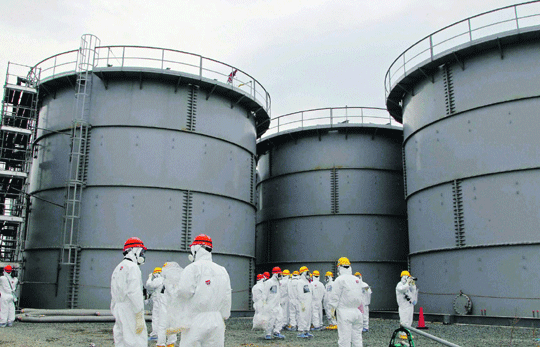 Fukushima Leaks: More Tank Leaks Found At Crippled Japanese Nuclear Plant HUFFINGTON POST, By MARI YAMAGUCHI 09/02/13 “……On Monday, Japan’s top nuclear regulator raised safety concerns about the hastily built storage tanks and their foundations after signs of new leaks.
One was found over the weekend in a connecting pipe, and plant operator, Tokyo Electric Power Co., said it suspects three storage tanks where elevated radioactivity was detected also have had leaks.
Nuclear Regulation Authority Chairman Shunichi Tanaka told a news conference that the small leak and possible other leaks have added to concerns about the plant’s stability.
They follow a major leak two weeks ago. TEPCO reported a loss of 300 tons of highly radioactive water from a steel tank on Aug. 19, saying most of it is believed to have seeped underground but some might have escaped into the sea. The company has yet to determine the cause or exactly where the water went.
More than 300 tanks there are of a similar type. About 1,000 tanks hold 330,000 tons of contaminated water at the plant, and the amount grows by 400 tons daily. The water is part of the makeshift system to keep the radioactive material at the plant stable. TEPCO also said it overlooked several signs of leaks – increases of radioactivity near the tanks and higher exposure levels for workers – for more than a month. http://www.huffingtonpost.com/2013/09/02/fukushima-leaks_n_3855621.html?ir=World
Investors wary indeed, as uranium prices continue their free fall
Market sources are not optimistic the spot U3O8 price will rebound in the near future. “You’ll see more sales that need to be done by year end and there will be more pressure on the sales side,” one market analyst said. “It doesn’t look encouraging for people who think prices will rebound” by December — it’s wishful thinking,” he said.
There has been no firm support since spot U3O8 prices dropped below $40/lb in June, the analyst said. “Some producer will have to announce either a delay in a [uranium mining] startup or that a major project will shut down production. There’s nothing else out there that would bolster the market,” he said.
 Uranium spot price weakens further in the wake of low-priced deal Washington (Platts) Jim Ostroff, Sep 2013/303 The spot price of uranium has dropped by about $1 in the past week to come in at about $34/lb, as a trading company’s deal last week to sell material that level continued to depress prices, market analysts said in interviews Tuesday.
The last time U3O8 spot prices were below the current average was November 14, 2005, when price publisher Ux Consulting reported a weekly price of $33.95/lb. The company did not begin to publish a daily Broker Average Price until 2009. The BAP is based on information from Evolution Markets and Numerco.
“Spot uranium supply continues to outstrip demand even as discretionary and utility demand step forward to take advantage of declining prices,” Continue reading
By Sept 15, Japan will have no operating nuclear reactors

 Japan’s online nuclear reactors to be halted http://www.sott.net/article/265773-Japans-online-nuclear-reactors-to-be-halted NHK World, 02 Sep 2013 The only 2 nuclear reactors online in Japan will soon be shut down for regular inspections. That means all nuclear power generators in the country will be offline for the first time in about 14 months.
On Monday afternoon, Kansai Electric began lowering the power output of the Number 3 reactor for regular inspections. The reactor will come to a halt on Tuesday morning. The plant operator also plans to halt the Number 4 reactor for a regular check on September 15th.
To gain approval for the restart of their offline reactors, Ohi and 5 other nuclear plants are undergoing assessments by the Nuclear Regulation Authority.
Nuclear fusion going nowhere
 Is Europe’s Nuclear Fusion ‘Experiment’ Melting Down?, Zero Hedge, Tyler Durden on 09/03/2013 “…….Fusion nuclear energy has been described as both the ‘Hail Mary pass’ and ‘Holy Grail’ of renewable energy sources. Fusion, the process that powers the sun by fusing together light atoms at extremely high temperatures, offers almost unlimited potential. The fuel is practically inexhaustible, the production process emits no greenhouse gasses and it is inherently safe from many of the safety concerns that have tarnished the reputation of fission nuclear energy. Finally, unlike most renewable energy sources under development, fusion nuclear energy could serve as a base load power source, providing huge amounts of energy around the clock relatively efficiently.
Despite the demonstrated potential, fusion has always been a technology perpetually on the horizon,only 30 years away from commercialization. Like fission technology, fusion was developed for military use over 60 years ago, however, commercial utilization has eluded it.
Cheaper solar cells with nanotechnology
 Cheaper Solar Cells With Abundant Earth Materials http://www.energymatters.com.au/index.php?main_page=news_article&article_id=3921 4 Sept 13 University of Alberta scientists have used nanotechnology to design a solar cell incorporating abundant-earth elements, which they say could lead to cheaper and more prolific solar power in off-grid areas.
The team’s work revolves around finding ways to lower the cost of print and spray-on solar technology using nanoparticle-based photovoltaic cells. Jillian Buriak, senior research officer of the UA’s National Institute for Nanotechnology and fellow researchers used two commonly occurring elements, zinc and phosphorous, to form zinc phosphide, a highly conductive and photosensitive nanoparticle. The team then invented a method for dissolving the nanocrystals into a red-coloured ink capable of absorbing light and transforming it to energy.
Buriak believes this photovoltaic ink is an important step towards mass production of solar power through roll-to-roll printing and spray-on techniques.
“Nanoparticle-based ‘inks’ could be used to literally paint or print solar cells or precise compositions,” she said.
“Half the world already lives off the grid, and with demand for electrical power expected to double by the year 2050, it is important that renewable energy sources like solar power are made more affordable by lowering the costs of manufacturing.”
According to the University, the advantage of using such abundant-earth elements in the solar research is that both materials are more plentiful than scarce materials such as cadmium and are free from manufacturing restrictions imposed on lead-based nanoparticles.
Team member Hosnay Mobarok of UA’s Faculty of Science discovered the method of turning the zinc phosphide nanoparticles into a photovoltaic liquid. Erik Luber, from the Faculty of Engineering then worked on making the film responsive to sunlight.
The team have built a prototype solar panel and are currently working on spray-coating larger solar cells to test their efficiencies.
The work, funded in part by the Natural Sciences and Engineering Research Council of Canada, has been published in the journal ACS Nano.
1 This Month



Tell the Ukrainian Government to Drop Prosecution of Peace Activist Yurii Sheliazhenko

Petition to revoke the licensing of the Near Surface Nuclear Disposal Facility (NSDF) at Chalk River. https://www.ourcommons.ca/petitions/en/Petition/Details?Petition=e-7247


of the week – STOP SMALL MODULAR REACTORS IN CANADA
To see nuclear-related stories in greater depth and intensity – go to https://nuclearinformation.wordpress.com
-
Archives
- March 2026 (212)
- February 2026 (268)
- January 2026 (308)
- December 2025 (358)
- November 2025 (359)
- October 2025 (376)
- September 2025 (258)
- August 2025 (319)
- July 2025 (230)
- June 2025 (348)
- May 2025 (261)
- April 2025 (305)
-
Categories
- 1
- 1 NUCLEAR ISSUES
- business and costs
- climate change
- culture and arts
- ENERGY
- environment
- health
- history
- indigenous issues
- Legal
- marketing of nuclear
- media
- opposition to nuclear
- PERSONAL STORIES
- politics
- politics international
- Religion and ethics
- safety
- secrets,lies and civil liberties
- spinbuster
- technology
- Uranium
- wastes
- weapons and war
- Women
- 2 WORLD
- ACTION
- AFRICA
- Atrocities
- AUSTRALIA
- Christina's notes
- Christina's themes
- culture and arts
- Events
- Fuk 2022
- Fuk 2023
- Fukushima 2017
- Fukushima 2018
- fukushima 2019
- Fukushima 2020
- Fukushima 2021
- general
- global warming
- Humour (God we need it)
- Nuclear
- RARE EARTHS
- Reference
- resources – print
- Resources -audiovicual
- Weekly Newsletter
- World
- World Nuclear
- YouTube
-
RSS
Entries RSS
Comments RSS
 nuclear-news