‘A Dangerous Delusion’ – book shows up Western errors about Iran’s nuclear ambitions
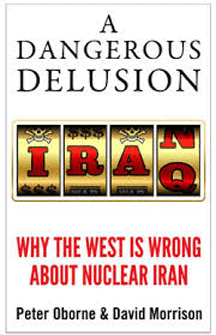 BOOKS: ‘Delusion’ Challenges U.S. Claims About Nuclear Iran Global Issues, by Peter Jenkins September 02, 2013 Inter Press Service LONDON, Sep 02 – A Dangerous Delusion is the work of one of Britain’s most brilliant political commentators, Peter Oborne, and an Irish physicist, David Morrison, who has written powerfully about the misleading of British public and parliamentary opinion in the run-up to the 2003 Iraq War.
This book will infuriate neoconservatives, Likudniks and members of the Saudi royal family but enlighten all who struggle with what to think about the claim that Iran’s nuclear programme threatens the survival of Israel, the security of Arab states in the Persian Gulf, and global peace.
Writing with verve and concision as well as with the indignation that has been a feature of good criticism since the days of Juvenal, the authors spare the reader potentially tedious detail so that the book can be devoured in a matter of hours. Their purpose, stated early in the work, is to argue that U.S. and European confrontation with Iran over its nuclear activities is unnecessary and irrational. Insofar as some concern about Iranian intentions has been and is justified, that concern can be allayed by measures that Iran has been ready to volunteer since 2005 and by more intrusive international monitoring.
An international legal instrument, the Nuclear Non-Proliferation Treaty (NPT), has a starring part in the story. This treaty, one of the fruits of the détente following the 1962 Cuban missile crisis, has been remarkably successful in discouraging the spread of nuclear weapons. Iran has been a party since the NPT entered into force in 1970. 3
In 1968 a senior U.S. official testified before the Senate that the newly drafted NPT did not prohibit the acquisition of nuclear technologies that could be used for military as well as civil purposes (dual-use).
It was assumed that parties would have an interest in complying with a treaty designed to limit the spread of devastating weapons and that those tempted to stray would be deterred by frequent international monitoring of the use of nuclear material……..
since 2007 U.S. intelligence estimates have stressed the absence of an Iranian decision to use its enrichment plants to make fuel for nuclear weapons; the IAEA has repeatedly stated that Iran’s known nuclear material remains in civil use; and the only nuclear weapon activity in Iran for which there is evidence is the kind of research that many NPT parties are assumed to have undertaken.
Trying to account for this irrational handling of the Iranian case, the authors posit a U.S. determination to prevent Iran from becoming a major Middle East power.
That view may be the most questionable of their judgements, as possible explanations exist elsewhere: intensive lobbying in Washington, London and Paris by Israel and Saudi Arabia, which see Iran as a regional rival and need to justify the strategic demands they make of the United States……..
By endorsing the proposition that Iran’s nuclear ambitions must be curbed by sanctions or the use of force, the mainstream media risk repeating their past mistake of failing to question the Bush/Blair case for war on Saddam Hussein.
A Dangerous Delusion was written before Iran’s June presidential election, begging the question of whether the re-emergence of pragmatic diplomatists in Tehran will encourage Western politicians to heed the “plea for sanity” with which Oborne and Morrison close.
“It’s time we asked…why we have felt such a need to stigmatise and punish Iran….Once we do that…we may find it surprisingly easy to strike a deal which can satisfy all sides.”
*Peter Jenkins was a British career diplomat for 33 years following studies at the Universities of Cambridge and Harvard. He served in Vienna (twice), Washington, Paris, Brasilia and Geneva. His last assignment (2001-06) was that of UK Ambassador to the IAEA and UN (Vienna). Since 2006 he has represented the Renewable Energy and Energy Efficiency Partnership, advised the Director of IIASA and set up a partnership, ADRgAmbassadors, with former diplomatic colleagues, to offer the corporate sector dispute resolution and solutions to cross-border problems. http://www.globalissues.org/news/2013/09/02/17394
No comments yet.
1 This Month



Tell the Ukrainian Government to Drop Prosecution of Peace Activist Yurii Sheliazhenko

Petition to revoke the licensing of the Near Surface Nuclear Disposal Facility (NSDF) at Chalk River. https://www.ourcommons.ca/petitions/en/Petition/Details?Petition=e-7247


of the week – STOP SMALL MODULAR REACTORS IN CANADA
To see nuclear-related stories in greater depth and intensity – go to https://nuclearinformation.wordpress.com
-
Archives
- March 2026 (222)
- February 2026 (268)
- January 2026 (308)
- December 2025 (358)
- November 2025 (359)
- October 2025 (376)
- September 2025 (258)
- August 2025 (319)
- July 2025 (230)
- June 2025 (348)
- May 2025 (261)
- April 2025 (305)
-
Categories
- 1
- 1 NUCLEAR ISSUES
- business and costs
- climate change
- culture and arts
- ENERGY
- environment
- health
- history
- indigenous issues
- Legal
- marketing of nuclear
- media
- opposition to nuclear
- PERSONAL STORIES
- politics
- politics international
- Religion and ethics
- safety
- secrets,lies and civil liberties
- spinbuster
- technology
- Uranium
- wastes
- weapons and war
- Women
- 2 WORLD
- ACTION
- AFRICA
- Atrocities
- AUSTRALIA
- Christina's notes
- Christina's themes
- culture and arts
- Events
- Fuk 2022
- Fuk 2023
- Fukushima 2017
- Fukushima 2018
- fukushima 2019
- Fukushima 2020
- Fukushima 2021
- general
- global warming
- Humour (God we need it)
- Nuclear
- RARE EARTHS
- Reference
- resources – print
- Resources -audiovicual
- Weekly Newsletter
- World
- World Nuclear
- YouTube
-
RSS
Entries RSS
Comments RSS
 nuclear-news
Leave a comment