Nuclear waste from France to be dumped in Mississippi?
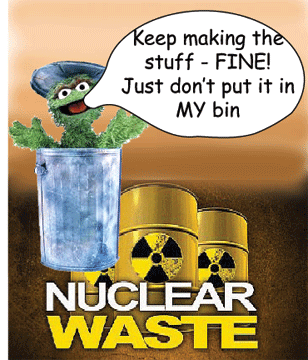 Cottonmouth – Is Mississippi going to be storing France’s Nuclear Waste? http://yallpolitics.com/index.php/yp/post/35788/ 28 Aug 13, While Bryant and his entourage were having a good time in Paris sampling the French lifestyle, did they take a moment to consider how most of the lights are powered there? You may be surprised to find out it’s nuclear power. France generates about 75 percent of its electricity needs from nuclear power. Their nuclear waste has to go somewhere, right? Why not Mississippi?
During their trip to France, did Bryant and his MDA director negotiate a deal with the French government to house that country’s nuclear waste?
Representatives from the Mississippi Energy Institute noted that they know of communities, that they did not specify, which are interested in this project. Were they referring to communities in France instead of Mississippi?
Depleted uranium, radiation, and fracking

 Wrecking the Earth: Fracking has grave radiation risks few talk about Rt.com Christopher Busby 28 Aug 13, Environmentalists point to various dangerous consequences of using fracking technology, but none can be compared to the issue of radiation exposure and radioactive contamination of the development areas it poses…….. The key to fracking
 Uranium is the key element to fracking, or hydraulic fracturing, to use its proper name. In the real-world version of Phineas Fogg’s “Eighty Days Around the World,” burning the ship’s masts and furniture to make steam, governments are now encouraging the oil and gas merchants to blast their way deep into the Earth to squeeze the last ounce of oil and gas from that poor creature. But there will be a terrible revenge. Locked up in the strata into which they pump the pressurized process water, to fracture and thus create the huge surface area sponge which will yield up its cargo of gas and oil, is a monstrous amount of natural uranium and its deadly daughter Radium-226. And vast amounts of the radioactive alpha emitting gas Radon-222, and its own daughters Bismuth 214, Lead-210 and the alpha emitter Polonium-210. Remember Polonium-210? That was the material used when a few millionths of a gram poisoned ex-Russian agent Alexander Litvinenko. Continue reading
Radioactive plume will arrive at uneven times and concentrations on USA West Coast
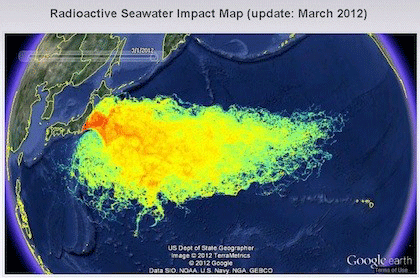 Fukushima radioactive plume to reach US in three years Phys Org 28 Aug 13“….While atmospheric radiation was detected on the US west coast within days of the incident, the radioactive particles in the ocean plume take considerably longer to travel the same distance.
In the paper, researchers from the Centre of Excellence for Climate System Science and others used a range of ocean simulations to track the path of the radiation from the Fukushima incident.
The models identified where it would likely travel through the world’s oceans for the next 10 years…… Observers on the west coast of the United States will be able to see a measurable increase in radioactive material three years after the event,” said one of the paper’s authors, Dr Erik van Sebille…… Eddies and giant whirlpools – some tens of kilometres wide – and other currents in the open ocean continue this dilution process and direct the radioactive particles to different areas along the US west coast.
“Although some uncertainties remain around the total amount released and the likely concentrations that would be observed, we have shown unambiguously that the contact with the north-west American coasts will not be identical everywhere,” said Dr Vincent Rossi.
“Shelf waters north of 45°N will experience higher concentrations during a shorter period, when compared to the Californian coast. This late but prolonged exposure is due to the three-dimensional pathways of the plume. The plume will be forced down deeper into the ocean toward the subtropics before rising up again along the southern Californian shelf.”
Interestingly, the great majority of the radioactive material will stay in the North Pacific, with very little crossing south of the Equator in the first decade. Eventually over a number of decades, a measurable but otherwise harmless signature of the radiation will spread into other ocean basins, particularly the Indian and South Pacific oceans……. For those interested in tracking the path of the radiation, we have developed a website to help them.
“Using this website, members of the public can click on an area in the ocean and track the movement of the radiation or any other form of pollution on the ocean surface over the next 10 years.”
Read more at: http://phys.org/news/2013-08-fukushima-radioactive-plume-years.html#jCp
Japan has to take back radiation-contaminated containers sent to Taiwan
 Taiwan returns radiation-contaminated containers to Japan Global Post 28 Aug 13 Fifteen radiation-contaminated containers from Japan have been sent back since Japan’s earthquake, tsunami and the nuclear meltdowns at the Fukushima Daiichi power plant in March 2011, Taiwan’s Atomic Energy Council told Kyodo News on Wednesday.
The council said once a container is detected contaminated with radiation at Kaohsiung port, the importer is given a choice to either clean the container if it wishes to see the container enter Taiwan or not clean the container, which will then be sent back to where it came.
The Liberty Times reported in its Wednesday issue that Kaohsiung Customs has detected 226 containers contaminated with radiation coming from or routed through Japan since March 2011.
Kaohsiung Customs are the island’s only seaport equipped with radiation detection monitors that screen more than 95 percent of all container traffic…… http://www.globalpost.com/dispatch/news/kyodo-news-international/130828/taiwan-returns-radiation-contaminated-containers-japan
Inherent dangers in Mississippi as a nuclear waste storage place
Reject nuclear waste storage http://www.clarionledger.com/article/20130827/OPINION01/308270012/Reject-nuclear-waste-storage Aug. 26, 2013 Some ideas are so bad they don’t deserve consideration, and such is the case with the Mississippi Energy Institute’s proposal to build a permanent nuclear waste storage facility in Mississippi.
Yucca Mountain in Nevada was designated the nation’s nuclear waste repository in 1987, but federal funding for the project ended in 2010 after extreme political pressure was placed on Congress and the Obama administration. The pressure came from concerned citizens and activists who feared having the highly radioactive material shipped through their hometowns to the site.
The Energy Department continues to look for a new site, and in 2012, released a blue ribbon study outlining the urgency for determining a new geological repository to consolidate the nuclear waste that is currently being housed in temporary locations across the country.
While nuclear energy itself faces its share of controversy, we believe that it is a safe, viable energy source when properly monitored and maintained. The same could be argued about storing nuclear waste, but we feel doing so overlooks inherent dangers indirectly associated with making Mississippi a temporary or long-term storage facility. Spent fuel rods from nuclear reactors are the most radioactive material of nuclear waste. These rods produce 99 percent of the radiation from nuclear waste, even though they make up a minority of the actual volume of nuclear waste. Nuclear waste can take anywhere from 100 years to thousands of years — in some cases 1 million years — to reach a point where it is no longer radioactive enough to pose a threat.
It’s the presence of such material — not to mention the transportation of it from all across the country to the Magnolia State — that has many people concerned. We tend to agree with those concerns. Despite the nation’s spotless record in transporting nuclear waste, we don’t want to become the destination for U.S. nuclear waste. It would take only one accident to do irreparable damage for decades or longer.
Of course, Mississippi becoming the consolidated geological dumping site for the nation’s nuclear waste is not something that will happen overnight. It would likely take a decade or longer for such a designation to be decided by the federal government. However, short-term storage can happen much sooner.
MEI wants to bring short-term storage of nuclear waste to Mississippi and use emerging technologies to develop a nuclear waste recycling program. Being able to recycle such material is better than burying it thousands of feet underground, and we support the research into such technologies. However, Mississippi does not have to become a short-term storage site for U.S. nuclear waste to conduct such studies.
The nuclear power plant in Port Gibson already stores nuclear waste. It, like other plants, has no place to send the waste for storage. Without a more permanent solution, Port Gibson and other facilities will face real issues. The Energy Department was right in 2012 to insist that the federal government move forward with deliberate speed in finding a permanent, national solution.
However, we hope that Gov. Phil Bryant and state lawmakers will politely remove Mississippi from any consideration — short-term or long-term — as a site to store the nuclear waste from across the country. Some risks are just too great, especially for returns that will not be fully realized for at least 15 years.
Indian Point nuclear power plant could be next on the list for closure
N.Y. nuclear plant won’t close, owner says, USA Today, 28 Aug 13 “………Anti-nuclear activists in Vermont applauded Entergy’s decision. The environmental group Riverkeeper, a longtime Indian Point foe, said the New York plant’s own financial pressures likely will lead to its closure.
Those include costs to strengthen its aging infrastructure and meet various state and federal requirements. Indian Point’s 40-year operating licenses expire this month and in 2015, and Entergy has applied for 20-year extensions.
“The economics of this plant are not going to end up any better than Vermont Yankee,” Riverkeeper President Paul Gallay said.
Entergy dismissed Riverkeeper’s assessment.
Indian Point also is facing a $1.52 billion lawsuit filed by another former plant security official, Clifton “Skip” Travis, who alleged that the plant had a lax security culture. Travis’ suit is pending in New York State Supreme Court…….
US West Coast to get Fukushima radioactive plume over next 3 years
Fukushima radioactive plume being tracked toward U.S. West Coast iStock Analyst CANBERRA, Australia, Aug. 28 (UPI) — The radioactive plume from the 2011 Fukushima nuclear disaster will reach U.S. shores within 3 years of the date of the incident, Australian researchers say.
Atmospheric radiation was detected on the U.S. West Coast within days of the incident, but radioactive particles in the ocean plume take considerably longer to travel the same distance…….
Other currents in the open ocean will contribute to this dilution process and direct the radioactive particles to different areas along the U.S. West Coast, they said.
“Although some uncertainties remain around the total amount released and the likely concentrations that would be observed, we have shown unambiguously that the contact with the north-west American coasts will not be identical everywhere,” researcher Vincent Rossi said.
Kazakhstan’s water imperilled by in situ leaching of uranium
Scientists studying the effects of ISL doubt how quickly mine sites can self-cleanse. This uncertainty appears to be little known to both Kazakhstan’s nuclear industry and fledgling environmentalists.
no site in the US has been entirely returned to pre-mining conditions
The cost of being the world’s No.1 uranium producer Kazakhstan’s industry has skyrocketed in the past 10 years. But what could that mean for the environment? Christian Science Monitor, By Ben Arnoldy, Staff writer / August 28, 2013 ASTANA, KAZAKHSTAN
If you make a toxic mess under one of the most isolated parts of the planet, does it matter if you don’t clean it up? Does it make a difference if that mess will be there for thousands of years? Scientists are asking those questions as Kazakhstan has steadily risen to become the world’s No. 1 uranium producer, surpassing such nations as the United States, Canada, and Australia, which require more cleanup.
Rather than employing miners to haul rock up to the surface, mine operators in Kazakhstan have embraced a newer – and generally cleaner – process by which a chemical solution is injected down a pipe to dissolve the underground uranium deposits and then is sucked back up to the surface.

This in situ leach (ISL) method avoids making a mess above ground, but leaves toxic levels of heavy metals in the ground water. In the US, companies using the method have tried for years and failed to return ground water to its pre-mining state. Continue reading
127 countries now supporting renewable energy schemes
Renewable energy support schemes now present in 127 countries, report finds PV Magazine, 28. AUGUST 2013 | MARKETS & TRENDS, GLOBAL PV MARKETS, APPLICATIONS & INSTALLATIONS | BY: IAN CLOVER The Worldwatch Institute — an independent research organization based in Washington D.C. — reports that 127 countries worldwide have now enacted support schemes for renewable energy…….. Despite the economic downturn leaving a number of countries mired in recession and hamstrung by shrinking budgets, investment in renewable energy development and expansion has generally followed an upward trend, particularly in the solar photovoltaics industry, which has seen module costs fall by as much as 80% since 2008, and 20% since 2012.
At the beginning of this year, 66 countries offered tax incentives on renewable energy development, the report finds. And as the technology has proliferated, so has regional diversity.
In the middle of the decade, 58% of countries that enacted renewable energy support schemes were located in Europe and Central Asia. Today, that figure is slightly more than a third of the global total, with East Asia and the Pacific (21%), and Latin America and the Caribbean (LAC) following closely. http://www.pv-magazine.com/news/details/beitrag/renewable-energy-support-schemes-now-present-in-127-countries–report-finds_100012528/#ixzz2dOMWGZNk
1 This Month

of the week – Shut Down Drone Warfare!


Tell the Ukrainian Government to Drop Prosecution of Peace Activist Yurii Sheliazhenko

Petition to revoke the licensing of the Near Surface Nuclear Disposal Facility (NSDF) at Chalk River. https://www.ourcommons.ca/petitions/en/Petition/Details?Petition=e-7247
To see nuclear-related stories in greater depth and intensity – go to https://nuclearinformation.wordpress.com
-
Archives
- April 2026 (91)
- March 2026 (251)
- February 2026 (268)
- January 2026 (308)
- December 2025 (358)
- November 2025 (359)
- October 2025 (376)
- September 2025 (257)
- August 2025 (319)
- July 2025 (230)
- June 2025 (348)
- May 2025 (261)
-
Categories
- 1
- 1 NUCLEAR ISSUES
- business and costs
- climate change
- culture and arts
- ENERGY
- environment
- health
- history
- indigenous issues
- Legal
- marketing of nuclear
- media
- opposition to nuclear
- PERSONAL STORIES
- politics
- politics international
- Religion and ethics
- safety
- secrets,lies and civil liberties
- spinbuster
- technology
- Uranium
- wastes
- weapons and war
- Women
- 2 WORLD
- ACTION
- AFRICA
- Atrocities
- AUSTRALIA
- Christina's notes
- Christina's themes
- culture and arts
- Events
- Fuk 2022
- Fuk 2023
- Fukushima 2017
- Fukushima 2018
- fukushima 2019
- Fukushima 2020
- Fukushima 2021
- general
- global warming
- Humour (God we need it)
- Nuclear
- RARE EARTHS
- Reference
- resources – print
- Resources -audiovicual
- Weekly Newsletter
- World
- World Nuclear
- YouTube
-
RSS
Entries RSS
Comments RSS
 nuclear-news