Book ‘The Power of Promise’ -India’s nuclear industry rotten to the core
 In case of a catastrophic accident, almost the entire fiscal burden will be borne by Indians – as will, of course, all the death and despair. What is worse, as Ramana points out, the reactor suppliers now have diminished incentive to ensure quality and safety……
The fears of Koodankulam’s residents are well-founded. Ramana notes that the new Russian reactors, called VVER-1000, are of a design that has displayed persistent problems of a kind that can cause a severe accident
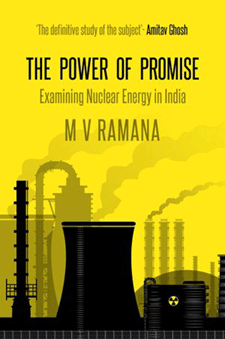
A rotten core 26 August 2013 By Madhusree Mukerjee M V Ramana’s book dissects India’s nuclear-power lobby to expose its lies and deceit. “……The delusions If the majority of Indians are unaware of the risks, it may be because they have been always kept in the dark about nuclear matters. Ramana demonstrates that the nuclear establishment in India has insulated itself from the people it purports to serve by means of a culture of secrecy and mendacity that obscures the true fiscal, environmental and human cost of nuclear energy. By publishing The Power of Promise, he has opened the windows of a long-shuttered room and let the sunlight stream in.
Darkness was always necessary to nurturing India’s nuclear programme. In the 1950s, physicist Homi Bhabha used his friendship with prime minister Jawaharlal Nehru to propose the construction of “a very small and high powered body” to direct India’s nuclear ambitions, “composed of, say, three people with executive power, and answerable directly to the Prime Minister without any intervening link.” Only such an exclusive arrangement could ensure the secrecy that nuclear affairs required, Bhabha successfully argued. The resulting Atomic Energy Commission (AEC), which oversees the civilian nuclear programme, reports directly to the prime minister’s office and functions without parliamentary oversight, as does its subordinate body, the Department of Atomic Energy (DAE), which operates most nuclear facilities. The secrecy and impunity that Bhabha won for these agencies enabled him and his successors to sustain the twin delusions of affordability and safety on which the programme rests.
Right at the start, Bhabha fudged the accounting to falsely claim that within ten years nuclear power would become cheaper than coal in most of India. Such deceptions have now become routine, and to that end the nuclear agencies often omit key financial data from reports……
The nuclear establishment has also gone to extraordinary lengths to conceal information on another matter: safety…….
Globally, atomic energy is on the decline because of concerns about safety and cost. In consequence, the major powers are aiding their homegrown nuclear power companies by helping them sell to developing countries. In 2008, George Bush and Manmohan Singh signed the landmark Indo-US nuclear agreement, which allowed India to evade international restrictions and thereby import uranium and nuclear reactors. France and Russia went along with the deal, enabling India to join the exclusive club of accepted nuclear powers. But prestige comes at a price. As Anil Kakodkar, a former chairman of the AEC, explained in January 2011, the US, France, and Russia had helped lift the prevailing sanctions against India “and hence, for the nurturing of their business interests, we made deals with them for nuclear projects.” The pricey new imports are being sited at Koodankulam, at the southern tip of India (Russian reactors); at Jaitapur in Maharashtra, near an earthquake faultline (French reactors); at Kovvada in Andhra Pradesh and Mithi Virdi in Gujarat (American reactors).
Yet the triad of powerful nations wanted more. A major deterrent to nuclear power is the cost of a catastrophic accident: the Chernobyl explosion alone has cost hundreds of billions of dollars. India, therefore, came under intense pressure to protect nuclear suppliers from financial losses in case of a mishap. The resulting Nuclear Liability Act of 2010 limits the damages to be paid by nuclear operators and suppliers to INR 1500 crores (currently approximately USD 250 million) – a small fraction of the capital cost of a reactor and a minute fraction of the potential cost of an accident. Even that was not enough to satisfy the vendors’ powerful backers, however, so the Indian government further weakened the provisions by executive fiat. The net result is that in case of a catastrophic accident, almost the entire fiscal burden will be borne by Indians – as will, of course, all the death and despair. What is worse, as Ramana points out, the reactor suppliers now have diminished incentive to ensure quality and safety……
The fears of Koodankulam’s residents are well-founded. Ramana notes that the new Russian reactors, called VVER-1000, are of a design that has displayed persistent problems of a kind that can cause a severe accident. Even more worrisome, earlier this year Russian prosecutors arrested three officers of companies that had allegedly provided defective equipment for several nuclear reactors, including those in Koodankulam…….
The Power of Promiseshows that when things go wrong with such intrinsically dangerous technologies, it is not destiny but human hubris and fallibility that are culpable. The book is too informative to be an easy read; nevertheless it needs to be read by everyone who cares about Indians, so that such dangerous delusions can be dispelled by the bright light of day.
Madhusree Mukherjee is the author of two books, Churchill’s Secret War (2010) and The Land of Naked People (2003), as well as a science journalist and former physicist. http://www.himalmag.com/component/content/article/5188-a-rotten-core.html
August 29, 2013 -
Posted by Christina Macpherson |
India, resources - print, secrets,lies and civil liberties
No comments yet.
 In case of a catastrophic accident, almost the entire fiscal burden will be borne by Indians – as will, of course, all the death and despair. What is worse, as Ramana points out, the reactor suppliers now have diminished incentive to ensure quality and safety……



 nuclear-news
Leave a comment