The 2011 Fukushima nuclear accident was just the beginning of a continuous disaster
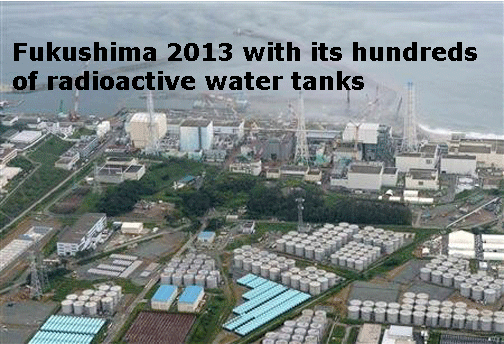 We can see this same “continuous” trend with the accident at Fukushima. The triple meltdown itself at Fukushima in March 2011 was just the beginning
nuclear power accidents are no longer one-off events. Instead, they can span years or even decades, creating a sort of “continuous accident”.
Is Fukushima the new normal for nuclear reactors? the Conversation, Benjamin Sovacool, 27 Aug 13, “…..In the early 1980s, Yale sociologist Charles Perrow argued that the partial meltdown of a nuclear reactor at Three Mile Island was a “normal accident”. The crux of his argument was that complicated technological systems have unavoidable problems that can’t be designed around.
Perrow’s argument — still relevant today — rested on three pillars. First, people are fallible, even at nuclear reactors. Operator error is still a very common factor in incidents and accidents.
Second, big accidents almost always have very small beginnings. Nuclear power plants are so complex that relatively simple things — shirt tails, fuses, light bulbs, mice, cats, and candles — can disrupt the entire system.
And finally, many failures are those of organisations more than technology. Given the right event, all these factors can lead to system-wide failure. Perrow concludes that such high-tech, dangerous systems are hopeless and should be abandoned, as the inevitable risks of failure outweigh any conceivable benefits.
Nuclear reactors do have inherent advantages over fossil fuels, but Perrow’s argument raises serious questions about nuclear safety.
Never-ending accidents
Even so, Perrow was writing in the 1980s. Surely things have improved since then? Well, perhaps not.
If you consider the full range of incidents and accidents reported on the International Nuclear Event Scale, there have been hundreds of events over the past few decades. One peer-reviewed study identified 105 nuclear accidents totalling U$176.9 billion in damages and 4,231 fatalities worldwide from 1952 to 2011. The International Atomic Energy Agency also reports no less than 2,400 separate incidents since the organisation began collecting data in the 1950s.
Most of these incidents involved no major releases of radiation or fatalities. But three emerging trends still cause reason for grave concern.
First, major modern nuclear power accidents are no longer one-off events. Instead, they can span years or even decades, creating a sort of “continuous accident”.
The infamous Chernobyl nuclear power may have started on April 25 1986, but it continued into the early 1990s. Secrecy, further accidents, and wildfires in the exclusion zone meant that exposure to dangerous levels of radiation weren’t controlled immediately.
We can see this same “continuous” trend with the accident at Fukushima. The triple meltdown itself at Fukushima in March 2011 was just the beginning…………http://theconversation.com/is-fukushima-the-new-normal-for-nuclear-reactors-17391
No comments yet.
1 This Month

of the week – Shut Down Drone Warfare!


Tell the Ukrainian Government to Drop Prosecution of Peace Activist Yurii Sheliazhenko

Petition to revoke the licensing of the Near Surface Nuclear Disposal Facility (NSDF) at Chalk River. https://www.ourcommons.ca/petitions/en/Petition/Details?Petition=e-7247
To see nuclear-related stories in greater depth and intensity – go to https://nuclearinformation.wordpress.com
-
Archives
- March 2026 (244)
- February 2026 (268)
- January 2026 (308)
- December 2025 (358)
- November 2025 (359)
- October 2025 (376)
- September 2025 (257)
- August 2025 (319)
- July 2025 (230)
- June 2025 (348)
- May 2025 (261)
- April 2025 (305)
-
Categories
- 1
- 1 NUCLEAR ISSUES
- business and costs
- climate change
- culture and arts
- ENERGY
- environment
- health
- history
- indigenous issues
- Legal
- marketing of nuclear
- media
- opposition to nuclear
- PERSONAL STORIES
- politics
- politics international
- Religion and ethics
- safety
- secrets,lies and civil liberties
- spinbuster
- technology
- Uranium
- wastes
- weapons and war
- Women
- 2 WORLD
- ACTION
- AFRICA
- Atrocities
- AUSTRALIA
- Christina's notes
- Christina's themes
- culture and arts
- Events
- Fuk 2022
- Fuk 2023
- Fukushima 2017
- Fukushima 2018
- fukushima 2019
- Fukushima 2020
- Fukushima 2021
- general
- global warming
- Humour (God we need it)
- Nuclear
- RARE EARTHS
- Reference
- resources – print
- Resources -audiovicual
- Weekly Newsletter
- World
- World Nuclear
- YouTube
-
RSS
Entries RSS
Comments RSS
 nuclear-news
Leave a comment