Lawmakers urge PM Abe to stay in Japan, declare State of Emergency
 Lawmaker: Declare ‘State of Emergency’ right away and intervene at Fukushima — Japan Professor: Issue S.O.S. now, it’s really an emergency… Gov’t is utterly lost, international help is needed http://enenews.com/lawmaker-japan-should-declare-state-of-emergency-right-now-and-intervene-at-fukushima-kyoto-professor-govt-should-issue-s-o-s-its-really-an-emergency-they-are-utterly-lost-internati New York Times,s, August 23, 2013: Opposition lawmakers here have demanded that [Prime Minister Shinzo] Abe stay home and declare a state of emergency. “The nuclear crisis is real and ongoing, yet the government continues to look the other way,” said Yoshiko Kira of the opposition Japan Communist Party, which made significant gains in parliamentary elections last month. “The government should declare a state of emergency right now, and intervene to stop the outflow of contaminated water,” Ms. Kira said at an anti-nuclear rally outside Mr. Abe’s office in Tokyo. Mr. Abe remains popular, and it is uncertain how large a liability the crisis at the Fukushima plant will become for him. But it has become increasingly clear that the latest problems may be too large for the plant’s operator, the Tokyo Electric Power Company, or Tepco, to handle. Radio Free Europe, Aug 24, 2013: Komei Hosokawa, professor of environmental sociology at Kyoto Seika University in Japan, says that international assistance will be needed to deal with the mounting issues. “TEPCO hasn’t been working very [well] to handle the situation, and the Japanese government is sort of utterly lost,” he says. “The government at the moment is very reluctant to issue an SOS, but I think we should. It’s really an emergency going on.” See also: Asahi: Japan officially in “state of nuclear emergency” still — Clearly shows Fukushima disaster on going — Crisis far from over… gov’t far too late, commitment far too weak
Danger in new nuclear reactor designs
Is Fukushima the new normal for nuclear reactors? the Conversation, Benjamin Sovacool, 27 Aug 13, “……..New designs, new problems There is some evidence that newer reactor designs and systems are more prone to accidents. Dennis Berry, Director Emeritus of Sandia National Laboratories, explains that the problem with new reactors and accidents is twofold: scenarios arise that are impossible to plan for in simulations, and people make mistakes.
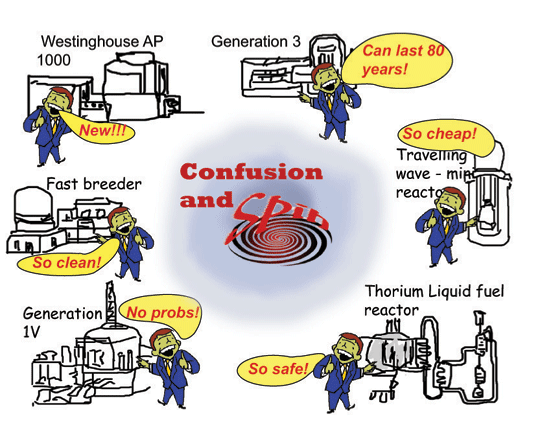
As he put it:
Fabrication, construction, operation, and maintenance of new reactors will face a steep learning curve: advanced technologies will have a heightened risk of accidents and mistakes. The technology may be proven, but people are not.
Former nuclear engineer David Lochbaum has noted that almost all serious nuclear accidents have occurred when operators have little experience with a plant. This makes new systems incredibly risky………http://theconversation.com/is-fukushima-the-new-normal-for-nuclear-reactors-17391
UK Labour has an electoral asset – opposition to Trident nuclear replacement
 New nuclear weapons for the UK: a challenge Labour can’t dodge REBECCA JOHNSON 50-50, 23 August 2013 Labour could turn opposition to the billion pound Trident replacement into an electoral asset, but instead appears to be sleepwalking to oblivion. Rebecca Johnson makes the case for challenging Trident replacement, and says it’s time to mobilise civil society
The 2015 general election may be this country’s last chance to avoid wasting billions of pounds on new nuclear weapons that one of Labour’s greatest Foreign Secretaries, Robin Cook, condemned as “worse than irrelevant” for addressing 21st century security challenges. Following the sham Trident Alternatives Review, it is clear that we need to mobilise civil society pressure to scrap Trident and elect a new government that is willing and able to participate in multilateral disarmament negotiations to rid the world of the scourge of nuclear weapons for all time.
The rational case was won a long time ago, even with many Conservatives. Across most of the world, nuclear weapons are recognised to be clumsy, outdated weapons that carry residual risks but cannot be used for dealing with the real world security challenges we might face in the 21st century and beyond. Replacing the current submarines with another Trident system is a foolish project driven by the economic interests of a handful of British and American defence contractors well versed in manipulating political fears, vanity, and inertia among our politicians and civil servants. Tony Blair’s memoirs reveal that despite recognising that there was no military or security case for replacing Trident, he felt it would be easier to carry on nuclear business as usual than to initiate the political arguments at home and be accused of “downgrading our status”. Now this shortsighted procurement is being taken forward by David Cameron. Nick Clegg – having been outmanoeuvred by Cameron over the Review – is bent on overcoming Liberal Democrat scepticism and getting his Party to back Trident replacement. Labour could turn opposition to Trident replacement into an electoral asset, but instead appears to be sleepwalking to oblivion…… http://www.opendemocracy.net/5050/rebecca-johnson/new-nuclear-weapons-for-uk-challenge-labour-can%E2%80%99t-dodge
Even Miniscule Amounts of Radiation Can Be Dangerous
 Fukushima: Think Low Level Radiation Is Harmless? Think Again… UKIAH BLOG In Around the web on August 25, 2013Time to combat radiation threat From WASHINGTON’S BLOG Cutting through the Misinformation
In response to the news that mass quantities of highly-radioactive water are flowing from Fukushima into the Pacific Ocean – and that the radioactivity is spreading to North America – the usual suspects are saying that that low-level radiation won’t hurt anyone.
Indeed, some advocate intentionally dumping all of Fukushima’s radiation into the sea as a “safe” solution.
(And some folks are pretending that a little radiation is good for you.)
The truth is quite different.
Even Miniscule Amounts of Radiation Can Be Dangerous
A major 2012 scientific study proves that low-level radiation can cause huge health problems. Science Daily reports:
Even the very lowest levels of radiation are harmful to life, scientists have concluded in the Cambridge Philosophical Society’s journal Biological Reviews. Reporting the results of a wide-ranging analysis of 46 peer-reviewed studies published over the past 40 years, researchers from the University of South Carolina and the University of Paris-Sud found that variation in low-level, natural background radiation was found to have small, but highly statistically significant, negative effects on DNA as well as several measures of health.
The review is a meta-analysis of studies of locations around the globe …. “Pooling across multiple studies, in multiple areas, and in a rigorous statistical manner provides a tool to really get at these questions about low-level radiation.”
Mousseau and co-author Anders Møller of the University of Paris-Sud combed the scientific literature, examining more than 5,000 papers involving natural background radiation that were narrowed to 46 for quantitative comparison. The selected studies all examined both a control group and a more highly irradiated population and quantified the size of the radiation levels for each. Each paper also reported test statistics that allowed direct comparison between the studies.
The organisms studied included plants and animals, but had a large preponderance of human subjects. Each study examined one or more possible effects of radiation, such as DNA damage measured in the lab, prevalence of a disease such as Down’s Syndrome, or the sex ratio produced in offspring. For each effect, a statistical algorithm was used to generate a single value, the effect size, which could be compared across all the studies.
The scientists reported significant negative effects in a range of categories, including immunology, physiology, mutation and disease occurrence. The frequency of negative effects was beyond that of random chance…….
Nuclear energy can’t be both safe and cheap
 Is Fukushima the new normal for nuclear reactors? the Conversation, Benjamin Sovacool, 27 Aug 13, “……..Electric pressure The third problem is electric market restructuring. This puts more pressure on nuclear operators to keep costs low, potentially compromising safety.
The problem is, as former Nuclear Regulatory Commission chair Peter Bradford states, “nuclear energy can be cheap, or it can be safe. But it can’t be both.” And even then, “there’s always the possibility somebody will cut a corner”.
For example, the pressure to build new generators on existing sites to avoid finding new locations can increase the risk of catastrophe, since there is a greater chance that one accident can affect multiple reactors.
Nuclear waste storage is also becoming more dangerous, with many spent fuel pools packed with more fuel rods to keep costs low, making them hotter and denser. Operators have to addboron to water pool to absorb neutrons, increasing the risk of chain reaction, or criticality, accidents.
The industry has also been trying to tinker with reactor sizes and promote designs that operators have little experience with, making operator training a factor. Some of these new reactor designs use more fuel and create more heat, meaning they have bigger cores containing larger quantities of dangerous fissionable materials, increasing the magnitude of any accident that could occur……..http://theconversation.com/is-fukushima-the-new-normal-for-nuclear-reactors-17391
Russia repeats offer to help Japan in the international crisis of Fukushima radiation
The idea of pumping water for cooling was never going to be anything but a “machine for generating radioactive water,”

 Russia Offers Fukushima Cleanup Help as Tepco Reaches Out By Yuriy Humber & Jacob Adelman – Aug 25, 2013 Russia repeated an offer first made two years ago to help Japan clean up its accident-ravaged Fukushima nuclear station, welcoming Tokyo Electric Power Co. (9501)’s decision to seek outside help.

As Tokyo Electric pumps thousands of metric tons of water through the wrecked Fukushima station to cool its melted cores, the tainted run-off was found to be leaking into groundwater and the ocean. The approach to cooling and decommissioning the station will need to change and include technologies developed outside of Japan if the cleanup is to succeed, said Vladimir Asmolov, first deputy director general of Rosenergoatom, the state-owned Russian nuclear utility.
“In our globalized nuclear industry we don’t have national accidents, they are all international,” Asmolov said. Since Japan’s new government took over in December, talks on cooperating between the two countries on the Fukushima cleanup have turned “positive” and Russia is ready to offer its assistance, he said by phone from Moscow last week. Continue reading
AUDIO: Ocean acidification a factor in global warming
 AUDIO: Researchers identify new factor in global warming http://www.abc.net.au/news/2013-08-26/researchers-identify-new-factor-in-global-warming/4912664 26 Aug 2013, 2:26pm AEST Researchers at the Max-Planck Institute for Meteorology in Germany have studied a factor in climate change which has not been included in previous climate change projections. They say that as the oceans take in more CO2, they will produce less of a sulphur compound which blocks radiation from the sun.
Source: The World Today | Duration: 4min 21sec
Topics: climate-change, earth-sciences, research-organisations, germany
SCOTT BEVAN: A scientific study released today highlights a factor in global warming which has not previously been taken into account – and the news is not good.
It shows that, as the acid levels in sea water change, oceans will release less of a gas which protects against climate change.
It comes as another study on ocean acidification warns that ocean ecosystems will be in for substantial change as climate change strengthens its hold. Continue reading
AUDIO: Mark Willacy reports on the gloom of Fukushima fishermen
there’s a sense of hopelessness and pessimism that they’ll ever be able to go out and catch fish again.
Fishing ban reinstated as Fukushima nuclear leaks affect marine life http://www.abc.net.au/am/content/2013/s3833333.htm Mark Willacy reported this story on Monday, August 26, 2013 TONY EASTLEY: With the Fukushima nuclear plant leaking hundreds of tonnes of radioactive water into the Pacific every day, fishing has once again been banned off the coast.
While scientists say it’s too early to tell how the contamination will affect marine life, test catches have shown that some fish – especially bottom-feeding species, have been affected.
The ABC’s North Asia correspondent Mark Willacy has managed to get a berth on a boat which is catching fish for testing off the coast.
I spoke to him via satellite phone a short time ago. …….. Continue reading
What do we tell the younger generation about what happened to our ocean?
TV: We’re talking about generations being affected by Fukushima, and also their future healthcare… How are those in charge getting away with this, time after time by just saying sorry? — What do we tell the younger generation about what happened to our ocean? (VIDEOS) http://enenews.com/tv-were-talking-about-generations-of-people-being-affected-by-fukushima-and-also-their-healthcare-into-the-future-how-are-those-in-charge-getting-away-with-this-time-after-time-
Asia Today, , Aug 23, 2013 – James Chau, Anchor (At 2:30 in): How is this one company been able to get away with this time after time, and just coming up with a sorry? Because we’re talking about generations involved here — and also their healthcare into the future.
Watch the Asia Today broadcast here
CNTV, Aug. 23, 2013 – Tomioka Residents (At 1:00 in): “What can we tell the younger generation about what happened to our ocean?” “It is not acceptable to say the water has accumulated and unfortunately some of them slipped into the sea.” Residents fear the situation may be uncontrollable. “It is no longer a matter for the Tokyo Electric. It is becoming an international matter and I want the government to take  the initiative to prevent these occurrences.”
So-called “background radiation” – most of it created by the nuclear industry
Fukushima: Think Low Level Radiation Is Harmless? Think Again… UKIAH BLOG In Around the web on August 25, 2013Time to combat radiation threat From WASHINGTON’S BLOG
“……..Most “Background Radiation” Didn’t Exist Before Nuclear Weapons Testing and Nuclear Reactors Nuclear apologists pretend that we get a higher exposure from background radiation (when we fly, for example) or x-rays then we get from nuclear accidents.
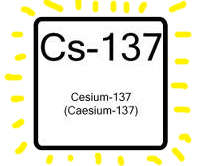 In fact, there was exactly zero background radioactive cesium or iodine before above-ground nuclear testing and nuclear accidents started.
Wikipedia provides some details on the distribution of cesium-137 due to human activities:
Small amounts of caesium-134 and caesium-137 were released into the environment during nearly all nuclear weapon tests and some nuclear accidents, most notably the Chernobyl disaster.
Caesium-137 is unique in that it is totally anthropogenic. Unlike most other radioisotopes, caesium-137 is not produced from its non-radioactive isotope, but from uranium. It did not occur in nature before nuclear weapons testing began. By observing the characteristic gamma rays emitted by this isotope, it is possible to determine whether the contents of a given sealed container were made before or after the advent of atomic bomb explosions. This procedure has been used by researchers to check the authenticity of certain rare wines, most notably the purported “Jefferson bottles”.
As the EPA notes:
Cesium-133 is the only naturally occurring isotope and is non-radioactive; all other isotopes, including cesium-137, are produced by human activity. Continue reading
USA’s nuclear reactors are excellent terrorist targets

 How U.S. nuclear reactors are vulnerable to terrorists By Alan J. Kuperman, CNN, 26 Aug 13 Editor’s note: Kuperman is editor of Nuclear Terrorism and Global Security: The Challenge of Phasing out Highly Enriched Uranium, and coordinator of theNuclear Proliferation Prevention Project (NPPP) at the LBJ School of Public Affairs, University of Texas at Austin, where he is an associate professor. The views expressed are his own.
Nearly a dozen years after the al Qaeda strikes of September 11, 2001, America’s nuclear power plants – and civilian research facilities with bomb-grade uranium – are still not required to protect against a maximum credible terrorist attack of this scale. It is time for policymakers to act, if they want to prevent disaster.
The vulnerability to a terrorist strike was a key finding of a year-long study that I co-authored, as part of a larger interdisciplinary project at the University of Texas at Austin, under a contract for the Office of the Secretary of Defense (which has no responsibility for the final contents of the study)…….
More from CNN: How nations risk nuclear terrorism
Nominally, our government is supposed to protect us against threats that exceed what utilities must defend against. Unfortunately, that is not happening. A terrorist attack could penetrate a facility in minutes to induce a meltdown, while government SWAT teams would not fully engage for at least an hour and a half, according to Congressional testimony by the Project on Government Oversight.
A second danger is the potential theft of bomb-grade, highly enriched uranium from this country’s three civilian research reactors that still use such fuel. The good news is that these facilities have committed to convert to safer, low-enriched uranium fuel, which is not suitable for nuclear weapons. Unfortunately, the conversion program is delayed by technical snags, so the reactors will continue to use bomb-grade uranium for another decade or more.
Most troubling, these research sites are exempt from defending against the modest, posited terrorist attack that utilities must protect against. So, our civilian facilities with bomb-grade uranium are even less secure than nuclear power plants. The amount of bomb-grade uranium at each site might not be sufficient for a nuclear weapon, depending on the sophistication of the bomb-maker, but the U.S. government has been assiduously vacuuming up even smaller amounts of such material around the world, to prevent the spread of nuclear weapons, as detailed in my latest book…… http://globalpublicsquare.blogs.cnn.com/2013/08/26/how-u-s-nuclear-reactors-are-vulnerable-to-terrorists/
Nuclear power as cure for climate change: no good without waste disposal
The situation highlights a major flaw in the president’s plan for relying on nuclear power as part of the effort to combat climate change. It’s not a real plan when it doesn’t make provisions for safe disposal. Existing and decommissioned plants have been storing their spent fuel on-site, either in pools or encased in concrete casks. It’s an unacceptable situation. The casks, which will be used to store waste at the defunct San Onofre Nuclear Generating Station, can withstand even strong earthquakes, but their lifetime is measured in decades, while the waste will be dangerous for hundreds of thousands of years.
In other words, nuclear policy requires farsighted thinking. California law wisely prohibits the construction of new nuclear plants until a safe method has been devised for permanently disposing of waste. A mature federal energy policy would do the same.
Nuclear waste can’t wait http://www.latimes.com/opinion/editorials/la-ed-yucca-mountain-nuclear-waste-disposal-20130825,0,3109839.story President Obama’s plan for relying on nuclear power as part of the effort to combat climate change is incomplete without a disposal provision. By The Times editorial board August 25, 2013
In the 1957 Isaac Asimov short story “Silly Asses,”Earthlings are added to a galactic book of planetary races that have reached maturity — defined as those that have developed nuclear capability. But then the keeper of the book learns that atomic tests are being conducted on Earth and crosses the planet off the list. Asimov was writing during the A-bomb years, before the construction of nuclear power plants. How unacceptable would it seem to the fictional keeper of the book that we have been building and operating these reactors for decades without a place to store the waste? Continue reading
Whingeing about nuclear wastes, (but still not stopping making them)

the best plan is to just stop making the stuff
inaction is no longer an option. Twelve states, including California, Massachusetts and Wisconsin, have banned the construction of new nuclear plants until the waste problem is resolved. The byproducts of electricity production and the manufacture of nuclear weapons cannot stay forever in scores of de facto repositories. The public has a right to an efficient and safe long-term waste storage system.
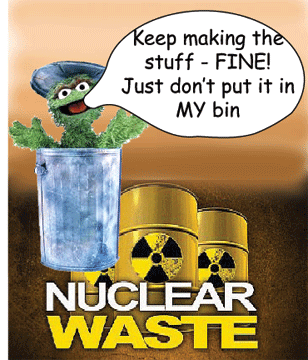 U.S. must commit to permanent, safe disposal of nuclear waste NJ.com By James McGovern 26 Aug 13If someone had suggested 30 years ago that electricity users would be contributing billions of dollars to a government trust fund — and getting nothing in return — the idea would have been dismissed as fantasy.
But this is not made up. It’s really happening, and there’s a possibility it will continue indefinitely unless an effort is made to put a stop to it……..
Here in New Jersey, we have paid more than $665 million into the waste fund — and the money keeps flowing. Nationally, the payments exceed $35.7 billion — and they are growing at a rate of $300 million each year.
What’s more, the Department of Energy was legally obligated to take possession of the used fuel rods no later than 1998, but the used fuel remains where it always has been, in engineered water pools and concrete-and-steel casks at nuclear plants. Reactors such as Salem 1 and 2, Hope Creek and Oyster Creek in New Jersey were not designed to hold used fuel indefinitely. Rather, their mission is electricity production for homes and industry. Continue reading
Closed door meeting between nuclear regulators and — FirstEnergy Corp
FirstEnergy’s nuclear security an issue in an NRC closed-door meeting, Cleveland.com By John Funk, The Plain Dealer August 26, 2013 KING OF PRUSSIA, Pa — FirstEnergy Corp.’s nuclear operating company has asked for a closed-door meeting with top federal regulators about security issues at the company’s nuclear reactor near Pittsburgh.
The Nuclear Regulatory Commission said on Monday that it would meet with company representatives on Sept. 5 at an NRC regional headquarters near Philadelphia.
Security forces at FirstEnergy’s Beaver Valley power plant apparently failed part of a routine “force-on-force” exercise in April. Beaver Valley contains two reactors.
The details of the force-on-force exercise are classified and may never be made public, but the NRC earlier this month warned the company in a public letter that it was considering a citation against the company because the security failure looked significant….. http://www.cleveland.com/business/index.ssf/2013/08/firstenergys_nuclear_security.html
Anti nuclear activists camp outside UK Atomic Weapons Establishment
Nuclear activists camp out at weapons centre Mornng Star, Sunday 25 August 2013 by Paddy McGuffin Home Affairs Reporter Anti-nuclear campaigners swooped on Britain’s Atomic Weapons Establishment early today morning to protest against the £100 billion Trident replacement.
More than 20 activists set up camp outside the AWE in Burghfield, Berkshire, at 2am, pitching their tents under cover of darkness for a fortnight of protest.
Organisers Trident Ploughshares and Action AWE said they wanted politicians to support Britain’s disarmament obligations under the nuclear Non-Proliferation Treaty and join multilateral efforts to ban nuclear weapons worldwide.
It’s the latest in a campaign of action to highlight the lunacy of nuclear weapons across England and Scotland.
Activists are planning a blockade of the site on September 2……. http://www.morningstaronline.co.uk/news/content/view/full/136775
1 This Month
10 March A LIVE WEBINAR THE REAL EFFECTS OF NUCLEAR POWER
What the Industry Isn’t Telling Us
1:00 PM Mountain, 2 pm Central, 3 pm Eastern. Live on the Keepers of the Water Facebook page



18 March Webinar @ 1 PM EST: An Assessment of SMR Projects: The Case of Canada
register for the zoom:
https://us02web.zoom.us/webinar/register/WN_o8BIIOUvQ2ONJR1nta65DQ#/registration


of the week – STOP SMALL MODULAR REACTORS IN CANADA
To see nuclear-related stories in greater depth and intensity – go to https://nuclearinformation.wordpress.com
-
Archives
- March 2026 (109)
- February 2026 (268)
- January 2026 (308)
- December 2025 (358)
- November 2025 (359)
- October 2025 (376)
- September 2025 (258)
- August 2025 (319)
- July 2025 (230)
- June 2025 (348)
- May 2025 (261)
- April 2025 (305)
-
Categories
- 1
- 1 NUCLEAR ISSUES
- business and costs
- climate change
- culture and arts
- ENERGY
- environment
- health
- history
- indigenous issues
- Legal
- marketing of nuclear
- media
- opposition to nuclear
- PERSONAL STORIES
- politics
- politics international
- Religion and ethics
- safety
- secrets,lies and civil liberties
- spinbuster
- technology
- Uranium
- wastes
- weapons and war
- Women
- 2 WORLD
- ACTION
- AFRICA
- Atrocities
- AUSTRALIA
- Christina's notes
- Christina's themes
- culture and arts
- Events
- Fuk 2022
- Fuk 2023
- Fukushima 2017
- Fukushima 2018
- fukushima 2019
- Fukushima 2020
- Fukushima 2021
- general
- global warming
- Humour (God we need it)
- Nuclear
- RARE EARTHS
- Reference
- resources – print
- Resources -audiovicual
- Weekly Newsletter
- World
- World Nuclear
- YouTube
-
RSS
Entries RSS
Comments RSS
 nuclear-news