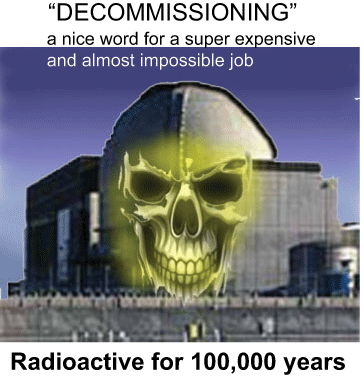
“Decommissioning” -a pretty word for the nightmare that is Fukushima nuclear clean-up
the inevitable discourse manipulation – something that we have seen in the media ever since this disaster occurred. “Decommission the plant” suggests some calm and ordered scientific process akin to shutting down and defueling an old reactor which has reached the end of its design life. It sparks images of a wise nuclear engineer in a lab coat consulting a document, discussing some issue with a worker in brilliant white overalls with a Tepco logo, wearing a white hard-hat. The reality is that this is a nightmare disaster area where no one has the slightest idea what to do and which has always been out of control. All that they can do is continue to pump in the seawater to hope that the various lumps of molten fuel will not increase their rate of fissioning. And pray.
 Pump and pray: Tepco might have to pour water on Fukushima wreckage forever Science Alert, CHRISTOPHER BUSBY 19 AUGUST 2013 Fukushima is a nightmare disaster area, and no one has the slightest idea what to do. The game is to prevent the crippled nuclear plant from turning into an “open-air super reactor spectacular” which would result in a hazardous, melted catastrophe…..
it is quite clear that the reactors are no longer containing the molten fuel – some proportion of which is now in the ground underneath them. Both this material and the remaining material in what was the containment are very hot and are fissioning. Tepco is quite aware – and so is everyone else in the know – that the only hope of preventing what could become an open-air super reactor spectacular is to cool the fuel, the lumps of fuel distributed throughout the system, mainly in the holed pressure vessels, and also in the spent fuel tanks and in the ground under the reactors.
That all this is fissioning away merrily (though at a low level) is clear from the occasional reports of short half life nuclides like the radioXenons. The game is to prevent it all turning into the open air super reactor located somewhere under the ground. To do this, they have to pump vast amounts of water into the reactors, the fuel pond and generally all over the area where they think the stuff is or might be. This means seawater since luckily they are near the sea. But they are also unluckily near the sea – since you cannot pump the sea onto the land without it wanting to flow back into the sea.
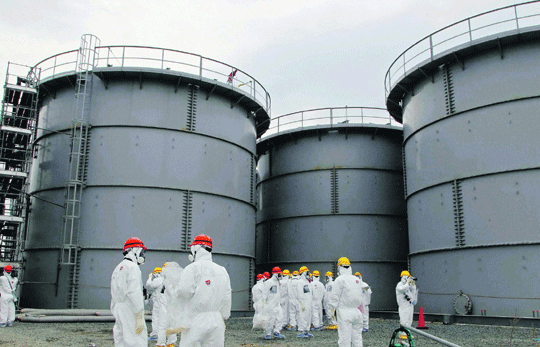
Now a good proportion of the radioactive elements, the radionuclides, are soluble in water. The Caesiums 137 and 134, Strontiums 89 and 90, Barium 140, Radium 226, Lead 210, Rutheniums and Rhodiums, Silvers and Mercuries, Carbons and Tritiums, Iodines and noble gases Kryptons and Xenons merrily dissolve in the hot seawater. There is also a likelihood that the normally insoluble Uraniums, Plutoniums and Neptuniums will dissolve in seawater to some extent, because of the chloride ions. And if they don’t, the micron and nano-particles of these materials will disperse in the water as colloidal suspensions. So a lot of this stuff gets into the sea. Of course, most of the fuss is being made by the Americans who are on the other side of the Pacific Ocean. How unfair that the USA should suffer from the Japanese affair, they think. And also feel a level of fear, underneath all this. As perhaps they should since it is their crappy reactors that blew up……..
There are some things I want to say about all this. First is the inevitable discourse manipulation – something that we have seen in the media ever since this disaster occurred. “Decommission the plant” suggests some calm and ordered scientific process akin to shutting down and defueling an old reactor which has reached the end of its design life. It sparks images of a wise nuclear engineer in a lab coat consulting a document, discussing some issue with a worker in brilliant white overalls with a Tepco logo, wearing a white hard-hat. The reality is that this is a nightmare disaster area where no one has the slightest idea what to do and which has always been out of control. All that they can do is continue to pump in the seawater to hope that the various lumps of molten fuel will not increase their rate of fissioning. And pray. The water will then pick up the radionuclides and flow downhill back to the sea. Of course, they can put up a barrier; surround the plant with a wall. But eventually the water will fill up the pond and flow over the wall. All that water will create a soggy marsh and destabilize the foundations of the reactor buildings which will then collapse and prevent further cooling. Then the Spectacular. All this is predictable enough
Let us look at some numbers. Four hundred tons of seawater a day are flowing into the sea. That is 400 cubic meters. In one year, that is 146,000 cubic meters. That is a pond 10 meters deep and 120 meters square. This will have to go on forever, a new pond every year, unless they can get the radioactive material out. But here is the other problem. They can’t get close enough because the radiation levels are too high. The water itself is lethally radioactive. Gamma radiation levels tens of meters from the water are enormously high. No one can approach without being fried.
‘Anyone living within 1km of the coast near Fukushima should get out’ ……..
And what about the future? The future is bleak. I see no way of resolving the catastrophe. They will either have to pour water on the wreckage forever, and thus continue to contaminate the local sea, or find some more drastic immediate solution. I was told that US experts had the idea at the beginning of bombing the reactors into the harbour. Not so stupid in my opinion. That at least may enable them to get sufficiently close to the pieces to pick them up, and should also solve the cooling problem. Apparently (my contact said) the French argued them out of it because of the negative effect on nuclear energy (and Uranium shares).
Professor Christopher Busby is from the European Committee on Radiation Risks for RT. http://www.sciencealert.com.au/opinions/20131808-24704-2.html
No comments yet.
1 This Month

of the week – Shut Down Drone Warfare!


Tell the Ukrainian Government to Drop Prosecution of Peace Activist Yurii Sheliazhenko

Petition to revoke the licensing of the Near Surface Nuclear Disposal Facility (NSDF) at Chalk River. https://www.ourcommons.ca/petitions/en/Petition/Details?Petition=e-7247
To see nuclear-related stories in greater depth and intensity – go to https://nuclearinformation.wordpress.com
-
Archives
- April 2026 (91)
- March 2026 (251)
- February 2026 (268)
- January 2026 (308)
- December 2025 (358)
- November 2025 (359)
- October 2025 (376)
- September 2025 (257)
- August 2025 (319)
- July 2025 (230)
- June 2025 (348)
- May 2025 (261)
-
Categories
- 1
- 1 NUCLEAR ISSUES
- business and costs
- climate change
- culture and arts
- ENERGY
- environment
- health
- history
- indigenous issues
- Legal
- marketing of nuclear
- media
- opposition to nuclear
- PERSONAL STORIES
- politics
- politics international
- Religion and ethics
- safety
- secrets,lies and civil liberties
- spinbuster
- technology
- Uranium
- wastes
- weapons and war
- Women
- 2 WORLD
- ACTION
- AFRICA
- Atrocities
- AUSTRALIA
- Christina's notes
- Christina's themes
- culture and arts
- Events
- Fuk 2022
- Fuk 2023
- Fukushima 2017
- Fukushima 2018
- fukushima 2019
- Fukushima 2020
- Fukushima 2021
- general
- global warming
- Humour (God we need it)
- Nuclear
- RARE EARTHS
- Reference
- resources – print
- Resources -audiovicual
- Weekly Newsletter
- World
- World Nuclear
- YouTube
-
RSS
Entries RSS
Comments RSS
 nuclear-news
Leave a comment