Fukushima’s ice wall fraught with problems, but what else can they do?
At Fukushima, those problems will be even more extreme, but the cost of doing nothing is even higher
 How to Build an Ice Wall Around a Leaking Nuclear Reactor Yahoo News, Alexis C. Madrigal, The Atlantic 14 Aug 13 Building cryogenic barriers sounds like the specialty of an obscure supervillain, but it’s a well-established technique in civil engineering, used regularly for tunnel boring and mining. Ground freezing was even tested as a way of containing radioactive waste in the 1990s at Oak Ridge National Laboratory and performed admirably.
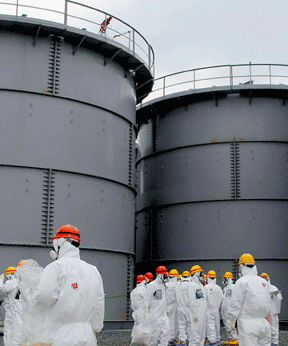
at left, workers near Fukushima radioactive water storage tanks
Joe Sopko, the civil engineering firm Moretrench’s director of ground freezing, has spoken with several consultants about the details of the project, and he’s convinced it’s certainly possible. “This is not a complicated freeze job. It really isn’t,” he told me. “However, the installation, because of the radiation, is.”…….
Here’s how it works. Freeze pipes, made from normal steel, are sunk into the ground at regular intervals. The spacing is normally about one meter. Then, some type of coolant is fed into the pipes. Sopko uses a brine — salty liquid which can be cooled far below the freezing point of fresh water without turning into a solid. On the surface, a big refrigerator chills the liquid, which is pumped into the pipes. The liquid extracts heat from the ground, and returns to the chiller, where it is recooled and sent back down. It’s not a fast process and can take many months. (Sometimes, for speed’s sake an expendable refrigerant like liquid nitrogen is used, but it requires trucking in tanks full of the stuff.)
First, ice forms in columns around the freeze pipes. Then, as time goes on, the ice spreads out, linking the columns. Finally, an impermeable wall forms. For containment, it’s important that the ice extend all the way down to the bedrock, so that the walls of ice form a box with the bedrock at the bottom. If an earthquake cracks the ice or the power goes out for a period of times, refrigerating the ground again re-seals the wall.
“You have all this cold frozen soil that water wants to leak through,” Yarmak said. “But as the water leaks its way through, it freezes, and the wall heals itself back up.”………
The key problem ground freezing projects can run into, Sopko said, was fast flowing groundwater. Flow rates above 1 meter per day can make it difficult for the freeze wall to form. But he said that he’d spoken with people with knowledge of the site, who said the rate was a tenth of that, or about 10 centimeters per day.
The most difficult thing, as in all cryogenic barrier construction, is the drilling.
“The holes have to go in straight. They have to be parallel to each other,” Sopko said. “If the pipes deviate too far apart from each other, then, you don’t get closure between the two.” In other words, you’d have holes in your wall.
Arctic Foundation’s Yarmak also noted that the difficulty of the drilling would vary. The installation of the pipes on the inland side of the complex would be relatively easier because the water you’d encounter would be less contaminated. It’s on the other side, after the water has passed through the plant, that the drilling could get tricky.
“If it’s contaminated material, then everything gets really expensive, and things slow down. And you have to make sure you’re keeping your people safe and not screwing up the environment more than it already is,” Yarmak said.
However, if the engineers can get the inland and wing walls to form, then the amount of water flowing through the plant could drop enough to make drilling on the ocean side a little easier.
Still, working on a contaminated site is just difficult. At Oak Ridge, Yarmak’s crew had to stay on a patch of pavement that had been plopped down over an old cooling pond. “You couldn’t walk off the pavement. The pavement was clean, but the woods were not. You couldn’t go into the woods. If the leaves came down, you had to blow them away because they were contaminated,” he said. “It was quite an interesting job, but it was a little stressful. You wanted to make sure your crew stayed safe.”
At Fukushima, those problems will be even more extreme, but the cost of doing nothing is even higher. http://news.yahoo.com/build-ice-wall-around-leaking-nuclear-reactor-100203877.html
No comments yet.
1 This Month


Tell the Ukrainian Government to Drop Prosecution of Peace Activist Yurii Sheliazhenko

Petition to revoke the licensing of the Near Surface Nuclear Disposal Facility (NSDF) at Chalk River. https://www.ourcommons.ca/petitions/en/Petition/Details?Petition=e-7247


of the week – STOP SMALL MODULAR REACTORS IN CANADA
To see nuclear-related stories in greater depth and intensity – go to https://nuclearinformation.wordpress.com
-
Archives
- March 2026 (204)
- February 2026 (268)
- January 2026 (308)
- December 2025 (358)
- November 2025 (359)
- October 2025 (376)
- September 2025 (258)
- August 2025 (319)
- July 2025 (230)
- June 2025 (348)
- May 2025 (261)
- April 2025 (305)
-
Categories
- 1
- 1 NUCLEAR ISSUES
- business and costs
- climate change
- culture and arts
- ENERGY
- environment
- health
- history
- indigenous issues
- Legal
- marketing of nuclear
- media
- opposition to nuclear
- PERSONAL STORIES
- politics
- politics international
- Religion and ethics
- safety
- secrets,lies and civil liberties
- spinbuster
- technology
- Uranium
- wastes
- weapons and war
- Women
- 2 WORLD
- ACTION
- AFRICA
- Atrocities
- AUSTRALIA
- Christina's notes
- Christina's themes
- culture and arts
- Events
- Fuk 2022
- Fuk 2023
- Fukushima 2017
- Fukushima 2018
- fukushima 2019
- Fukushima 2020
- Fukushima 2021
- general
- global warming
- Humour (God we need it)
- Nuclear
- RARE EARTHS
- Reference
- resources – print
- Resources -audiovicual
- Weekly Newsletter
- World
- World Nuclear
- YouTube
-
RSS
Entries RSS
Comments RSS
 nuclear-news
Leave a comment